Showing posts with label Rauch & Co.. Show all posts

Tuesday, June 15, 2021

Rounding Up the Victorians

This article has been included in The Leadhead's Pencil Blog Volume 7, now available here.

If you don't want the book but you enjoy the article, please consider supporting the Blog project here.

The collecting universe seems to have a cyclical rhythm.  When I piddle through online auctions, my search is usually for “pencils” rather than for any particular breed or vintage – yet from unrelated sellers, like pencils of similar feathers will flock together to my doorstep.

The image at the beginning of yesterday’s article grouped together a cluster of Victorians that landed here within a fairly short time, from random sources.


For starters, here are three interesting John Hollands:


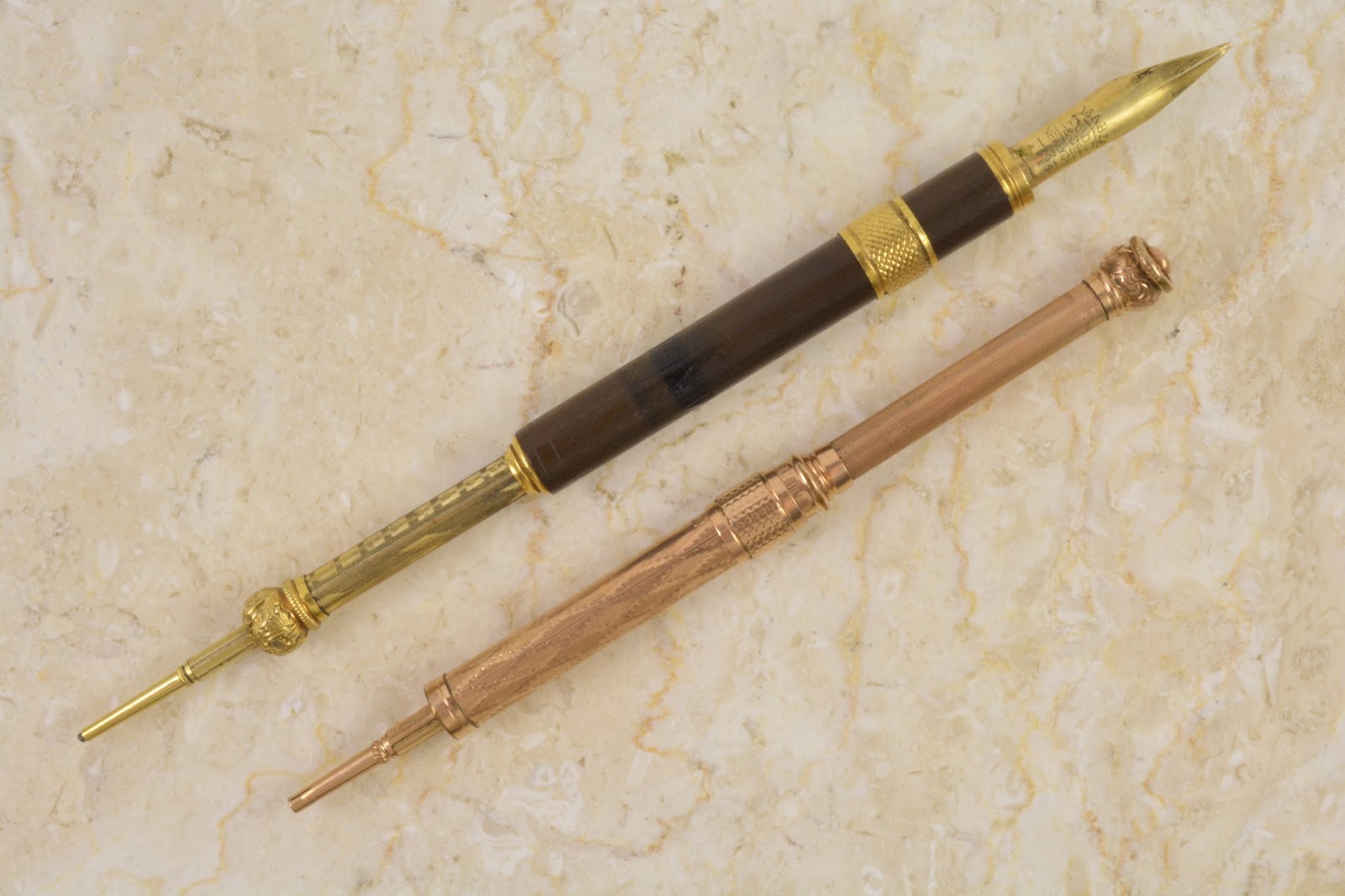
Represented here from top are a dip pen, a combination dip pen and pencil (based, incidentally, on John Mabie’s October 3, 1854 patent discussed yesterday), and a magic pencil.  


Still, the holder is marked Holland, and as a proud Ohioan, it’s nice to see the Cincinnati maker’s mark:


And then there’s that nib . . . a big, gorgeous, and tougher-to-find Number 6 “horseshoe” nib


The combo is a tiny little thing, with a much smaller Holland Number 2 nib that needs a little bit of work:


What really attracted me to this one is the barrel composition: sterling and rose gold on the barrel, with yellow gold ends and slider ring – two-tone Victorians you’ll find from time to time . . . but tri-tone?  


That third Holland looks like an ordinary magic pencil, but there’s something special about it:
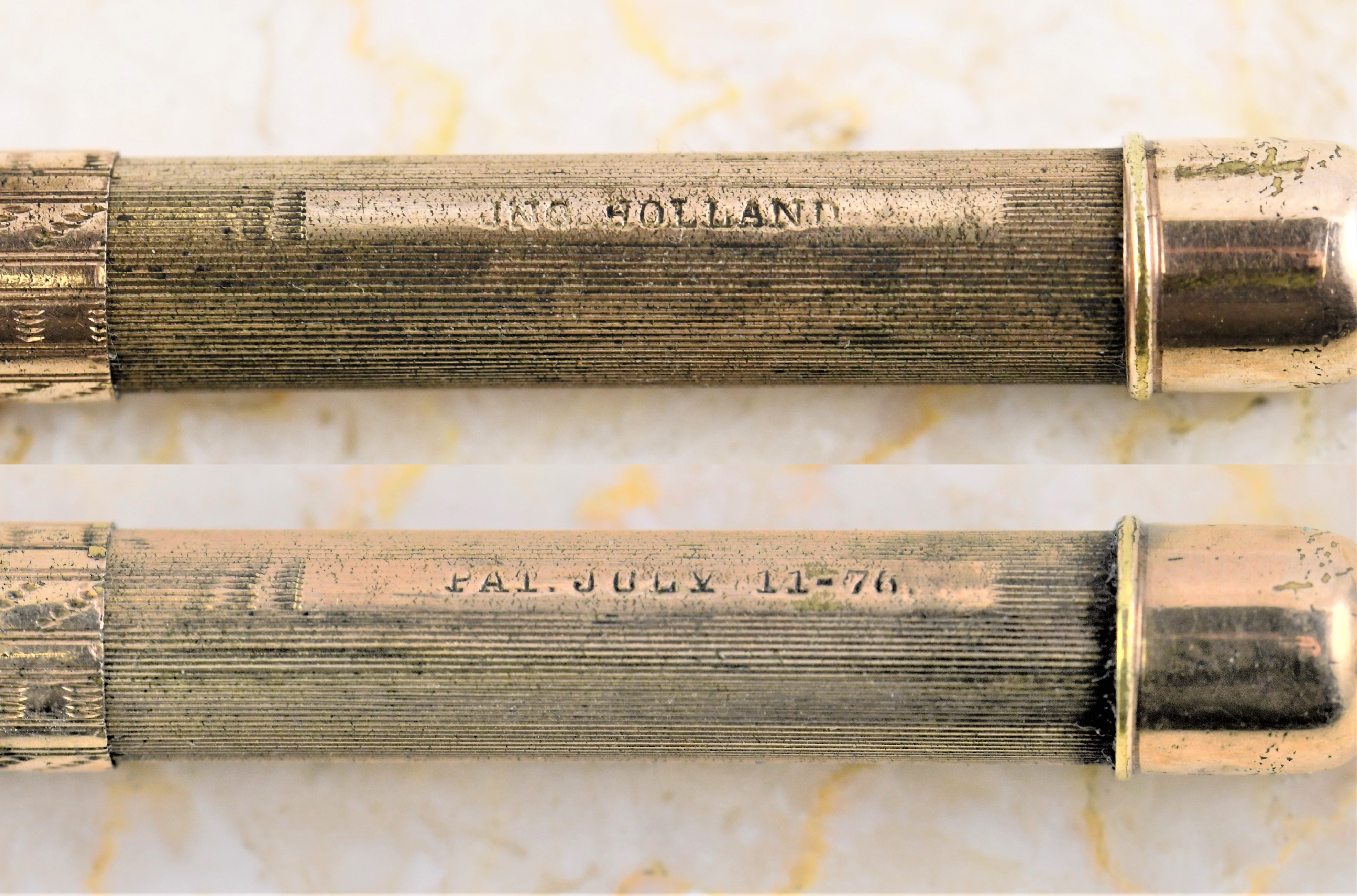

The extender reads “Jno. Holland” on one side, and “Pat. Jul 11 - 76" on the other – and I didn’t have a writing instrument with that patent date in my collection.  It’s listed in American Writing Instrument Patents 1799-1910: patent number 179,743 was applied for by Edward Tyrell of Cincinnati, Ohio on June 8, 1876.  It was issued with lightning speed in just over a month, and assigned to John Holland:


Next to find its way to me is this large slider pencil, sporting handsome engraving reading “Sophia S. Brown 1853";


Lettering on the other side of the barrel is much smaller but speaks louder, at least to me:


I described it as a “large” slider pencil, and you might not think it is until I tell you it’s a Rauch & Co.  By Rauch standards, it’s a behemoth:


Next up is one of those large “convertible” pencils – you can either extract the pencil leaving the case hooked to a watch chain or use it in the case:


It resembles other pencils I’ve written about here before:


Those other three are a Simmons, a Cross (AXT, for A.T. Cross), and a Mabie Todd:


This one, however, is marked U.S. Fountain Pen Company, predecessor firm to the U.S. Victor Pen Company:


I’m not sure where to file this next one away in my collection.  It has two interesting tells: that distinctive rose gold, and the odd placement of the joint for the twist mechanism, farther towards the end rather than right in the middle:


The seller described it as a Bailey, Banks & Biddle, which was true . . . but it also bears a patent date of June 27, 1865:


I recently wrote about the history of the Philadelphia jewelry firm of Bailey, Banks & Biddle (see Volume 6, page 119).  I’ve also written about the man who received that 1865 patent, a little-known inventor named Frederick W. Cox (Volume 4, page 175).   My only other example of the Cox patent is in black hard rubber, and may have been made by Mabie Todd:


After much agonizing, I decided the two Cox pencils go together . . . and I’m noting that here mostly to remind myself where on earth I put that other Bailey, Banks & Biddle!

Finally, this last one was described in an online auction, as not in working order.  I was feeling a little frisky, so I threw in a nominal bid thinking it might be fun seeing if I could do anything with it. 


I was pleasantly surprised when it arrived to find that the pencil was operating just fine – that was half the battle, anyway . . . 


The nib slider, however, wouldn’t budge at all.  I used the old lighter fluid trick to see if that might loosen things up a bit, and it did – I got it to move forward just far enough that the tip of a nib emerged from the end, and I was able to pull it out: a cheap steel fountain pen nib that had nothing to do with a Victorian (the Holland nib with the horseshoe cutout earlier was an exception -- Victorian dip pen nibs typically don't have breather holes).  

With the nib out, I tried the slider again – no more progress, so I hit it with more lighter fluid, then a little dab of oil in the slit, and the tip of another cheap steel nib peeked out.  


Good Lord . . . how many clowns were going to pop out of this car?  With the second nib extracted, I got my answer as the slider freed up at last.  There were three nibs in this one, and the third was a whopper:


Miraculously, the original F.T. Pearce & Co. nib was undamaged by all the junk that had been shoved on top of it.  Best of all, I didn’t have a Pearce nib in my collection – the closest thing I have is an interesting Pearce & Hoagland from Frank T. Pearce’s earlier partnership (Volume 3, page 3).

Thursday, May 21, 2020

Mother of All Ringtops

This article has been edited and included in The Leadhead's Pencil Blog Volume 6, now on sale at The Legendary Lead Company.  I have just a few hard copies left of the first printing, available here, and an ebook version in pdf format is available for download here.

If you don't want the book but you enjoy this article, please consider supporting the Blog project here.

Chuck Cohen had this inconspicuous hunk of metal on his table at the Philadelphia Show in January:


We both knew what it was, so it was an easy sell – there’s a lot more going on here than meets the eye:


The front end pulls out to reveal sliders on either side of the extension tube, one for a dip pen nib and the other for a pencil.  The nib in this one may or may not be right . . .


Mabie, Todd & Co. was headed by John Mabie, who had previously worked with, and eventually became partners with, John Rauch – one of America’s earliest pen and pencil makers.  Mabie sort of “retired” for health reasons from Rauch’s firm in 1851, but Mabie was back in New York by late 1852 to form a new partnership with Alexander Johnston, then John Knapp (see ). 

Why is the John Mabie connection relevant?  Because of what is very faintly imprinted on either side of the barrel:


“Rauch’s Patent / Jany. 6 1852.”  The reference is to patent number 8,640 issued to John H. Rauch on that date:


There’s an important nuance in this imprint: it’s “Rauch’s Patent,” so it doesn’t necessarily mean it was made by or sold by John H. Rauch.  Maybe it was, maybe it was licensed for production by someone else.  Or should I say, “Mabie” it was licensed for production by someone else, because the two remained at least friendly in later years . . . there’s a lot of crossover between Mabie Todd products and Rauch products.  Suffice to say that if this didn’t have a Rauch nib, I would still consider it perfectly correct with one bearing a Mabie Todd imprint.

This was the second example of an 1852 Rauch patent I had found and truth be told, I had to get it because I want to see how it measured up to the other one in my collection . . . literally.  As you’ve probably gathered from the title of this article, my other 1852 Rauch is a ringtop, but if you were expecting a dainty little ladies’ version of this combo, I’m sorry to disappoint . . .


She’s bigger, she’s heavier and while she sports neither a Rauch nor a Mabie Todd nib, the one that’s in it is a substantial bit of hardware:


That Fairchild Number 6 nib will get some attention when you whip that thing out!   Every square millimeter of this is hand engraved as exquisitely as a presentation pistol:


Every bit, of course, except exactly enough space for the imprints, and not one bit more:


Thursday, August 31, 2017

Everybody and their Brother

This article has been edited and included in The Leadhead's Pencil Blog Volume 5; copies are available print on demand through Amazon here, and I offer an ebook version in pdf format at the Legendary Lead Company here.

If you don't want the book but you enjoy this article, please consider supporting the Blog project here.

Seems like just about everybody made pen/pencil combos that look like this one:


I’ve shown you ones like this made by Mabie Todd.  Albert Bagley and Hicks also made them, although the Bagley version usually has an elaborate finial at the top.  This one, however, is marked Rauch:


The nib is a “Ruby Point.”  


And here’s another one of these, along the same lines:


The nib this one had was an embarrassing steel nib . . . we’ll just skip that part and get to the second tanagiental relationship to Mabie Todd.  The imprint indicates Kurtz & Monaghan, in addition to the 10 karat gold content:


Kurtz & Monaghan was succeeded by Edward Todd & Co. in 1871 after Todd parted ways with John Mabie.

Tuesday, September 13, 2016

More on the Rauch/Mabie Connnection

This article has been edited and included in The Leadhead's Pencil Blog Volume 4; copies are available print on demand through Amazon here, and I offer an ebook version in pdf format at the Legendary Lead Company here.

If you don't want the book but you enjoy this article, please consider supporting the Blog project here.

I’ve written here before about John Rauch, the early New York manufacturer for whom a young John Mabie went to work in the early 1840s.   A while back, I think it was at the Baltimore Show in 2015, I found this specimen:


This is a dip pen and pencil combination, with a conventional slider at one end, but unlike most, the pencil protrudes out the end of the extender, rather than from the same end as the nib:


At the top end is a patent date that’s a little hard to make out – the June 22 is clear, but unless you know that patents were only issued on Tuesdays, you wouldn’t know that the year was 1869:


The patent is for the unusual way the pencil protrudes from the back end rather than the front, and refers to John’s patent number 91,665:


As I was going through all of the Victorians I had lining up for photographs, I also found this pair of Mabie Todds, or sort of . . .


The smaller one is a more conventional sort of magic pencil and dip pen combo, but despite its small size and rather conventional construction, I really liked that rose gold:


But as for that other one, there’s that same unusual pencil:


The Rauch patent date is found, just as on the other example, and there’s no other imprints on the barrel:


Yet this one has a Mabie Todd nib in it:


Ordinarily, I don’t put much stock in what nib I find in these – they are too easy to replace, and over the last 150 years or so who knows how many times these have been replaced.  But in this case, with an established connection between Rauch and Mabie (see http://leadheadpencils.blogspot.com/2014/12/the-r.html), I’m prepared to accept this “as found” as being arguably original.