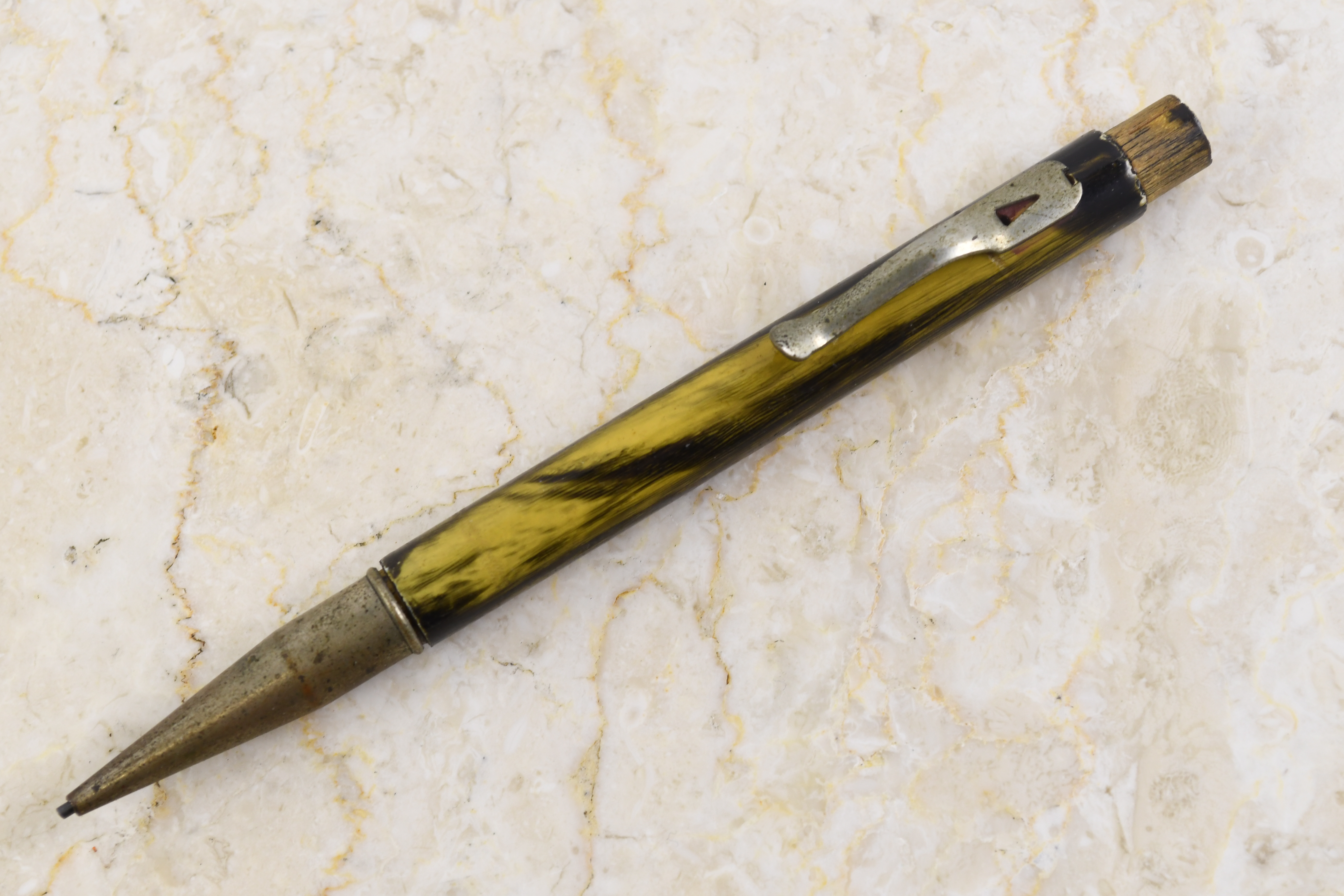
Showing posts with label Ruxton. Show all posts

Thursday, September 11, 2025

Post Fifteen Hundred . . . Ish

A few weeks before I restarted the blog, I received an email from Ron Knapp, a collector of Pentel and slide-rule pencils. Ron had stumbled across my article titled “Post Number 1,000" (January 13, 2017: Volume 4, page 351). In that article, I had searched for an appropriate subject for the milestone, and what floated to the surface was the discovery of an archive of Ruxton Multi-Vider pencils, paraphernalia, and (gulp) prototypes.


At the time I wrote the article, all that was known about the Ruxton was its shadowy connection with its English inventor A. Gahagan and Wall Street tycoon W. V. C. Ruxton (who was named in the patent but was more likely the financier). The small hoard I had acquired connected the Ruxton with an unlikely personality: Leonard G. Yoder, whose company, Yoder Instruments, was headquartered in sleepy East Palestine, Ohio. The connection was supported by Ruxton letterhead, modified to add “Leonard G. Yoder, Prop.” at the top and the East Palestine factory and office, after the company’s prior quarters in New York’s Greybar Building had been vacated:


The provenance of the Ruxton items I displayed in that article was as good as it gets. Leonard Yoder was survived by two daughters: Anna lived in Rockville, Tennessee, and the online seller from whom I purchased this lot confirmed that she had acquired it from some people who cleaned out a house in Rockville. Leonard’s other daughter, Katherine, still lived in East Palestine at the time: I interviewed her, and she confirmed that her sister Anna had all that remained of Leonard’s involvement with the Ruxton Multi-Vider.

I noted in my previous article that the online seller was a little cagey about the details concerning how and from whom she acquired this lot, and I suspected she was reluctant to share information because she did not want me cutting out the middleman (either if or because there was more stuff in that house to be had). Whether that was true or not, Ron Knapp confirmed my suspicions: yes, there was more, and he was the one who had acquired it.

Ron sent me several images of the things he had acquired; the back story is that a person hired to demolish a barn in London, Tennessee had found these items and had the sense to get them into the hands of a local antiques dealer who Ron knows rather than throw it all away. I mentioned it would be nice to follow up “Post Number 1,000" with a “Post Number 1,500,” circling back around to the Ruxton brand for the occasion. After all, as the blog restarted it was inching closer to that millenium and a half mark.

It wasn’t that I forgot . . . it was just that I forgot to keep track of how many articles had been posted, and by the time I took a breath to think about writing this article, that 1,500th post had already run. This entry is post number 1,518.

What Ron acquired was ephemera rather than the pencils themselves. The first image he shared with me was this shot of some Multi-Vider labels: 


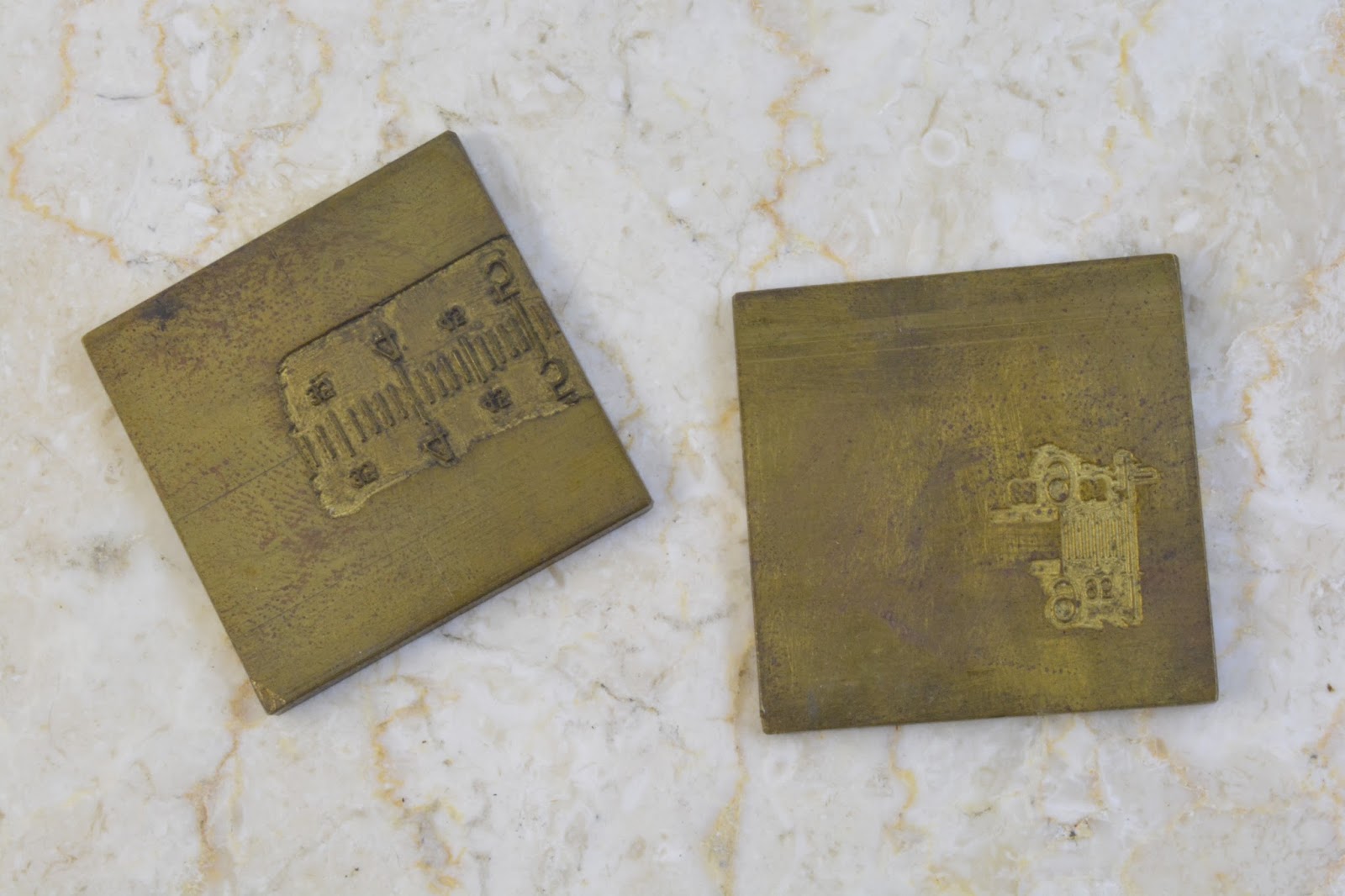
These were printed using the very printer’s block I had displayed in my previous article


Then there was routine correspondence, all dating to 1935. Many of these letters were follow up notes regarding repairs that Yoder had not yet completed or orders for more pencils. This one, from Harris Grand of the New York Department of Public Works, was dated March 15, 1935:


What is significant about this one is that it is still accompanied by the envelope in which it arrived, showing that Leonard Yoder was the man in charge in 1935, and he was still located in the Graybar Building:


There’s one other letter in here that provides some interesting leads . . . and a possible interesting connection. It is from Leonard Yoder to R.E. Phelps at Tennant Sons & Co. and is dated June 14, 1935. Yoder’s letter, however, is written on letterhead for Southland Chemicals, Incorporated of Nashville, Tennessee:


The letter makes no reference to Yoder’s title or status with Southland Chemicals, and Southland doesn’t appear to have been involved in producing any of the materials that would go into the manufacture of Ruxton pencils; the firm was established in late 1934, and only a month prior to this letter, Southland’s director of sales, H.O. Williams, was killed in an automobile crash on March 13, 1935. Southland was apparently dissolved in a legal action brought by the company’s creditors in 1938.

The simplest answer is that whoever typed this letter picked up the wrong letterhead, since Yoder was involved with Ruxton, Yoder Instruments, and Southland. 

Tennant Sons & Co., to whom the letter was addressed, was formed as an importing/exporting sales company in the metal trade, which makes sense in this context. Yoder also mentions that production “is pretty well set” after talking with “Bedford and Valverde,” with the latter being called on to “look after things during the day, such as buying brass, having plating done, etc.”

I didn’t find any evidence of a firm called “Bedford and Valverde,” and Yoder may have been referring only to two individuals by those names, but there is one other name that comes up: Yoder says that Valverde is not doing “actual production” since “Charlie has jumped into the harness and is really doing a job.” 

Yoder reveals on page two of the letter that Charlie’s last name is Klagges – that grabbed my attention, because it is not a common name and it has only come up in my world in reference to one brand: the Klagges-Essig repeating pencil:


I threw out everything I had been able to learn about the Klagges-Essig in “One Decade Down” (June 2, 2021: Volume 7, page 163). These pencils are scarce beyond scarce.


The pencils strongly resemble cap-actuated repeating pencils made by Esterbrook, and a patent for such a repeating pencil was applied for by one Henry C. Klagges of Collingswood, New Jersey on November 18, 1937 and granted as patent 2,216,780 on October 8, 1940:


I have not found any more examples of the Klagges-Essig since that article was published, but I did get to see one in burgundy pearl at the Raleigh Pen Show in June. My friend Dexter Mills stopped by my table (again) to tease me with this red pearl example (again) which I was unable to convince him to part with (again). At least I was able to take home a picture of it:


I am convinced that “Charlie” Klagges as referred to in Leroy Yoder’s 1935 letter is one and the same person as Henry C. Klagges, although none of his patents spell out his middle name. The Klagges name appears six times in American Writing Instrument Patents Vol. 2: 1911-1945: the earliest was Elsie Klagges of Glendale, New York, who applied to patent a screw drive pencil on February 21, 1928. 

The other five were issued to Henry C. Klagges; all of them (the Klagges-Essig repeating pencil patent and four fountain pen improvements) were assigned to the Esterbrook Steel Pen Manufacturing Company, and the earliest of the five was his repeating pencil patent, applied for as stated earlier in 1937. So what was Henry “Charlie” Klagges doing in 1935? Apparently he was doing general manufacturing work - Yoder inquires on page 2, “What does Charlie say about the possibility of making up more Multi-Viders from the slides we have on hand?”  

There is one last detail crammed into this letter that bears mention: Yoder comments that while he had not yet persuaded the Tennessee Eastman Corporation to do molding for him, he had made arrangements to acquire a supply of Tennessee Eastman’s special thermoplastic, which was developed in 1929 and was trademarked as “Tenite” in 1932. Unfortunately, Tenite warps and degrades over time; if Ruxton Multi-Viders were ever made of the stuff, they did not work for very long. 

Yoder’s handwritten note at the end of this letter asks about “the extra set of model patterns.” That might explain these, which were shown in my previous article on the Ruxton:


These were in a box marked “MV samples” and as I noted in the article, these test barrels appear unsuitable for use as Multi-Vider barrels.

Ron Knapp’s papers, combined with what we already knew about the Ruxton, fill in some important details in the story. Now we know that the Ruxton did not go the way of the dodo in the wake of the stock market crash of 1929, as previously thought. We don’t know when Leonard Yoder and his Yoder Instruments Company became involved, but we know that he was in charge by 1935, and Ruxton Multi-Vider did not move from the Graybar Building in New York until after 1935. We know that Leonard Yoder apparently had some components left in 1935 and that he was looking for ways to have new barrels molded to assemble them.

Did Yoder succeed? All of the advertisements I know of for the Ruxton Multi-Vider were published in 1929, and there’s a handful of stationer’s notices for “Multi-Vider” pencils – without the Ruxton name – in 1930 and 1931 (with one lone reference in December, 1932). Perhaps they were marketed under another name, although Yoder himself was still calling them the “Multi-Vider” in his 1935 letter. 

Hope springs eternal - when I wrote that last article about the Ruxton, I hoped that one day someone may stumble across it and have more to share of the story. Lightning has now struck once, and I’m looking forward to it striking again.

Sunday, July 4, 2021

That's All I'm Going To Say About That

This article has been included in The Leadhead's Pencil Blog Volume 7, now available here.


If you don't want the book but you enjoy the article, please consider supporting the Blog project here.

When I sit down to write one of these articles, my method of picking the topic of the day is very non-scientific:  I open the file folder containing all the pictures I’ve taken, and I scroll through until I find something that I think would be fun to write about.  As the more meaty subjects get pulled out and placed in the “published” file, what's left behind are the brisket tips -- good stuff, worth photographing and definitely worth noting here, but more of an appetizer than a meal.  While each of these notes might not be enough for a complete article, today I'll string a few of these little notes together into a little tune.  

The Colorgraph:

I haven’t written about the Colorgraph for some time, most recently in Volume 2, page 95.  Since I’ve found so few of these duplex pencils over the years, it’s one of those brands I’ll chase even if I think I already have one, in the hopes there will be some tiny difference that will add to the story.  Recently, I chased and caught an example in black:


Unfortunately, it was identical to my other examples (and I still haven’t found an intact earlier model, with the longer nose).  So . . . all I have to tell you is that they also come in black.


The Ruxton:

The 1,000th post here at the Blog (Volume 4, page 351) covered the Ruxton well, including the company’s archive of prototype and shop models as well as production examples – including some boxed ones.  I bought this one because the box was different - the other examples in my collection are dark blue with black lettering, but this one you can actually read:


The pencil is extremely clean, but unfortunately there’s nothing different about it from what I’ve shown you already:


The Welsh Manufacturing Company:

This one was in a box lot of junk that came my way, and it wasn’t my intended target.  


From the clip and the nose, I knew it was made by the Welsh Manufacturing Company of Providence, Rhode Island.  Here it is shown alongside other variations on the theme:


I would have just put it in the Welsh drawer without photographing it, except for one small detail:


This one has a painted wood barrel.


The “Arrow Double”:

I’d never heard of this one before:


It nearly identical to one already in my collection, with two exceptions:


First, it lacks that great arched “14kt Gold Plate” imprint on the clip:


And second, the producer’s imprint on the top is different.  I say producer, because I don’t know who manufactured either one:


The one I had is an Ajax; this new one is marked “Arrow Double.”  I haven’t been able to discover anything about the Arrow Double in the year since I found it.


The Bridge Set:

I had such high hopes for this next find:


This nice box contained a beautiful set of sterling pencils marked with card suits:


I wrote about a similar set in a recent article about bridge pencil sets in Volume 6, page 194.  On page 196, I showed an English set by William Manton along the same lines that Joe Nemecek had given to me; it was newer than I had hoped, bearing a hallmark dating it to 1979.


This set appears to be older, and I expected hallmarks that would be a bit more . . . well, a bit more vintage than me, anyway.  Alas, there are no hallmarks and it appears to have been made for export to the United States, marked only “Made in England / Sterling Silver.” 


An Interesting Sheaffer Sharp Point:

This Sheaffer Sharp Point is on the early side of production, with a bowler clip and that zigzag-with-dots pattern:


What’s inside isn’t what I would expect.


The earliest Sharp Points look like this inside (see Volume 4, page 324):


While later Sheaffers (early 1920s on) look like this:


I’m not sure where this one fits in.


Cross-Built:

Here’s three very similar pencils . . . the bottom one is a typical Cross Century:


Two are marked on the clip: the Cross, and one marked “Swank.”


The Swank brand appeared in Volume 1, page 345 – on a ruler pencil/tie clip pencil.  Swank, Inc., as reported in that previous article, survives as a division of Randa Accessories.  The third pencil has a plain clip, but a nice imprint on the barrel:


It’s a “PAT One Twenty.”  PAT was a trademark of Ketcham & McDougall, Inc., better known for making those pencils attached to a pin by a retractable chain.  The company claimed to first use the mark on September 18, 1936, according to the trademark registration:


All three of these pencils share very similar features, and my suspicion is that Cross made all three.  The Swank and PAT One Twenty share another element - that black plastic ring in the middle:


Welty’s

At the Krinke auction, one of my impulse buys was this fountain pen, complete with the box but with a conspicuously absent pencil:


The imprint is on the barrel, concealed under the cap when closed:


The pen was made by DeWitt-LaFrance, and I wasn’t planning on chasing it until I saw how small it was:


I wrote about the Welty’s DeWitt-LaFrance pencils in Volume 3, page 158; I came across the pen at some time since.  If the matching Welty’s pencil surfaces, it would be about the smallest DeWitt-LaFrance pencil I’ve seen.


The Baby Jumbo:

The Baby Jumbo is in Volume 1, page 373, and it’s not really “mechanical.”  A wood pencil is wedged in the neck of a glass bottle containing candy:


There was another example up for bids at the Krinke auction; I took “just in case” pictures of it before the auction started, because this one had the original paper label on it:


It would have been nice to bring this one home, but the pencil was identical to what I had, and the only thing the label provided was a cute admonishment to “Write your mother a letter today.”  When the bidding got a little crazy on this one, I couldn’t justify spending what it would take - so my “just in case” picture will have to do!

Friday, January 13, 2017

Post Number 1,000: Ruxton Multi-Vider Redux

This article has been edited and included in The Leadhead's Pencil Blog Volume 4; copies are available print on demand through Amazon here, and I offer an ebook version in pdf format at the Legendary Lead Company here.

If you don't want the book but you enjoy this article, please consider supporting the Blog project here.

I’m having a hard time writing this.  It’s not because I don’t know which pencils I’m going to write about – that’s coming in a minute. It’s because the title of the article has gotten into my head.

When I started this blog, the idea was to use it as an update service for the people who bought my book, The Catalogue of American Mechanical Pencils, a book weighing in at 178 pages.  The blog is about 1,200 pages of manuscript, and I still think I could continue writing indefinitely.

Well, sort of.  The problem is, I don’t want to right now.  I’ve taken breaks from the blog here before – to write American Writing Instrument Patents 1799-1910, then to write American Writing Instrument Patents Volume 2: 1911-1945 . . . then to edit The Pennant.  I’ve finally learned it isn’t really a “break” if I’m just going off to work on something else for awhile.

So this time I’m going to take a break to ask myself what I want to do right now.  I’ve got a pile of projects I’ve been trying to get around to writing, some pencil-related, most not.  Maybe I’ll pick one of those up.  Then again, maybe I’ll sleep in a little later in the mornings for awhile.

I’m sure I won’t be able to resist coming back and posting once in awhile, but in the meantime, I  wanted to leave you -- for now -- with something special.  After I sized up a vast library of photographs I’ve taken over the last five years and scraps of research, looking for the perfect subject for the millennial post, one stood head and shoulders over all others:


This pile of stuff showed up, all in one lot, listed in an online auction titled “RUXTON MULTI-VIDER MECHANICAL PENCIL/SLIDERULE LOT PROTOTYPES,EPHEMERA,SAMPLES” in April, 2014.  No fewer than six of my friends emailed me in the first few hours after it was listed to tell me to look at it, and it was already on my radar.  Chase it to the end, I did.  Pay through the nose, I did.  Regret it, though, I did not.


The lettering inside the box lids is a little tough to read:


“Ruxton MULTI-VIDER Pencil / Multiplies - Divides / Pat. Apld. For.”  Ruxton Multi-Viders are a cult classic among pencil collectors, and finding one in any condition is usually a cause for celebration.  Two mint boxed examples?  That should draw a “holy cow” from even the most grizzled collector:


Ruxtons were combination slide rule/mechanical pencils operated by pulling the crown and the tip to slide the two halves of the barrel. Internally, these two examples are a little different:


I posted an article about the Ruxton here four years ago at http://leadheadpencils.blogspot.com/2012/09/the-ruxton-multi-vider.html.   Not much has been written about the Ruxtons, and my rudimentary article four years ago is still one of the top search results on the subject.  We know they were patented in Great Britain on an application filed on January 21, 1929 and granted February 20, 1930 as number 325,327.


The named patentees in the England were A. Gahagan and Wall Street tycoon W. V. C. Ruxton (see my previous article for the story behind him); for whatever reason, the patent was apparently never issued in the United States.  The earliest advertisements I could find were from December, 1928.  Here’s one, as printed in Boys’ Life:


Advertisements continued through 1929, in Popular Science and Popular Mechanics, with the last magazine advertisements I could find dating to September, 1929:


The stock market crashed in October, 1929, and the absence of advertising after then has suggested that the Ruxton Multi-Vider was an early casualty of what would become the Great Depression.  There’s only one documented piece of literature concerning the pencil which might have been published after then – a Christmas brochure attributed to late 1929 and published at http://retrocalculators.com/ruxton.htm, a website dedicated to slide rules and calculating machines.

There was one of these brochures included in this lot of Ruxton materials.  Here it is, published in its entirety – including the cover page, which says the Ruxton is “the gift for 1929” and provides the source for the 1929 attribution.  Maybe 1929 – but it could also have been for 1928 (as in, the gift for the coming year, not the present one):


There was also a great tri-fold brochure in this lot; while it is undated, I’m sure it was printed prior to the crash of 1929, since one of the advertised uses for the pencil is for “calculating stock yields”:


This lot of Ruxton materials, though, contains the first evidence of life after ‘29 for the brand.   Have a look at this curious piece of letterhead:


Compared with the cover page of that ‘28 or ‘29 Christmas brochure:


The Ruxton Multi-Vider Corporation from the Greybar Building in New York  was succeeded by Leonard G. Yoder, proprietor of the Multi-Vider.  According to this, Yoder maintained an office in New York, at 252 Lafayette Street, but the “factory and office” of the company was located at 140 North Market Street, East Palestine, Ohio:


Here’s another clue: a printers block made for newspaper advertisements, which references the “Multi-Vider” and “Yoder Instruments” of East Palestine, Ohio:


I can’t find any instance of a published advertisement using this block.  Yoder Instruments made a wide variety of mathematical and scientific instruments, including Grove’s Moto-Math set, introduced in 1947, and surveyors’ sextants.  The sextants seem to have been produced in the greatest quantity, given the large number which have survived.  This advertisement for telescopes, printed in 1957, indicates that Yoder Instruments had been “Instrument Manufacturers Since 1930" – dead on if Leonard G. Yoder took over production of the Multi-Vider on his own account after 1929.


Yoder died in 1977, and his obituary indicates he was survived by two daughters, Katherine and Anna.


Anna lived in Rockville, Tennessee: I contacted the ebay seller of this lot after the auction closed to ask where it came from, and the seller – the owner of an antique mall near Rockville – said some people came in who were cleaning out a house in Rockville and sold her the whole box.  She couldn’t (or more likely wouldn’t, after she did so well on the lot I purchased from her) tell me who they were or whether there were other documents or items of historical value still in that house.

My next step was to track down Katherine, who still lives in East Palestine, close to 140 North Market Street.  She was very young in 1930, but she does remember that her father made slide rule pencils for some English chaps . . . she doesn’t remember who and she wasn’t aware of any surviving documents.  She was, however, able to confirm one important detail:  that her sister in Tennessee had whatever was left of her father’s pencil operations, and the box I acquired was from Leonard G. Yoder.

That’s provenance.  And that’s what makes the rest of the items that were in this lot particularly exciting:


I don’t believe that Leonard Yoder and Yoder Instruments started making the Multi-Vider in 1930.  Katherine remembers her father making pencils for some Englishmen: the Multi-Vider was patented not in the U.S., but in England – and all known examples were made in the United States.  In addition, had Yoder bought the company at the end of 1929, he would have acquired all of the tooling, parts and designs already being manufactured and there would have been no need to reinvent the wheel.  When Yoder Instruments advertisements indicate the company was established in 1930, I believe that means that Mr. Yoder, who had been manufacturing these pencils for the Ruxton Multi-Vider Corporation since 1928 or so, set up his own company to continue making them after Ruxton itself perished.

So what you are about to see are, beyond any question in my mind, are the original shop models and prototypes for the Ruxton Multi-Vider.

These three were wood and ebonite shop pieces testing different ways to make the barrel halves slide:


Note that the top example has what is left of a paper label glued to its surface, calibrated to test how the slide rule function would operate in practice:


Here are a few plain brass rods, used to test machined engraving:


One rod has incomplete engraving or stamping:


There were a couple of dies thrown in with the lot – note that the one on the right has what looks like exactly this same incomplete engraving:


Also included were two pieces of cardboard marked with Multi-Vider calibrations.  They might have been intended as gauges against which to check imprinted barrels for accuracy:


Here are three experimental, all-metal pencils, testing different means of telescoping actions:


The top example most closely resembles the production Ruxtons, and it is calibrated on the barrel . . . but without numbers:


The hexagonal one has four facets which telescope out over the end of the pencil:


Revealing that it is built around an ordinary barrel of a wooden pencil:


The dents on the nozzle of that third example, fitted with a large ball clip, were there when this arrived to me.  They were likely put there by Leonard himself, who must have been frustrated after it was assembled to find out how difficult it was to pull apart again.  With quite a bit of wrestling – using rubber bands to grip it rather than a pair of pliers – I was able to extend it a bit:


This next grouping of ebonite shop models is really interesting.  These illustrate how the slider function found on production Ruxtons is approaching its final form, as the unmarked top example indicates:


The clip should look familiar: it’s taken from an oversized Autopoint – identical clips were available on production Autopoints in 1927.  Instead of the hex bolt, however, these clips were secured with flathead screws:


Only the bottom example is calibrated with numbers, but look closely:   those numbers are hand-engraved, not machined:


Next are three fully functional, all-metal Multi-Vider prototypes; the top example is made of brass with a cap and tip that are tarnished like silver, while the other two appear to be all chrome-plated steel:


Also included in this lot were five production Ruxtons:


Three of these appear to be regular production models – black and the black/maroon combination being the most common.  The white example is in very rough condition, with plastic that has shrunk, warped, cracked and interfered with the sliding action – possibly a customer return, since it is engraved with a name.  What’s unusual about it is that it is marked not on the barrel, but with an imprint at the top, something I hadn’t seen before:


There’s one other example in this group with that feature – the one with a shorter cap I haven’t seen on a Ruxton:


Finally, I’ve got one last thing to show you that came with all this, which gives you a sense of what might have been.  Included was a ragged cardboard box with metal reinforced corners, marked “MV Samples” on one end:


Inside of which was a smaller box:


Filled with Ruxton barrels molded in different colors:


Can you imagine trying to read the numbers on a Ruxton made from this?