Showing posts with label Parker bridge set. Show all posts

Monday, November 24, 2025

As Good As It Gets

I promised yesterday that I’d be back with more information about Parker’s Vest Pocket (or “golf”) pencils. Back I am . . . with a mic drop moment from the Ohio Pen Show.

I move a little slower than I used to these days, conserving my energy rather than running around like a madman – even though I still have a bottle of Jameson on me. Were it not for the kindness of friends, I would have missed what Mike Conway brought in the door that Thursday morning in Columbus; fortunately, Nik Pang was right there when it arrived, and he made a point to acquire it and bring it down to offer it to me.


The story, according to Mike, is that Ruth Reuter was a Parker employee, and “Parker Desk Set” suggests there’s a desk pen and base inside. The “BDS,” however, indicates this is better than that – much, much better, especially for us pencil guys. I’m assuming the letters BDS stand for “Bridge Desk Set.” Inside the cardboard sleeve is a box containing four other boxes, each branded for one of the four card suits.


And inside each of those boxes were four perfectly preserved little desk pencil bases for the four suits, accompanied by a Parker Vest Pocket pencil.


Fortunately, I had learned my lesson at DC about not bringing enough cash, so all I needed to know from Nik was how much of it he wanted. For me, this concluded years of searching: in “The Silent Underbidder” (August 11, 2012: Volume 1, page 300), I told the story of how Joe Nemecek won a set like this at the Triangle Pen Show auction that year. Here is Joe’s set, photographed during that auction:


No, I wasn’t really the underbidder – we agreed that Joe would chase the set, because he’s a bigger Parker fan than I am. If he won, and I told him to be sure that he did, I said I would purchase his less complete set to help him defray the cost. Joe did win, and I did buy Joe’s. At the time I thought to myself, how hard can it be to complete the set?


Hard. Damn hard. In fact, I was only able to find a club suit in the box, and it took a few months to find another black and two red pencils, which presented its own unexpected challenges – there’s a few different variations of these pencils, and it drove me nuts trying to find all four that were exactly the same (see “Where the Sun Don’t Shine” on April 15, 2013: Volume 2, page 137).

Joe’s set was reputedly from a Parker salesman, which is why it was outfitted with pencils in Madarin yellow, jade, marine green and black; I suspect Ruth also wanted a little more variety in her set, replacing two pencils with the Moderne Black-and-Pearl and the burgundy pearl ones. Still, since I’m a preservationist first and I like to keep things as they came to me, and I knew this find would be the cover shot for this volume of the book. I played around with a couple rough concepts, and proudly I posted what I came up with:


Ooohs and aaahs were what I expected. What I got, however, was “get that pearl and black pencil out of there!” from more than one person. Whew, I thought . . . at least I hadn’t massaged that image enough to see that one of them was burgundy pearl rather than black.

One of the naysayers was Larry Liebman: I explained to him how this was how the set came to me, but he was unpersuaded. “Yeah, but it really should have two red and two black,” he replied.

I asked Larry if he had actual documentation of that, and he sent me pictures of two advertisements, one of which was in the Saturday Evening Post on July 26, 1930. I renewed my online subscription so I could get access to their archived issues; there it was, right inside the front cover:


Elsewhere in this advertisement, those stubby little pencils are called “Midget Vest Parkers,” but here the set is advertised as including “Midget Pencils in black and lacquer red.”


The set was advertised for a whopping $24, and the illustration explains something else. All of the complete sets I have seen are missing a lid for the outer box, but when David Isaacson shared pictures of his set in our online discussion, it had something I had never noticed: card suit stickers on the bottom of the box. I turned mine over, and whaddaya know . . . 


There they are . . . or were, anyway, except for the intact spade. This didn’t make any sense to me until I saw that Saturday Evening Post advertisement: what I thought was the box base was actually the lid. 

Anybody have a spare box bottom? It would be nice, but I’m not the least bit disappointed. To my knowledge, this is the only set known that still has the outer cardboard sleeve.

Larry shared another advertisement with me that answered another question I raised yesterday - my concern was that the more streamlined Moderne Black-and-Pearl pencil that came with my set may have been made later.


Here’s that other advertisement: it isn’t dated, nor does it say in what magazine it was published, but it also describes the bridge set as “new,” so it is reasonable to think it was also published in mid-1930:


The text doesn’t say that the pencils are red and black, and the black and white rudimentary drawing shows all four suits in black . . . but I agree that it’s reasonable to think the white pencils shown are the red ones (even though there’s a black one with the heart and a white one with the club – sigh . . . so it goes with advertising art). However, like the other ad, this appears to show the more squared off tops. 


But did you notice the interchangeable ringtop for the desk pencil at the top of the advertisement?


It looks like the streamlined and squared off caps were in production at the same time, depending on a customer’s choice. Although I can’t rule out that eventually Parker gravitated towards the more streamlined caps, this provides the proof that if our friend Ruth Reuter wanted a different pencil in her set when she pulled it from the assembly line, a shorter more streamlined Moderne Black-and-Pearl was right there for the swapping at the time.

Although I’m ultra-cautious when I’m making changes to things when they have been undisturbed for so long, I agree that it’s acceptable to swap out the two pencils in Ruth’s set with the black and red pencils from “When Good Luck Is a Bad Thing” on October 31:


But I still keep the pencils that came with this set right alongside them.

And I’m still looking for the bottom of that outer box.

Tuesday, June 16, 2020

Coincidence No More

This article has been edited and included in The Leadhead's Pencil Blog Volume 6, now on sale at The Legendary Lead Company.  I have just a few hard copies left of the first printing, available here, and an ebook version in pdf format is available for download here.

If you don't want the book but you enjoy this article, please consider supporting the Blog project here.


There’s two types of “bridge pencils.”  In America, they usually took the form of pencils with on-board scoring “cheat sheets,” like those ones bearing a seal of approval from Ely Culbertson, bridge-playing rock star of the 1930s (see "Bridge Player of the Century").

Overseas, bridge pencils were less gimmicky and more genteel sets of four pencils, representing the four card suits, one for each player in a game of contract bridge.  They were typically packaged in nice cases, to be brought out ceremoniously like fine china for a more formal sort of social occasion.  

And, since they typically aren’t American, they fall outside my self-imposed collecting bailiwick.  “Two’s a coincidence and three’s a collection” has been my mantra, which is why as late as 2015 I was still counting these as “two” (see"This Counts as Two, Right?"):


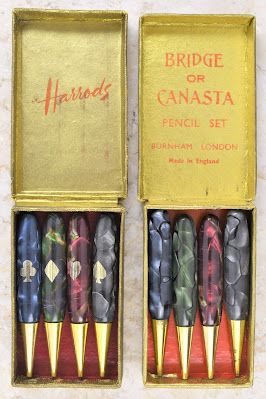
These sets were made by English maker Burnham; the Canasta set is so marked, and the set marked “Harrod’s” inside the box lid was marketed by the London department store by that name.

The fiction that I don’t collect these has long since collapsed, and I’m keen on finding nice bridge sets regardless of their country of manufacture.  The first picture in this article is from the box lid of a set that recently came my way via Jerome Rosenthal:


While Mabie Todd & Co. is a firm with American origins, the “Ltd.” at the end designates its British operations, and the pencils are clearly continental.  They have triangular barrels, and the colors are just spectacular:


And unlike the Burnham sets, these pencils sport imprints.  Even if they didn’t I wouldn’t question whether these are Mabie Todds, but it doesn’t hurt to have that extra little bit of confirmation:


“‘DACE’ / Mabie, Todd & Co. Ltd. / Registered No. 728198.”  It’s frustrating trying to find information concerning British registrations; they consider such historical information over there to be a profit center.  One day I aspire to do for British patents and trademarks what I’ve been able to do over here, where free access facilitated the creation of the reference books I needed.  Unfortunately, without spending a considerable amount of money on British records, a registration number like this is about as useful as a bicycle is to a fish, so the saying goes.

A rant for another day, I suppose.  

Here’s another British bridge set, which Joe Nemecek gifted to me:


I used to think this was a much older set which had been rehoused in something much newer, since the pencils look like something from the turn of the last century.  Quite a coincidence though, to find a perfectly sized case with four perfectly sized bands to hold these:


The hallmarks tell me that this is all original and as it should be.  It’s quite a bit newer than it looks, and newer also than nearly everything in my collection:


The three stamps in the middle are traditional English silver hallmarks, which have been in use for hundreds of years.  The one on the left is an anchor, denoting Birmingham assay office.  The lion denotes sterling silver (and is a duplicate of the more recent “925" marks on the right).  The important one is that script E, which is the date code corresponding to 1979.  

As for the “W.M” at the beginning, that is the manufacturer’s hallmark.  The only one I found operating in Birmingham in 1979 was William Manton, also known as Birmingham Gold & Silversmiths, Ltd.

The lure of matching pencils with card suits even pulls me in when they are more humble; these came in a box marked “Germany” but are otherwise unidentified:


Then there’s this set, which turned up at the DC show a couple years ago.  


There’s no markings on the pencils other than “Foreign” (meaning foreign to the UK, into which they were imported), and they combine American kitch with a bit of European flair: four pencils, each marked with all four suits and bearing on-board cheat sheets, accompanied with a nice metal plate with an “Honor Column” and brief description of penalties.  At the tops, square inserts prevent these clipless pencils from rolling, which might suggest “Foreign” meant brought back to the crown from the former colonies – that’s just like what you’ll see on the Vanco bridge pencil (see "Trick Pencils . . . For Tricks").


Here in the states, where the Slencil company turned out these “Stag Slencil” bridge sets (featured here back in 2013, see The Leadhead’s Pencil Blog Vol. 2, page 247):


Slencil was one of the few American companies turning out four pencil sets like the ones in Europe, but an article such as this wouldn’t be complete without including the American royalty on the subject:


Resting comfortably in a corner of the museum is Parker’s offerings on the subject: the bridge set consisting of four enameled and separately boxed bases, with red and black golf pencils.  I’ve written about these more continental sets before (see The Leadhead’s Pencil Blog, Vol. 1 at page 300 and Vol. 2 at page 137), and also about Parker’s scoring pencils in the foreground (those weird triangular pencils with red round tops - see Vol. 1, page 318 and more recently, at "Bridging the Gap"). 

I don’t have anything new to add about the Parker stuff – it just didn’t seem right to post an article about bridge sets without including them. 

PS - Joe Nemecek has a similar affinity for things like this - check out his post over at Joe's Pencil Pages:  Joe's Bridge sets.

Monday, April 15, 2013

At Least It's Where The Sun Don't Shine

Last August at the DC Show, Joe Nemecek sold me a Parker Bridge set, which included the bases for all four suits, one of which was boxed and included the correct pencil:


To learn more, this full article is included in The Leadhead's Pencil Blog Volume 2, available at Amazon, Barnes & Noble and everywhere else you buy books, or you can order a copy signed by yours truly through the Legendary Lead Company HERE.