Showing posts with label Eversharp Skyline. Show all posts

Saturday, November 22, 2025

Witness for the Prosecution

Step one: observe. Step two: compare those observations to what you know. Step three: draw reasonable conclusions. That process always serves me well.

Still, when one of those reasonable conclusions runs contrary to a bit of our collective lore, I often get some pushback. We grow fond of the stories that are passed down to us, even when they are ludicrous – often out of the love and respect we have for the people from whom we heard those stories. If you said George Parker came out with ringtop Duofolds in pastel moire colors because he was really the Easter Bunny, you could do so with a straight face by prefacing that statement with “Fultz once said .  . ..” 

No, Michael Fultz never said any such thing. That’s intended as a tribute to how much I respect the man and how much influence he still has today.

When it came to the conclusions I drew regarding Wahl-marked Skyline pens (“A Better, Simpler Explanation” on October 18, 2025), I was bucking the time-honored story that the newly-minted Eversharp, Inc. slapped the Wahl name on a few Skylines just to preserve the exclusive rights to the Wahl name. 

That never made much sense to me – from my own experience, when I purchased the assets of the failed Autopoint Company, I didn’t pursue Autopoint’s trademarked names – I renamed my existing Legendary Lead Company the Legendary Pencil Company. Many people have asked me why I didn’t want the Autopoint name, and I tell them all the same thing: Autopoint failed because it wasn’t paying anybody, including its landlord. My name was better than theirs. 

Wahl was in the same boat in 1939, facing threats from the Federal Trade Commission, angry shareholders and litigation. Putting the Wahl name on a new Eversharp Inc. product would only paint a target on the new company’s back.

To my surprise, “A Better, Simpler Explanation” was well received. Several collectors looked at their Wahl-marked Skylines pens and without exception, everyone saw the same thing I was seeing: Wahl markings on the back of the clip for no apparent reason as well as on the front. All reached the same conclusion I did, that the Skyline was introduced before the first advertisements for them appeared in 1940, and before Wahl reorganized into Eversharp, Inc.

A Wahl catalog or official Wahl announcement would provide the concrete proof, but none are known as of this writing. No matter how reasonable the conclusion is, even if beyond a reasonable doubt, it’s a circumstantial case.  If only there was some hard, primary evidence . . .

No, I didn’t do this on purpose, although the timing couldn’t have been better. Janet and I trekked over to Springfield last weekend to browse an antique mall we had not visited for some time, and one display case had this in it:


The slots are narrower, suggesting this case was intended for pencils rather than fountain pens, and the glass is acid-etched with words, including one that shouldn’t be there:


“Wahl Eversharp Skyline.” That is as clear a pronouncement as you could want that the Skyline was introduced in 1939 or very early 1940, before The Wahl Company ceased to exist. But wait . . . there’s more . . . the smaller text beneath the main title is extremely difficult to make out, but I was able to decipher it with a loupe:

“Super Flex    Full Flex    Medium Flex   Oxford   Demi”

The word “Oxford” is the one that stands out, because the name is one the Wahl Company used for its inexpensive lines during the 1930s; there is no evidence that Eversharp, Inc. ever used the name after the merger.

And wait . . . there’s even more . . . 

On the top edge of the case, the dealer who originally used this case put handwritten stickers on the top of the lid, so that a salesman could see the model numbers and prices without opening the case for the customer on the other side of the counter. Of course there is no direct evidence that these stickers were there in 1939, rather than stuck on there by some random person for some random reason at some random time over the last 75 years or so. However, I’ll tell you why I do believe they were put there in 1939 – and this is where things get really interesting. 


The stickers read:

#162 / $1.00

#8 / 108 / $7.36

#72 / 172 / $1.25

#72X / $1.25


#162 / $1.40

#165 / $1.50

#106 / (unreadable)

#166 / $1.40

These appear to be Skyline model numbers – almost. Skyline fountain pens had two-digit model numbers, and the pencil used the same numbers with the addition of a leading number 1.Therefore, for example, a standard length Modern Stripe Skyline pen was Model 75 and the matching pencil was model 175.

Chapter Fifteen in Eversharp: Cornerstone of an Industry, includes a comprehensive taxonomy of Skyline configurations and model designations compiled from period catalog materials and surviving examples with price stickers. The model numbers for nearly every surviving variant has been identified.

Not a single one of the model numbers on this display case matches what we know to exist. Each of these numbers, though, is tantalizingly close. Models 160 and 161 were demi and standard-size Presentation Skylines, respectively, with ribbed, gold-filled upper barrels. Models 162, 165, and 166, however, are unknown.

Models 170 and 171 were demi and standard-size “Presentation Vertical” Skylines, respectively, with their gold-filled upper barrels adorned with lines running lengthwise rather than around the barrel. Models 174 and 175 were the demi and standard-size “Modern Stripe” (nicknamed “moire” by collectors) – the 1940 price sheet on page 336 in Eversharp added a suffix of B, G, or S to denote the color (blue, green, or silver grey). 

Model 172 and Model 72 (presumably, the matching fountain pen) are unknown, and the possible existence of a Model 72X pen is really exciting. Other known Skyline models with a letter suffix denoted special barrel materials: Model 78P was the unicorn all-Platinum pen, Model 78SY was the Command Performance pen in solid 14k gold, Model 78Y denoted a gold-filled cap and barrel, and Model 78W had a stainless cap.

The sterling-capped Skyline, like the one from that earlier article, has not been documented with an official model number; perhaps X designated sterling, although I’d think if that were true it would be Model 78X, not Model 72X. Maybe it was something else; since it only cost $1.25, it likely wasn’t any other expensive material – maybe it was the brown Modern Stripe, since “B” was already occupied by the color blue. Who knows – maybe these stickers set doorbuster prices to clear out old Wahl models after the reorganization. 

Then there’s that crazy #8 / 108 designation, which appears to have been $7.36 for a pen and pencil set (if I’m reading the handwriting correctly). Models 100, 101, 102, and 103 were lower-tier press-clip models meant for utilitarian use, and press-clip pens were “especially for grade school use” (see page 348 in Eversharp for the advertisement which documents this).  There was no Model 108, according to my research, and there was no Model 106, either. I’ve never seen a sticker on a press-clip pen – not surprising, since they were made to be abused and nearly every example I’ve seen was ridden hard and put away wet. Whatever this was, it was more expensive than anything known in the 100 series of Skylines.

Here is my theory, based on comparing these observations to what we know. The consolidation into Eversharp, Inc. was in the works for a year before it was consummated in early 1940. The Skyline was already well into development, and it was likely test-marketed by Wahl to be sure it would be a tremendous success for the newly-formed company.

The main reason for the reorganization was for Wahl to escape all of the obligations that were dragging the company down – one substantial obligation was the company’s repair obligations pursuant to its double-check lifetime warranty. Perhaps the model designations for the Skylines were already planned before the reorganization, but for Wahl's test marketing purposes, Wahl used different model numbers to differentiate those pens and pencils which the new company would have no warranty obligation to repair.

Yes, I know that part is conjecture – a reasonable conclusion, based on comparing what we observe here to what we already know. Now, as all of my Eversharp fans in the peanut gallery digest this article and look more closely at the examples they have, our challenge is to determine if there are stickered examples that bear any of these mystery model numbers to see if this conjecture is ultimately proven correct.

A few notes of caution as we undertake this new challenge: first, the fountain pens had price bands on their barrels, and to my knowledge all of the caps are interchangeable. Other than “junk box provenance,” there is no way to know whether the cap on a banded barrel is original to the pen. Finding a barrel with a price band of “72X” would be exciting, but not conclusive. Pencils, on the other hand, had one-piece barrel, so a pencil marked “172X” would be the clincher to tell us what the matching fountain pen looked like.

There’s another caution on the pencils, though: my previous article discussed the name “Wahl” stamped on the back of the fountain pen clips, as well as on the front. I went through my stash of Model 174 and 175 modern stripe (or “moire”) Skyline pencils, which from what we know were introduced at the outset – they are either marked “Eversharp Skyline” or they have no markings at all.

Again, this is just a theory: perhaps the pre-reorganization Skyline pencils lacked this stamp to indicate they were not made by Eversharp, Inc.

I continue to hold out hope that documents will one day surface to answer all of these questions once and for all. Until then, please observe and report. I’m reminded of a great quote by Tommy Lee Jones in the 1997 film, Men in Black: “1,500 years ago, everybody knew the Earth was the center of the universe. Five hundred years ago, everybody knew the earth was flat. And fifteen minutes ago, you knew that humans were alone on this planet. Imagine what you'll know tomorrow.” 


Sunday, October 19, 2025

A Stainless Unicorn and Schröedinger's Platinum

The Wahl Company got into the writing instrument industry backwards. While Parker, Sheaffer, and Waterman were fountain pen companies which later added pencils to match their pens, Wahl started out making pencils first in 1915, when it was known as the Wahl Adding Machine Company and started making pencils as a contractor for Charles Keeran’s Eversharp Pencil Company. Later, after Wahl acquired a controlling interest in Keeran’s company, Wahl went into the pen business with the purchase of the Boston Fountain Pen Company in 1917.

Wahl’s origins in the industry as a pencil manufacturer would influence the company in the decades to come, and that is what makes its products particularly fascinating to pencil collectors: there are many Eversharp pencils that do not have a matching fountain pen.

Except, of course, when it comes to those pesky Eversharp Skylines with sterling caps and other Skylines with clips marked “Wahl,” as shown in yesterday’s article. Those are a rare frustration for pencil collectors, because matching Skyline pencils are not known to exist. 

It is reasonable to conclude, given Wahl’s history, that no Skyline pencils were made with Wahl-marked clips: beginning in 1917, it was “The Wahl Pen and Eversharp Pencil,” and it wouldn’t be until much later that Wahl would mark a fountain pen model as an “Eversharp.” For that reason, I’ve resigned myself to the fact that there probably never was a Skyline pencil marked “Wahl” on the clip. Prove me wrong, as they say.

Hope springs eternal, though, that one day a Skyline pencil with a sterling silver overlay will be found: it is one of those things that “should” exist, because there is no reason it should not exist and everything we know about Wahl suggests that it would exist.

When Pat Mohan went home from the Raleigh Pen Show to check the cap imprints on his Wahl-marked Skyline fountain pens for me, I’ll admit that I held out faint hope that Pat would return to the show with that knowing smile on his face I’ve seen so many times and a conversation starting with “I’ll bet you haven’t seen one of these” as he handed me a Wahl-marked Skyliine pencil.

Pat did return to the show with that exact expression on his face, and our conversation began exactly that way. No, he didn’t have a sterling Skyline pencil on him, but he had this:


There’s lots to unpack with this pencil, starting with the derby and clip assembly. This has what Eversharp called a “Streamliner” top end - instead of a buttressed clip, Streamliners lack the upper mounting.


The Eversharp Streamliner was a lower-priced version of the Skyline, designated Model 198 in the demi size and Model 199 as a full-length pencil, all as discussed on page 341 in Eversharp. Until Pat’s example surfaced, every Streamliner I have seen has sported a plain barrel, with no overlay or trim bands.


Now let’s pile on that stainless overlay. The Eversharp Skyline in stainless is the third most rare variation in the series – behind sterling silver and that mythical platinum version. I’d rate the solid gold Skylines as fourth most rare, at least when they were made, but their numbers continue to dwindle with the skyrocketing price of gold. The temptation to scrap 14k examples poses an unprecedented threat to their survival, particularly when it comes to badly dented or worn examples.

Within that subset of third-place stainless Skylines, Pat’s Streamliner has other unique characteristics. Note that the overlay is significantly shorter than “usual”:


The two examples in the center are the most commonly encountered Skyline Stainless variants, featuring either gold filled or the slightly less common stainless clip assembly. The example at bottom came from the late Fred Krinke’s auction – see “I’m Gonna Drive (500 Miles)” (April 3, 2021: Volume 7, page 4).

Whenever something comes along that isn’t supposed to exist, I always have to take into account the possibility that someone may have “made” it by combining parts that aren’t supposed to go together. I’ve considered and rejected that possibility.

First, transplanting derby and clip assemblies from one Skyline pencil to another is a huge pain in the neck. Repair instructions at the time directed repairmen to crush the entire derby assembly with a pair of pliers, pull it out, and press fit an entire new derby and clip assembly. The decades have not been kind to Skyline plastics, which have become so brittle that this procedure – labor intensive and risky even when these were new – is nearly (but not entirely) impossible now. I successfully performed the operation in “Radical Surgery on a Skyline” (February 21, 2013: Volume 2, page 58), but it took quite a bit of time. The experiment was only worthwhile because I was grafting a 14k solid gold overlay and derby onto a barrel from an ordinary Presentation example.

Also, the upper portion of the barrels of these overlay Skylines are milled down a bit so that the overlay is flush with the diameter of the lower barrel. If Pat’s weird Streamliner Stainless began life with a plain barrel, someone would have had to turning the top portion of the barrel on a lathe so that the stainless sleeve slides over it. Did I mention how brittle these Skyline plastics have become over the last eight decades?

Let’s assume that a hobbyist with above-average machining skills was willing to spend the time to precisely mill down the upper portion of an ordinary Skyline barrel, remove the derby, slip a shorter tube of stainless steel of the exact diameter into position, and install a Streamliner derby and clip assembly. 

That didn’t happen.


No Skyline I have ever seen has a “Made in USA” stamp on the barrel, and Pat’s example has that stamp just below the end of the overlay. Without question, Pat’s variation is factory.
Now I need to circle back around to that full length metal barrel from Fred Krinke’s auction. I took this picture of it before the auction started in case I didn’t win it:


This shot didn’t come out the way I hoped it would  – “Skyline Noir,” I called it when the image ran in Volume 7. It didn’t convey all the detail that I had hoped, but it did convey the mysterious and dramatic nature of the beast.

I have assumed that Fred’s Skyline was a prototype with a full length, stainless steel barrel. That’s how I reported it here at the blog and also in Eversharp: Cornerstone of an Industry. On page 317 in Eversharp, I noted “[t]he 1940 price sheet lists the Presentation Stainless as Model 178W, but a full-length stainless model is unlisted. It might have been Model 178S.”

Or . . . 

Recall from yesterday’s article that this same 1940 price sheet does list a Skyline with a platinum cap and barrel – the ultimate unicorn in the Skyline series, with no surviving fountain pens (Model 78P) “and – gulp – a platinum pencil (Model 178P).”  

Can platinum be mistaken for stainless steel? Yes it can, and it often is . . . but I’m not about to subject Fred’s pencil to scratch testing or other intrusive means that will damage it in any way, so I researched how else to distinguish the two metals. One way is the color of the metal: platinum is a deeper gray than stainless, which is brighter and has more of a modern feel. Have another look at this closeup of the tips:


I’d already noted the absence of the typical band around the nose found on other Skylines, and that almost matte, darker finish.

Platinum is also heavier than stainless steel: I had thought that Fred’s pencil was heavier just because the metal overlay is full length, but now that I’m wondering whether it might be platinum, I can feel more heft than I would expect. Of course, that’s not a reliable indicator, without a full length stainless barrel to weigh for comparison. 

As I explored non-invasive ways to test for platinum, the primary lesson I learned was that there are a lot of seriously weird and stupid people on the Internet. “Read the hallmark and see if it says platinum,” said one intellectual giant. There was one suggestion I thought was helpful, although I don’t know whether it is true: one source claims that hydrogen pyroxide will fizz dramatically when a few drops are applied to platinum, but not to stainless steel.

Janet looked at me a bit sideways when I came into the master bath, raided the first aid supplies, and put a few drops on the barrel of Fred’s pencil. Some context likely would have been helpful before I did that.

No fizz, for whatever that is worth, but that same source that had me doing weird things with a pencil in my bathroom also said it isn’t a particularly reliable test, depending on the purity of the platinum.

I’m torn between which is better: being able to introduce to you the first documented example of a Skyline Model 78P in platinum (and having to correct something I wrote in Eversharp), or having a wholly undocumented full stainless example.

I suppose until I have a more definitive diagnosis, I have both.

Saturday, October 18, 2025

A Better, Simpler Explanation

Even though I’m best known for my work with mechanical pencils, I do buy fountain pens when the occasion calls for it. The occasion called for it when I stopped by Myk Daigle’s table at the Raleigh Show.


This is an Eversharp Skyline fountain pen, but with a cap overlay made of  sterling silver. Sterling caps on Skylines are the second most rare of all . . . even more so than solid gold. 


The only Skylines that are more rare than these are Skylines with platinum caps and barrels, which have long been rumored to exist, but to my knowledge if platinum Skylines were actually made, none are known to have survived. Skylines with sterling silver caps were not cataloged, but the platinum cap and barrel version was – on page 336 of Eversharp: Cornerstone of an Industry, I included a price sheet dated to 1940 which includes a reference to the platinum pen (Model 78P) and – gulp – a platinum pencil (Model 178P) model. The low-resolution image in the book was the best available and was contributed by Jim Mamoulides, who says he found it somewhere back in 2003.


No sterling cap Skyline pencils are known to exist, but I’m happy to settle for an example of the pen – not only for its extreme rarity, but also because the opportunity it provided to examine one in person gave me a little extra information that allows me to address a longstanding mystery about the Skyline. Note that the clip is marked “Wahl” rather than the usual Eversharp marking:


That matches the nib, which is also marked Wahl:


Collectors have debated these Wahl-marked Skylines for decades. On page 349, I included an image of Wahl-clip Skylines in “Modern Stripe” (also referred to by collectors as “Moire”) in Pat Mohan’s collection.


“There is no definitive proof concerning how or why these were made,” I wrote. “The leading theory is that Eversharp, Inc. stamped the Wahl name on a few pens to preserve exclusive rights to use the Wahl name – or to prevent anyone else from using it.”

That statement is correct – I mean, that is the leading theory. I have always thought that leading theory was pure hogwash.

Chapter Fourteen in Eversharp, “End of the Wahl Company,” details the events beginning in 1939 which ultimately ended in the reorganization of The Wahl Company into Eversharp, Inc. under the new leadership of Martin L. Straus. Several unfortunate events befell Wahl in 1939, including the Federal Trade Commission’s ruling that Wahl’s Safety Ink Shut-Off did not work as advertised and renewed litigation initiated by Charles Keeran (inventor of the original Eversharp), and several of Wahl’s directors resigned in December 1939. A new corporation, Eversharp, Inc., was formed in March of 1940, and on May 7, 1940, Wahl’s shareholders voted overwhelmingly to merge the Wahl Company into Eversharp, Inc. 

Now consider the history of the Skyline, outlined here in “The Post that Launched 454 Pages” (August 15, 2025). Martin Straus had retained Industrial Designer Henry Dreyfuss to create the look of these new pens and pencils, and Dreyfuss’ conceptual drawings were dated January, 1940. Dreyfuss’ drawings show unmarked clips, but otherwise they show the Skyline in what would be its finished form.

Dreyfuss also designed the rectangular cartouche containing double-check marks that would be incorporated into the Skyline’s clip. His preliminary design was dated June 6, 1940, and the final drawings were dated July 17, 1940. The Skyline debuted in newspaper advertisements in October, 1940.

The Skyline was essentially ready to move into production while the Wahl Company was on its last legs, while a reorganization into Eversharp, Inc. was in the works but had not yet been voted on by shareholders. My theory, as I wrote the book, was that Wahl-marked Skylines were test marketed during that uncertain time, perhaps as an additional means to influence the votes of uncertain shareholders in favor of a merger.

It’s a good theory, but that isn’t enough by itself to prove the point. “Although Martin Straus and Henry Dreyfuss began work on the Skyline prior to the Wahl reorganization in April 1940, there is no evidence that Wahl introduced the model before the merger,” I admitted on page 349.

Now, with Myk’s example of this sterling-cap Skyline in hand, I believe the clip assembly on this Wahl-marked example provides a little more evidence. Myk’s example has a damaged clip assembly, so he gave me the original assembly in a little baggie – he had fitted it with a typical, Eversharp-marked clip and derby for daily use. Those assemblies have an imprint that reads “Eversharp Skyline”:


The Wahl-marked clip that Myk’s pen originally was fitted with, though, reads only “Wahl.” Note that the tabs securing the clip to the band have broken.


If the leading theory is correct – that Eversharp, Inc. stamped the Wahl name on a few pens just to preserve the new company’s rights to the Wahl name – there would be no need to stamp the Wahl name here. In fact, it would make a lot more sense to stamp the Eversharp name there to make clear who was using the name.

I believe the Wahl name was stamped all over these examples with Wahl-marked clips because they were made before the merger was approved in May, 1940, during test marketing of the new pens done to provide nervous shareholders with some comfort that great things were on the horizon if they voted in favor of the merger.

I put my theory to the test: Pat Mohan was also in attendance at the Raleigh Show, and he lives close enough to the show that he was able to look more closely at all of his Wahl-marked Skylines. Without exception, Pat reported the next day, every example he owns has this same Wahl imprint on the back side.

When Pat returned to Raleigh with his report, he had something else with him . . . 

Friday, August 15, 2025

The Post that Launched 454 Pages

 I wrote the following article in February, 2024. After it was finished, I took a step back and thought to myself, “this is a really interesting detail about the Eversharp Skyline.” 

Off to the races went my brain . . . “oh hey, and I have a lot of other interesting details about the Skyline,” I continued . . .  “and then there’s all those other interesting details about all those other Wahl and Eversharp models.”

And so the internal monologue grew deafening, accompanied by the ever more deafening chorus of  reader requests, gently but persistently asking me when I was going to write the Eversharp book.

So I did.

The revelations that emanated from this article were included in Eversharp: Cornerstone of an Industry, on page 324. The back story, however, was outside the scope of a scholarly monograph. As I was dusting things off and getting ready to restart things around here, I ran across the draft of the article. 

The internal monologue began again. “But you already included most of this in the book,” I said. “But not all of your readers here have the book,” I replied. “Shut up and have fun,” my third inner voice piped up. 

It’s getting crowded in there, so I’m shutting down the conversation. Here is what I wrote. . .

- Jesse Wins a Beer -

“I’ll buy a beer at the next show for the first person to see what’s ‘wrong’ here…” I teased in the Fountain Pens group on Facebook.


A lively guessing game ensued, and every wrong guess merited a “no beer for you.” Those who said “they aren’t fountain pens” earned a “DEFINITELY no beer for you.” I should have told those in the latter category that they needed to buy me one. 

After a few missed swings from the peanut gallery, Jesse Tanenblatt commented that the trim bands on these three examples are not where they are “supposed” to be. 

I look forward to tipping a glass with Jesse next time I see him, likely in Baltimore. Here are the three oddballs shown alongside their regular counterparts:


Jesse is a very observant sort of guy, but I like to think I might have planted a subconscious seed with an article titled “All for the Paper” (June 16, 2021: Volume 7, page 201). The short green example was featured at the end of that article; since then, one of the others surfaced at the 2021 Raleigh Show (I don’t remember who had it), and Nik Pang had the other at the 2022 Philly show. 

I had included the earliest advertisements I had found for Eversharp’s new Skyline in that 2021 article, which were published in October, 1940 and showed only fountain pens, sometimes referred to as the Skyline, sometimes as the “Gold Seal Pen” and still other times, simply as the new Eversharp with a “Magic Feed.” An advertisement published in January, 1941 finally shows a pencil, and while the artwork is fuzzy, it appears to show the trim band right where one would expect to see it, on the border between the striped upper and solid lower sections of the barrel. 

Then came that advertisement in The Bloomington Pantagraph on February 13, 1941:


There is this same trim band placement, and the three examples that have surfaced prove this was no artistic license – a very small number were in fact manufactured in this configuration. In my own classification system for Skyline configurations, I refer to Skylines with striped upper barrels as the “Skyline Standard I”, with “Standard II” denoting a wider center band. Now that I’ve found three of these examples with the odd trim band placement, I’m inclined to refer to them as the “Standard Ia.”

I’ve been making this up as I go along for years, so I might as well keep making things up now.

We know these Standard Ia pencils were made very early in the Skyline’s production run, although that February 1941 advertisement was published a few months after the Skylines first appeared. The Skyline Standard Ia is in my opinion more true to the Skyline form. Cap bands on the matching pens weren’t right on the lip, so moving the band up a bit on the pencils makes these a better match for the pens they were meant to accompany. That raises the question: if these look better, why were they discontinued? 

That question might be answered by another detail you might have noticed in that first image. . . J. Andrew Sonnemaker and Hugh Cordingley were quick to point it out, and I suppose runner-up beers are in order for each of them.


While the example from my last article has the typical “double check” cartouche at the top of the clip, J. Andrew and Hugh pointed out that two I have found since then do not.  Huh, I said to myself as I read Andrew and Hugh’s comments. I’ll admit that I didn’t notice that until they mentioned it, and the question opens an entirely  new can of worms (or beer).

Since the Skyline Standard Ia configuration appears in such an early advertisement, the first possibility to rule out is that perhaps the double check cartouche was added after the Skyline was introduced. Stationer’s newspaper advertisements frequently use fanciful artwork, and that is at least partially the case with that February 1941 advertisement. Note also that the cartouche as illustrated isn’t exactly what one would expect to see. It isn’t rectangular: the bottom is rounded, so it looks more like a shield.


Was this added to existing artwork that lacked a double check mark, drawn before Eversharp had finally settled on how it would look? Maybe, but I think that gives stationers too much credit.  

Retailers typically were not as quick as manufacturers to update the artwork they had on hand; perhaps that February 1941 advertisement used artwork Eversharp had supplied to retailers months earlier. If artwork showing that alternate trim band placement was outdated, it wasn’t outdated by much: it was still only a few months old at the time this ad was published.

Other evidence indicates (1) the shield-shaped cartouche was fanciful artwork, and (2) the regular cartouche was used on Skylines from the outset. That evidence comes from Jack Leone, who invited me down to his place some eight years or so ago to take pictures of some things for this blog. We ended up spending the day shooting his entire collection, and he had some things I wasn’t expecting to see, including some original drawings by Henry Dreyfuss, the designer of the Skyline. Here’s a concept drawing Dreyfuss made of a Skyline set dated January 15, 1940:


Note that the clips illustrated are entirely unmarked, and the pencil is shown with a “Streamliner” clip rather than the matching buttressed clips Eversharp eventually used.

Jack also had a couple fascinating Dreyfuss drawings showing the double check cartouche. The first, captioned drawing number 59, is dated June 6, 1940:


Eversharp apparently had concerns about how this would look when reduced to the width of the clips. Drawing 59-A, dated July 17, 1940, beefs up the tails of the checkmarks to make them more visible, and it shows the design reduced to the actual size:


The earliest Skyline advertisements, published in October 1940, show what appears to be this cartouche. A trademark registration for this design would be helpful, since it would provide a date on which Eversharp first used this mark in commerce. Unfortunately, if the company did so, I didn’t find it in the course of researching American Writing Instrument Trademarks 1870-1953 (although I found two earlier incarnations of the mark as reported in the book).  

However, I think the date shown on the Dreyfuss drawings, coupled with the October 1940 advertisements, are good enough to state that Dreyfuss’ double check cartouche was available and apparently in production on Skylines from the outset. No, I don’t think my two pencils lack the mark because they were sooper dooper early. There must be some other reason.

I think that reason is that Eversharp intentionally omitted the mark because the company did not want these pencils to be covered by the guarantee it denoted.

The upper and lower parts of these pencil barrels were glued together, and when they separate there’s no repairing them – broken once is broken forever. The  Skyline Standard Ia may be rare because most of the ones that were made broke, either when swaging the band above the joint or in use.

Moving the band to cover that joint provided an extra bit of reinforcement at the weakest part of a Skyline pencil barrel. I believe that in the case of the Standard Ia, structural integrity quickly trumped aesthetics. They looked nicer, but in the end it was more important that they be durable enough to warrant with a double-check guarantee than to be pretty.

Yes, I believe the Standard Ia is the earliest incarnation of Eversharp Skyline pencils with striped upper barrels. No, I don’t think lacking the double check is how “first year” Skyline Standard pencils (or pens, for that matter) are identified, because the vast majority of such “first year” Skylines have that seal. Yes – I think Eversharp was hesitant to warrant what they suspected would be a model more prone to failure. 

There I go, thinking again.

“Shut up and drink your beer,” I replied to myself.

Tuesday, July 20, 2021

The Toughest Skyline Series

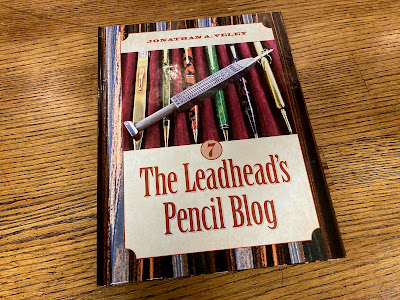
This article has been included in The Leadhead's Pencil Blog Volume 7, now available here.


If you don't want the book but you enjoy the article, please consider supporting the Blog project here.

Pardon me while I whoop and holler about something that doesn’t look all that out of the ordinary:


It is an Eversharp Skyline, in one of those flat, muted colors that is so dark you need strong light (and in the case of photography, to change up the background a bit) to see the colors.  This one is demi-sized, maroon . . . and in about the toughest configuration to find in a Skyline pencil.

I’ve been championing a uniform system for categorizing Skyline variants since before I wrote The Catalogue.  Pens, I reasoned, have interchangeable caps, so if you really want to know what variants were factory Eversharp, you have to look to the pencils since the pencil barrels are a one-piece unit.  The different types I found are laid out on page 72 of The Catalogue and, ten years later, that system has held up very well.

The categories I defined started with Standard (striated) and Presentation (metal top end) models:


Skyline Standard I: striated top section, thin band

Skyline Standard II: striated top section, thick band

Presentation: ribbed gold filled top section

Presentation Vertical: gold filled top, lengthwise lines

Presentation Dart: gold filled top, engine turned design

Here's a closer look at the Presentation models (not shown are the 14k tops, which are plain, and the stainless ones):


Next are the “Solid” series, consisting of a single material for the entire barrel:


From top:

Solid I: single color/material barrel with no bands

Solid II: single color/material barrel, thin center band

Solid III: single color/material barrel, thick center band

Streamliner: simplified clip/derby assembly

Finally, there are the “Press Clip” Skylines, many of which did not have a matching fountain pen.  Clips are stapled into the barrel rather than being part of a separate derby assembly:


Press Clip I: simple clip pressed into barrel, no bands

Press Clip II: simple clip pressed into barrel, single band

Other variations have emerged in the years since The Catalogue was released, but all have been additions to the “Press Clip” family of Skyline variations.  I’ve shown them here as they were discovered: from top, the Press Clip III, IV, V . . . and “holy cow,” which I’ve called VI (for the last of these, see Volume 4, page 140).

This maroon pencil is in the Solid I series - a barrel having all one color and no bands.  The all-stainless Skyline earlier in this volume (page , the one I would drive 500 miles for) was in this same series.  I include the “modern stripe” or “moire” pencils in this same grouping, but they are easier to find than pencils in flat colors.  Once your eyes adjust to the fact that this is a standard Skyline derby assembly but a boring one-piece, bandless barrel, you’ll notice how tough these are to find.  

Most of the other series in my Skyline collection have long since been completed.  Some, like the Solid II and Solid III series, appear only to have been made in limited colors, but I will whoop and holler just as loud if I find one of those off the beaten track as I am today about a plain ol’ maroon one.  As for the Solid I series in plain colors, I’ve found both sizes in black, blue and maroon; I’ve found one regular sized model in green, and none in brown or grey.


Do the “missing” sizes and colors exist?  You tell me.


Wednesday, June 16, 2021

All For the Paper

This article has been included in The Leadhead's Pencil Blog Volume 7, now available here.


If you don't want the book but you enjoy the article, please consider supporting the Blog project here.

This was advertised as a “set” in an online auction.  


The pencils are run-of-the-mill Eversharp Skylines, and both went straight to the sale bins for the next pen show.  The box is also Skyline era . . . nothing special there:


The paperwork, however, grabbed my attention.  I’ve arranged them as they were shown in the auction pictures, and I could see something that didn’t fit in at all with the pencils or the box.  In fact, they didn’t fit in with any Eversharp paperwork I’ve been able to study:


Eversharp didn’t refer to Skylines as “Gold Seal Repeaters,” because instead of a seal the double-check mark was incorporated into the clip.  This paperwork therefore likely pre-dates the introduction of the Skyline in 1941, and the combination of those two terms – “Gold Seal” and “Repeater” – places that paperwork within a very narrow, fascinating time period in Eversharp’s history.

When the item arrived, there were papers for both Gold Seal Repeaters and Gold Seal pens:


With one extra little twist:


“Eversharp, Inc.”  We’ll come back to that in a minute, because there was one other piece of paper folded up in this group . . . with stars on it . . .


For the Eversharp White Star Repeater.  Printed on the back are generic Eversharp repeating pencil instructions, which apply to all Eversharp models of this time period:


Step 2 of the instructions, regarding removal of the “Magic-Button,” illustrates a Coronet clip:


The Coronet, however, didn’t have any seals or white stars . . . and there’s something else to notice on the front side:


The White Star paperwork was printed by The Wahl Company, not Eversharp, Inc., in March, 1940.  

I’ve also written about Wahl’s garage sale of pens and pencils cobbled together from leftover parts – most notably, in connection with the X-seal pens and pencils (see Volume 6, page 110-112).  The general consensus has been that these weird variants were part of a financial reorganization of the company in 1939.

While Wahl might have been making use of leftover parts in 1939, the reorganization didn’t happen until 1940.  An account published in The Chicago Tribune on June 12, 1940, after the dust settled, stated that The Wahl Company showed a net loss for the year ending February 29, 1940, as well as in 1938 (no information was reported for 1939).  

The company’s largest and most formidable group of creditors was its own shareholders: dividends had been declared over the years, but Wahl had not paid accrued dividends on preferred shares of the company’s stock since 1930, and holders of common shares had not been paid since 1924.

On March 13, 1940, The Wilmington, Delaware News Journal reported that a new corporation, Eversharp, Inc., had been incorporated.   


On April 13, The News Journal published notice of a special meeting of the shareholders in The Wahl Company: on May 7, 1940, the shareholders would be considering a merger.  Holders of 7% preferred shares of Wahl Company stock, which had accrued dividends of $80.50 per share, would receive six shares of preferred stock and five shares of common stock in the new company.  Common stockholders would receive one share of common stock in Eversharp, Inc. for every 2 ½ shares of Wahl Company common stock:


The Associated Press reported that the deal was approved at the May 7 meeting, by a vote of 120,907 to 3,701.  

All of this happened just as the White Star line was being introduced.  I’ve written about “White Star” Eversharps before (see Volume 3, page 238 and most recently in Volume 5, page 224), and I’ve always dated them to 1940 or so because at some point I’ve seen another piece of paperwork, also dated March, 1940.  The typical White Star pencil is an aluminum-barrel affair, sporting Eversharp’s prettiest clip of all time:


The domed, gold-filled caps are correct on this series; the top example has a Skyline button for a replacement, and one has an eraser simply wedged in where the button should be.  The example second from top isn’t clipless – I’ve turned it around to show the location of the imprint.

Advertising for these pencils is consistent with the paperwork I’ve turned up.  The earliest advertisement I found for them appeared in The Indianapolis News on March 27, 1940, describing them as the “World’s First Thin Lead Eversharp Repeater Pencil”:


That’s pretty awkward wording.  Official national advertising described them as the “World’s First Thin Lead Repeating Pencil,” like this one published in The Spokane Chronicle on May 10, 1940:


The other series of pencils Eversharp made with White Stars are much harder to come by:


These featured in Volume 5, page 224, and the second one from bottom, with two equally thick gold bands at the top and a double check seal rather than the White Star, was discussed in Volume 3, page 238:


Could this be the “Gold Seal Repeater” from the paperwork at the beginning of this article?  Maybe . . . after all, these have been identified as the Eversharp “Victory,” advertised in 1941 (see Volume 4, page 174):


If . . . Eversharp was consistent in how the company referred to its products – recall that the Four Square from around the same time was referred to at different times as the Forty Niner or the Red Spot (see Volume 5, page 130).  Could “Gold Seal” Repeater have referred to things which didn’t have Gold Seals, like the Skyline?

The earliest advertisements I found reveal that the Skyline moniker was used from the model’s introduction.  Here’s an advertisement published in The Town Talk in Alexandria, Louisiana on October 4, 1940:


However, on January 21, 1941, The Indianapolis News ran an advertisement for “The New Eversharp Gold Seal Pen”:


Granted, both of these are jewelers’ advertisements rather than official Eversharp ads . . . but The Town Talk didn’t pull the word “Skyline” out of thin air, and I doubt that The Indianapolis News plucked “Gold Seal Pen” out of the blue, either.  

Then there’s this advertisement, which ran in several newspapers in February, 1941.  This one ran in The Bloomington Pantagraph on February 13:


These advertisements specifically mention Henry Dreyfuss as the designer, but the name “Skyline” isn’t used.  The pen is described only as having a “Magic Feed,” although the picture of the airplane and the reference to writing at altitudes above 12,000 feet tie in well with the Skyline name.

There’s one other thing to notice: the placement of the trim band on the pencil.  In the January, 1941 advertisement, the band falls on the boundary between the striped upper section and solid color lower section, but in the February advertisements, the band is moved up into the striated section, to better match the bands on the pen. 

Was this artistic license?  After all, the trim band on pencils always falls on the boundary between the two materials, right?


Almost always.  Out of all my Skylines, this is the only example like this that I’ve been able to find.  Apparently the modification was extremely short-lived, very early in production.