Showing posts with label Nupoint. Show all posts

Thursday, April 22, 2021

Henber Wrinkles - Part Three

This article has been included in The Leadhead's Pencil Blog Volume 7, now available here.
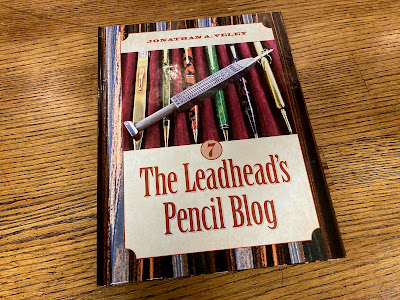

If you don't want the book but you enjoy the article, please consider supporting the Blog project here.

I’ve saved the most fascinating new wrinkle in the Henber story for last:


When I saw this one, I instantly recognized it as a Henber.  Of course it’s a Henber, right?  Here’s the ringtop Henbers from the article a couple days ago:


As was the case with yesterday’s installment, I was confident there was a mistake in the listing, but I knew this would be really interesting if the listing was actually right.

The listing was actually right:


“Keen-Point.”  Huh.

I pull Occam’s Razor out at every opportunity, mostly to regulate my wild imagination.  Occam’s Razor suggests that the far-flung Henber Company in Minneapolis pulled a cool-sounding name out of thin air, slapped it on a pencil and was quickly reprimanded by those who rightfully claimed the name to knock it off.

Occam, however, needs to pack that switchblade away for a moment.  Perhaps that is not the simplest explanation.

The “Keen-Point” name has (until now) been found in two, well-documented and apparently unrelated incarnations.  The earlier one was O.R. Johnson, who offered metal Keen-Point pencils in 1921 and 1922:


Johnson was marketing his Keen-Points at the same time Henber was active, between 1921 and 1923, so there’s a bright line between two possibilities: either Henber blundered into using the name without Johnson’s permission and Johnson put a stop to it, or Johnson was somehow involved with Henber.

And then there was Charles Keeran, who adopted the Keen-Point name after he was ousted from Autopoint the second time in 1924.  Keeran registered a trademark for “Keen-Point” in a distinctive font:


Keeran claimed in his registration that he first used the mark on November 21, 1928 – but that’s this specific mark.  He might have used the words “Keen-Point” earlier, and Keeran’s activities after he left Autopoint are difficult to piece together.  In Chapter 7 of A Century of Autopoint, I show how his patents filed after 1924 show that he first dusted off his “Keeran Products Corporation” to market “The Keeran Pencil,” in 1925, then affiliated himself with Julius Swanberg and Robert Chelton for a short time around 1926.

But there are holes in the story, and plenty of room in the timeline for Keeran to scoot up to Minneapolis for a bit to pick up the pieces of Henber after the company called it quits in early 1923 – perhaps after Samuel Kanner was finished playing around with it.

History is what floats to the surface when facts are assembled in chronological order.  The three wrinkles presented in these last three articles provide tantalizing new facts – the infuriating part is I don’t know in what order to put them:

1.  The Henber Company offered Henber pencils between late 1921 and February, 1923;

2.  O.R. Johnson Co. offered “Keen-Point” pencils between 1921 and 1922, and at least one pencil marked “Keen-Point” is identical to the Henber;

3.  The Louis F. Dow Co. offered sterling Dow pencils engraved with the same, distinctive chasing on the barrel as the Henber.  One of the examples sports a logo on the box lid dating it to sometime after August, 1923, but that doesn’t mean sterling Dows like this weren’t offered earlier;

4.  Whoever made Samuel Kanner’s “Nupoint” pencils, advertised between 1921 and 1924, also made at least one identical pencil marked “Henber”;

5.  There is a gap between the time O.R. Johnson Co. offered “Keen-Point” pencils in 1921-1922 and when Charles Keeran claimed he first used a stylized “Keen-Point” logo in 1928.  Keeran might have used the name (but not the logo) as early as 1924, when he departed Autopoint.

The artifacts themselves can only tell us so much.  One of these days, I’m hoping some documentary evidence will surface to make some sense out of all this.


Wednesday, April 21, 2021

Henber Wrinkles, Part Two

This article has been included in The Leadhead's Pencil Blog Volume 7, now available here.


If you don't want the book but you enjoy the article, please consider supporting the Blog project here.

When this showed up in an online auction, I was convinced the seller paired pictures of the wrong pencil with the auction title. 


The listing title identified it as a Henber, but the pencil looked to be identical to something else in my collection:


That clip, with it’s exaggerated hump, is something I instantly recognized:


It’s what you often find on Samuel Kanner’s early line of “Nupoint” pencils:


But wait . . . there’s more.  Recall that the Henber has distinctive machining that extends farther down the nose, past where it begins to narrow down to the point.  On the Nupoint, that machining stops before the joint separating the nose drive from the barrel – Henbers, on the other hand, are rear drive. 


Even the engraving on these two pencils is identical, in that V-shaped pattern reminiscent of Superite pencils made by DeWitt-LaFrance:


Yet there it is, just like the seller said: it’s imprinted “Henber.”


This is a fascinating turn of events.  Samuel Kanner’s Nupoint pencils were advertised, just like the Dow, in late 1922; by late 1924, this particular clip was abandoned, and by 1925 Kanner dropped the “Nupoint” name in favor of Presto and switched to a repeating pencil design (the great granddaddy of the Eversharp Skyline, by theft and deception).

Henbers were offered as promotional prizes, while Samuel Kanner, from what I can tell, was a dedicated manufacturer.  If one supplied the other, in this case I would guess that Kanner supplied The Henber Company.  I can’t say, however, that Kanner manufactured all of the Henbers - but I can say with relative certainty that he did this one.

And another one, which has been lounging around the museum for God knows how long, without me noticing what was different about it:


That’s right . . . the Kanner-related Henbers also came in ringtop configuration.


Sunday, June 7, 2020

On a Not-So-Lazy Sunday

This article has been edited and included in The Leadhead's Pencil Blog Volume 6, now on sale at The Legendary Lead Company.  I have just a few hard copies left of the first printing, available here, and an ebook version in pdf format is available for download here.

If you don't want the book but you enjoy this article, please consider supporting the Blog project here.

A few weeks ago, an internet search for something other than what I am going to write about today landed me on Etsy’s doorstep.  The site’s focus is more along the lines of arts and crafts, so I don’t usually go hunting for old pencils over there - but since I was there, I decided to browse around a bit and see what there was to see.

And see I did:


These were in two separate listings, both for the same price which was a bit more than I wanted to pay.  After a day or two I found myself able to swallow as to the ringtop, then a day later decided I might as well take a deep breath and buy the other one.  The name imprinted on these is “Jeffrey”:


The reason I balked at buying the full-sized model was because it isn’t all there.  The clip has gone missing:


I had never heard of the “Jeffrey,” and unfortunately, that clip would have provided me with the best clue as to who might have made the pencil or marketed the brand.  That imprint looked similar to the “Broadway,” and that had me hoping that this might have been a DeWitt-LaFrance pencil (best known as maker of the Superite line).

With pencils in hand, I did my usual poking, prodding, pulling and twisting to see what I could figure out.  And there was my answer:


Those pivoted tops place these squarely into the family of pencils pioneered by Samuel Kanner – my third favorite obsession (after Rex and DeWitt-LaFrance, of course).   Articles posted here over the years are too numerous to list, and most were long enough ago that they are only in the books these days.

Here’s the short version:  Kanner picked up a patent issued to Abraham Pollak for a repeating pencil, which Kanner introduced in 1926 as the “Presto.”  Later incarnations of the Presto look a lot like Eversharp repeating pencils – due to the fact that Eversharp flat out stole the design.  Kanner sued and lost after Eversharp successfully argued that Kanner’s repeating pencil wasn’t really new, invalidating his patent.  And, Karma being what it is, within a couple years Eversharp would find itself on the losing side of that same argument when one of its ballpoint patents was similarly invalidated.

Abraham Pollak also received another, earlier patent, for a twist-action pencil:


See it?


That same feature exists on pencils marked “Nupoint” and “Hi-Speed”:


Pollak’s earlier patent, unlike his repeating pencil patent, wasn’t assigned to Samuel Kanner – and at the time, I didn’t know there were metal repeating pencils like the Presto out there, which would have made it easier to connect the dots, especially since one of those repeaters turned up in exactly the same pattern as the Jeffrey ringtop:


However, Michael Rosen came up with some splendid paperwork that traced the Nupoint squarely back to Kanner’s doorstep (see The Leadhead’s Pencil Blog Volume 2, page 237):


That’s the long answer to the question.  The short answer is these Jeffrey pencils were another brand name used by Samuel Kanner, and I haven’t found any documentation or advertisements to support that.  I just know.

Tuesday, September 5, 2017

The Research Scrap Reason

This article has been edited and included in The Leadhead's Pencil Blog Volume 5; copies are available print on demand through Amazon here, and I offer an ebook version in pdf format at the Legendary Lead Company here.

If you don't want the book but you enjoy this article, please consider supporting the Blog project here.

Yesterday (at http://leadheadpencils.blogspot.com/2017/09/let-me-count-ways.html), I listed seven different reasons why I was excited to show you these Prestos, the seventh of which was that I’ve been accumulating some bits and pieces of the Presto story tucked away that I’ve haven’t gotten around to stringing together into a story.


To summarize my research to date, it’s been four years since I was finally able to conclusively esstablish – with a bit of documentary proof supplied by Michael Rosen -- that Samuel Kanner, the assignee on the patents for the repeating pencils known as the Presto, was also the man behind the Nupoint brand (see http://leadheadpencils.blogspot.com/2013/09/it-would-have-been-so-much-easier-had-i.html).


So let’s start at the beginning, with the introduction of the Nupoint.  The first reference I found to the pencil was a short announcement in the Detroit Free Press from September, 1921:


In 1922, several advertisemts also showed these pencils, with their distinctive pivoted tops exposing the eraser mounted on the end:


In 1923, this advertisement appears to show the pencil in the same form, with perhaps a bit of artistic license (the top looks a bit different):


Now have a look at this advertisement, from 1924, and note the clip:


I’ve documented that clip before.  It also appears on pencils marked “Hi-Speed,” like these which, because of that same, patented pivoting top, I’ve always associated with Samuel Kanner and his Nupoint::


On August 22, 1925, in of all places the Helena, Montana Independent Record, this advertisement appeared:


This is the earliest – and so far the only – reference to the repeater version of the Nupoint.  It’s also the last reference I find to Kanner’s use of the Nupoint name.   Since I last visited the subject, I’ve found a few examples of both Nupoint and Presto versions of the same pencil:


(Including, by the way, the demonstrator at the bottom)


The only difference between the Nupoint and Presto versions is the imprint at the top:


Back in 2013, I pondered whether the trademark filing for “Nu-Point” in a different font had anything to do with Kanner at “The Monstor Footnote” (see http://leadheadpencils.blogspot.com/2013/09/the-monster-footnote.html).  I now believe that it was a case of one manufacturer who didn’t file a United States Trademark tripping over one who did, who objected to the use of the same name.  In the Nupouit trademark, as I mentioned in that earlier article, the date of first use claimed is July, 1921 – three months before that first reference I found to the Nupoint being marketed (albeit without a hyphen, and in a different script).

Thanks to a delightful and informative book that was just released, American Writing Instrument Trademarks 1870-1953 (shameless plug), we now have the Presto trademark registration, in which Kanner claimed that he first used the mark on July 1, 1925:


So Kanner abruptly changed the name of his pencils and promptly registered a trademark to protect the new name.  If that doesn’t scream objections from the prior registrant, I don’t know what does!

Kanner introduced the more commanding oversized bakelite models shortly after . . . here’s the first announcement for the “marvelous new” Presto, from the April 25, 1926 edition of the Cincinnati Inquirer:


And another advertisement, from the Philadelphia Inquirer on August 16:


Take a look at this advertisement, from the Winnepeg (Canada) Tribune on March 3, 1927:


That’s the same logo found on my large, oversized bakelite pencil from yesterday’s article:


Now have a look at these two ringtop versions of the Presto metal pencil:


The longer one was featured here before, when I was pondering whether Wahl might have made these early repeating pencils (see http://leadheadpencils.blogspot.com/2013/08/presto-revelation.html).  The shorter one came to me in an online auction, and I was excited to add it to my collection because it’s the only example I’ve found with a price sticker:


But when it arrived, I was surprised, pleased and puzzled by the imprint:


Did Kanner use the new, script style logo earlier, or did he continue making the metal version of his pencils for a time after introducing the snazzy new bakelite models?

Note that the imprint unlike every other metal example I’ve seen, is imprinted “Pat.”  Not “Pat. Pend.”  Abraham Pollak’s patent, assigned to Kanner, was granted on July 13, 1926 . . . and the bakelite models were introduced earlier that year.

So the answer is that this pencil offers proof that the metal pencils remained in production after the introduction of the bakelite models - if only for a short time.

(Note: footnotes coming over the weekend.  Stay tuned.)