Showing posts with label Ludden. Show all posts

Monday, April 16, 2018

Return of the Red-Legged Devil

This article has been edited and included in The Leadhead's Pencil Blog Volume 5; copies are available print on demand through Amazon here, and I offer an ebook version in pdf format at the Legendary Lead Company here.

If you don't want the book but you enjoy this article, please consider supporting the Blog project here.

This was the last thing I bought at the DC show last August.  After John Hall and I had packed everything up, we were making our last swing through the room to say goodbye to all of our friends when I passed by Rich Lott’s table.  I had been there several times over the course of that long weekend, and I’d bought several things from him . . . but I hadn’t noticed this one before:


I might have seen it, but disregarded it thinking it was broken.  Even after four days of active showhunting, though, I was still easily distracted by shiny objects . . . and I trailed off mid-sentence from saying a farewell to pick this one up and fiddle with it.

And I noticed something strange.  No, it wasn’t broken, and yes, it operates different from anything I’m used to seeing:


The entire outer barrel is a sleeve which advances the pencil.

All I could tell at the time – because I’d packed up my loupe, too – was that this thing was more than a little bit weird.   It wasn’t until I got home, got settled in and found my magnifier that I was able to see what was stamped on the inner barrel:


Patent Applied For, and a hallmark that I’ve come to recognize as a stylized “WAL,” for William A. Ludden, the “Red-Legged Devil” of Civil War fame (the original article on William, and his dad, can be found at https://leadheadpencils.blogspot.com/2015/12/the-red-legged-devil-or-is-it-devils.html).

Ludden has several patents to his credit listed in American Writing Instrument Patents 1799-1910.   All have spiral drives which advance the mechanisms by magic – this one is simply a straight slider, operated by moving the outer shell down rather than moving the innards.

It could be that someone else was the inventor of this design, and Ludden either acquired or licensed rights . . . but I don’t think so.

Not if the inspectors at the patent office were awake, because this had been done before:


John Hague’s 1839 patent (https://leadheadpencils.blogspot.com/2016/01/sleeping-at-switch.html) did the same thing.

Wednesday, August 30, 2017

The Blue-Legged Devil?

This article has been edited and included in The Leadhead's Pencil Blog Volume 5; copies are available print on demand through Amazon here, and I offer an ebook version in pdf format at the Legendary Lead Company here.

If you don't want the book but you enjoy this article, please consider supporting the Blog project here.

Before celluloid became the material of choice in the mid-1920s, if a pencil wasn’t all metal, it would generally have been sheathed in hard rubber, formulated using either Goodyear’s patent of May 6, 1851 or for a brief time, Austin G. Day’s patent of August 10, 1858 (see 
http://leadheadpencils.blogspot.com/2016/09/that-third-interesting-holland.html).  Nearly always, Nineteenth-century pencils in hard rubber were black; much less common and more desirable among collectors today is red hard rubber.  “Mottled” (a mix of red and black, which had a woodgrain or swirled look) wouldn’t come until towards the end of the Nineteenth century.

What I had never seen before the Raliegh Pen Show was this:


Paul Erano had a little pile of Victorian parts, of which this blue hard rubber pencil was the star of the show.  It was missing a nozzle and is still missing the front retainer, but . . . blue?  The only other manufacturer I can think of offhand which ventured outside red, black or mottled was Eclipse, which turned out navy blue and grey hard rubber pencils . . . but not for another half a century, in the 1920s!

The all-metal pencil at the top is marked with the WL hallmark, signifying that it was made by William Ludden, the “red legged devil” of Civil War fame (see http://leadheadpencils.blogspot.com/2015/12/the-red-legged-devil-or-is-it-devils.html):


The blue hard rubber example, though, is marked Ludden & Taylor:


Although the Luddens had a long career, their association with Taylor was extremely short-lived; in fact, the only reference I could find to the partnership was a notice of dissolution filed in 1879, when Ludden appeared to trade on his own up through 1878 (see http://leadheadpencils.blogspot.com/2015/12/the-long-way-around-barn.html).  That dates this pencil with some precision to late 1878 or early 1879.

A blue hard rubber pencil would have stood out as much in a jeweler’s cabinet in 1878-1879 as it did on Paul’s table nearly a century and a half later.  What amazes me is that if the color was produced at all, why it wasn’t produced in greater numbers?

Wednesday, September 14, 2016

A Missing Piece of the Ludden Story

This article has been edited and included in The Leadhead's Pencil Blog Volume 4; copies are available print on demand through Amazon here, and I offer an ebook version in pdf format at the Legendary Lead Company here.

If you don't want the book but you enjoy this article, please consider supporting the Blog project here.

A few months ago I was excited to write about an unusual patented pencil, which later unraveled the story of another obscure manufacturer, William (“Red-Legged Devil”) Ludden (see 
http://leadheadpencils.blogspot.com/2015/12/the-red-legged-devil-or-is-it-devils.html):


I would have included this example, had I been organized enough to know that I had it at the time . . .


and educated enough to know what that WL-ish looking hallmark meant . . .


In fact, if I’d researched this one first, the Ludden connection would have been much more straightforward to find, because the patent date on this one, October 17, 1871, is a correct and direct reference to a William Ludden patent I didn’t mention in my previous articles, number 119,935, for a fairly conventional magic pencil:


Friday, December 4, 2015

The Red-Legged Devil . . . or Is It Devils?

This article has been edited and included in The Leadhead's Pencil Blog Volume 4; copies are available print on demand through Amazon here, and I offer an ebook version in pdf format at the Legendary Lead Company here.

If you don't want the book but you enjoy this article, please consider supporting the Blog project here.


Yesterday’s search for the origins of the Patent April 17, 1874 Ludden pencil may have led me the long way around the barn for the answer – a simple typographical error – but along the way, I found out quite a bit more about the man William A. Ludden . . . or should I say, the men.

The first references I could find to Ludden occur in the Brooklyn press, in numerous announcements like this one, all published in 1848:


Sometime prior to 1858, when this report of the Exhibition of American Manufactures was published, Ludden had become partners with Jonathan Warren, trading under the name of “Warren & Ludden”:


The partnership was continuing to trade as Warren & Ludden when the Civil War broke out - the Boston Banner of Light featured an advertisement on August 17, 1861 for a “New Patent Combination Pen, which slides upon a wood pencil”:


The reference is to Jonathan Warren’s patent number 29,426, issued on July 31, 1860, which includes “a socket to receive the stick.”


Then history appears to take a strange turn.  One William A. Ludden, of Brooklyn, serves in  the 14th Regiment of the New York Militia at the outbreak of the Civil War.  The New York 14th, which dressed in distinctive baggy red trousers, got an equally colorful nickname name from none other than Confederate General Stonewall Jackson at the First Battle of Bull Run in April 1861, who upon seeing the 14th New York trying once again to take Henry House Hill, supposedly said, “Hold on boys!  Here come those red legged devils again!”

The nickname “Red Legged Devils” stuck, and Ludden survived Bull Run.  But in November, 1861, the Brooklyn Daily Eagle reported that he was missing in action after a skirmish (note his name is misspelled "Judden”):


Fortunately for Ludden, in the early months of the War the North and South exchanged prisoners rather than holding them captive; two years later, and Ludden would have been confined in horrific conditions as a prisoner of the Confederacy, in places like the notorious Andersonville.  However, in February, 1862, Ludden was released from Richmond and was back in Brooklyn:


The very month the red-legged devil came home, a William A. Ludden formed a new partnership with William C. Vosburgh, notice of which was published in the February, 1862 issue of American Agriculturalist:


They took out patent number 35,355 for a pencil with an eraser on an application they filed in April 1862


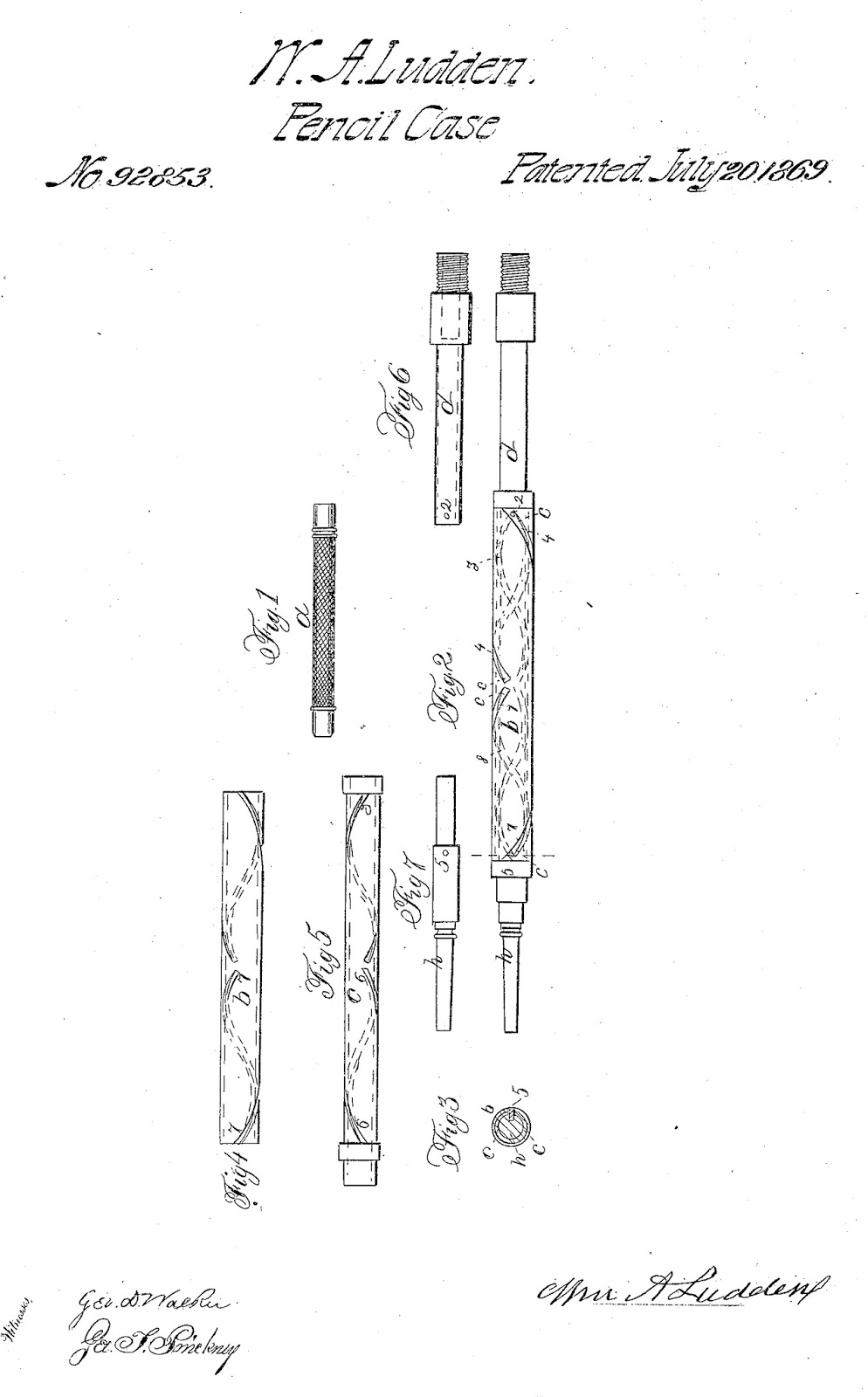
Patent number 35,355 was reissued in 1869; but in that same year William A. Ludden applied for and received patent number 92,853, with no trace of Vosburgh and no assignment to the partnership:


That may be because his association with Vosburgh had long since dissolved, as an 1865 business directory lists a “Vanvalkenburg & Ludden” under “Gold Pens” at 179 Broadway, and no other listing for Ludden in the directory (thanks to Daniel Kirchheimer, who found this one):


It would appear that between 1869 and 1878, Ludden was in business for himself, until his short-lived partnership of Ludden & Taylor, which was over by March, 1879 and replaced by Ludden & Dow, which continued through at least 1884 (see yesterday’s article for trade announcements).
All of this seemed to fall into place until I read Ludden’s obituary:


There’s William A. Ludden, “a veteran of the civil war and a pioneer manufacturer of gold pens,” but this ran in the New York Tribune on February 21, 1920.  For a man who went into the pen business in 1848 and served in the Civil War, that’s one epic lifetime!

One clue in the obituary unlocks the story behind Ludden – or should I say the Luddens.  According to William’s obituary, he was only seventy seven years old when he passed - that means he was born in 1843, and only five years old when William A. Ludden’s advertisements first ran in 1848.

The mystery was resolved by a biographical sketch of William A. Ludden, which appeared in Volume III of A History of Long Island From Its Earliest Settlement to the Present Time, by Peter Ross, published in 1902.


It’s easy to see from this history how the lives of father and son were conflated in the younger Ludden’s obituary.  Senior, born in 1818, and junior, born in 1843, shared the same name.  Both had military ties: while senior founded a home guard at the outbreak of the Civil War, junior pulled on his red pants and embarked on a successful military career as a “Red Legged Devil.”  Junior worked for Senior and “was associated with him in business through an extended period.”

I haven’t found a definitive date when senior passed away, although one source on ancestry.com indicated it was “after 1880.”  This is consistent with the Ludden & Dow advertisements from 1881; was the last reference to Ludden & Dow as a “Trustworthy House” in 1884 post mortem?

Or maybe the question should be: which Ludden, father or son?

Thursday, December 3, 2015

The Long Way Around The Barn

This article has been edited and included in The Leadhead's Pencil Blog Volume 4; copies are available print on demand through Amazon here, and I offer an ebook version in pdf format at the Legendary Lead Company here.

If you don't want the book but you enjoy this article, please consider supporting the Blog project here.

There’s a saying around here – I’m not sure whether it’s just an Ohio thing – that when when you went a little farther or worked a little harder than necessary, you “went the long way around the barn” to get where you were trying to go.

That’s what it felt like this time, but in retrospect, I think that long trip was the only way to get there.  It started with a couple of online auctions which brought these two to my doorstep over the last few months:


The top example is a typical “magic” pencil, so named for that class of pencils which, when the rear is pulled, the tip extends in the opposite direction – as if, in the Victorian way of thinking – by magic.  The lower one, however, does something very different.  It appears to be a retractable dip pen, with that slider ring, but when the ring is pulled back, it’s actually a ring-operated magic pencil, and a gold filled plug extends out the rear.


What attracted me to the magic pencil was a name on the side I wasn’t familiar with: Ludden & Taylor.


The only reference I was able to find to Ludden & Taylor was an indication that the partnership had dissolved as of March 1879, to be replaced by the firm of Ludden & Dow, formed by William A. Ludden and Ezra A. Dow and located at the same place – 192 Broadway.


Ludden & Dow lasted a little longer than its predecessor.  The 1881 edition of “The Rural New-Yorker” illustrated magic pencils, a figural cannon pencil, and dip pens for sale by the firm:


and the 1884 edition of American Agriculturalist continued to list Ludden & Dow on its list of “Trustworthy Houses.”

The other pencil I’ve pictured, however, is marked neither Ludden & Taylor or Ludden & Dow:


I’ve seen that WL-ish hallmark before, but unless you are thinking “WAL” when you are looking at it, you might not notice that there is a crossbar in the W and that’s the leg of an L on the right leg.  I was stumped when I started researching this one, and the only thing that had me pointing in Ludden’s direction was the similar pattern on the Ludden & Taylor.

The patent date, however, still had me a little stymied: April 17, 1874 didn’t fall on a Tuesday, so it couldn’t be a reference to an American patent.  Maybe it’s a misprint, I thought, but I couldn’t find a date with transposed digits that matches this description.  Maybe it’s the application date rather than the date it was issued?  Maybe, I thought, and if so, maybe I’ll find it and maybe I won’t – depending on whether a patent was ever actually issued on that application.

With no other hypothesis to go on, I focused my research on Ludden, and I found a few tantalizing clues.   While I was discussing this on Facebook, I commented that I thought it might have been patent 169,012, applied for on August 6, 1875 and issued October 9, 1875:


This is a slider-operated magic pencil, with a rear plug that extends out, just like mine.  But the dates are all wrong.  There’s another patent Ludden received which also looks promising, even though all the dates are just as wrong: patent number 151,230, applied for on February 19, 1874 and issued on May 26, 1874:


If I had any other leads, I never would have figured out where April 17, 1874 came from . . . but I didn’t.  So I just kept on digging.  It was a typographical error, all right, and here’s where it came from:


This is how Ludden’s patent 151,230 appeared as it was published in the Official Gazette of the United States Patent Office, in order right after patent number 151,229.  See it?


The application for patent number 151,229, the patent issued just before Ludden’s, was filed (by a guy from my home town of Newark, Ohio, by the way) . . . on April 17, 1874.

That’s the story of my pencil – but that’s nowhere near as interesting as the story behind William A. Ludden.  That story tomorrow. . .