Showing posts with label Fairchild. Show all posts

Wednesday, June 30, 2021

Victorian Odds and Ends

This article has been included in The Leadhead's Pencil Blog Volume 7, now available here.

If you don't want the book but you enjoy the article, please consider supporting the Blog project here.

I’ve photographed several Victorian-age pencils lately that are worthy of discussion but would make for pretty short articles on their own.  This first pair came in an online auction together:


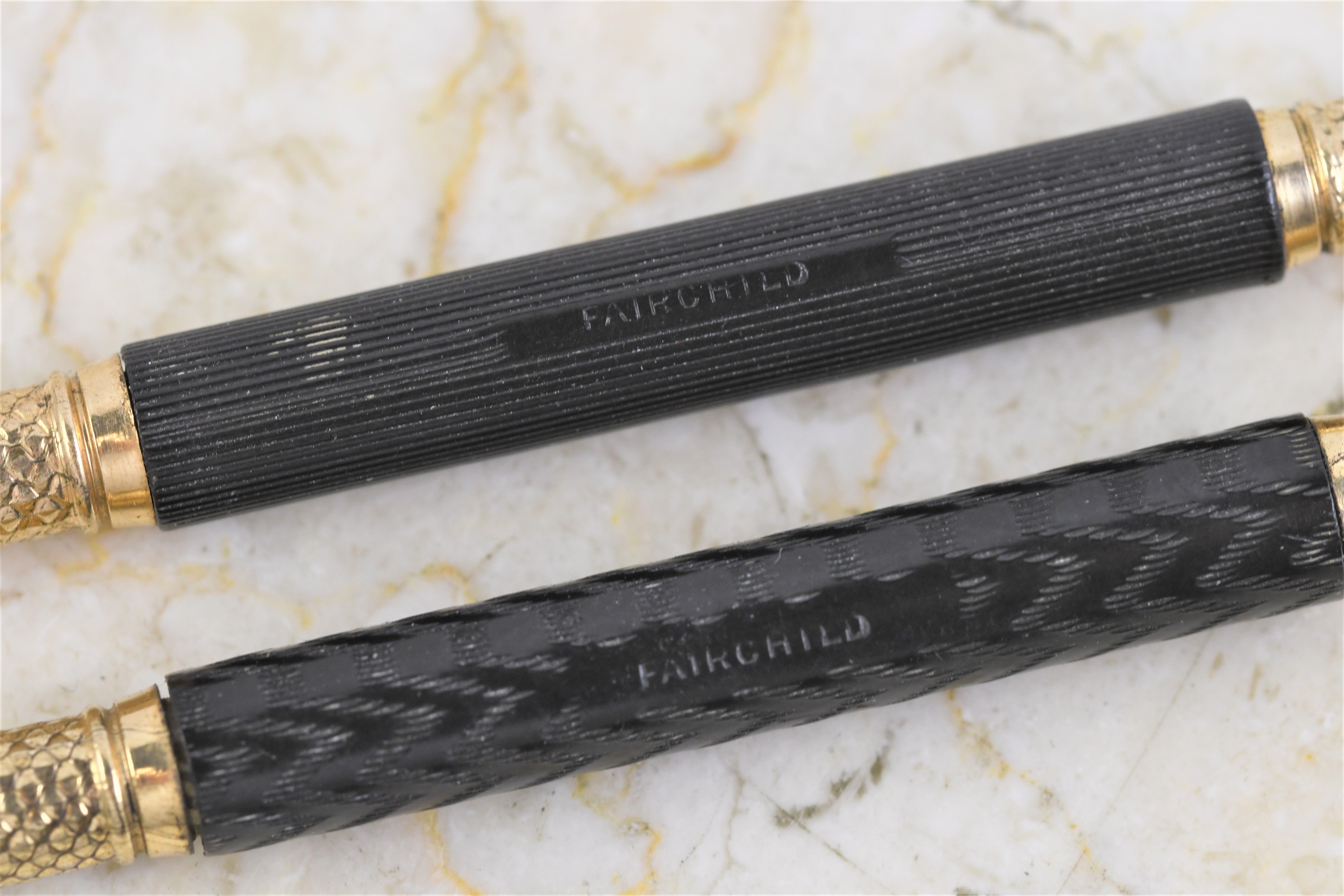
Pair of pairs, I should say.  Neither had leads in them, but I had some down at the Legendary Lead Company that fit and function fine.  I was going to pass one on to Joe, but with two patterns of double ended Fairchilds, I couldn’t decide which one I could stand to part with:

Next is a rather conventional hard rubber magic pencil.  I don’t remember whether I specifically targeted this one, or whether I noticed what was special about it only after it arrived:


It’s also marked Fairchild, but with an interesting patent date:


Looks like the makers could have used a cartouche that was a bit longer . . .  June 22, eighteen sixty-something, it reads.  Tasks like this are a job at which American Writing Instrument Patents 1799-1910 excels: all I had to go down the list looking for a year in which a patent was issued on June 22, and I found it – June 22, 1869:


And that’s interesting . . . first, because it was a patent issued to John Rauch, stamped on a Fairchild.  The “Victorian Mafia” of penmakers in New York made a deal to share technology and cut down on counterproductive competition (Volume 5, page 94), but the last time this patent turned up it was in connection with Mabie, Todd & Co., a more likely association given the connections between John Mabie and John Rauch (Volume 4, page 167).

What’s even more interesting is that in that last article, the patent turned up on a combination pen/pencil, and the pencil operated by advancing in the same direction it was pulled (a “sportsman” design, I’ve always called it), rather than in the opposite direction:


Next up is another magic pencil, but with a twist:


That tapered front end is unusual; although I’ve seen pencils in that shape, most are unmarked.  Not so with this one:


With the “Big H” mark, for William S. Hicks – by that time the firm was known as William S. Hicks’ Sons, since the Big H trademark wasn’t used until November 1, 1912 according to the registration certificate (see Volume 5, page 66).  


Last of the odds and ends is a pair of unmarked slider pencils, probably dating between the late 1840s and the Civil War.  These don’t attract much collector attention when they lack a maker’s imprint:


Sometimes, however, there is other historical value based on whatever personalization has been added to these, so I make it a habit to examine that before consigning them to the sale or parts bins.  I did a double take with the first one, then quickly grabbed my loupe for an even closer look:


At first I thought it was engraved “L.W.F.,” which got my heart pumping thinking this might once have been owned by Leroy W. Fairchild.  Alas – that nice, flowery engraving actually says “S.M.F.”  Oh well . . . you’ll see it on display at my next pen show.  Then I looked at the other one:


And then I looked harder . . . yep, it says “A.G.B.”  Could Albert G. Bagley have carried this in his pocket and jotted nasty notes to his former partners with it?

Sure, that’s a longshot.  But think about it: yes, some initials are more common than others, but there are 17,576 different combinations of initials, and there were only 23 million people in the United States in 1850.  Ignoring that some combinations are more common than others, that’s an average of just over 1,300 people per combination.

Now lets assume that this pencil was probably made on the east coast and didn’t go far . . . if it was made in the New York area as I suspect, there were only 515,000 people or so there in 1850 . . . that’s 29 people for each combination.

There’s no way to prove anything and I know the calculation is flimsy.  It’s just fun to think about.

Wednesday, May 12, 2021

A Victorian Hoard (Part Two)

This article has been included in The Leadhead's Pencil Blog Volume 7, now available here.


If you don't want the book but you enjoy the article, please consider supporting the Blog project here.

I had high hopes for a few items in this lot, but without the benefit of any written description, I had to bid  without knowing for certain whether anything in there would be worth adding to my collection:


My hopes were greatly exceeded . . . this bunch contributed seven solid additions to my collection:


I wasn’t expecting much out of that top pencil.  Hard rubber utilitarian pieces like that are fairly common, and I don’t keep them around unless they are marked.  Most are attributed to Cross or Eagle, but this one had more definitive branding: A.T. Cross:


The second one down I couldn’t wait to see and handle.  Many of these are unmarked, but more often they have at least Albert G. Bagley’s January 1, 1850 patent date on the middle section.  Sometimes, you get really lucky and find a solid imprint on the top end, and I have examples from Mabie Todd, Rauch, Kurtz & Moneghan and others . . . such as . . . 


“Fairchilds Manfr,” for Leroy W. Fairchild.  At first, a flash of disappointment – I have a Fairchild like this, also in sterling.  But when I compared the two, I was in for a pleasant surprise.  The new one is so much smaller:


Finding one of these at all is a longshot - but having two in my collection, in different sizes?   Priceless . . .


The new one, just like my other one, has a correct Fairchild nib - the OCD collector in me didn’t even flinch that I skipped a size in between, although I’ll admit that I’ll be keeping a sharp eye out for a number 3 now – and wondering if sizes 5 and up exist!


That third one down was my primary motivation for chasing the whole bunch.  I could see that it had a perpetual calendar at the top end, and from what I could tell it appeared to be an Addison: one of America’s earliest manufacturers, and one of my favorites.  When I got it in hand, it certainly fit in well with the other Addisons I’ve been able to find:


I knew that even if the seller had a loupe and took the time to identify what was in this lot, without some experience he or she likely wouldn’t find an Addison mark – they are so tiny that unless you know where to look and what you are looking for, they are easy to miss.  Loupe in hand, I scoured the barrel hoping to find that microscopic mark in the usual place, tucked in one of the flutes near the top:


To no avail.  I had almost resigned myself to saying “probably an Addison” when I took a closer look at the calendar, just to admire the artistry.  


Ah.  The last week of every week is Addison & Co., plain as day.  

Next up are two black hard rubber combination dip pen/pencils.  The larger of the two is marked Fairchild on the extender:


I didn’t have one in that material - the other two in my collection are all gold-filled:


The smaller of the black hard rubber combos from this lot has a well known name on it, but packs a curve ball:


Imprinted on the hard rubber is a simple imprint: Edward Todd & Co.


Ordinarily I would expect an Edward Todd imprint to be accompanied by a patent date of December 19, 1871; this one doesn’t, and with good reason.  This one doesn’t appear to have the 1871 patent works inside: note that the pencil is extended with the extender fully pulled out.  Patent 1871 Edward Todds only advance the pencil when the extender is pulled back, rotated and pushed nearly all the way back into the barrel:


While this new Edward Todd combo is a very typical configuration, it is definitely an atypical arrangement on an Edward Todd.

Second from the bottom in that opening shot is a pencil I really hoped would have some markings, since it strongly resembles the profile of a Waterman “checkbook pen” with its nail-shaped profile.  The barrel texture is close to an July 11, 1899 patent Eagle pencil (see Volume 2, page 127 for a discussion of Frank McEntyre’s design patent for that diamond pattern):


Alas, it is completely unmarked, except for “Sterling.”  I suppose the shape of that nozzle could be Eagle, but then again, it could be Cross.  Or Edward Todd.  There just isn’t enough there to know for sure:


I might have done a catch and release with this one, but it has an interesting feature that wasn’t apparent from the auction pictures and enamored me a bit:


Last - and the opposite of least - is that gold filled magic pencil at the bottom of the picture.  


It has a better imprint that most of the ones along these lines:


“Hicks Pat March 21, ‘71.”  Most of the time pencils bearing that patent date have only the date and lack the Hicks name; the reference is to patent 112,917 which was issued to William S. Hicks himself.  I showed off three Hicks 1871 patent pencils here in 2017 (Volume 5, page 101), and an updated group shot of all the ones in my collection shows something about this new one:


That plain gold filled barrel may be the least intricate one I have found – but it is the largest.

Wow, what a haul, I thought to myself as I finished unpacking everything.  Wow - seven new pencils, plus a couple toothpick/earspoons added in one fell swoop, I thought.  And then I did something that might seem ridiculous.  The next morning I was back online, browsing through the auctions again . . . like I needed more stuff. 

Huh.  That same seller had listed another lot of pens and pencils . . . 

Sunday, April 4, 2021

Star of the Show

This article has been included in The Leadhead's Pencil Blog Volume 7, now available here.


If you don't want the book but you enjoy the article, please consider supporting the Blog project here.

The most distinctive item in the first day of the Fred Krinke auction was a curved-top display case, embellished with the acid-etched inscription “Leroy W. Fairchild’s Gold Pens,” which sat in Fred’s Fountain Pen Shop in Los Angeles for many, many years.  I took a photograph of it during the preview, since I never expected to see it again:


David Nishimura and I talked about this one before the auction - all Krinke provenance aside, finding an ornate store display from the dip pen era is nearly impossible.  If I could get it for anywhere close to the opening bid, I said, I’d give chase.

Hopes were dashed that I would, as the auctioneer took a rare pause in the bidding when this one came up to discuss what a significant piece this was in the Krinke legacy.  Yet the bidding stalled out much earlier than anyone including myself expected, and I was able to bring it home.  It was a perfect storm: I didn’t have to worry about having it shipped, live attendance at the auction was sparse due to the bug, and it is just so big that most people don’t know where they would put it.

Finding room for it in my increasingly cramped collection zone, however, proved a challenge.  I moved the Redipoint exhibit to another area of the museum, and it barely fit atop one of my printer’s cabinets:


While there were logistical problems finding space for it, this case solved a huge problem for me.  As readers of The Catalogue have noted, there isn’t much in that ten-year-old book about Victorian writing instruments.  My interest in those has evolved in the years since the book was written, and by the time I moved the museum to its current quarters, I dedicated the top two rows on the “wall o’ pencils” to Victorians.  God’s plenty space, I thought at the time.

The rabbit hole deepened, then widened.  New additions have been stacking up like cordwood over spaces I had left open for new makers and examples, and I have puzzled about how I might rearrange things so things are a bit better organized.  Here’s the John Holland section, for example:  


A large Fairchild case easily accommodates all of my Fairchilds, my Fairchild & Johnsons, and the examples I have from the later Fairchild & Co.


I know it probably isn’t entirely cricket including the latter, unrelated companies here, but for me it’s about finding a place for everything so that everything has a place.  At last, the Victorian wing has a bit of breathing room . . .

For now!

Wednesday, April 1, 2020

The Joke Was On Me

This article has been edited and included in The Leadhead's Pencil Blog Volume 6, now on sale at The Legendary Lead Company.  I have just a few hard copies left of the first printing, available here, and an ebook version in pdf format is available for download here.

If you don't want the book but you enjoy this article, please consider supporting the Blog project here.

I had thought about coming up with a cute prank article for today, but nothing really seems funny.  I’ll just share a small prank I inadvertently played on myself.

At the Baltimore show this year, my good friend Tom Heath had a cigar box full of stuff on his table, but it wasn’t the kind of stuff you buy “by the pound,” as Rob Bader says.  It was some really good stuff.  One of the things in there really enamored me:


The first thing to notice about this magic pencil is how big it is - a hair over three inches closed, and about five inches when opened.  But then there’s the shape and design of it, with two plain sides, two with high relief detailing and a graceful, almost Coke-bottle profile.

Neither of which was as important to me as this:


There’s a manufacturers’ hallmark on the extender you won’t find very often, of an F within a skeleton key.  I had already done some research and concluded this was a Leroy W. Fairchild hallmark, and I was thinking if I ever sat down to start writing blog entries again, it would be nice to find a complete, intact example.  The only other example I had been able to turn up was missing the pencil mechanism, which I’d photographed five years ago:


But when I sat down to write this one up, I could not lay my hands on my notes.  I couldn’t find the pictures in my archive of pictures that hadn’t made it to the blog yet.  And . . . worst of all . . . I couldn’t find where I knew this mark was for L.W. Fairchild.

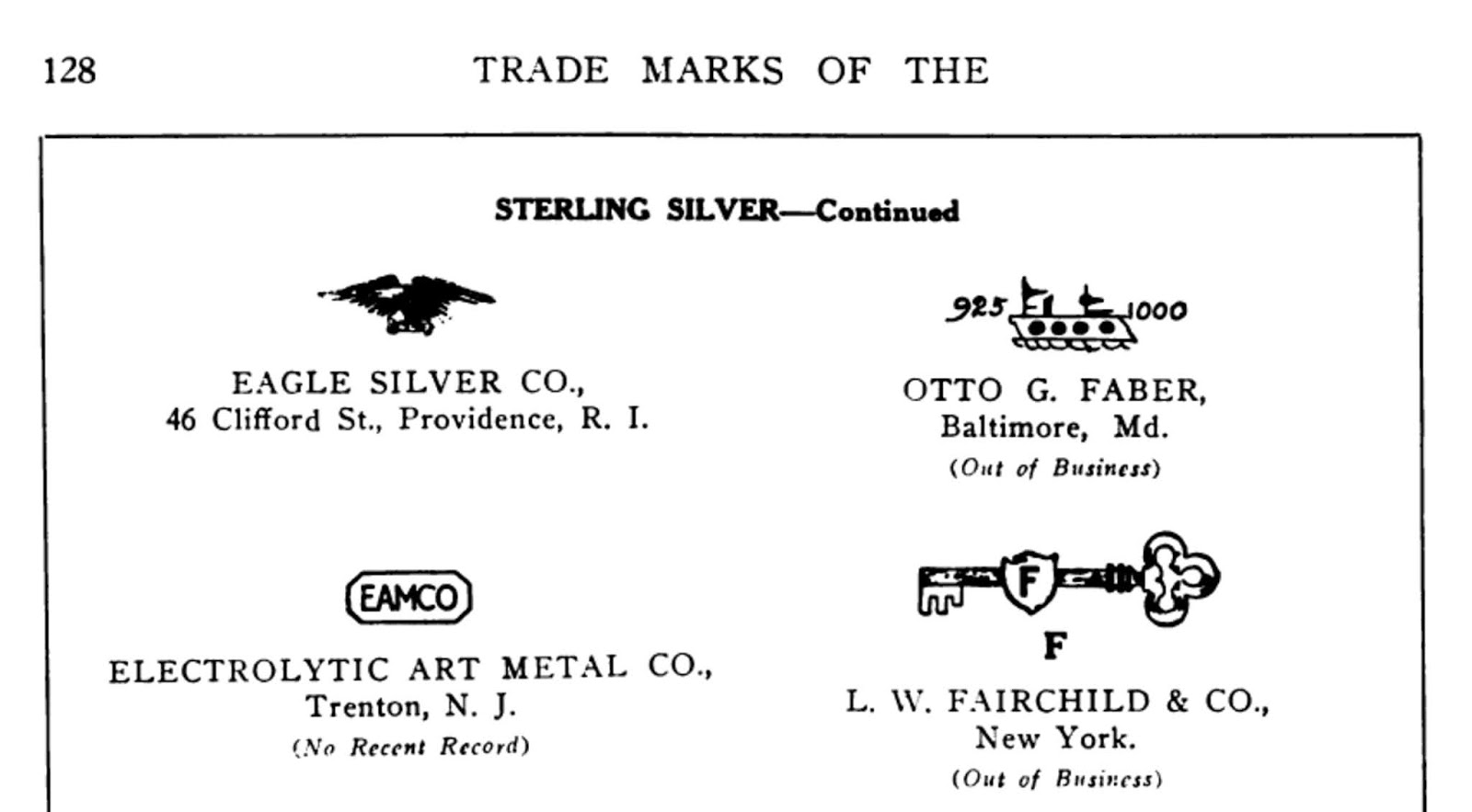
I checked American Writing Instrument Trademarks 1870-1953, and the mark wasn’t listed either in the Federal trademarks or in the excerpts I reproduced from Trade-Marks of the Jewelry and Kindred Trades, a Jewelers’ Circular publication that reported many unfiled trademarks used on writing instruments.  Then I remembered: it wasn’t contained in the pens and pencils section of Trade-Marks of the Jewelry and Kindred Trades, but in the listings for general sterling silver marks.  Retracing my steps, I found it:


So, my research all in order again, I went to post this article.  Just for a nice finishing touch, I checked the Fairchild section here at the blog, because I knew I had recently summarized the Fairchild history as written up by David Nishimura for The Pennant, and I thought it made sense to include that, too. I clicked on the tab for Fairchild at the blog, there it was:

The reason I couldn’t find all that research I had just redone was because I’d already posted an article about it.

So today, you got a couple of neat pictures of a really nice pencil, together with a story I’ve already told you.  Joke was on me.

I was determined to give you a little more, so here’s a couple new details.  The above image from Trade-marks of the Jewelry and Kindred Trades was taken from the 1922 edition, long after the original Fairchild firm was gone.  I worked my way backwards and checked the 1915 and 1904 editions, and they show exactly the same thing for this mark, complete with the “out of business” notation – not surprising since Fairchild-Johnson (a partnership between Leroy’s son Harry Johnson and Ephraim S. Johnson’s son) had succeeded him by 1904.

As for the first edition of Trade-Marks of the Jewelry and Kindred Trades, published in 1896 . . . I have never seen a physical or complete electronic copy.  When I was writing the book, the only copy I was able to locate was cataloged in the Victoria and Albert Museum in London.  I emailed them,  and they were kind enough to copy and email to me the relevant pages for inclusion in the book.

I wonder if anyone out there in the peanut gallery will be visiting the Victoria and Albert Museum anytime soon . . .

Monday, September 11, 2017

A Bit of Junk with a Story

This article has been edited and included in The Leadhead's Pencil Blog Volume 5; copies are available print on demand through Amazon here, and I offer an ebook version in pdf format at the Legendary Lead Company here.

If you don't want the book but you enjoy this article, please consider supporting the Blog project here.

I bought this dumb thing online even though the pencil part is misisng and the mechanism is all jammed up, paying too much money in the process because it’s sterling silver.  The sole reason for the purchase was the hallmark on the extension:


I’ve seen it a few times over the years . . . although it isn’t all that clear on this example, it’s the letter F, in what looks like a shield or a heart, skewered by a skeleton key.

I can’t see a hallmark containing the letter F without my mind immediately associating it with Leroy Fairchild.  Then there was also Fairchild & Johnson, started by Leroy’s son Harry and Ephraim S. Johnson’s son, which became Fairchild & Co. in 1905 . . . .   David Nishimura recently penned a very nice article for The Pennant, titled "Leroy W. Fairchild: The Little-Known History of a Well-Known Company," which appeared in my last issue as editor at the end of 2016.  David documented several marks used by the company . . . but not the F skewered by a key.

There’s an Online Encyclopedia of Silver Marks, Hallmarks and Makers Marks at www.925-1000.com, which does include the mark, and attributes it to Fairchild & Co., “successors to Fairchild & Johnson," and provides dates of 1919 to 1922, but there wasn’t a source quoted in the Online Encyclopedia.  My new book, American Writing Instrument Trademarks 1870-1953, doesn’t include the mark, which means it wasn’t registered as a United States Trademark . . . for writing instruments, anyway.  At the end of the book, I included excerpts from several editions of the 1922 edition of a publication from the Jewelers’ Circular Publishing Company, titled Trade-Marks of the Jewelry and Kindred Trades.  Alas . . . the only marks found in that edition were those documented in Nishimura’s article:


But wait a minute, I thought . . . I didn’t find the mark documented anywhere else but in a catalog of general silver marks, not writing instrument-specific marks.  And although I only included the writing instrument-specific sections of Trade-Marks of the Jewelry and Kindred Trades, it’s not like I don’t have the rest of that book to check . . .  And there it was:


There’s our mark, in use by “L.W. Fairchild & Co. (out of business).”

The exact wording in the 1922 edition is significant: Fairchild & Co., the successor to Fairchild & Johnson (that’s Harry Fairchild, Leroy’s son), is reported as using the name “Leroy W. Fairchild,” while L.W. Fairchild & Co. is reported as being “out of business.”

Nishimura reports in his article that Leroy W. Fairchild retired in 1890 upon his wife’s death, and Leroy W. Fairchild & Co. was subsequently reincorporated by his other sons in Newark, New Jersey.  After at least two reorganizations, spinning off part of the business in 1894 and reincorporation in New York in 1895, the failure of the business was reported in the press on September 12, 1896 – or rather, the apparent takeover by Leroy C. Fairchild, another of Leroy W’s sons, which had been competing with Leroy W. Fairchild for several years.

Harry set up Fairchild & Johnson, a wholly unrelated enterprise, in 1898, and it was renamed Fairchild & Co. in 1905.

Nishimura is silent about whether the name “L.W. Fairchild & Co.” was continued after 1896.  Since I also have the 1904 edition of Trade-Marks of the Jewelry and Kindred Trades, I checked that as well, and I think the question is fairly well answered:


The key mark was already long dead by 1904.

My best guess is that the F within a shield, skewered by a skeleton key, was used between 1890 and 1896 on products made by Leroy W. Fairchild & Co.