Showing posts with label Eversharp metal pencils. Show all posts

Wednesday, October 8, 2025

From Crawl to Stroll to Jog

Eversharp: Cornerstone of an Industry has been out for just about a year now, and it wouldn’t be the success that it is without a dedicated peanut gallery of collectors who helped me round things up to include in its pages. You might be tempted to think that 434 pages would cover the subject in its entirety . . . and you would be wrong. That’s why mechanical pencils have held my fascination for more than 25 years - I’ll never be “finished” as long as new things crawl out of the woodwork. 

And crawl they have – in fact, increased interest in the brand after the book came out has picked up the pace of new finds from crawl, to leisurely stroll, to a jog . . . yielding quite a few updates to report in a relatively short period of time.

The monster chapter in Eversharp was Chapter Four, which presents the most comprehensive guide ever published to metal Eversharp pencils made by the Wahl Company between 1917 and 1930. The law of inertia applies, and a peanut gallery in motion has remained in motion to tell me, show me, and sell me things that I would have included in the book had I known about them. Things like these:


David Yager and I like to get together at the Baltimore and DC Shows, and we made arrangements to meet during a somewhat quiet time at DC this year for him to show me these. I couldn’t pry them away from him, but I settled for “half mine” – that is, when he’s done enjoying them, I’ll get the chance to be their next caretaker.

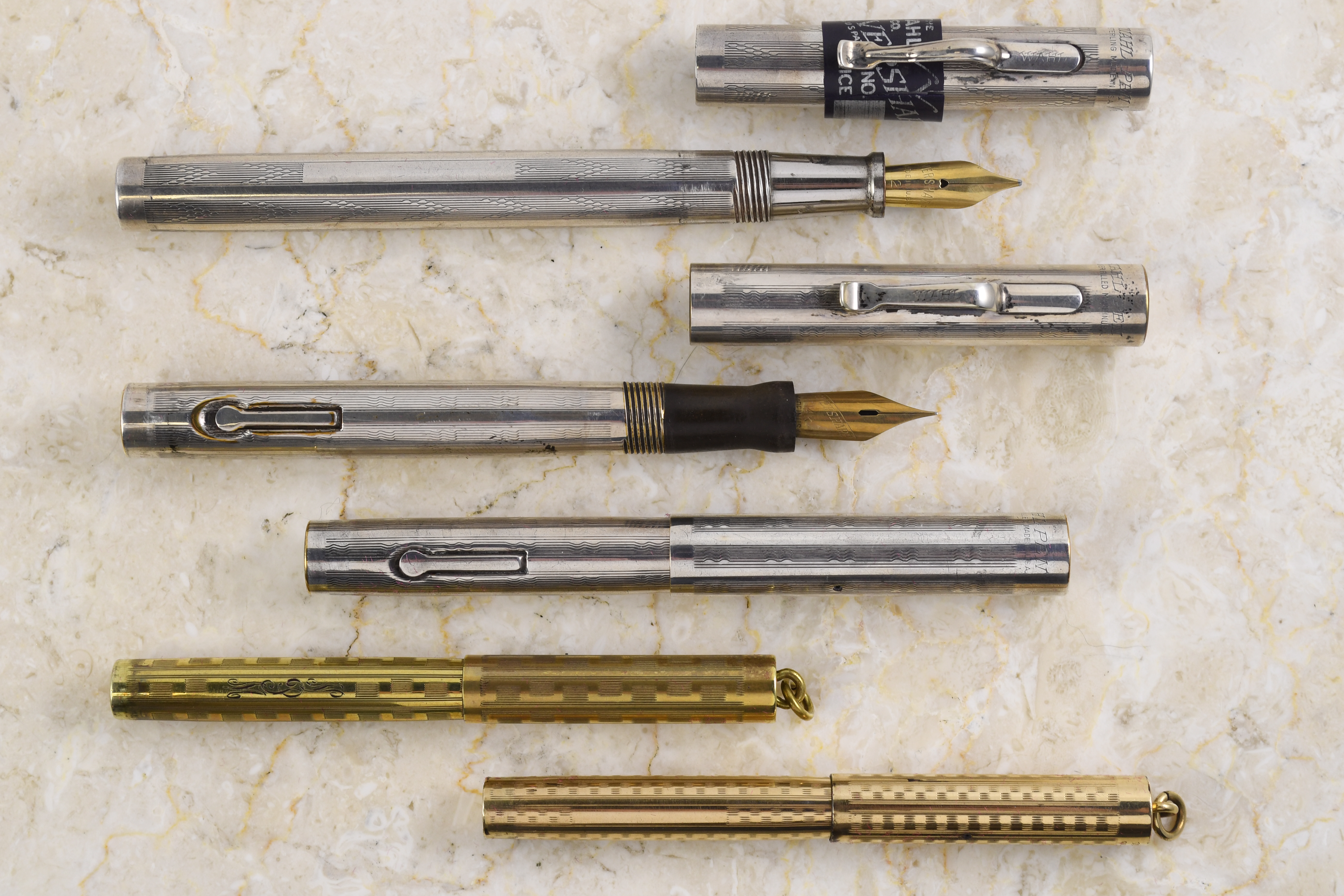
Turn to page 111 in the Eversharp book, and in Figure 4-155 you’ll see that top pattern included in a group of unfinished, experimental barrels residing in Jack Leone’s collection. David’s clipless example is the only one of these that I have seen finished into a working pencil. It is a post-1924 Improved Eversharp (see pages 70 and 71 in the book for the changes Wahl introduced in 1924), consistent with dating those experimental barrels to 1927 or 1928. It combines Wahl's Colonial pattern with alternating bands of rings:


David’s other example is pre-1924 and it is . . . unprecedented in my experience.  It is engine-turned across its entire barrel surface, like “Ripple” (Eversharp, page 92) or “Charlie Brown” (Eversharp, page 116), but the bumps in the engine turning have been changed to create hexagons – since I’m breaking the news and David didn’t tell me how he describes it, I’ll take a shot at dubbing an appropriate nickname: “Honeycomb” seems appropriate.


Now that I’ve photographed them, back they go to David until the day he’s ready to part with them. The top example in this next image was also borrowed:


The silver plated example is owned by Roger Veley – or “Dad,” as I call him. A few years ago, while we were working on the Autopoint book, I helped Dad photograph other things in his collection, including his Eversharps. I forgot that I had taken a picture of it when I wrote the book, because at the time, I didn’t understand what it was . . . in fact, none of us knew what it was, until Larry Liebman loaned me an original copy of Wahl’s 1929 catalog as I was writing the book.

With Larry’s help, I was able to identify this pattern on page 112 of the Eversharp book as  “Engine Turned” – that appears to have been Wahl’s formal name for the pattern. This “Engine Turned” pattern is a simplified version of “Lakeside” (Eversharp, page 104), which had blue enamel on the unengraved areas of the barrel. Wahl called it a “Champlevé” pattern, even though that isn’t technically correct: the Champlevé technique traditionally has colored enamel in the recessed areas, rather than on the exposed high points.

Jack Leone’s set of experimental barrels includes other Champlevé-style patterns (Eversharp, pages 109-110), including a Lakeside-ish patterned pen with orange enamel instead of blue. I hesitated to call that orange one “Lakeside,” since the only documentation of the name – a 1928 advertisement  in the Saturday Evening Post – doesn’t say whether “Lakeside” means blue enamel with this engraving, or whether the name included the same engraving accented with other colors. 

The other pencil in that last image has the same engraving as the Lakeside, but without the blue enamel – I included my short military-clip example on page 112 in the book. Gabriel Galecia Goldsmith included this full-length example in that bunch he sold me a few months ago (see “All Boxed In” on August 27, 2025). Here is a detail of my Lakeside as shown on page 104 in the Eversharp book, alongside Gabriel’s example and the one I borrowed from Dad:    


At least I can offer a more complete image . . . although the ringtop in “Engine Turned” shown on page 112 was on loan from Matt McColm, so until I find my own or borrow Matt's again, this will have to do:


As I was photographing these, I noticed something. While my military-clip example has absolutely no traces of the blue enamel seen on the Lakeside, the example I got from Gabriel has intact blue enamel underneath the clip:


That observation, unfortunately, leads to my first official correction of something I wrote in the Eversharp book. In describing this pattern, I wrote, “although the engraving is the same [as the Lakeside], the barrel also has fine ribbing.” My example of the Lakeside is in very good but not perfect condition, and when I looked at it more closely . . . 


The Lakeside also had that fine ribbing – likely to better promote adhesion of the enamel. That correction, however, raises yet another question.

If you examine those last two images closely, you’ll notice that while Gabriel’s pencil (and my military-clip example) have clearly visible gold fill in all unengraved areas, my Lakeside does not. I still cannot rule out the possibility that those with gold fill in the unengraved areas were never intended to have enamel applied to them – Wahl did something similar with its tinted barrel designs (Eversharp, pages 103 and 117), which sometimes had the tinting and sometimes did not. With luck, documentation might surface to prove that Wahl offered pencils with Lakeside engraving, sometimes with blue enamel and sometimes as a gold-on-silver unpainted version – maybe called “Lakeside,” maybe called something else.

Or, says Occam standing by with his razor, maybe the enamel on Gabriel’s pencil became so badly damaged that someone over the course of the last century stripped off whatever they could reach to make it look better. Either way, I’m still proud to own it.

Gabriel included another metal Eversharp in that last bunch he sold to me:


This one has a medallion secured to the clip that looks like a choo-choo at first blush.


Choo-choos, however, do not have hand cranks on the boiler. No, this is an accurate representation of a Todd Protectograph Check Writer, which was used to emboss the amount on checks to prevent alteration. The Todd Protectograph Company of Rochester, New York unveiled its 1918 Model in advertisements published beginning in 1917:


These last two finds arrived via online auctions – a different sort of peanut gallery, but a fruitful (or nut-full) one nonetheless. Whenever a fleur-de-lis Eversharp comes along, I have to bite on them: they are so hard to find that I’m always hoping to learn something new when I get one in hand:


I covered these on page 79 in the Eversharp book: they were uncataloged – at least, not in the catalogs that are available as of today (the earliest Wahl catalog in the PCA’s library dates to 1919). The fleur-de-lis pattern was patented by John C. Wahl, who applied for design patent number 56,681 on November 19, 1918:


Unfortunately, this pattern is usually very faint, particularly on the gold-filled examples, and this new find is no exception:


However, there is something loud and clear on this one that adds to my understanding about these: the imprint. On page 79 in Eversharp, I had dated the fleur-de-lis pattern to early 1917, since all of the examples I had found had imprints reading “Wahl Ever Sharp,” with “Ever Sharp” in two words. As I explained on page 68 in Eversharp, Wahl changed the imprints on its pencils several times: the “Wahl Ever Sharp” imprint (Type 2, I called it) was in use between mid-1916, when Wahl acquired a controlling interest in the Eversharp Pencil Company, and mid-1917, when Wahl contracted “Eversharp” to one word.

The engraving may be faint, but the imprint on this new find is loud and clear:


“Eversharp” in one word, with “Patented” spelled out. This is what I called a Type 3 imprint, because Wahl added “Made in U.S.A.” to its Type 4 imprints after establishing an English subsidiary in 1920. Since this is the only example I have found with this imprint, my very small sampling suggests, as the book indicates, that the vast majority of these were made before mid-1917; this example, however, proves that some were made later, but still before that 1919 catalog was published.

Our last update – for today – was something I scooped up because the opening bid was cheap and nobody else caught what was special about it. I was confident that I had one and thought I might make a buck or two selling it at the next show:


My confidence was misplaced. I saw that the lead was thicker than usual, but between the fuzzy online pictures and my failure to really look closely at it, I assumed it was a Series 7 Eversharp – a standard girth barrel, but fitted for fatter leads measuring .075", nearly twice the normal diameter. On page 105 in Eversharp, I showed two examples: a Model 761 in Check pattern and a Model 714 in Grecian Border (model numbers were the same as for regular Eversharps but with a leading number 7 to denote the larger lead size). I also indicated that there was a Dart pattern model 724 and a silver plate Model 720, both cataloged in 1925.

No Wahl catalog indicates that a plain, gold filled Model 760 was offered, so I should have been chasing this one as an avid collector rather than as a casual investor. However, this isn’t a Model 760, either . . . it is something else entirely. The lead size measures .120" – that’s checking pencil size. Shown here from top are a regular size .046" Eversharp, my Model 761 with .075" lead, this new find, and a Model 67 “Executive” Checking Pencil manufactured between 1922 and 1928.


Executive Checking pencils are covered in Chapter Five in the Eversharp book, along with the usual enameled checking pencils Eversharp made between 1921 and 1929. All of the Executive models shown on page 136 in the book were made between 1922 and 1928 – they were a little longer than this new example, and they all have that distinctive tip with a pronounced bevel:


The Executive also retained the Eversharp’s flat pre-1924 clip in all of its cataloged appearances, long after the improved clip found on this new example entered production on non-checking pencil models.


The shorter size, ribbed clip and different tip all conclusively identify this new addition as something I had not seen before in person: a 1929 Eversharp Executive . . . ish.

On page 138 in Eversharp, I included this image to illustrate the three generations of Wahl’s checking pencils, from the 1921 Eversharp 100 at top, the checking pencils made between 1922 and 1928, and at bottom the redesigned Wahl checking pencil of 1929:


On page 137 in Eversharp, I include this page from Larry’s copy of Wahl’s 1929 catalog, showing these redesigned checking pencils. The page includes a plain, gold filled checking pencil as Model 30260C. It is no longer called the “Executive” (hence the “ish”), but the text states that all of them, enameled or gold filled, were “much in demand by executives, accountants, shipping clerks and stock keepers.”


I didn’t specifically mention in the book that the Eversharp Executive was offered after 1928, mostly because I had never seen one. Now I have:


And my next challenge is to find an example of the 1921 Eversharp 100 in Executive configuration. Yes, I went back and rechecked Wahl’s 1921 catalog, and yes, they are only listed with painted enamel barrels.

Saturday, August 16, 2025

Wrong in the Right Way

The only difference between fiction and nonfiction is accuracy. Statements in print that are later proven wrong can demote an entire work from a scholarly text to a pretty picture book.

“This is what I have observed, here is how it compares with what I know, and here is what that evidence leads me to believe,” is how I approach new conclusions. In those terms, new evidence does not prove anything I said wrong, since all I’ve provided is a snapshot of what I thought I knew at the time. If anything, I’ve invited further study and the greater understanding it yields.

That being said, print publication is cruel. Once a book is printed, all the author can hope for is that it encapsulated as accurately and as completely as possible all of the knowledge that was rattling around upstairs as of the moment it was committed to print. If everybody waited until they know everything there is to know or that will ever be knowable to write a book, there would be no books. 

Eversharp: Cornerstone of an Industry thoroughly exhausted me. I poured into it everything I have learned about the brand over the last 25 years, and I believe it will remain a valuable reference long after I am gone with all the information it contains. However, I know nothing is complete, and I knew that I’d be circling around with updates and corrections.

Just not too many, I hoped. And not too soon.

This is my longwinded way of telling you that at the end of Eversharp: Cornerstone of an Industry, I posed a question that was unnecessary, because I had the answer right in front of me. That answer adds a little bit of context to the Eversharp story that, had I remembered it at the time, I might have added it into the book.

I am proud, however, to report that I was wrong in the right way.

On average, my books are “done” two or three months before the printed books are available. During that time I’ll make last minute tweaks, but it becomes more and more difficult as the production process moves forward until it’s time to call – literally – “pencils down.”

The Eversharp book had been picking up steam for months through 2024, with contributors offering me artifacts to photograph or acquire for the book. The law of inertia applies: new finds were continuing to arrive even as the printers were asking for proofs.

By the 2024 DC Show in August, the book was essentially complete, subject only to a final round of editing with the assistance of that most loyal knight Richard Keith. At the show, I picked up a few additional things to include in the book – no worries, since I do my own layout – reshooting and substituting images was still a simple matter.

Mostly.

Right before that show, an online auction yielded a solid gold early Heath-clip Ever Sharp, which I had referred to but had not shown in Chapter Three. By the time I had it in hand for photography, the layout was so tight that there was nowhere I could squeeze it in. I added one last page to the book: page 434, titled “Stop Press,” includes several images of that important find, and I was able to work a reference to page 434 into one of the captions in Chapter Three.


This article is not about that pencil. That “stop press” page, however, opened the door for what I’m going to tell you next.

At the DC Show, I reconnected with Myk Daigle – a fervent supporter of my research and the books I write. Myk had a couple parts on hand, and he gave them to me. “Maybe you can use these in your book,” he said.


I tucked them away to look at when I got home. If I can match these up with the metal Eversharp model to which they belong, I thought, I can swap these caps over and reshoot the images in which those models appear.

There was a problem.

I turned to pages 64 through 67 in the book, which provide a four-page table detailing every cataloged pattern of metal Eversharp pencil, together with the years in which each was cataloged and their model numbers.

Wahl’s catalogs did include a Model 22; it was the barleycorn pattern listed only in 1921, but it was only offered in gold-filled – nothing in silver plated or sterling.  Model 034 similarly made no sense, because Wahl did not use any model numbers with a leading zero and besides, Wahl’s model conventions provided that ringtop model designations ended with the suffix “SW,” for “short with ring.”

These were the first square-peg model designations that did not fit neatly into the round holes I had already documented in the book. I had to acknowledge it, so I used the last couple inches at the bottom of the “Stop Press” page 434.

Here’s the part where I got it wrong in the right way.

I said only what I knew. I explained how Model 22 and 034 did not fit into what I had compiled with respect to Wahl’s model designations, and the book ends with this statement: “Perhaps these were for Heath’s clutch pencils or Heath-made pencils marked for the Carey Pen Company, both of which used these same caps (see pages 42-44). Perhaps also there is something more to learn about these, still out there and waiting to be discovered.”

Observation, evidence, and a guess based on that evidence. Ending with an unanswered question like that is a valuable acknowledgment that any book exists in a continuum, as a statement of what was known at the time in a universe that will inevitably expand. Some day, I hoped, someone would come forward with the answer.

I didn’t know it would be me.

And I didn’t know I already had it.

While I was writing the Sheaffer and Eversharp books, I continued to add other things to my collection - but to keep my work table clear and stay focused, I was diligent about photographing new additions and putting them away to keep them out of sight and out of my easily distracted peripheral vision.

One of the things I had turned up along the way, back in February 2023, was a group of pens and pencils made by the DeWitt-LaFrance Company in Cambridge, Massachusetts – best known as the makers of the “Superite” brand of pens and pencils. The lot had surfaced in an online auction:


Yes, I do pick up fountain pens when the occasion calls for it – and when it comes to a cult brand of which I am a rabid devotee – the occasion calls for it. I had not seen a Superite fountain pen with a price band:


I shot these images in March, 2023, just as the Sheaffer book was being released and nearly a year before work began on the Eversharp book. If or when the blog restarts, I thought to myself, I’ll write something about these.

This was not what I had planned to write.

After the dust settled with the Eversharp book, and page 434 along with all its other pages were irrevocably committed to print, I dusted off that file folder of pictures, and I noticed that the top two pencils in that group shot had price bands that strongly resembled those found on early Ever Sharp pencils. I wondered . . . 


The example second from top is marked Model 10-B, printed in the same font as Myk’s Model 034 ringtop cap.

Which leads me to the coup de grace:


There it is: the Model 22 cap that Myk Daigle gave to me came from a Superite. Oh, I was so close . . . I had suggested Myk’s caps might be from a Heath-made pencil, and while that guess was wrong, it is fascinating that Superite pencils have caps that are identical to those on an Eversharp.

George W. Heath & Co. made the earliest Ever Sharp pencils, using modified and repurposed barrels from their clutch pencils (and which were also rebranded for the Carey Pen Company). When Wahl took over production of Keeran’s Ever Sharp in October 1915, it was because Keeran was frustrated that Heath could not keep up with his orders. Given Heath’s apparent refusal to allow Wahl to use his patent pending clip (as evidenced by Keeran’s hastily designed spade clip and John Wahl’s tombstone clip), Heath apparently did not take kindly to the transition.

It would be unreasonable to think that Heath would dig in its heels on the use of Heath’s clip, but would nevertheless willingly cooperate in supplying caps or the tooling used to make them . . . Wahl likely copied them, since the basic crown-shaped design was not the subject of any design patent or trademark and was in the public domain.

That would leave George W.  Heath & Co. with idle tooling and perhaps a supply of parts in late 1915 . . . and DeWitt-LaFrance burst onto the scene out of nowhere in 1918. I now believe that Heath either supplied caps or sold tooling to the fledgling DeWitt-LaFrance Company so that Superite pencils would sport caps so similar to those on an Eversharp that a couple of them erroneously wound up in a book about Eversharps.

There’s more evidence to support this theory: as I noted in “Wahl, Sheaffer, and the Race for Boston” (beginning on December 26, 2016: Volume 4, page 300), by 1921 the Wahl Company had noted it had hundreds of competitors who had copied the outward appearance of the venerable Eversharp. The Wahl Company only sued one of them: DeWitt-LaFrance (Volume 4, page 325).

I had previously thought Wahl singled out the makers of the Superite for litigation because DeWitt-LaFrance was one of the more successful companies offering writing instruments that looked like an Eversharp. Given what I have learned, I now theorize that the purpose of the litigation was to knock out a competitor that was producing parts that looked exactly like Eversharps - the very parts Wahl had copied in the first place.

Let’s add one last potential morsel to this theory. Here’s the nib from that fountain pen in the group:


Note the “H.” 

I asked David Nishimura whether that could designate “Heath,” but he does not recall any evidence that George W. Heath & Co. made its own nibs, and suggests it might stand for “Hicks” or something else.

And it starts again. Observation. Evidence. And a guess.

Monday, July 19, 2021

To Out-Heath Heath

This article has been included in The Leadhead's Pencil Blog Volume 7, now available here.


If you don't want the book but you enjoy the article, please consider supporting the Blog project here.

Charles Keeran had a problem in 1915.  His pencils were being made by the George W. Heath Company in Newark, New Jersey – a fine, quality operation that made some of the very best there was to offer.  Unfortunately, Heath wasn’t making them fast enough to keep up with the orders Keeran was receiving.  

Keeran met with representatives of the Wahl Company to see about purchasing some equipment to speed up production in-house, and within a short time Hugo Hasselquist and John Wahl convinced Keeran to let Wahl start making his pencils for him.  The first Wahl-made pencils were made beginning in October, 1915.

The jilted Heath predictably wouldn’t permit Wahl to use Heath’s patented clip, so Keeran hastily devised the spade clip in 1916 and then John Wahl patented the familiar tombstone clips found on millions of these pencils.  Apparently, Heath wouldn’t share tooling or otherwise allow Wahl to make the same patterns for Keeran’s Eversharps, either – the patterns found on Heath-clip Eversharps are generally not found on pencils made by Wahl.

The Wahl Adding Machine Company made typewriter doohickeys, not fine jewelry-quality writing instruments like Heath.  If Wahl was going to keep Keeran happy and build a profitable enterprise making quality pencils, the company was going to need to make more Eversharps than Heath did, and Wahl was going to have to make them just as well.  Like the hapless John Mason, who tried to “out-Tiffany Tiffany” (see Volume 5, page 136), Wahl needed to out-Heath Heath.

Which brings me to this:


The tombstone clip indicates this is Wahl Company production; the imprint narrows things down considerably more:


There’s no “Wahl” in the imprint, and Ever Sharp is two words.  This pencil was made after Keeran’s spade clip of 1916 was abandoned, and before Wahl added its name to the title in 1918 – this is an example of the Wahl Eversharp of 1917.

Patterns on Wahl pencils became standardized fairly quickly, with the exception of pencils like this one: later hand engraved models in sterling would follow a strict formula, even if they were “hand engraved.”  In 1917, Wahl was still feeling its way around, and gold filled pencils like this, with hand engraving, were interesting:


Yes, they were offered in both green gold fill as well as yellow gold fill, but the difference is in the patterns.  


No two are alike, and not just in a ‘same words, different handwriting’ kind of way.  These all have subtle differences, from the shapes at the end of the sets of lines to the number of dots, locations of flourishes and even the elements that went into the designs.


These take “hand engraved” to a new level – the artists had free hand in the design in addition to the execution:


Monday, April 5, 2021

The Tail that Wagged the Dog

This article has been included in The Leadhead's Pencil Blog Volume 7, now available here.


If you don't want the book but you enjoy the article, please consider supporting the Blog project here.

After an eight-hour drive, it only took me an hour or so to preview the auction lots I specifically came to see at the Krinke auction – the two pencils I needed to preview (the stainless Eversharp Skyline as well as another one I’ll tell you about later), plus a dozen or so other things my friends wanted me to look over before they decided how much to bid for them.

Oh, but there were thousands of other things there to look at, too, and this was the closest thing to a pen show I had been able to experience for a year . . . it would be such a pity not to geek out over the rest of the auction fare, just for kicks.  So I kicked.

One curious lot that I didn’t think I needed was this Eversharp/Wahl Pen store display:


“Curious,” I thought, in how it was being offered for sale.  The display had been in Fred Krinke’s Fountain Pen Shop since it opened in 1922, according to legend, and it was being sold as one lot, complete with its contents.  However, there was no reason to include the what was in the box – yes, it was fully stocked with fountain pens, pencils, and leads, but this clearly wasn’t the original stock.  


Those red, white and blue lead containers in the upper left cubby hole are V-Mail leads from World War II, and the plastic lead containers in the next cubicle are from the late 1930s.  Similarly, the pens and pencils span at least a decade . . . the only thing these items had in common was that Fred Krinke thought they all looked nice together in this case.  As for the leads . . . well, I’ve got a few of those to spare already.

From what I could tell online, I didn’t see anything I’d want to add to my collection . . . just inventory for the next pen show, whenever that happens.  A closer examination confirmed that assessment . . . with the exception of just one item:


If it looks a little bit fat, good eye – this is a rare oversized Eversharp metal pencil.  If you noticed the pattern – “wave,” the company called it – bonus points.

If you noticed that it’s an oversized Eversharp metal pencil with the wave pattern . . . well, you must read this blog a lot.  I’ve found just a handful of these oversized pencils over the years.  Some take .075" lead, some take standard .046" lead, but all of the ones I have found have either plain metal barrels or the “Grecian Border” pattern: 


The last time I visited the subject of the oversized metal Eversharp (Volume 4, page 96), I mentioned that the gold filled example is illustrated in the 1928 Wahl catalog but the Oxidized Grecian Border (silver filled over brass, with the brass exposed by the chasing) was not.  That’s technically correct, but I should have been more clear – 


The catalog shows the gold filled oversized pencil, second from left, with the grecian border pattern, designated model J414 (the regular full-length pencil to its left was model 14, and I’m betting J means oversize, and 4 means .046" lead).  Immediately to the right of the oversized is the standard diameter model, made to accommodate .075" lead and designated model 714 (the prefix “7" must mean .075" lead), so I’d bet that an oversized Grecian Border pencil with .075" lead would be model J714.  Oversized pencils with plain barrels are not found in the 1928 catalog – neither in silver plate nor gold filled.

The wave pattern, however, isn’t cataloged in any size at all in 1928.  Unfortunately, the PCA library doesn’t include catalogs for 1927 or 1926; a low-quality copy of a 1926 dealer’s flyer shows a “New Big Barrel, Big Lead Eversharp,” but it looks like that is the typical mottled hard rubber or jade celluloid model, not an all-metal one.  The 1925 catalog illustrates wave pencils, but only in ringtop and standard diameter clip models:


According to this, the standard issue wave pencil was model 35, which would make this oversized example a model J435 if Eversharp was consistent (I know that’s a mighty big if – we’ll see if a catalog ever shows up to substantiate this).   Here’s the oversized model shown next to the standard issue model 35, for comparison:


Whatever it was called, I had to have it if possible . . . but it was the only item in that case that interested me.  Even the case itself didn’t particularly interest me, since I have an entire double printer’s cabinet which houses my “world’s largest” Eversharp collection, with still a third of the drawers vacant:


I messaged Trevis Young, a metal Wahl pen fanatic, to see how much he might pitch in for the pens if I gave chase during the bidding, then sat on pins and needles.  The auctioneer’s only other pause in the bidding to hype up an item was for this lot, but his pitch focused on the fact that this case had been in Fred’s shop, allegedly since it was founded in 1922, and that it was offered intact, just as it had been left until this auction.  No attention was drawn to the items inside.

The opening bid was $500.00, and they had that bid from the online peanut gallery.  I bid $550.00, and for a moment bidding stalled . . . long enough that Trevis told me later he nearly jumped in, just in case I was sleeping at the switch.  Just before the hammer fell, someone else jumped in, but at the end of the day I was the highest bid, at $950.00.  

The price was mighty steep for one pencil and a case I didn’t really need, but Trevis was true to his word and he took a few items to help defray some of the cost.  Back in my hotel room, I went through what was in the case, and when I took out my prized new pencil, I found something I didn’t notice during the preview:


The pencil is fitted with one of the price “wafers” Eversharp used in the late 1920s, and unlike most of these the lettering isn’t worn at all.  And . . . a second pristine price wafer was in one of those cubby holes with the leads!

But there’s a problem.  The pencil also has a price band, with no model number, and neither of the wafers has a model number matching what I suspect the number would be for the pencil.  Also, those holes with side cutouts were generally used on ringtop models, so they slide over the ring to secure on the barrel end, and the spare one is bigger than the pencil’s diameter.

I hit the books looking for any reference to these numbers, and I found them in the 1929 catalog.  As I suspected, the wafer on my pencil was added later, just for a bit of NOS goodness, or maybe just as a convenient place to keep it.  Model 5212w designated a ringtop pen in jade green (“w” in Eversharpese meant “with ring”):


While Model 6412w designated the larger, gold seal Personal Point ringtop, also in jade:


That was a bit disappointing, but not a total loss – I’m confident there’s an Eversharp collector or two out there who needs these rings to add some correct NOS flavor to these exact pens, and that will also help offset the cost!

My apologies to any underbidders who wanted to see and handle the contents of this case intact, before they are separated to the four winds into my hands, Trevis, and other collectors.  As a consolation, Trevis and I agreed that before I shipped him his pens, I’d take the time to shoot better pictures of what was included, exactly as it came to me.  First up are the pens:


The top example has interesting flourishes on either side of the imprint that I haven’t seen before:


Two of the ringtops are earlier models, carrying over design features from the Boston Fountain Pen Company, which Wahl acquired in 1917:


Next are some Eversharp metal pencils, including two post-1924 model in “ripple” with the matching engraving on the works inside:


The second one from the bottom also had another neat feature on top:


An instruction sheet found in the case would have been correct for those post-1924 models, as it illustrates the “New, Perfected Wahl Eversharp.”


The last four pencils in the case are relatively unremarkable:


However, the one with the price banded is an upgrade to the one I have, and I’ll also keep that enamel-over-aluminum pencil in an unusual color I haven’t seen before, something close to Parker’s “Pompeiian.”

As for the case itself . . . well, now that it’s here, I have put it to good use.  I’ve long thought it a shame to confine my early Heath-clip Ever Sharp pencils to that printer’s cabinet, and this cabinet is early – not as early as the Heath-clip pencils of 1914-1915, but note that the “S” in Eversharp is a bit bigger:


That is only found on very early Wahl stuff – after the Boston pen acquisition at the beginning of 1917, but perhaps a transitional step from “Ever Sharp” (two words) to the truncated Eversharp of 1918.

Nevertheless, my earliest and most prized Ever Sharp pencils now reside comfortably in Fred Krinke’s case.  I’ve kept the leads in there for now, as a nod to his legacy, as well as the small slip of paper I found inside:


Thanks, Fred.