Showing posts with label Dur-O-Lite. Show all posts

Saturday, November 1, 2025

Zen and the Art of Picking

After David Nishimura and I finished negotiating the purchase of a Victorian collection from Rob Bader in DC, Rob mentioned that he had a few other random pencils that had come from that same collection. Since we bought everything else, Rob said, take whatever you want out of them.

I wasn’t greedy, but I did grab a couple items that are perennial favorites to me, including these four:


First is that cute little Gordon, with its telephone dialer and hugely disproportionate “fanged” clip. Even if I had five identical ones at home I would have snagged this one – the color is amazing, the telephone dialer ones are a delight, and besides – it was “free” (ish, he tells himself, after the amount of money he spent on the Victorians).


The clip didn’t look nearly this nice when I rescued it, and there was a lot of work involved in getting it looking presentable. The effort was worth it, because this scratched one of those longtime itches I’d forgotten I had.


In “Like Playing the Lottery” (March 7, 2013: Volume 2, page 83), I mused whether a two-tone Gordon was correct. “It’s possible that Gordon decided to jazz things up a bit by making two-color pencils out of parts from each,” I wrote, “but if anyone’s got a red veined example with a bronze and cream cap and wants to swap parts, I’m all ears!”

Now I’m all ears for an all red veined example. And it continues . . . 

That was happy accident number one from Rob’s freebie pile. Here’s number two:


I like these later Moore “Mastercraft” pencils, and I figured since I probably already had one, I wouldn’t mind carrying this one around as an everyday doodler (and besides, I told myself, it’s “free”).


And then I checked my photo archive . . .


I couldn’t have called a better shot.


That blue “Hiriter” is another one I wouldn’t have thought twice about if there was more money to be paid. Hiriter was a David Kahn brand (Kahn is best known as maker of the Wearever), although I don’t know if the Hiriter was for Kahn’s own account or whether it was supplied to some retailer. It wasn’t a high quality affair, but still – I liked the clip and the color, and when I got it home:


Now I have one that has all of its parts.

As for the last one in this group, it is a Dur-O-Lite and one of the earliest ones, at that. The company was founded in 1926, and that square bolt securing the clip to the barrel was only used until 1928. It isn’t the earliest, but it’s pretty early – that longer nose was adopted in early 1927.

I was sure I had one, but I’m a sucker for these and if I run across one that needs a clip or a good nose, I figured it would be handy to have. Besides . . . its free . . . and yes, I did have one.


But the one I have didn’t have this written on the side, which I didn’t notice when I plucked it from the pile to bring home:

I’m confident that if I had actually spent additional money on these things, I would never have batted four for four!

Wednesday, July 28, 2021

Lovejoy's Legacy

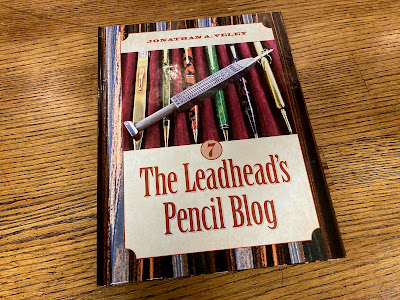
This article has been included in The Leadhead's Pencil Blog Volume 7, now available here.


If you don't want the book but you enjoy the article, please consider supporting the Blog project here.

As pandemic worries were starting to ease up, Janet and I made a Saturday day trip down to Waynesville, Ohio - the “Antiques Capital of the Midwest” as it was known back in the day.  

It just isn’t the same as it was in the late 1970s, when every home and storefront on Main Street was amazing to explore. As the 1980s gave way to the 1990s and things like Longaberger baskets became hot commodities, new, made-to-be-collectible items began to displace true antiques, showcased in newly constructed buildings shrouded in a haze of pumpkin spice poupourri.  Dad used to grumble when he’d open a shop door that if it smelled good inside, there probably wouldn’t be anything worth looking at.  He had a point.

Then came the rise of eBay – a harsh yardstick for what our investment-grade nicknacks were truly worth as they were liquidated for real pennies on our imaginary dollars in online auctions.  The collapse of the antiques and collectibles market – at least from an investment perspective – inevitably followed.

Waynesville still proudly clings to its title with a death grip, although the Springfield Chamber of Commerce an hour to the north now also claims it, with its Interstate antiques megamalls and Extravaganza weekends at the fairgrounds.  I haven’t been back to Waynesville in years, and as Janet and I strolled up Main Street I noticed many of the places I remembered visiting as a kid have been converted back into private homes.  As Waynesville’s tourist prospects rose in the 1970s, residents along Main Street were forced out to make way for more shops; these days settlers are urged to move back in to fill up vacancies.

I didn’t spend much . . . a framed print for my daughter’s new apartment and lunch with a side of craft beer at the new pub in town.  We wandered into one of the shops after lunch – it smelled good, and I was done in minutes.  Janet was still milling around inside while I stepped out onto the porch – and on my phone, I opened up the Antiques Capital’s nemesis to see if there were any pencils there.

While I didn’t buy a single pencil during an entire day of shopping in Waynesville, I committed to buying one there on that porch in the final seconds of the first auction that popped up:


At first blush, this looks like W.S. Hicks pencils I’ve shown here at the blog quite a few times . . . but the close up pictures indicated this was something altogether different.  Most of these are nose-drive pencils, but the closeup pictures revealed that line near the nose is just a decorative groove rather than a joint – right beneath the words “Tiffany & Co.” and “Sterling.” There’s no Hicks, Edward Todd or Louis Tamis Hallmark:


The pencil is engraved with a very recent date for this style of pencil: September 7, 1957.


Then there’s that top – I wondered . . . could this be a Tiffany repeating pencil?


When the pencil arrived, I confirmed that yes Virginia, it is a repeater.  Even more interesting is what kind of repeater it is, as evidenced by something the auction pictures didn’t show clearly.  The jaws which grip the lead extend slightly outside the barrel.  


I was mulling this one over with Larry Liebman on the phone when it dawned on me where I had seen this before – it’s so far out of its element that I didn’t recognize it at first.  With the lead removed, the jaws contract enough that the entire mechanism slips right out.  Alongside an Eversharp Envoy, it’s clear that this is Charles Lovejoy’s patented design:


Lovejoy applied for his patent on January 22, 1944, and it was issued on September 12, 1944 as number, 2,358,091.  It was assigned to his employer at the time, the Moore Pen Company:


Originally, Lovejoy’s mechanism was put into use of Moore’s “Mastercraft” line (Volume 1, page 180), but it was later integrated into Moore’s Fingertip line (so named because Fingertip fountain pens had an inset that looked like a fingernail).  The Fingertip was Moore’s last gasp as ballpoints wreaked havoc on the fountain pen market, and according to the sources I’ve read, Moore failed in 1956.  

The following year, Eversharp’s writing instrument division was sold to Parker on December 19, 1957 (Volume 4, page 81), and Parker didn’t continue any of the pencils Eversharp had made previously.  Dur-O-Lite, however, picked up the line and continued to make Lovejoy-patent pencils into the 1960s.

That’s why this picture makes sense:


From top, there’s the new-to-me Tiffany, an Eversharp “Lovejoy Skyline” as I call them, a Moore Fingertip, and a Dur-O-Lite Ejector.

The Lovejoy patent Tiffany adds wrinkles to an already complicated story.  There’s no patent date, even though the Lovejoy patent didn’t expire until 1961.  Tiffany didn’t make any of its writing instruments; without a hallmark, I’d have to say the only remaining suspect which might have made the barrel in 1957 would have been Louis Tamis.

But who supplied the mechanism?  I’ve theorized in the past that by the time Eversharp sold what was left of its writing instruments division to Parker – just three months after the date engraved on this Lovejoy patent Tiffany – Eversharp’s entire pencil program had already been sold off.  Since the Dur-O-Lite shares both the same Lovejoy mechanism and the same clip found on the Eversharp Symphony, I’ve always believed Dur-O-Lite was Eversharp’s heir (Volume 5, page 223).

This is the first Lovejoy patent Tiffany I’ve seen, and I don’t think there were very many of them.  It was engraved in late 1957, but the mechanisms might have been sourced by Tiffany earlier . . . given the rapid succession of demises of Moore and Eversharp, it could have come from either of them.

But then there’s the possibility that Tiffany bought mechanisms from the lowly Dur-O-Lite Pencil Company, which makes me chuckle.  Lipstick on a pig, so to speak.    


Tuesday, June 22, 2021

For My Amusement

This article has been included in The Leadhead's Pencil Blog Volume 7, now available here.


If you don't want the book but you enjoy the article, please consider supporting the Blog project here.

When Michael Krut sent me the black and pearl Eversharp Doric I wrote about a few weeks ago (see "My First Love"), he included a few stowaways – bits and pieces of things that he thought I might enjoy, just for fun.  One of them was this:


My initial thought when it popped out of the box was that it might be an unusual smaller version of the Autopoint Model 466 – from that awkward transitional period in 1931 when the noses had been changed from the long metal ones to Bakelite, but before the top end was redesigned to include a matching plastic cap.


These Autopoint transitional models are tougher to find, even though they were offered in Autopoint catalogs through 1936 – for more information, see A Century of Autopoint, page 112.

I’ve never seen a smaller model, and this one looked like it had a replacement cap, from a Dur-O-Lite.  Good luck finding the right cap, I thought . . .


But then I noticed the imprint, and this little guy went from amusing to fascinating faster than you can say Dur-O-Lite or Autopoint:  Keen Point (only two syllables – that’s why it’s faster).  


The Keen Point was also discussed in A Century of Autopoint, due to its connection with the inventor of the original Autopoint, Charles Keeran (see Chapter 7 in A Century of Autopoint).  After Keeran’s second ouster from Autopoint, he engaged in a series of associations with other manufacturers.  In 1927, he filed his trademark registration for the Keen-Point logo:


The earliest Keen Points were made by Dur-O-Lite, as illustrated on page 83:


On that same page, I illustrated a Dur-O-Lite (top) compared to a Keen Point (bottom) with their noses removed, to show how they are different inside.  As I noted in the book, very few Dur-O-Lites, probably very late production during the flattop series, share that same barrel end treatment:


This new example shares similar barrel end treatment:


As I mentioned when I restarted this blog, I’m writing these articles while I’m taking a break from writing a book about the history of Dur-O-Lite titled Dur-O-Lite: The Clandestine Company.   I delve more heavily into the Keen Point in its pages, and I now know that by the time Dur-O-Lite relocated from Chicago to Sycamore, Illinois in 1931, the mark no longer belonged to Charles Keeran.  It had been acquired by Dur-O-Lite, which was by that time marketing a lower priced “Keen-Point” line of pencils.

The cap on Michael’s pencil is probably correct: Dur-O-Lite did offer a thin model during the flattop era which used that cap.  Here’s an image showing that same cap on a slim model found in the Dur-O-Lite factory archive which will be included in the new book:


What I didn’t know until Michael’s example came along was that there were demi-sized thin models, and that the Keen Point changed out the tips from metal to plastic, then the cap.   All the other examples I’ve found have either both metal ends, or both plastic.  


I’m sure that Autopoint inspired Dur-O-Lite to change out the tips.  However, given that this is the only Keen Point I’ve ever seen which didn’t change out the top end as well, I’m wondering if Dur-O-Lite didn’t inspire Autopoint to change out the caps in return.

Monday, June 29, 2020

Panda Craps

This article has been edited and included in The Leadhead's Pencil Blog Volume 6, now on sale at The Legendary Lead Company.  I have just a few hard copies left of the first printing, available here, and an ebook version in pdf format is available for download here.

If you don't want the book but you enjoy this article, please consider supporting the Blog project here.

(Originally scheduled to post May 15, 2018) 

Several years ago at the Springfield Extravaganza I found a boxed Dur-O-Lite, identified by a model name I hadn’t known of before:


The “7-11" pencil is a thin model with a deco-style clip, equipped with the same removable-nose mechanism the company had used since its formation in 1926, a vestige from its roots in Autopoint.


“7-11" refers to a “natural” roll of the dice in craps - an automatic winning roll of either a 7 or an 11.


Then along came the Panda Pencil Company, whose assets I purchased in 2014 when they sold their building.  Panda Pencil was a subsidiary of Dur-O-Lite, a fact the company kept a closely guarded secret while quietly supplying lead to many of Dur-O-Lite’s competitors, including without limitation Autopoint, Eversharp, Parker, Sheaffer and (possibly) Eberhard Faber.  

Along with millions of sticks of lead were a few other odds and ends, including a few pencils.  Some of them added a bit more to the 7-11 pencil story:


“Make a Game of Selling More in ‘64 / Give New 7-11 Pencils By Dur-O-Lite” these samples read, along with the dice motif on the tops:


The company had a great sense of humor.  These were also in Panda’s archives:


“Now More Than Ever People Appreciate Dur-O-Lite . . . The No. 1 Pencil” and “Confidentially, Haven’t You Hade Enough Cheap Ball Pens?” 


Now more than ever was 1972, the occasion of the company’s 46th Anniversary - in case you were wondering how I’ve known the company was formed in 1926 for all these years.  The ferrule on that one shows a Dur-O-Lite magnet attracting customers:


On the other is a somewhat creepy dude, encouraging you to “face” the fact that ball pens were going the way of the dodo:


Sunday, May 10, 2020

Too Keen to Throw Out

This article has been edited and included in The Leadhead's Pencil Blog Volume 6, now on sale at The Legendary Lead Company.  I have just a few hard copies left of the first printing, available here, and an ebook version in pdf format is available for download here.

If you don't want the book but you enjoy this article, please consider supporting the Blog project here.

We have become a throwaway society.  Go to an office supply store, and most of the products you’ll see weren’t built for quality – they were meant to be used once and disposed of.  Sure, I know there’s modern “refillable” pencils that are widely available, your Pentels and your Zebras, but hold one of these things in one hand and a vintage pencil in the other, and ask yourself which one would be some thing you’d be proud to give to a favorite grandchild.

No comparison in my mind, but I’m biased.  Plus, unless you’re going to doodle moustaches on microfiche copies of newspapers, I’m just not understanding how people get pleasure out of writing with .3mm or .5mm lead.  Heck, I find .7mm lead to be . . . sterile.  Give me a good old 1.1mm pencil – and call it .046 inches please, since the metric system has no place in proper conversation – fill it with a nice soft lead . . . ahhh. . .

OK, my prejudice is showing.  I’ll move on, but not before I summarize my thoughts by saying that most of the pencils being sold today are being thrown out, and they should be.

The trend started in the 1950s, when Americans were ready after years of war for anything that made life more convenient.  Pioneering the field of disposable mechanical pencils, believe it or not, was Dur-O-Lite, which revived a venerable name it had used for decades – Keen-Point – and applied it to a single use pencil.


This picture is from page 84 of A Century of Autopoint, and as mentioned in the book, the new pencil with that weird, fleshy-colored nose was patented by Frank J. Stoeberl, who applied for his patent on July 7, 1960.  It would take three years for the patent to finally be granted, as number 3,097,628 on July 16, 1963.


Yeah, they come in a few colors and a few variations, but in general I don’t get too excited about them.  They look cheap and feel cheap, because they were cheap.  Still, when this surfaced and it wasn’t too expensive, I thought it worth preserving:


Cheaper by the dozen, I suppose.  Since these were meant to be consumed rather than used, I thought it unusual to find a complete dozen of them, complete with a cardboard band to hold them together:


Now these next examples cost a bit more.  They went ‘round the horn on ebay so many times with me almost biting on them that I don’t remember whether I bought them because the price finally dropped, or whether I was that tired of looking at them:


The Eugene Dietzgen Drafting Company was set up as the Eugene Dietzgen drafting company at the end of the 19th Century; Dietzgen had emigrated to the United States from Germany in 1881, sent by his father, the socialist and Marxist philosopher Joseph Dietzgen.  Joseph was looking for a way to secure his papers and documents from the authorities in Germany, and Eugene may have been trying to avoid the military draft.

In America, Dietzgen prospered as a capitalist . . . although perhaps as a hat tip to his father, his manufacturing facilities included some forward-thinking innovations for the comfort of his workers, according to Wikipedia, “includ[ing] separate bathrooms for men and women, open windowsills with flowers decorating the air, and a general atmosphere of a healthy working community.”

Dietzgen is a company best known for making slide rules, compasses and other drafting tools, and you’d expect that company to relish in the sorts of skinny lead precision instruments you’ll find today, rather than a cheap throwaway.  And engineers being such a persnickety bunch, you’d think they wouldn’t need the guidance imprinted on these pencils:


Thanks, captain obvious.

Sunday, May 3, 2020

There But For the Grace of God

This article has been edited and included in The Leadhead's Pencil Blog Volume 6, now on sale at The Legendary Lead Company.  I have just a few hard copies left of the first printing, available here, and an ebook version in pdf format is available for download here.

If you don't want the book but you enjoy this article, please consider supporting the Blog project here.

Loyal Knight Lawrence King emailed me the other day to tell me about a group of Dur-O-Lite pencils he had found:


This is an impressive array of early models, starting with the red and white swirled example, which has the bolted on clip and short nose indicative of first year production, in 1926-1927:


In addition, the cream/yellow example has an unusual bushing connecting the top end of the barrel to the cap, a feature that I haven’t seen on these.  Note also the different milling at the nose end of the barrel:


What’s interesting to me, and what caught Lawrence’s attention, was the name on the barrel.  Lawrence owns a copy of A Century of Autopoint, and he’s used it:


All these Dur-O-Lites are imprinted with the name “W.K. Bracken”:


Chapter One of A Century of Autopoint documents the early life of Charles Keeran, inventor of the Eversharp and later of the Autopoint (the original one that went defunct in 1922; Keeran had a hand in some improvements to the Autopoint that survives today).  Prior to getting into pencils, Keeran cut his teeth as an inventor in the food canning industry – his first endeavor, The Illinois Pickle Company, was incorporated by Charles Keeran, Julius K. Funk (a wealthy local businessman and real estate investor), and local Bloomington lawyer . . . William K. Bracken.

Bracken later assisted Keeran with the establishment of the Keeran-Funk Company, a moderately successful company which marketed Keeran’s new cardboard-backed wax seals for canning jars:


But when Keeran’s most familiar fruit jar innovation was introduced, the White Crown Fruit Jar which should have secured Keeran’s fame and fortune for life, things took a bad turn for Keeran:


Julius Funk apparently decided he no longer had need for Keeran (a theme that would recur throughout Keeran’s life, attracting wealthy investors who would later profit from his inventions).   Funk, Bracken and a few others set up a separate White Crown Fruit Jar Company in August, 1913, and it was that abandonment which left Keeran to think for the first time about inventing a new pencil – his patent application for the Eversharp was filed in October, 1913.

Keeran never held Bracken’s association with Funk against him, and he likely couldn’t – Bracken was related to the Funks by marriage (his wife was Grace Funk Bracken), and where family went, so went the Bloomington lawyer.   When Keeran established the Eversharp Pencil Company in 1914, William K. Bracken was again one of its incorporators, in addition to being a shareholder and director.

After Keeran was ousted from Eversharp in 1917, he set up Autopoint Pencil Company . . . and was ousted from it in around April, 1921, landing at the new Realite Pencil Company.  Realite then gobbled up Autopoint in 1923, and Keeran was made the new Autopoint’s president – and then he got ousted from Autopoint a second time, in 1924.  In Chapter 7 of the book, I’ve traced Keeran’s career after Autopoint – he landed, for a time and apparently as an independent contractor – at Dur-O-Lite during its early days.  In fact, after he registered a trade name “Keen Point” in 1927, he had Dur-O-Lite make pencils for him marked with that name:


It’s no surprise, given Bracken’s long association with Charles Keeran, that Bracken would have the inside track on some early Dur-O-Lite products, and Lawrence’s little collection of these bearing the Bloomington lawyer’s name fits beautifully into the Keeran/Eversharp/Autopoint story. 

William Bracken had a long and distinguished legal career in Bloomington, regularly speaking later in life to his Rotary Club about his collecting passions, including harmonicas and Abraham Lincoln memorabilia.  An account written after his death reported that he even built an addition onto his home on Chestnut Street to house his Lincolniana. 

Bracken passed away on December 10, 1947, and a brief death notice was published on December 14 in the Bloomington Pantagraph, in the pages of which he had appeared countless times, described only as “Bloomington lawyer and widely known collector of Lincoln lore”: 


In faraway Brookville, Indiana, notice of Bracken’s death appeared on December 18, 1947.  Passing mention is made of his law practice, but not even his obsession with Lincoln made it into  print there – his passing was noted only because he had “assisted with the publication” of the Brookville Democrat fifty years earlier, in the 1890s.


A shiver just went up my spine.  There but for the grace of God – I started my career as a journalist before I became a lawyer, before I developed an unhealthy obsession for mechanical pencils – and whatever I’ve managed to accomplish as a lawyer will likely be eclipsed by this weird little habit.

Sigh.  Guess I’d better at least go get my name stamped on some pencils.