Showing posts with label Presto. Show all posts

Tuesday, September 16, 2025

Of Radios, Pencils, and a Migraine

I have known about these pencils for years, but it wasn’t until the last year or so before I finally acquired one. 


All that I remember is that I caught this one “fishing with hand grenades” – that is, I bought a whole bunch of crap and this one happened to be in it. The clip reads “Cunningham Radio Tubes”:


That clip explains why these always seem to go for more money than I could justify paying. Collectibles that sit at the intersection of different disciplines tend to be valued more highly – in this case, pencil collectors and radio aficionados both chase them, and the radio guys are more likely to spend the bigger money. This example, like all of the others I have seen, is in a great lapis color with distinctive red bands, and on the side of the barrel, there’s also a metal plaque offering birthday greetings to “O.D.M.”


Cunningham Radio Tubes were marketed by Elmer T. Cunningham, who founded the Audio Tron Sales Company in San Francisco in 1915. Cunningham was a slippery character who fought off numerous patent infringement claims and went through a number of different business organizations – it is a fascinating history, but if I attempted to lay out the entire saga here (1) I doubt I would do the story justice, especially for any radio enthusiasts in the audience and (2) it would take me so far out into left field that I fear I would never get around to the story I’m telling today. 

For our purposes, by 1931 the most recent incarnation of the Cunningham Radio Tubes business, by then going by “E.T. Cunningham, Inc.,” had been purchased by RCA. The distinctive letter C on the clip is drawn from Cunningham’s handwritten signature, as shown in this magazine advertisement published in 1925 or so:


I don’t believe the makers of Cunningham Radio Tubes got a wild hair and went into the pencil business (even though the Tri-Pen Company, makers of Triad pens and pencils, did exactly that). This is the only color and configuration in which I believe these are found, and if Cunningham had started a pencil business I’d expect to see more than one variation. I believe this is a specially commissioned advertising pencil, complete with a figural cap made to look like one of the company’s radio tubes.

My best guess as to who might have manufactured these pencils is Mabie Todd & Co., which used that same color celluloid, offered colored bands like these on some models, and Mabie Todd pencils share that slender front end and elongated metal tip. In the absence of any manufacturer’s marking, that is just my best guess. 

That guess took a weird left turn recently. Unless Mabie Todd did some really weird stuff like what I’m about to show you, and I don’t think it did, Elmer Cunningham must have sourced pencils from other manufacturers, as well.

And who that manufacturer might have been is just fascinating . . . 


Bob Speerbrecher (known by eBay shoppers as Speerbob) sometimes sends me pictures of things he is getting ready to list to ask for my input about what they are and what a reasonable price might be to ask. In this case, I told him not to bother listing it, because he had already found his buyer. Neither of us knew what a reasonable price for it might be, so we agreed that I’d find some extra pencils laying around to send him in trade (and that trade, I’ll tell you at some point, was an entire story all its own).

There are three weird things about this pencil I have to show you. The obvious first question concerns that cap - I don’t remember whether I made the connection while Bob and I were discussing the pencil by email, but by the time it arrived I understood exactly what it was:


Yes, Virginia . . . that’s Elmer’s distinctive handwriting all right. Although the pencil is not otherwise marked, the shape of the cap and the letter stamped on top of it are all I need to identify this as another Cunningham Radio Tubes advertising pencil.


I took another look at my lapis Cunningham Radio Tubes pencil because I didn’t recall that same treatment, but it does share that same letter C on top of the cap. It was so faintly stamped that I hadn’t noticed it before.


Speerbob’s Cunningham pencil is enigmatic. It is an early repeater pencil, and its resemblance to a Presto is both uncanny and just a little bit off.


The lead is significantly thicker on the Cunningham pencil, while all of the Presto repeaters I have seen have been uniformly equipped to accept ordinary 1.1 millimeter leads. If Presto was commissioned to make a special order pencil, in this case they made one that was really special. The oddities continue inside:


The internal workings of Presto repeaters are as consistent as the lead size they used, but this Cunningham repeater is built a little different, with a nose cone that screws into the threaded end of the barrel and different proportions of the brass inner parts. The Presto was derived from Abraham Pollak’s patent number 1,592,502 issued on July 13, 1926.


Pollak’s patent is famous because it was invalidated after the Gilfred Corporation (makers of the Everfeed, descended from the Presto) sued Eversharp for infringement of this very patent. I discussed the Gilfred v. Eversharp litigation in one of  my earliest articles here, long since wiped from the Internet but surviving in print form - see “My Find of the Year” (December 31, 2011: Volume 1, page 63). The story was also reprised in Eversharp: Cornerstone of an Industry, at page 314.

In my opinion, this Cunningham pencil is so similar to a Presto repeater that they must have been made by the same manufacturer. At the time, with Pollak’s patent fresh on the books, anyone else copying his design this closely would have treaded in perilous waters indeed.

Unless . . . 

I told you earlier there are three weird things about this pencil: the Cunningham connection and this pencil’s weird, close-but-not-exact relationship to the Presto are two of them. The third weird thing about it is that unusual clip:


I have never seen a clip like that on a Presto, but I have seen it . . . and so have you:


That’s our Cunningham posed alongside an early Ever Sharp made between 1913 and 1915. Charles Keeran’s earliest Ever Sharp pencils (“Eversharp” was two words in those days) were manufactured by George W. Heath & Co., and they sported clips patented by brothers George and Alfred Heath, who applied for patent 1,145,583 on June 12, 1912. Their patent was granted on July 6, 1915:


There is no question that what we see on this Cunningham pencil is this same patented Heath clip, with a ball added at its terminus. On Ever Sharp pencils, these are invariably stamped “Pat. App. For”; Keeran had hired the Wahl Adding Machine Company to take over production of his Ever Sharp in October 1915, and no Ever Sharp pencils are known to exist with the actual patent date stamped on the clips.


However, this Cunningham pencil has no markings on the clip, sending my thought process in an entirely new direction. In the mid-1920s, when this Cunningham pencil was likely made, Heath’s clip patent was still very much in force – unless someone else succeeded in court to invalidate it, but I haven’t seen any evidence for that. Maybe someone acquired the rights to the patent, or maybe someone deliberately copied it.

No love was lost between Heath and the makers of the Eversharp after production of the Ever Sharp was turned over to Wahl - Heath apparently refused to allow Wahl to license the clip, so Keeran and John Wahl scrambled to design new clips (first the spade or “trowel” clip, followed quickly by Wahl’s ubiquitous tombstone-shaped version). I have no idea why the Wahl Company would have any interest in acquiring Heath’s clip after coming up with its own.

Yet, I can’t shake this feeling that this is more than a coincidence. This is the second connection I’ve found between the Presto and the Eversharp: the Gilfred v. Eversharp litigation in 1940 is one, and this Presto-ish pencil’s use of the Heath clips Ever Sharp pencils once used makes two.

There may be three.

Back in 2013, I compared Presto’s earlier, metal repeating pencils to engine-turned Wahl Eversharps. I found them to be so similar that I theorized The Wahl Company may have been the actual manufacturer of those early metal Prestos. See “Presto! A Revelation!” (August 15, 2013: Volume 2, page 214).


There’s more. While Presto did not to my knowledge offer pencils using fatter leads like this Cunningham, The Wahl Company offered several models equipped for .075" leads, just like the Cunningham pencil. In addition, one repeating pencil with thick lead and a shaky Wahl connection also comes to mind:


This is the John C. Wahl “120,” which was not a product of the Wahl Company exactly, but by John C. Wahl, Inc. John was still connected with Wahl at the time the John C. Wahl 120 was made; for whatever reason the company that bore Wahl’s name did not pursue the project but apparently allowed him to produce the pencil on his own – see “Not Just to Show Off” (February 10, 2015: Volume 3, page 221). 

Wahl’s patent for what I believe was the John C. Wahl 120 was applied for on June 19, 1939 and was issued on August 6, 1940 as number 2,210,845.


John Wahl’s design is a bit different from what we see on the Cunningham pencil, which in turn is a bit different from the Presto. While E.T. Cunningham, Inc. had been sold to RCA by the time the John C. Wahl 120 was introduced, RCA was still advertising radio tubes under the Cunningham name.

All I know at this point is that my head hurts.

Thursday, June 3, 2021

Find Some Space

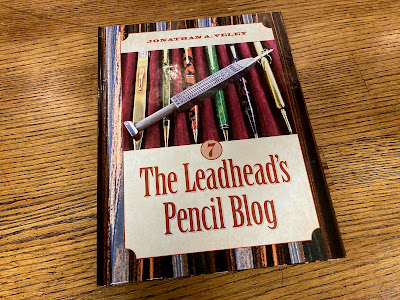
This article has been included in The Leadhead's Pencil Blog Volume 7, now available here.


If you don't want the book but you enjoy the article, please consider supporting the Blog project here.

Poor Janet was overjoyed when I gave up collecting bottles to take up pens and pencils, thinking they would take up so much less space.  Of course, I never had anywhere near 15,000 or more bottles in my collection, so we’ll never have a real apples to apples comparison on that thought . . . let’s just say Janet is less enthusiastic about my twenty-year obsession with these things than she was when everything fit comfortably in one printers’ cabinet with room to spare.

These days, as my rationed space for hobby activities bulges to the point of overflowing, I’m very selective about taking in anything bigger than a pen or pencil.  There are some things, though, that I can’t resist buying even when I know I might already have one, like those great, oversized repeating pencils made by Samuel Kanner between 1926 and the Depression:


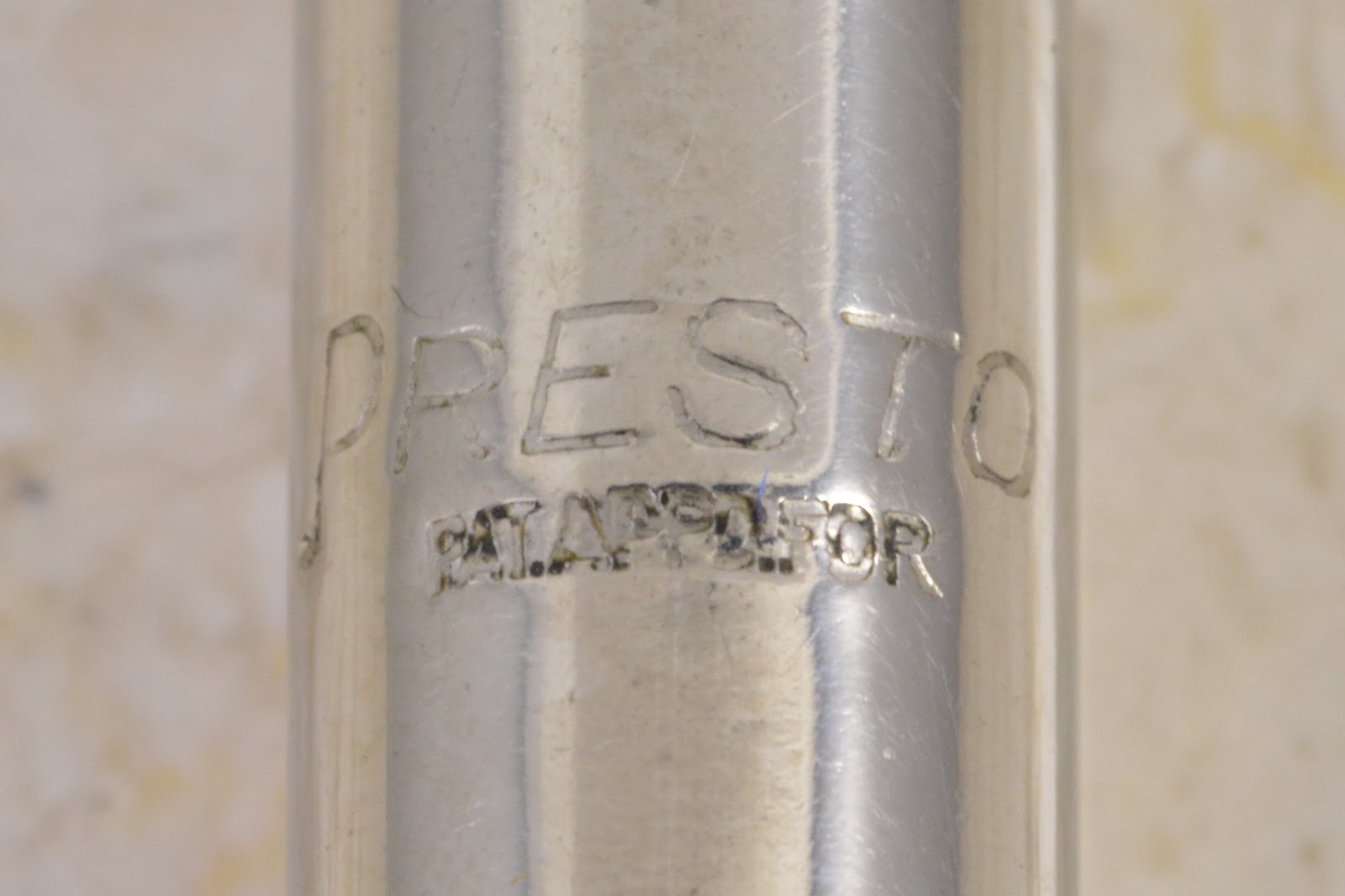
This one, like so many others in my collection, is marked simply “Presto / Pat. Appd. For”:


When it arrived, I took it down to put it with the others, knowing it would likely be a duplicate, but it wasn’t.  When I compared it to my other chrome-plated examples, I found that four other times I’ve done this, buying Prestos just for the heck of it, and no two are alike.  There are faceted and round barrels, matching bakelite buttons and metal ones, and some of the caps fit over the top of the pencil rather than inside it:


I did have one other Presto in an identical configuration, but it has gold filled trim.


The gold filled one turned up at the Raleigh Pen Show auction in 2017, as part of a “set” . . . ish (see Volume 5, page 106).  There was a matching pen in the box, but it also included a mammoth Presto desk pen in the same color:


That desk pen is just mammoth, but being the Presto freak that I am, I couldn’t turn it away.  It didn’t fit in the slots alongside my other Prestos, but it lounges comfortably nearby, like that extra relative at Thanksgiving dinner stuck at the kid’s table trying to eat in a dignified manner with knees to chest.

That desk pen leads me to my encounter with Ben Mawhorter, who was supposed to meet me at a couple canceled pen shows to show me another Presto desk pen he had found, with a base and lamp.  That gave me pause . . . where would I find space for it?  Never mind . . . I bought it, sight unseen.  You’ll like it, Ben reassured me.  He was right:


I like the industrial look to that lamp, although with that articulating arm, I’m not sure whether it should be set like this or held high, like the Presto version of the Statue of Liberty:


At least that might save a little bit of space, I thought.  The pen was slightly less than I hoped for, though.  I do like the butterscotch celluloid taper, which matches the base.  Presto pens and pencils had barrels made of bakelite, and it’s unusual to find this mix of materials:


However, it’s missing the “Presto” logo on the lever, like my other one has:


The lever itself and the way it is cut into the barrel are just what I would expect to see.  I’ll buy that it is a Presto, even though neither the base nor the pen is marked at all.  It is fitted with a Presto nib - it looks smaller than the one I already had, but they are both marked size 8.  It might just be crammed down farther inside the section, which is just a little bit different.


Even though the nib is all that ties this desk set to Presto, I’m convinced it is.  It might have been made near the end of the run, when brand marketing wasn’t as important as getting things put together and out the door.

So great – now to find space in a crowded room for something that, strictly speaking, doesn’t fit in with the collection.  Even the kid’s table isn’t big enough, so time to rearrange things.  After shifting things around, I did find the perfect place for it:


On the top of that first printers’ cabinet.


Sunday, June 7, 2020

On a Not-So-Lazy Sunday

This article has been edited and included in The Leadhead's Pencil Blog Volume 6, now on sale at The Legendary Lead Company.  I have just a few hard copies left of the first printing, available here, and an ebook version in pdf format is available for download here.

If you don't want the book but you enjoy this article, please consider supporting the Blog project here.

A few weeks ago, an internet search for something other than what I am going to write about today landed me on Etsy’s doorstep.  The site’s focus is more along the lines of arts and crafts, so I don’t usually go hunting for old pencils over there - but since I was there, I decided to browse around a bit and see what there was to see.

And see I did:


These were in two separate listings, both for the same price which was a bit more than I wanted to pay.  After a day or two I found myself able to swallow as to the ringtop, then a day later decided I might as well take a deep breath and buy the other one.  The name imprinted on these is “Jeffrey”:


The reason I balked at buying the full-sized model was because it isn’t all there.  The clip has gone missing:


I had never heard of the “Jeffrey,” and unfortunately, that clip would have provided me with the best clue as to who might have made the pencil or marketed the brand.  That imprint looked similar to the “Broadway,” and that had me hoping that this might have been a DeWitt-LaFrance pencil (best known as maker of the Superite line).

With pencils in hand, I did my usual poking, prodding, pulling and twisting to see what I could figure out.  And there was my answer:


Those pivoted tops place these squarely into the family of pencils pioneered by Samuel Kanner – my third favorite obsession (after Rex and DeWitt-LaFrance, of course).   Articles posted here over the years are too numerous to list, and most were long enough ago that they are only in the books these days.

Here’s the short version:  Kanner picked up a patent issued to Abraham Pollak for a repeating pencil, which Kanner introduced in 1926 as the “Presto.”  Later incarnations of the Presto look a lot like Eversharp repeating pencils – due to the fact that Eversharp flat out stole the design.  Kanner sued and lost after Eversharp successfully argued that Kanner’s repeating pencil wasn’t really new, invalidating his patent.  And, Karma being what it is, within a couple years Eversharp would find itself on the losing side of that same argument when one of its ballpoint patents was similarly invalidated.

Abraham Pollak also received another, earlier patent, for a twist-action pencil:


See it?


That same feature exists on pencils marked “Nupoint” and “Hi-Speed”:


Pollak’s earlier patent, unlike his repeating pencil patent, wasn’t assigned to Samuel Kanner – and at the time, I didn’t know there were metal repeating pencils like the Presto out there, which would have made it easier to connect the dots, especially since one of those repeaters turned up in exactly the same pattern as the Jeffrey ringtop:


However, Michael Rosen came up with some splendid paperwork that traced the Nupoint squarely back to Kanner’s doorstep (see The Leadhead’s Pencil Blog Volume 2, page 237):


That’s the long answer to the question.  The short answer is these Jeffrey pencils were another brand name used by Samuel Kanner, and I haven’t found any documentation or advertisements to support that.  I just know.

Sunday, May 6, 2018

Just a Name or a Clue?

This article has been edited and included in The Leadhead's Pencil Blog Volume 5; copies are available print on demand through Amazon here, and I offer an ebook version in pdf format at the Legendary Lead Company here.

If you don't want the book but you enjoy this article, please consider supporting the Blog project here.

This Presto came up recently in an online auction, and since it was reasonable and I’m always looking for more information on the brand, I went ahead and brought it home:


When I brought it home, I found that it was a dead ringer for the most important Presto in my collection: Samuel Kanner’s personal demonstrator:


I dug these old pictures out from The Catalogue, where they appear on pages 122 and 123, mostly because I wanted to know whether I had lost the cap on Kanner’s demonstrator or whether I never had it.

While my Kanner demonstrator is marked “Patented,” this new find is marked patent applied for:


But unlike Kanner’s demonstrator, this one has a different personalization:


“Jack Sprat.”  Note how much more detailed the lettering is, on this example that matches a pencil owned by the company’s owner.  Is this just a name, wrought with a little more care than one might normally see by a jeweler or salesperson? 

Is it a flippant reference to the nursery rhyme?

Or is it a clue?

Monday, April 2, 2018

In Search of the Presto's Final Resting Place

This article has been edited and included in The Leadhead's Pencil Blog Volume 5; copies are available print on demand through Amazon here, and I offer an ebook version in pdf format at the Legendary Lead Company here.

If you don't want the book but you enjoy this article, please consider supporting the Blog project here.

I bought a collection from a guy who emailed me out of the blue a couple of years ago.  After swapping a couple of pictures, everything looked promising – I would have been much more leery of this kind of deal if he hadn’t volunteered to send me the whole collection on approval.

I approved.

A lot of what was in there were things that just sort of filled in some gaps in my collection - mostly upgrades of things I had in lesser condition, or minor variations such as a different color in a series . . . stuff that makes me smile, but doesn’t really make for much of a blog article.  Nearly everything I kept slipped quietly into my collection.

Still, there were a couple of surprises:


This one is marked “Everlast.”


What’s unusual is that this one, unlike all of the crappy nose-drive Everlasts you’ll find out there, is a repeating pencil.  From all outward appearances, it isn’t just any repeating pencil – it looks a lot like a Gilfred.

Samuel Kanner’s exploits have been an ongoing theme here at the blog.  He started with his Nupoint brand, then using Abraham Pollak’s patent for a repeater, went on to make the Nupoint Repeater, followed sometime around 1925-6 by the Presto, first in the same metal incarnation and then in those oversized bakelite models that are just too cool.

Later on, the Presto took on a more slender, decidedly cheaper incarnation as the “Everfeed,” although the Everfeed typically had a sterling clip stapled into that cheap plastic.  There were similar pencils marked “Nasco,” “Whitlock” and, as the title of this article suggests, the “Gilfred,” which unlocked for me the secret that the Gilfred Corporation made all of these later incarnations of the brand (Kanner’s association at that point remains unclear), and that Gilfred unsuccessfully sued Eversharp for infringement of the Pollak patent, which Eversharp appropriated for all of its repeating pencils from the late 1930s on (see “My Find of the Year” way back in 2011 at https://leadheadpencils.blogspot.com/2011/12/my-find-of-year.html - the images were wiped out but the story is still there).


I reposted this picture last September showing, from top, a later Presto, a Gilfred, an Everfeed and an Eversharp Doric repeater (“Presto Footnote Number One” at https://leadheadpencils.blogspot.com/2017/09/presto-footnote-number-one.html). 

This Everlast has some design cues taken from each of these - in particular, note how similar the trim band is to the Everfeed and Gilfred.  But that shorter nose . . . and what’s inside looks a little bit different:


In particular, that torpedo-shaped front end of the mechanism:


The Everlast name was the subject of two trademarks, found in American Writing Instrument Trademarks 1870-1953.  The earlier of the two, unfortunately, has not been preserved – all that remains is what was published in the Official Gazette, indicating that the name was in use beginning on September 2, 1933 by the Everlast Pen and Pencil Company of New York:


A second trademark, for a stylized logo, was filed for registration in 1947.  Since this one was preserved, we have considerably more information to go on here.  By this time, the company was known simply as Everlast Pen Corporation, and the President, Maurice J. Waldinger, said the company was located at 644 Broadway, New York.  Since the date of first use claimed for this second mark is the same date, I think it’s a fair assumption these were one and the same entity:


I didn’t find any newspaper advertisements for a repeating version of the Everlast - just standard twist mechanism pencils.  I widened my search to look for Everfeed pencils, and I learned something.  The common Everfeeds like the ones shown in the pictures above appear to have been made in the mid-1940s:


But when the “New Ever-feed repeating pencil” was introduced in 1940, it was fatter – and it had that same black nose and smaller tip:


Just like this odd Everlast repeater.

There’s a lot of research to do and much to learn about how all of these companies were related to each other.  Was the name “Everfeed” a tradename adopted by the Everlast Pen and Pencil Company?  No trademark was filed that I found, but the advertisements originated disproportionately from New York. 

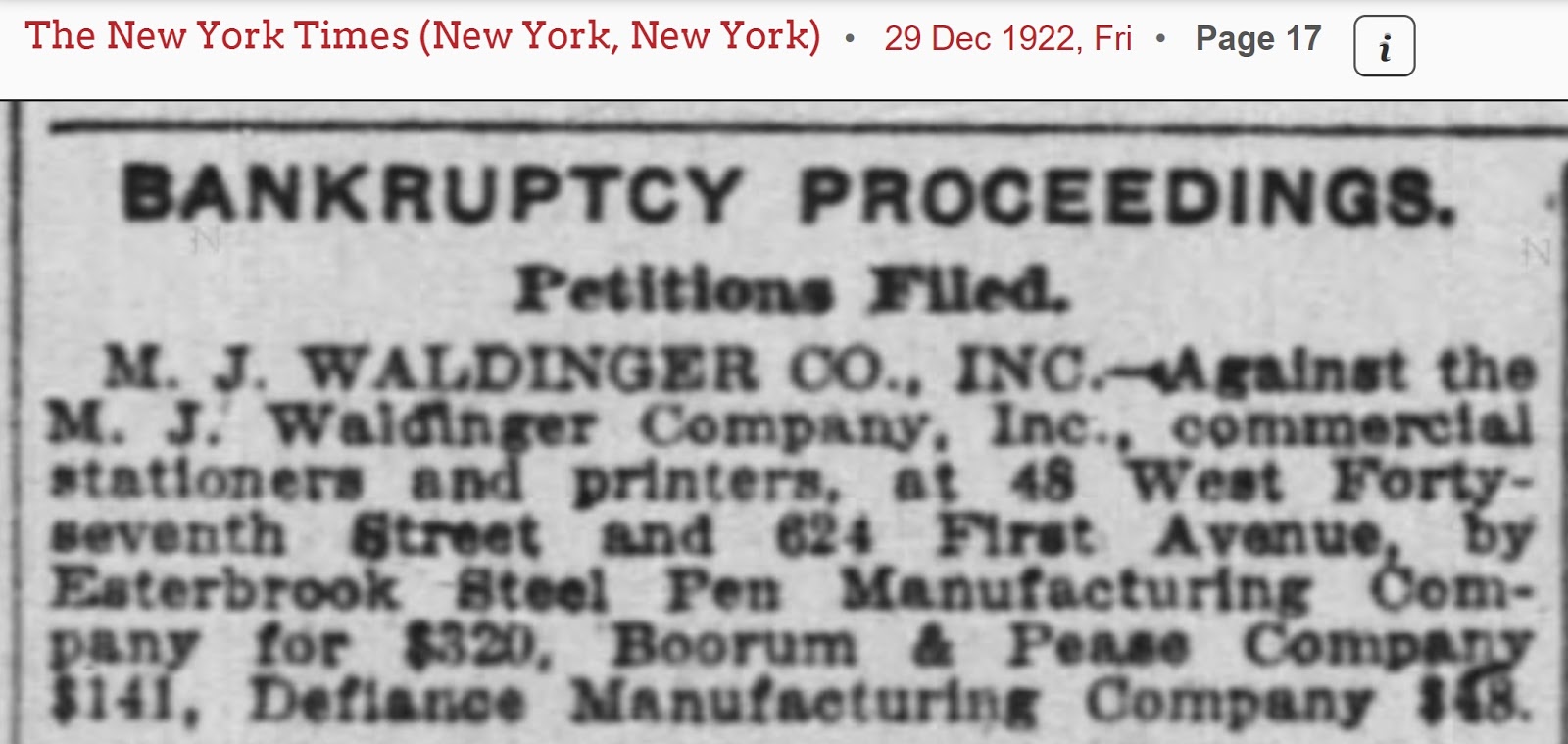
Following up on the Waldinger lead, I found that a stationer by the name of the M.J. Waldinger Co. leased space at 48 West 47th Street, New York:


And just two years later, his creditors forced him into bankruptcy – including the Esterbrook Steel Pen Manufacturing Company, as reported in the December 29, 1922 edition of The New York Times: