Showing posts with label American Lead Pencil Co.. Show all posts

Monday, October 6, 2025

Some American Adventures

The American Lead Pencil Company of New York doesn’t get much respect, since the company’s products were made for the lower-priced market. Cross-town rival Eagle Pencil Company did much the same thing, but with a much wider range of products and, therefore, a proportionally greater cult following. 

A few things have been accumulating around the A.L.P. wing of the museum (in case you have seen pencils with that imprint on the top . . . well, now you know what that stands for), starting with one that is so nice, you might question whether “lower-priced” is really a fair characterization of the company’s products:


This is a Venus Everpointed, and about the only thing subtle about it is the faint imprint on the upper barrel.


These came both with slightly domed crown tops like this, but also with rounded caps resembling a metal Conklin pencil. Both were pictured a few years ago in “The ‘Everrounded,’ Perhaps” (March 1, 2018: Volume 5, page 168), in which other variations along these lines appeared:


The American Lead Pencil Company’s bread and butter, however, was the company’s woodcased pencils, and the Venus name is more closely associated with wood pencils than their mechanical ones. American, like Eagle, had a flair for kitsch, and one of their more dramatic offerings surfaced in a box lot of pencils John Martenson sold to me at the Chicago Show in May:


This is the American Model 400 “Club,” complete with a figural golf club tip for which a patent was applied for:


That would have been a design patent to protect the tip’s appearance, rather than a utility patent to protect its function – except perhaps on the miniest of mini-golf courses. I was unable to find any patent issued to protect a golf club-shaped pencil topper. I did list a design patent for a hockey stick -shaped pencil in American Writing Instrument Patents Vol. 2: 1911-1945, but hockey players don’t use woods, and that design patent wasn’t issued until 1932.

There’s another clue on the back side of the club: “Trade Mark.” 


I’m striking out again there: in American Writing Instrument Trademarks 1870-1953, I didn’t list a trademark either for a golf club-shaped pencil, or for the word “Club” in connection with writing instruments.

What I did find, when I went to file my American “Club” pencil away, was that I already had one – or at least, something very close:


Apparently the “Club” came both in a wood and an iron, also marked with the “Trade Mark” on the face of the club:


This No. 129 “Aurora” set of wax crayons with holder  came from an online auction:


The holder is the most primitive form of “mechanical” pencil, called a porte crayon amongst those who collect pencils with their pinkies extended. It is nothing more than a tube with a slot on the end - sliding the ring forward with a crayon in place clamps the holder down to secure it for writing.


This next item is a nice piece of ephemera that was gifted to me by a visitor to the museum – I don’t remember who it was, so someone please remind me:


This 1892 postcard thanked a good customer for a recent order.


Such a nice snapshot in time, with fantastic artwork and a connection to the Housatonic Railroad Company of Bridgeport, Connecticut, was the perfect piece to put next to my “Little Giant” American dropper pencil, which has that same shield logo - see “That’s Heavy, Man” (December 20, 2016: Volume 4, page 294).


I have no idea where this last item came from – these things seem to reproduce like rabbits whenever I turn out the lights in the museum for the night.


The box is empty, and I haven’t seen an American Lead Pencil branded as the “Jewel” – but if I ever do, I know where it belongs!

Friday, June 25, 2021

Pencil Yahtzee

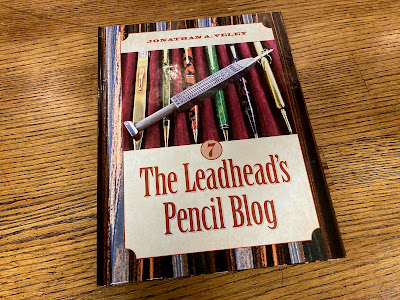
This article has been included in The Leadhead's Pencil Blog Volume 7, now available here.


If you don't want the book but you enjoy the article, please consider supporting the Blog project here.

Pencil names during the 1920s were a lot of fun.  If you took a pair of dice and wrote words on the faces . . . ever, sharp, rite, ready, point, real . . . and give them a roll, no matter what comes up, you’ll get a known brand name.   Eversharp, Sharp Point, Realpoint.  You can even roll a double and get Rite-Rite.

A few weeks ago I rolled a new one: Ready Sharp.


The listing didn’t contain much information, but I knew more information would be available once I examined what was underneath the pencil in that great box:


It’s a shame this example is a ringtop, because that clip would be the clincher - however, the crown is similar enough to what is illustrated, and that rib near the nose helps, too.  I’m confident this pencil was what originally went with this box:


I would like to see a side-clip model someday, just to know whether that’s an accommodation clip that slips on or whether it was permanently attached.  Good to know where to put the lead (it would have been great if it read “Put it here, dummy”):


What was surprising was the imprint on the pencil.  Nice to see the positive attribution for this brand name:


The American Lead Pencil Company of New York.  

Now, let’s see if I can roll a “Sharp Sharp” . . . or maybe a “Pointy Point” . . .


Saturday, June 6, 2020

Lifting the Veil a Bit More

This article has been edited and included in The Leadhead's Pencil Blog Volume 6, now on sale at The Legendary Lead Company.  I have just a few hard copies left of the first printing, available here, and an ebook version in pdf format is available for download here.

If you don't want the book but you enjoy this article, please consider supporting the Blog project here.

One of the last articles I posted here before my hiatus in 2018 ("Lifting the Veil") was about this set of pencils:


The logo stands for “Veiled Prophet,” an organization in the St. Louis area that put on an annual “Fair St. Louis.”   That article leaves something out: without any manufacturer’s imprints, I wasn’t able to speculate on who might have made these generic-looking pencils, distinguishable only by their square red upper fittings (which prevent these clipless pencils from rolling around) and exposed erasers.


Even though this set was in its original box and as mint as you’d ever see, there is nothing to indicate who made them:


However, a recent online auction for another set of these appears to answer that question.  The set up for bids is identical to mine, with one small difference:


Now I suppose it’s possible that over the course of 85 years, someone might have picked up a box of pencils and thought it would look cool to slap an unrelated sticker on the front of it, but I’m back to Occam’s razor – the most reasonable explanation is that the maker of these pencils put its label on some of them, just not mine:


I’m good with attributing these to the American Lead Pencil Company, “Makers of the famous VENUS Pencils.”

Until just a couple days ago, that was all I had to add about Veiled Prophet pencils . . . but then a package arrived from Rob Bader, bearing something I’d been eyeing in his online store for a year or more.  I finally had to bite on it, since it fits in perfectly with another article you’ll see here a bit later.  When I unwrapped what was inside, though, this wasn’t what I was expecting:


I thought Rob got his wires crossed, but the pencil I was waiting for was also in there, along with a note: “Let me know if you want this one too,” it read.  

Maybe, maybe not, I thought.  It’s a Hutcheon “Finer Pointe,” and I do like those:


But it’s a lot like one I have already.  


You’ve seen it before, in The Leadhead’s Pencil Blog Vol.2, page 168.  The top part of this one also made a cameo appearance in "The Tangled Web" when I was comparing this later clip to what appears on the “Fine Point” pencils initially offered by General Manufacturing (before General came up with the goofy lever-operated Kaligraf).

On the plus side, Rob’s pencil has that more graceful, earlier clip and a pattern that’s more intricate than the one I’ve already shown you, but judging from the traces of black in the recesses and the fact that the first part of the imprint is so weak, I’m suspecting at some point in its history someone polished the tar out of it in an effort to make it look pretty (not Rob, by the way – he knows better than that).  

But there was something else about Rob’s pencil that had me abandoning my plus/minus chart.  Embossed lettering is fairly unique to Hutcheon – it’s on the back side of one of my “Hutch Clutch” pencils (see "The Mabie Todd-Hutcheon Connection").  It’s the second one from top in this picture:


Rob’s pencil also has embossing along these lines, but what it says fits perfectly in a “Veiled Prophet” update:


“Vail of Profit St. Louis Mo. 1923.”   I have no idea what it means or for what purpose it was made, but I do have a much better idea what it is meant to suggest – only because John Rimakis clued me in to the meaning of those “Veiled Prophet” pencils and I’d written about them here before.

I called Rob.  “I suppose you’re calling me about that pencil I sent you,” he said.  “Do you want it?”

“Yeah, you got me," I sighed.  "I’ve already photographed it to include in this Saturday’s article.”  We’ll settle up in Raleigh this August, I suppose.  If the creek don’t rise, as Rob would say.

Thursday, March 1, 2018

"Everrounded," Perhaps

This article has been edited and included in The Leadhead's Pencil Blog Volume 5; copies are available print on demand through Amazon here, and I offer an ebook version in pdf format at the Legendary Lead Company here.

If you don't want the book but you enjoy this article, please consider supporting the Blog project here.

When I saw the first of these two – I don’t know which one it was – my first thought was that they might be Conklin pencils, with those rounded caps.


However, the finish isn’t quite what you’d expect of Conklin, and those green bands around the top tell a different story.  Different companies filed trademarks for different colored bands, and a green band denotes the American Lead Pencil Company.  In American Writing Instrument Trademarks 1870-1953, I list three different trademarks registered by American with respect to the green band.  The earliest, number 66,976, was applied for by Byron Goldsmith on May 31, 1907, claiming that the mark had been used by the company since September 20, 1906. 

The registration certificate isn’t much to look at  – it was issued during a time when registration certificates referred to attached drawings which, of course, haven’t been preserved.  I did, however, fish the illustration out of the issue of the Official Gazette in which the drawing was published for objection, and I included it in the book:


The imprints are also a trademark of the American Lead Pencil Company – Venus:


There’s eight different trademarks for “Venus” in American Writing Instrument Trademarks; the earliest, number 40,090, was applied for on March 9, 1903, in which the date of first use claimed was January 10, 1903:


What is really interesting about these two pencils is their shape, with those round, distinctive caps.  I hadn’t seen them before – normally metal Venus pencils are along these lines:


These were the Venus “Everpointed” pencils:


No, there’s no trademark I’ve found for “Everpointed,” and I wouldn’t expect to.  As I mentioned recently when discussing an 1840s tube of “Everpoint Leads” from Henry Cohen & Co., the word “Everpoint” was coined by S. Mordan & Co. at the dawn of the mechanical pencil industry but quickly became a generic term.  By the time these pencils were made, the word had been in such common use in connection with mechanical pencils that the mark would have lacked any specific proprietary meaning.

Incidentally, the full-sized, boxed example came with some great paperwork I’ve had photographed for awhile, so since I’m on the subject . . .