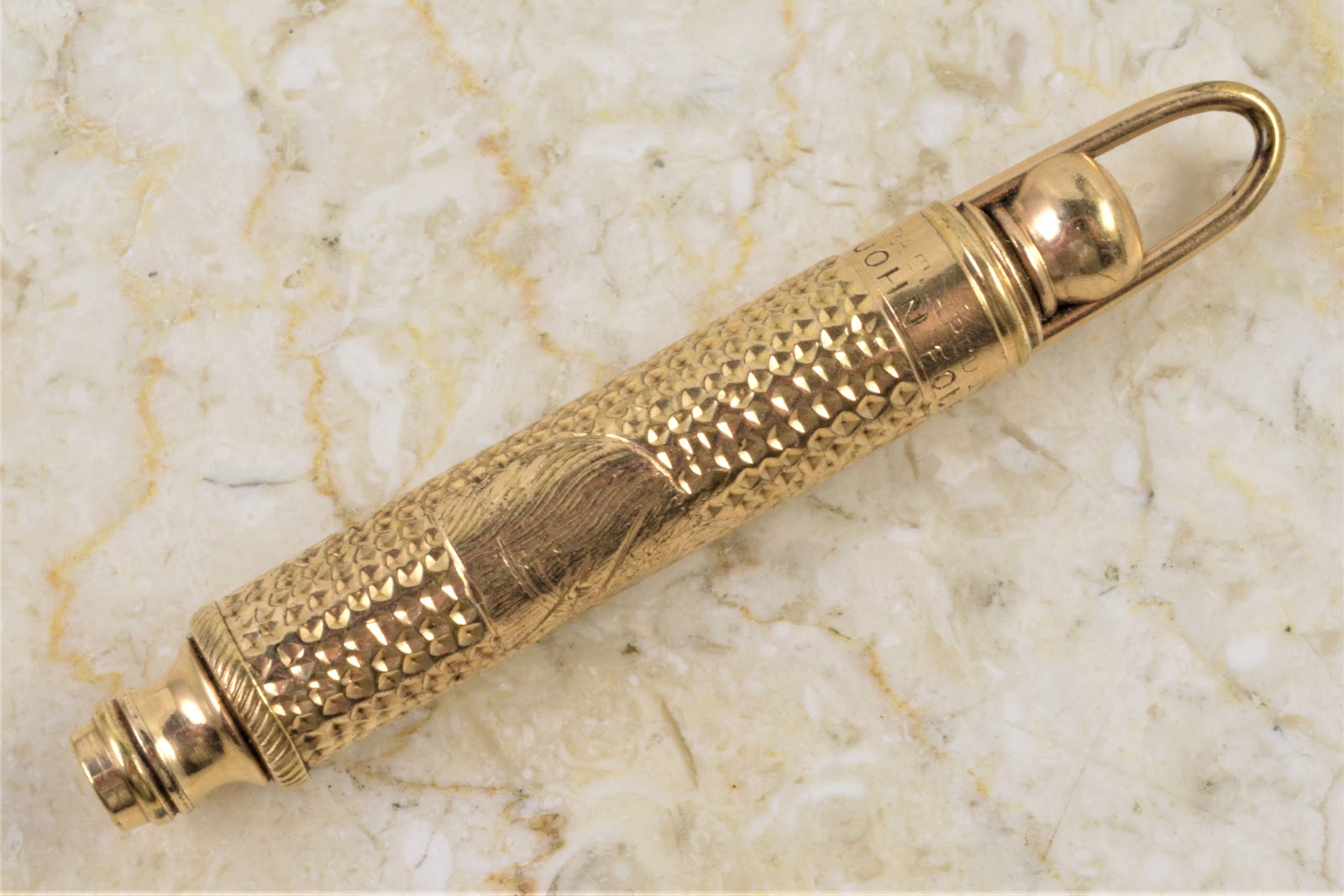
This is the last installment in a three-part series about John Foley, the New York "gold pen man." The first installment is posted here.
Democracy often needs people and personalities who fit more comfortably on the battlefield for freedom than they would at cocktail parties. It is difficult to imagine Patrick Henry exclaiming “Give me Liberty or give me death,” then calming down enough to add “and pass the cheese dip, please.”
John Foley, from all indications, was that very sort of character. Foley ventured into politics to play a significant role in toppling Boss Tweed’s corrupt Tammany Ring because he wasn’t afraid of a fight; by 1875, that fight was over, but Foley wasn’t out of fight.
For a time, John Foley appeared to settle comfortably back into his gold pen business, setting up shop at 2 Astor House, New York.

Astor House had been one of New York’s premier hotels, built by John Jacob Astor and opened in 1836. By 1876, the aging hotel’s glamour had faded somewhat, and portions of the building were being carved out and rented by various merchants. This image, from Wikipedia, is attributed to circa 1905:

Foley’s self-published 1875 “History of Foley’s Gold Pens,” as discussed yesterday, doesn’t contain much history specific to John Foley, other than his summary of the Tammany Hall affair. It does, however, contain extensive catalog images of John Foley’s products. No “Madeleine” pencils are shown, but there is a page showing hard rubber combination dip pens and pencils made pursuant to John Mabie’s October 3, 1854 patent, like the example I acquired from Scott Jones.


Foley’s shop in Astor House was likely more showroom than factory, and while the catalog pages all show holders marked with Foley’s name, all of these penholders and pencil cases were probably sourced from other New York manufacturers, like the Mabie Todd & Co. combination holders. The only items made in-house by Foley were his nibs, perhaps on-site, but he might have had a small manufacturing site elsewhere.
We do know that in 1876, John Foley purchased property at Bainbridge Street and Lewis Avenue in Brooklyn, because he was mixed up in a mortgage dispute that resulted in a mandamus action to correct the records, as reported in the Brooklyn Eagle on May 18, 1876:

Tracking John Foley’s activities in New York newspapers is made difficult by the fact that Foley never used a middle initial in his advertisements nor throughout the press reports concerning the Tammany Hall affair. There were many other people named John Foley in New York, including lumbermen, engineers, attorneys, thugs in the crime pages, and even murderers, most of whose names included a middle initial. Reports concerning Foley "the gold pen man" best pinpoint those reports concerning our man, but I still think the one in this litigation is our guy: it’s a John Foley, in court, asking for an extraordinary remedy for someone to be “mandamused” (that turn of phrase made me chuckle).
Foley’s fortunes began to turn in 1879, when his wealthy wife died and left her fortune to their children rather than to her husband. On February 24, 1880, John Foley advertised his residence on East 73rd Street for rent in the New York Tribune, and again in early 1881; on October 3, 1881 the New York Times reported that a fire caused $1,000 in damage to the property – a much larger sum than it sounds, adjusting for inflation in the 150 years since. Perhaps in order to recoup his losses, Foley advertised more heavily soon after the fire, and his advertisements specify that he had diversified into manufacturing “Foley’s Patent Stylographic Pen or Ink Pencil.”

John Foley never patented a stylographic pen, according to all my research that went into writing American Writing Instrument Patents 1799-1910, and I have no evidence regarding what patents, if any, he licensed. All that is certain is that he did not acquire rights from the MacKinnon Pen Company, one of the most prolific stylographic pen manufacturers at the time. We know this because MacKinnon sued Foley for patent infringement in 1882. After a trial, Foley won the case as reported in the New York Tribune on February 25, 1882; a more detailed report followed in the Tribune on March 3, which said that while MacKinnon’s attorney’s called 12 witnesses, Foley alone testified in his defense. According to the report, Foley’s “prompt and frank statement” was all that it took to convince judge and jury to find in his favor.

Foley’s fame and influence was going to his head as his money troubles continued to mount. On February 28, 1883, the New York Times reported that legislation that had been introduced to pay John Foley for his services as Supervisor during his fight with the Tweed organization. He had done a great service and dedicated most of his life to taking Tweed down, but in the process he was never paid for the work that he did.

In 1885, one of Foley’s traveling salesman, Jerome B. Shaw, was arrested and faced charges of embezzling from Foley. The report published in the New York Times on February 13, 1885 indicated that the authorities were holding Shaw on just two instances of theft, “but the complainant asserts that at least 100 similar complaints could be made against him if necessary.”

The Sun’s coverage of the incident published the same day added some context to Foley’s allegations against Shaw - the salesman already had an active case pending against John Foley for libel at the time the allegations were made.

No report details what became of either case, suggesting both Shaw’s case and the charges of embezzlement were dismissed, leaving Foley’s reputation somewhat tarnished in the process. Things got worse in 1888: on January 23, 1888, the New York Evening World published a news story regarding an unusual dispute between John Foley and a tenant. Foley had sublet part of his venerable Astor House location to a “ticket scalper,” then padlocked a portion of the area he had subleased. After the tenant’s clerk removed the lock to retrieve his belongings, John Foley had the clerk arrested and charged with malicious mischief.
In the MacKinnon case six years earlier, all the court needed was John Foley’s word and sterling reputation; this time was much different. Even though “Foley said twenty words to [his tenant’s] one,” the case was dismissed. In fact, the Judge reprimanded Foley for his outrageous behavior and threatened to fine him for contempt.

Foley was aggrieved yet again in May 1888, and the New York Tribune reported on “John Foley’s Peculiar Actions” on May 11, 1888. Foley was becoming well known for his bizarre attempts to seek the imprisonment of anybody whom he believed had wronged him, and in this case he believed a man named Clarence Foster had stolen a small amount from him. The police had arrested Foster but released him due to a lack of evidence, so Foley found out who was on the sitting grand jury and visited the foreman at his home in a misguided attempt to persuade him to begin an investigation.
Denied justice again, Foley burst into the office of the acting district attorney to demand that a case be opened - after being turned away, he came back a second time and became so agitated that an officer was called to remove him from the premises. Shortly after, one of John Foley’s sons appeared at the District Attorney’s office to ask whether the subpoena he had received to testify was genuine - police confirmed that the subpoena was a forgery, and Foley’s son said he thought he had seen his father writing it.

The Foley family was imploding. John had served as executor of his wife’s estate since her passing in 1879, leaving her estate to their children. In the nine years since, John had never accounted to the courts or to his children with respect to how her assets were being administered. Tensions in the Foley family reached a breaking point in 1888: one of John Foley’s sons, Daniel L. Foley, left his father’s employ and founded D.L. Foley & Co. Daniel’s story is amply covered by David Nishimura’s article posted here.
Another of John’s sons, John Foley Jr., also began his own gold pen business in 1888, but his story was far messier. John Jr. had been employed by his father at 2 Astor House, Broadway, where Foley had been operating since his glory days as an outspoken reformer. However, in May of 1885 the Astors raised John Foley’s rent, and Foley was forced to relocate to 18 John Street, New York. After the move, John Jr., began asking his father questions about how he was handling his mother’s estate, since he had yet to see a penny of his inheritance. Rather than answering his son’s questions, John Sr. fired the 21-year-old on the spot.
Junior can’t be blamed for what he did next. He secured financial backing from friends, leased his father’s old shop space at 2 Astor House, and hung out a shingle selling pens as John Foley Jr. John Jr. enjoyed immediate and substantial success, and his proud father promptly sued him in an attempt to restrain his son from selling gold pens under the name “Foley.”
John Foley, once the toast of the town for taking down Boss Tweed, and the man whose gravitas in the MacKinnon patent fight was enough to carry the day singlehandedly, was reduced to being referred to as “that man of many litigations” in the report of the trial, published in the Evening World on October 15, 1888.

John Foley Jr. won the case, but that didn’t stop John Sr. from publishing notices in several newspapers to “warn” the public that “TWO concerns, presumably unable to sell pens of their own manufacture, are making Pens claimed by them to be FOLEY’S GOLD PENS,” that he is engaged in litigation to stop this “FRAUD and PIRACY,” and calling on the public to “AID THE CAUSE OF JUSTICE AND FAIR DEALING” by withholding payment to those who sold them.

John Jr. can therefore not be blamed for what he did next . . . again. On November 14, 1888, the Brooklyn Daily Times reported that John Jr. sued his father for mishandling assets of his mother’s estate after it was clear that his father had sold one of his mother’s properties to one of his clerks for a nominal sum, then bought it back from him. The judge set aside all of the fraudulent dealings.

John Sr. was becoming increasingly desperate and sought outside investors to remain in business. On January 19, 1889, the New York Times reported that Foley had gone into business with Samuel R. Mann to form the Foley Gold Pen Company. Mann was affiliated with the Rockford Watch Company; other directors were Frank Bowman, Dr. J. Blake White, and Thomas Bishop, according to the New York Tribune on January 18, 1889.

The Foley Gold Pen Company may never have gotten off the ground, since the only time the name appeared in newspapers was in these two reports of the company’s formation. In April, 1889, John Jr. closed the net further, taking matters into his own hands and filing a partition action to force the sale of some of his mother’s properties. The foreclosure sale was set for April 18, 1889, according to the sale notice published in the Brooklyn Eagle on April 3, 1889.
Neither father nor son backed down in this battle of wills. On July 14, 1890, John Sr. published notice in the New York Times that he had relocated – of all places – to 7 Astor House, with an added jab that “IMITATION PENS bearing my name are sold in my former store in the Astor House block.”

John Sr. would be in court again in 1891, this time as the star witness for the defense after John Jr. sued Samuel Bennett & Co. Bennett had refused to pay for nibs they had received, claiming they were not genuine “John Foley pens.” Despite father’s testimony that his son’s nibs were nothing but an inferior copy of the genuine article, John Jr. won.

Foley remained at 7 Astor House, lobbing spitwads at his son, through at least 1892. By the time the 1894 New York City Directory was published, he had relocated to 183 Broadway:

John Foley remained in business at the Broadway location until August 1898, when Foley sold his business to Joseph R. Jackson, Jr.; however, the story does not end there. The details of the transaction were reported in The Jewelers’ Circular and Horological Review on April 26, 1899: Jackson had purchased the business, including the storefront at 187 Broadway (note: at some point John Foley may have moved next door from 183 Broadway) and the factory leased at 5 and 7 Dey Street, New York. The purchase price was $15,000 – $4,000 up front, with a mortgage for $11,000 securing the balance payable to Foley’s new wife, Elma. Foley agreed to a 10-year noncompete clause, and he and Elma continued to work at the Dey Street factory.
After the sale was completed, Jackson learned that John Foley had grossly overstated the value of his machinery, the amount of his annual sales, and the quality of his reputation. Jackson sued Foley for fraud, seeking the return of his down payment and a declaration that the mortgage he had given to Foley’s wife be declared void.

After a three-day trial, Judge Keogh granted judgment in Jackson’s favor, awarding him $4,098 in damages against John Foley and unwinding the transaction. On July 29, 1899, the New York Tribune reported that the Sheriff had executed on Jackson’s judgment, selling off all of the office furniture and stock of gold pens at 5 and 7 Dey Street. “[A]t one time [Foley] was a leader in the trade, but in the last ten years business has decreased and he has been in considerable family litigation,” the report reads. The sale realized only $600 to be applied to Jackson’s judgment, so on November 14, 1899 the New York Times reported that a receiver had been appointed to liquidate whatever remained of John Foley’s business.

Foley fought his cause against Jackson to the end, but the judgment against him was affirmed on appeal; the decision was reported in the New York Tribune on July 19, 1900. He died on August 24, 1903, and obituaries published across the country lionized him for his singlehanded fight against Boss Tweed’s corruption.

It was John Foley’s struggle against public corruption rather than his reputation as the “gold pen man” that would become his legacy. He had pursued justice “with such vigor that his opponents called him a common scold,” but by the end of his life John Foley had nobody left in his life but opponents, including his own family. Obituaries reported that John Foley was survived by his wife Elma and by the eight children he had with his first wife; none of these children were identified by name, so whether Michael Foley was acknowledged as one of John Foley’s sons was never answered.
The manner in which all of Foley’s other relationships had collapsed by the end of his life gives the pencil that inspired this series of articles even greater meaning:

John Foley’s tender memorialization of his daughter Madeleine’s name is a solitary and poignant reminder that through all of his struggles, maybe just one of his children was still by his side at the end.
At least, that’s how I prefer to look at it.