Showing posts with label Eagle Automatic. Show all posts

Tuesday, February 13, 2018

Hoffman and Boman Ride Again

This article has been edited and included in The Leadhead's Pencil Blog Volume 5; copies are available print on demand through Amazon here, and I offer an ebook version in pdf format at the Legendary Lead Company here.

If you don't want the book but you enjoy this article, please consider supporting the Blog project here.

The Eagle Pencil Company is one of my favorite manufacturers to collect, since the dizzying array of innovations the company introduced – some great, some just plain goofy – provides endless variety.

One of the best ideas the company had was that of the “Automatic” or “Stop Gauge” pencil, first patented by Joseph Hoffman in 1879 and later refined in 1885 by Claes Boman.  These thick lead pencils, which merely held lead in a chuck that would be released by the press of a button on the aft end, are the great granddaddy of all techincal leadholders and all modern “clutch” style pencils,

There were also later incarnations of the Stop Gauge, such as these:


These things are like an elephant hiding in the corner.  Although they are much larger than most pencils, for some reason they just don’t jump out at you as much as you would expect, and it wasn’t until just a couple years ago that I know they existed.  At the tip end you’ll find the characteristc thick lead and gripping jaws:


On the cap, they are identified as the “Clutch” No. 692 – and with a more recent patent number of 2,134,570:


The patent number refers to Joseph Meilner’s pencil, for which he applied for a patent on May 17, 1935 and which was granted on October 25, 1938:


I’ve read and reread the text of the patent, and I honestly can’t tell what was new and exciting about Meilner’s incarnation of the pencil.  Even the sharpener built into the cap he states is just an optional bit, and nothing is claimed as patentable for that feature (besides, it was opted out in all three of my examples). 

There was another less robust version of the Stop Gauge , too: the model number 10, which more closely resembled its ancestor.  There’s one shown amongst the early Eagles pictured on page 45 of The Catalogue, It’s the gold colored one near the middle:


I don’t think this one belongs in the company of Victorian Eagles, though.  While the design is older (notwithstanding the “Pat. Pend.” imprint), the No.10 probably dates to the 1930s – this example turned up on a store card with an Eagle logo dating to the Depression, and referring to it on the card only as the Eagle “Prestop”:


Note also the indication that the Prestop took a four-inch lead, which also places this example squarely in the “Square 4" era. 

Lastly, along the lines of the Clutch and the No. 10 is this odd duck:


This one shares the same overall appearance of the No. 10 and uses a thicker lead like the “Clutch,” but this has a nose drive twist mechanism:


Chris Egolf turned this one up for me.  It’s an Eagle “75-60,” and it apparently cost twenty cents, twice the price of the number 10:


The numbering is significant . . . or maybe it isn’t.  In its earliest incarnation, the Stop Gauge was sometimes referred to as the “Automatic.”   In the the thirties, Eagle applied the name to a spiral drive plastic pencils - with a 75- model number, and the “Giant Automatics,” the large souvenir pencils with a conventional nose drive stuck in the front end, which all share a 75- prefix as well. 

Saturday, August 12, 2017

What a Box!

This article has been edited and included in The Leadhead's Pencil Blog Volume 5; copies are available print on demand through Amazon here, and I offer an ebook version in pdf format at the Legendary Lead Company here.

If you don't want the book but you enjoy this article, please consider supporting the Blog project here.

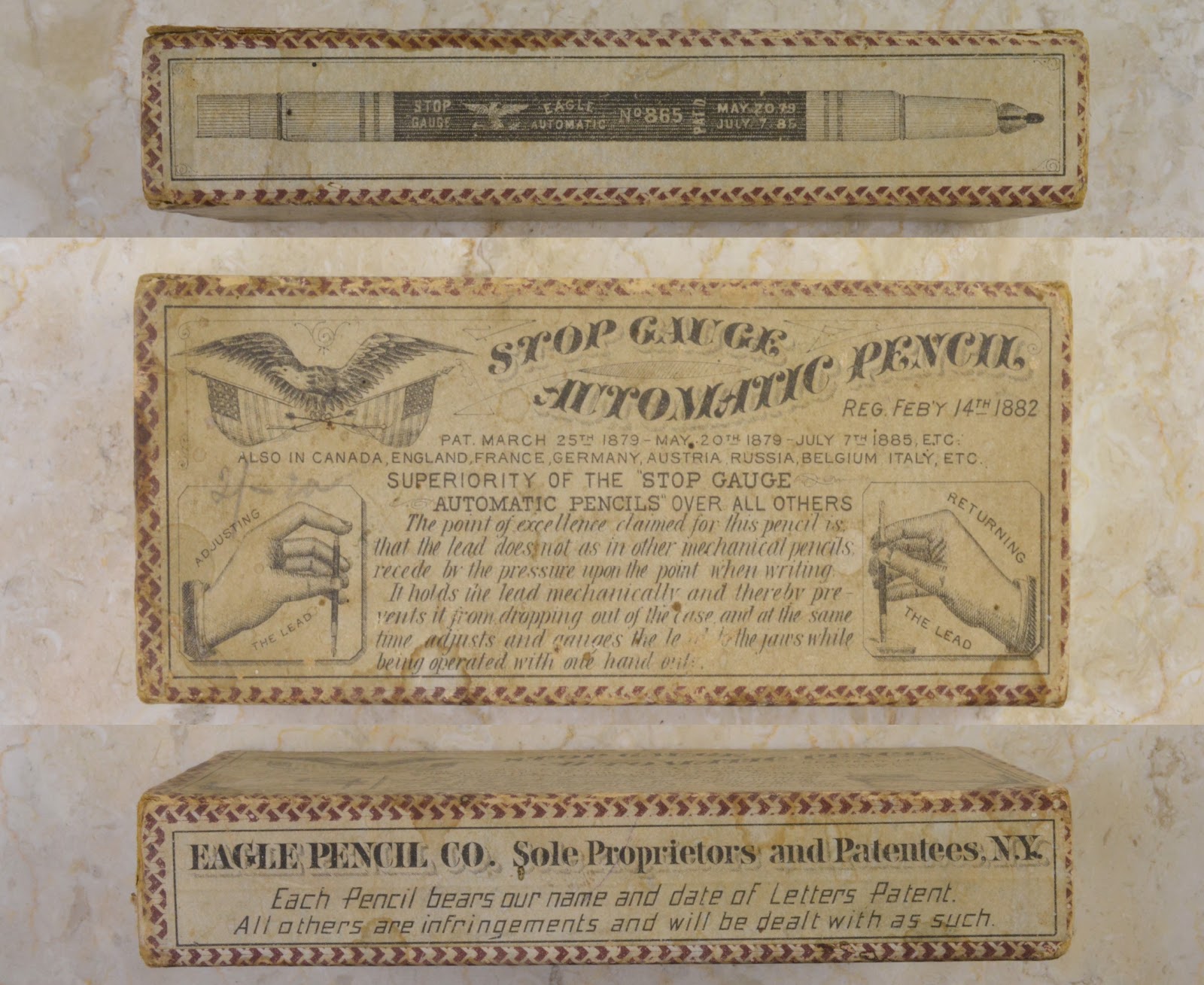
Since I spent so much time yesterday talking about Eagle Automatics, it seemed a good time to show off one that came my way recently:


The top of the box was a little rough, but it was unusual in having two drawers, one for the pencil and one containing a box of copying leads:


Both the pencil and the leads I have, and neither is particularly noteworthy.  What is special is the other three sides of the box, which are very well preserved and which contain some amazing graphics and some interesting language:


In particular, note what’s written on that bottom panel:


“Each pencil bears our name and date of Letters Patent.  All others are infringements and will be dealt with as such.”

What’s interesting to me is the ominous nature of the warning.  Yes, Eagle emblazoned nearly everything they made with patent dates and when it came to both patents and trademarks the company was both prolific and territorial.  However, a warning like this suggests that there was at least one product which actually infringed upon Eagle’s patents – or was close enough to justify such strong language.

Now to find the “all others!”

Friday, August 11, 2017

A Different Take on a Familiar Name

This article has been edited and included in The Leadhead's Pencil Blog Volume 5; copies are available print on demand through Amazon here, and I offer an ebook version in pdf format at the Legendary Lead Company here.

If you don't want the book but you enjoy this article, please consider supporting the Blog project here.

In a recent auction of larger, flattop pencils online, this was not the one that interested me the most:


The pencil appeared to be a Magnum Pointer (see page 47 of The Catalogue), but in red . . . a color that I didn’t have.  Besides, I don’t think I’ve added one to my collection since I wrote the book:


But with that silver-colored trim, it doesn’t quite fit into the series.   I wondered if it might instead be part of this series:


At the Chicago Show three years ago I bought an advertisement from Terry Mawhorter referring to these as the “Silver Canary.”  The advertisement was for a third-party contest, though, with these pens and pencils being offered as a prize – so I wasn’t firmly convinced that was the name Eagle gave to it.  Unfortunately, that piece of ephemera was such an odd shape that was sure to put it someplace where it wouldn’t get damaged.  That explains why I can’t lay my hands on it to snap a picture for it now; it is amazing how few things get lost around the museum, but when things go missing they really go missing.

No worries.  It will turn up.

In the meantime, though, I don’t think this new Eagle belongs alongside the Silver Canary, since the latter sports clips which are bolted on, as well as a bell-shaped cap:


This example, just like those gold-filled Magnum Pointers, has a distinctive clip stamped “Pat. Pend.”:


I’m not sure whether the imprint relates to just the clip or to the entre pencil.  The patent for the pencil is easy: it was applied for by Otto Huber on June 6, 1929 and was issued on April 14, 1931 as number 1,800,201:


The clip, though, is a little trickier to find.  Since to my knowledge it appears only on Eagle Magnum Pointers, I checked the “Patents by Assignee” section of American Writing Instrument Patents Volume 2: 1911-1945, and none of the clip patents listed under Eagle fit the bill.  Some rainy day I’ll wade through all the clip patents to see if this patent was issued to an individual and was never assigned to Eagle – or even more fascinating, if the patent was assigned to a company other than Eagle.

Of course, it’s possible the patent was never issued at all.

There are two types of Magnum Pointers in the Eagle lineup, and this one appears to have a bit of both: the trim of the “Platinite Finish” line, and the clip of the gold-filled ones.  Note that on the platinite finish ones, the barrels are faceted and the clip matches the earlier “Ritaway” series:


Magnum Pointers are prominently marked on the cap on both series:


Which leads me to one other interesting feature on this new addition.  It isn’t marked “Magnum Pointer”


It’s marked “Automatic.”

The Automatic name has a long and varied history with the Eagle Pencil Company.  It was originally used to describe the company’s early “Stop Gauge” clutch pencils and was registered as a trademark by Eagle (yes, it’s included in American Writing Instrument Trademarks 1870-1953) as number 9,102 on February 14, 1882:


The name was also applied to later Eagle pencils, both the thin model Automatics frequently found with “Property of U.S. Government” imprints as well as the wooden Giant Automatics, including those painted with Chicago Worlds’ Fair, Popeye and other souvenir scenes.

Does this mean my example comes before, after or during the Platinite Finish and gold filled Magnum Pointers?  I’ve always been inclined to think Platinite Finish Magnum Pointers came first, since they carried over features from earlier lines, while the gold filled ones were a later, more refined step.  Since the skinny plastic Automatic wasn’t patented until a bit later, after flattop pencils such as these had become passe, I’m inclined to think that after upscaling the Magnum Pointer line with gold filled trim, Eagle reverted back to Platinite trim to cut costs and revived an old and venerable name in an effort to boost sales – shortly before abandoning everything but the Automatic name.

Sunday, November 20, 2016

For Those Who Like Advertisers

This article has been edited and included in The Leadhead's Pencil Blog Volume 4; copies are available print on demand through Amazon here, and I offer an ebook version in pdf format at the Legendary Lead Company here.

If you don't want the book but you enjoy this article, please consider supporting the Blog project here.

I almost cast this one aside when it popped out of the boxful of pencils I bought in DC: sure, it’s a neat graphic of a clothespin, I thought, but do I really need to start collecting those?


Fortunately, curiosity drove me to see what was inside.  While the pencil is unmarked, it is without doubt a chubby version of the Eagle automatic, printed with the same graphics from the box lid:


Monday, December 22, 2014

The Pencil That Isn't

Joe Nemecek asked me some months ago if I had ever heard of a "John Birch" pencil. I hadn’t:


The spring-loaded button on the rear end opens the jaws, which close and clamp around a piece of lead when the button is released – exactly like an Eagle Automatic. But there are two problems:


To learn more, this full article is included in The Leadhead's Pencil Blog Volume 3, available at Amazon, Barnes & Noble and everywhere else you buy books, or you can order a copy signed by yours truly through the Legendary Lead Company HERE.


Tuesday, December 9, 2014

A Couple More Eagles

When Joe Nemecek and I got together last month, we made sure to get a few pictures of some of the Eagles Joe has been turning up lately. First, he managed to score another of the goliath Eagle Automatic pencils:


I wrote about my red example a couple years ago (http://leadheadpencils.blogspot.com/2012/05/will-gentleman-from-bulgaria-please.html); here it was compared to a normal Automatic . . .

To learn more, this full article is included in The Leadhead's Pencil Blog Volume 3, available at Amazon, Barnes & Noble and everywhere else you buy books, or you can order a copy signed by yours truly through the Legendary Lead Company HERE.


Thursday, September 27, 2012

Drop The Quotations

Way back on February 14, I wrote an article on Eagle Drop pencils. A few weeks ago, I was rereading that article to see if I put the phrase "Drop pencil" in quotes – I’d always heard them called that, and the name fits perfectly for what they do, but the only words on the examples I’d found were "Eagle Pencil Co." and the patent dates.

I try to be careful when I don’t have any evidence that a title for a pencil is the formal name given to it by its manufacturer, because otherwise it’s simply a descriptive collector’s nickname that we use today as a matter of convenience. I probably should apologize that I didn’t say "drop pencil" is a nickname.

But I can’t.

A while back, a seller in an online auction who didn’t appear to know beans about pencils included in his description of a fuzzy picture showing several pencils that one was an Eagle Drop pencil. Here it is . . .

NOTE:  This article is now included in the print version of The Leadhead's Pencil Blog, available anywhere you buy books, or also from The Legendary Lead Company.

To order, here's the link:  Volume 1 at Legendary Lead Company