Showing posts with label Keene. Show all posts

Sunday, June 20, 2021

Rib Night at the Museum

This article has been included in The Leadhead's Pencil Blog Volume 7, now available here.
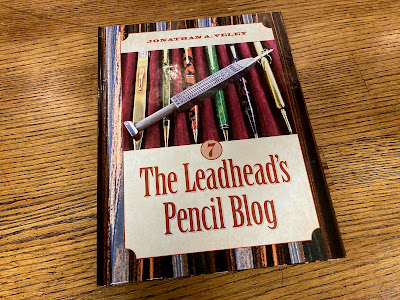

If you don't want the book but you enjoy the article, please consider supporting the Blog project here.

There’s something I want you to notice about that “sterling”(ish) Morrison ringtop from yesterday’s article: that little ring just beneath the cap:


A “tell,” I call it . . . a distinctive little feature that suggests connection with other brands.  The diamonds around the crown are another one.  I’ve come to believe that the Rex Manufacturing Company was quietly working behind the scenes making all of these, shortly before McNary’s patent launched the company onto its trajectory into “stardom,” in my little world.

Recently, a couple other ribbed pencils came my way.  The first is this one:


The name on this one is “Wilrite” – another one that I thought had made the blog before, but I don’t see it. 


 I know I took pictures of one at the Baltimore Show, back when it was at the Tremont Grand.   I don’t remember who had it, but it’s the full-size set along the same lines:


Inside the box lid, there’s a neat logo with “Reg. U.S. Pat. Off.” beneath it:


That’s a cue to check trademarks registered with the Patent Office, and the Wilrite trademark is included in American Writing Instrument Trademarks 1870-1953:


Gustave Rappeport, as Secretary and Treasurer of the Wilrite Fountain Pen Corporation, claimed that the company had used the mark since January, 1922, and the company’s address was 312-314 Lafayette Street, New York City as of the date of the application, January 23, 1925.

The trademark application must have been filed while the company was in the process of moving.  A Wilrite  advertisement for sales representatives in the Chicago Tribune on March 22, 1925 identified the company’s address as 1493 Broadway:


Morrison, according to the trademark filing in yesterday’s article, was offering pencils with that same little rib near the top just a few doors down, at 1547 Broadway.  In fact, New York seems to be the common denominator for a lot of these:


The first two beneath the Wilrite have that same rib, but the top ends and crowns are different.  You’ve seen them before: the “Bonnwear” (Volume 3, page 33 and most recently in Volume 6, page 25):


And the Ever-Rite (Volume 3, page 71).  Note that the color of the cap is slightly different from the barrel, so I can’t say with certainty that it isn’t a replacement:


The Bonnwear and Ever-Rite have a Sheafferesque mechanism, which has led me back down that rabbit hole several times.  The others, however, have caps that just pull off just like the Wilrite.  From top to bottom, there’s a “Keene New York,” sporting a cap with diamonds around the crown, like the Morrison:


A “Just-Rite / P.S.M. Co” (see Volume 4, page 147), with those same diamonds:


A “Handy Pencil,” also with those diamonds:


And a “Newark Pen Co.,” with the same ribbing on the top as the Wilrite:


After these pictures were taken, another one surfaced in an online auction:
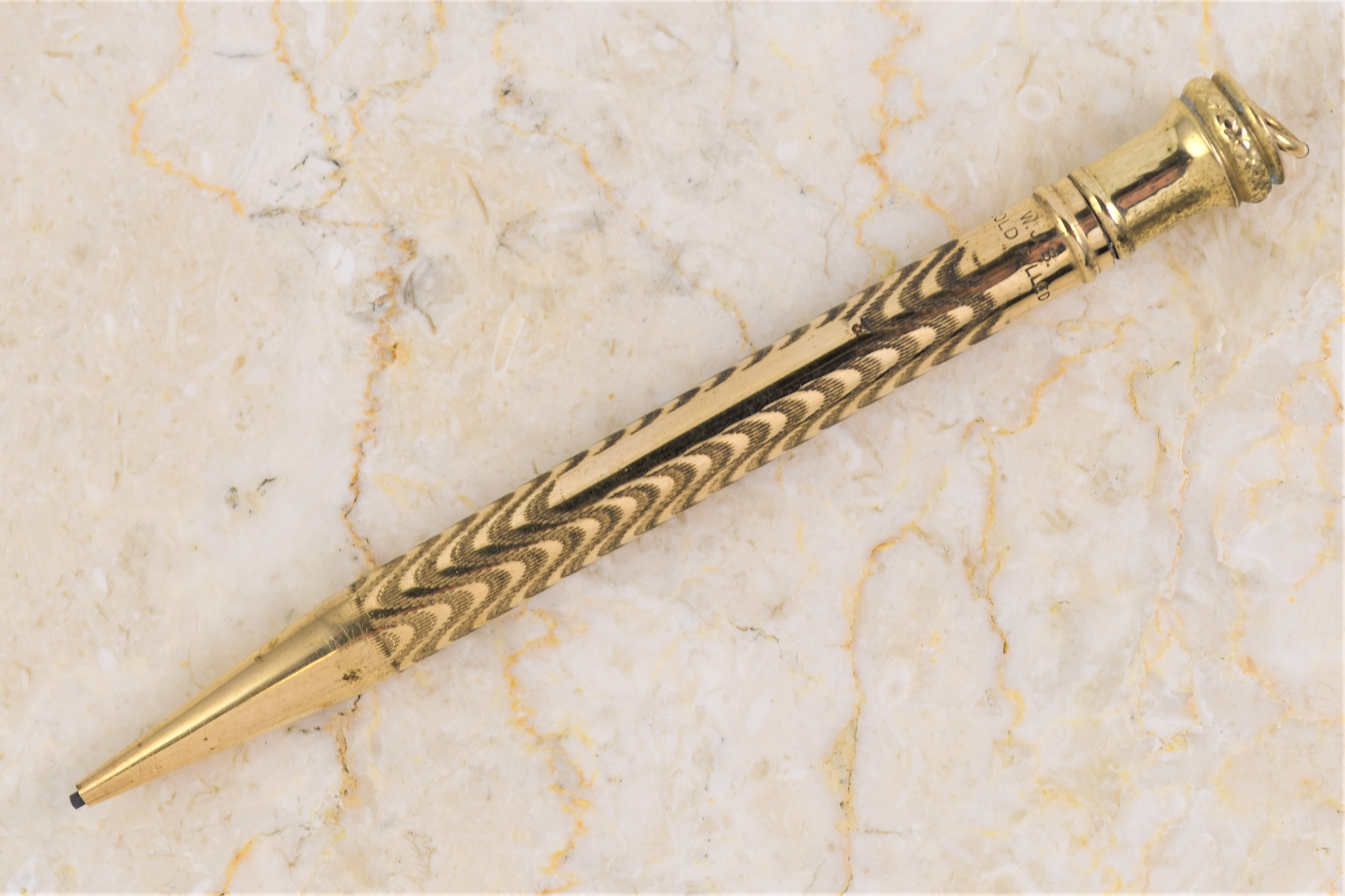

This one also has diamonds around the crown, and another shadowy imprint – “W.J.B.”:


I’m confident that the same firm made the ribbed pencils marked Morrison, Wilrite, Keene, Just-Rite, Handy Pencil, Newark Pen Co., and W.J.B.  It definitely wasn’t Keene, because he was a jeweler, not a manufacturer (see Volume 5, page 285).  I suspect it wasn’t Morrison or Newark Pen, since both were mainly in the pen business.  

That leaves open the P.S.M. Co., maker of the “Just-Rite,” whoever this W.J.B. was, and whoever made the “Handy Pencil.” 

Or someone else entirely.  I haven’t given up on Rex as a possibility, but as of this writing I don’t have enough information.

Sunday, March 29, 2020

One Meene Greene Keene

This article has been edited and included in The Leadhead's Pencil Blog Volume 6, now on sale at The Legendary Lead Company.  I have just a few hard copies left of the first printing, available here, and an ebook version in pdf format is available for download here.

If you don't want the book but you enjoy this article, please consider supporting the Blog project here.

Charles A. Keene is a fascinating character . . . one of the last articles I ran before I quit writing here the last time was his biography.  The article ran in October, 2018 at https://leadheadpencils.blogspot.com/2018/10/charles-keene.html.

The earlier metal Keene-marked pencils are a cult thing, known only to a few hardcore pencil guys since there were no matching pens.  Later examples, accompanied by large matching fountain pens, are somewhat better known and were obviously made by Eclipse, as you can see from the use of Eclipse’s 1923 patent clips.


Yeah, that pen with a price tag is killer -- the “Big Bill.”  I haven’t thought about it in years, and it figured into an article I posted here that has long since been the victim of Google’s image-cleansing purge.  For those who have the print or ebook version of The Leadhead’s Pencil Blog there’s more about that one in Volume 2, on page 50.

I’ve heard of all-black barrel Keene pencils, in addition to the red and mottled (kinda) hard rubber versions.  But outside of black, red and both, I never knew of anything else.  It always seemed odd to me that the flamboyant Keene, hiring a manufacturer that used a lot of brightly colored plastics, didn’t custom order some pens and pencils with a bit more flair to them.

Until a chance find online turned this one up:


I’m loving that green swirled color.   Eclipse clips are a pain in the behind to try to repair, adjust or replace, so I have no doubt that this Keene clip is what was originally installed.   If there are other interesting Eclipse pencils out there with Keene clips, I’d like to know about them.

Friday, October 26, 2018

Charles A. Keene

This article has been edited and included in The Leadhead's Pencil Blog Volume 5; copies are available print on demand through Amazon here, and I offer an ebook version in pdf format at the Legendary Lead Company here.

If you don't want the book but you enjoy this article, please consider supporting the Blog project here.

I wasn’t planning on writing about Charles A. Keene, but one online score has me revisiting the subject.   Marked “Charles A. Keene / 180 Broadway,” this one twists in the middle to advance a very Victorian-looking mechanism:


Keene is best known for the large flattop pens and pencils made by Eclipse (the pen was called the “Big Bill” – see Volume 2, page 50).  I’ve also run across thin-barreled metal pencils in sheaths (Volume 4, page 213).  Here’s all of them together:


Something bothered me about this latest find, because it looked so much older than the others.  This led me to check around to see what I could find about Keene: sources I’ve read only refer to him dismissively as a “New York jeweler,” but there was much more to the man and his business.

Other jewelers hated him.

Keene was born in 1866.  According to his own advertisements, he claimed to have founded his jewelers business in 1881, but that date must have been when he first went into apprenticeship; this advertisement, which appeared in the Brooklyn Daily Eagle on November 27, 1898, states that he had gone into business 14 years earlier – in 1884 – “after serving for years under the leading masters of my profession”:


Keene started his career, not in New York, but in Boston, with what appears to have been a tempestuous family relationship.  On December 17, 1887, the Boston Globe reported that a 21-year-old Keene had been arrested and jailed for “an assault upon his wife’s mother”:


What became of the matter was not reported, so far as I can tell, nor do I know whether the young man’s marriage withstood the incident.   If the charges weren’t dropped, young Charles did not serve a significant sentence:  “KEENE, the Jeweller” began advertising in the Globe in early 1889, at 1301 Washington Street, Boston.  This advertisement is from January 27, 1889:


1301 Washington Street was the former address of Keith & Company, a jewelry firm.  It is possible this is where Keene apprenticed (advertisement from the July 22, 1882 edition of the Globe):


“Keene Optical Company” also advertised its services at 1301 Washington Street, Boston.  This is from the Globe on October 29, 1889:


Keene suffered a violent robbery on January 8, 1890, when theives barred the door, smashed out the front windows and ran off with all the stock they could carry.  The robbery made national news – this account appeared in the Buffalo Evening News on January 8, 1890:


The robbery may not have been random, because Keene wasn’t making any friends within the trade.  On November 1, 1891, the Boston Globe reported that other Boston jewellers were complaining bitterly that Keene was selling watches below wholesale cost:


Keene had a flair for the dramatic, and undeterred by any grumblings from his competitors, he became a prolific advertiser of cut-rate jewelry.  In the Globe on December 18, 1892, he announced “Keene’s Big Undertaking,” his liquidation of a Boston jobber’s stock:


Around 1898, Keene established shop in New York, at 140 Fulton.  He shows up in the 1898 Trow’s directory at that location:


The move might have overextended him: on Christmas Day, 1898, he announced he was “compelled” to sell off a large stock of watches at “Keene’s Watch Store.”


During this time, he continued to maintain locations in both New York and Boston, as this advertisement in the October 14, 1900 edition of the Brooklyn Daily Eagle indicates:


On April 11, 1902, Keene’s Watch Store ran a large advertisement in The New York Times for a clearance sale, “‘Clearing up clean’ prior to ‘Removal’ to our handsome new store, 180 Broadway.”


There was a secret to Keene’s success, and it wasn’t just buying in quantity.  At the time, the United States aggressively protected domestic manufacturers through tariffs – taxes on imported goods.  While these tariffs allowed manufacturers to charge higher prices at home, frequently companies would “dump” excess product in foreign markets to make it less economical for foreign companies to make competing products, even for consumption on their own turf.

Charles A. Keene figured out that he could travel abroad, buy goods that were dumped there by American companies, and reimport them back into the United States.  Even after he paid the tariffs due, he was able to sell the reimported goods for far less than the wholesale prices U.S. companies charged dealers for goods that were made and sold here.

Keene's success made him a lot of enemies - particularly in the “Watch Trust,” a group of manufacturers dedicated to maintaining prices through ensuring that American watches would not be sold for less than a price they considered reasonable.  On April 4, 1907, Keene, as President of the Independent Watch Dealers’ Association, met with the Assistant U.S. Attorney General to discuss the Department of Justice’s investigation into the Watch Trust’s activities, as reported in the May 4, 1907 edition of The Fitchburg (Massachusetts) Sentinel:


In 1911, the Waltham Watch Company had enough with Keene and sued him on a theory that due to Waltham’s patents, the watch company could prohibit Keene from selling its patented watches for less than Waltham sold the same products to its dealers.  The filing of the lawsuit was reported in The New York Times on April 8, 1911:


Keene won the case, but it wasn’t until 1914 before the United States Supreme Court denied Waltham’s appeals.  At almost exactly the same time, curious notices start appearing in Keene’s advertising: some unscrupulous jeweler set up shop next door to Keene and was apparently trying to undermine Keene’s business.  This notice was in the December 30, 1914 issue of the New York Evening World:


The only advertisements I can find for writing instrument offered by Keene were around this time, as well.  On April 16, 1914, the New York Evening World ran this advertisement for gold filled pencils:


A few months later, beginning in October, 1914, Keene advertised clutch pencils.  This advertisement, in the December 16, 1914 edition of the Evening World, states that Keene would offer ten thousand gold filled and sterling clutch pencils:


He also offered pens, much earlier than the Keene pens made by Eclipse.  The following advertisement for “Keene’s Self Filler Safety Fountain Pens” appeared in The Kingston (New York) Daily Freeman on August 25, 1916:


In 1922, Keene faced criminal charges for passing off a belt buckle as sterling, when the attachment was made of baser metal.  He was convicted, but the judge suspended his sentence after finding that Keene did not intend to deceive; Keene explained that the attachment could not be made of softer sterling because it would not be strong enough.  This was reported in the Evening World on June 23, 1922.


The company remained in business until 1932, when an auctioneer was retained to sell Keene’s remaining stock upon his retirement, as advertised in the New York Daily News on March 16, 1932:


Charles A. Keene died on July 26, 1947, back in the Boston area where his career started.


Saturday, October 15, 2016

It Was Worse Than a Dent

This article has been edited and included in The Leadhead's Pencil Blog Volume 4; copies are available print on demand through Amazon here, and I offer an ebook version in pdf format at the Legendary Lead Company here.

If you don't want the book but you enjoy this article, please consider supporting the Blog project here.

A couple years ago, I got more than a buck’s worth of fun out of a Keene pencil with an enormous dent in the barrel (see “Just Because it Exists” at http://leadheadpencils.blogspot.com/2015/01/just-because-it-exists.html):


I learned at the Triangle Pen Show that there was more wrong with that one that just the big dent in the side, when this one came out of Rob Bader’s junk box:


It is missing the decorative sheath into which the pencil fits:


And it wasn’t 1/4 12K gold fill . . .


It was 1/40.

Monday, January 19, 2015

Just Because It Exists

Condition is everything, some will say. Pass on an example with issues and wait for a clean one – so goes the conventional widsom. "They didn’t just make one," I’ve even been known to say.

But when it’s just a buck or two in a junk box, and it fills in a little bit of a story I’d like to tell, I don’t play according to Hoyle:


To learn more, this full article is included in The Leadhead's Pencil Blog Volume 3, available at Amazon, Barnes & Noble and everywhere else you buy books, or you can order a copy signed by yours truly through the Legendary Lead Company HERE.


Saturday, February 16, 2013

A Couple Keene Bits of New Information

At the Philadelphia Show, Leonard Finkel had this fantastic Keene pencil on his table:


I just had to have it, because I just knew how nice it would look next to the one I had at home:


To learn more, this full article is included in The Leadhead's Pencil Blog Volume 2, available at Amazon, Barnes & Noble and everywhere else you buy books, or you can order a copy signed by yours truly through the Legendary Lead Company HERE.