Showing posts with label Laughlin. Show all posts

Wednesday, October 22, 2025

The Second, Third, and Other Shoes Drop

My only complaint about the DC Supershow, held every August, is that so many of my friends are there that it is a challenge finding more than a few minutes to talk with each of them. Things only slow down to a reasonable pace on Sunday, by which time everyone is so thoroughly exhausted and “peopled” out that we are collectively ready to return to our normal, quirky lives.

I don’t even bother to set up on Thursday, so I can see everyone and share things we brought to show each other; I’ll typically have a backpack containing only a case of things I brought to show people and a bottle of Jameson’s. Both are typically empty by the time festivities end on that first day.

As I wandered about the room, my old friend R. George Adams flagged me down. R. George, you may recall, found that weird Stylofede pencil for me (see “The Pencil and the Tramp” on August 5, 2025), and he’s got a great eye for the unusual and the weird. 

This time, R. George wanted to offer me some wonderful pieces out of his collection of Carter’s pens and pencils. Two of his fountain pens enamored me; usually, I’m too cheap to spend big money on fountain pens, particularly in the first few minutes after I arrive at a show, but I was unable to resist these.


At the time, I assumed one of these was a duplicate of the DeLaCo example from yesterday’s article because I couldn’t remember what the imprint read. I didn’t mind adding a complete and intact example, even if it proved to be a duplicate, but I was pleasantly surprised when I got home:


Yesterday’s DeLaCo pen is now in the company of identical pens marked Superite (DeWitt-LaFrance’s later flagship brand) and Laughlin, of Detroit, Michigan. As for the nibs, the Superite has one of those “S” marked nibs I was telling you about yesterday, and the Laughlin has a number 5 size Snapfil nib.


That Snapfil is an unusual nib, typically found on the General Manufacturing and Houston Pen Company’s Snapfil lines of fountain pens (General Manufacturing also produced those grail “Kaligraf” pencils). By the time these were made, around 1920, Laughlin was sourcing pens rather than making them; I don’t know whether the company sourced nibs and pens separately and put them together or whether this is a random replacement.

R.George had a few pencils to show me, too. They are the four examples in the middle of this next image:


Before I get to R. George’s pencils, a word about that black hard rubber example at top. It is one of the earliest of the Carter-branded pencils, a rebadged version of the hard rubber Superite pencils. The Carter Ink Company purchased DeWitt-LaFrance in 1925, but I wouldn’t discount the possibility that Carter’s was sourcing pens and pencils from DeWitt-LaFrance before the sale.

This one came to me from an online auction that closed shortly after I got home from the DC show – it’s a duplicate that’s both an upgrade in one respect and a downgrade in another:


My other black hard rubber example has badly discolored hard rubber and corroded trim . . . but it has a price sticker. Both of my black hard rubber examples have groups of lines on the barrel. DeWitt-LaFrance made identical pencils for the Rexall Drug Stores under the “Signet” line; Signet pencils had gold filled trim, and the black hard rubber ones came either with or without those groups of lines. See “Chasing and Fixing Signets” (July 8, 2021: Volume 7, page 246).

All but one of these Carter’s pencils have nickel trim rather than gold-filled, but the existence of that red hard rubber Carter with gold filled trim suggests that there’s no reason all of these others might also come with that trim . . . and the Signet line was also offered in mottled hard rubber, too. 

The first of the four Carter’s pencils that came from R. George is that great pink and white oversized pencil; these were student or utility models, I believe, and to my knowledge there were no comparable fountain pens. With an exposed eraser, I’ve only found these in black or red hard rubber, and the crown tops found on these student models are unique to this series.


I wrote about that blue one during the first year of the blog – see “If Only All ‘Student Pencils’ Were This Nice!” (March 30, 2012: Volume 1, page 159). While larger, these are also lighter since it’s a thinner plastic barrel rather than the more hefty Coralite or hard rubber.

The second R. George Special was that Pearltex pencil in blue . . . or blueish, anyway. Pearltex shades vary from one pencil to the next and no, that’s not discoloration, which comes from exposure to rubber ink sacs, ink, or a combination of the two, something that typically doesn’t plague pencils. When I bought it, I had checked my notes, and I thought this one would fit nicely into my collection, which included what I thought was a short grey and the short and long models in blue. However, when I got them all together under the strong lights in my photo setup, it isn’t so clear.


My “gray” ringtop looks more pink, and the “blue” ringtop looks more gray. Colors on the Pearltex series are so often a matter of degree, though, and in this case I’m just content that R. George’s addition is clearly different from what was already represented in this series. 

The third R. George Memorial Carter is in lapis Coraltex – it’s very close to a model I recently wrote about in “Duly Twisted” (October 2, 2025). In that earlier article, I noted that I already had three Lapis Carter pencils, but this one is a variation I didn’t have:


Carter pencils with a single band at the top are earlier; Carter’s fountain pens are shown with a single wide cap band in newspaper advertisements from 1926 through mid-1928, while advertisements beginning in late 1928 illustrate double cap bands like these. While these advertisements do not show the matching pencils, I don’t believe it is a stretch to say that the banding on the pencils matched fountain pens made at the same time.

The two white Pearltex examples at the bottom are a story all their own: the oversized model was the fourth R. George Special from the DC Show, and Terry Mawhorter had the ringtop. I was happy and a little irritated at the same time to find these, because I had to reshoot a picture that was a real pain in the neck to stage. Here’s the original image, taken to commemorate the addition of a ringtop identical to the one I got from Terry:


This shows Carter models in white Pearltex, which evolved on a slightly different track from the same pencils in other colors. The top three examples are not a match for any other Carter’s pens or pencils of the era.


I had planned an article months ago about why  streamlined ringtops in white Pearltex have a single trim bands at the top, while all the other colors have twin bands.


Later versions in white Pearltex match the same models in other colors . . . mostly. The last of the full-length Carter pencils blended elements from the flattop series with the cheaper Carter products made in the 1930s.


Carter eventually abandoned the distinctive LaFrance clip; these later models sport very unusual colors, but I haven't found one in white Pearltex.


Later Carter ringtops are unmarked and were not made in as wide a range of colors, but the distinctive Pearltex and trim are unmistakable. Note the shorter caps on the grey models – this is too small a sampling to draw any conclusions, other than that there were two different cap lengths.


During those sad last days of Carter’s writing instrument production, not even the side clip models were marked with the Carter’s name.


In fact, it wasn’t until 2018 that I was able to confirm that these were made by the company, established by indirect means in “Settles the Issue in My Mind” (February 25, 2018: Volume 5, page 164) and from scant newspaper advertisements in  “Chapter and Verse” (October 9, 2018: Volume 5, page 263). Formal confirmation arrived after I acquired a 1931 (or so) Carter catalog from Rob Bader (see “The Inconvenient Question” on June 12, 2021: Volume 7, page 190).


As Carter’s Ink Company prepared to throw in the towel with the production of writing instruments some time in the early 1930s, there were some final modifications – or debasements, depending on how you view it – to the designs, including the addition of a standard black and pearl to the lineup and the deletion of the domed tops.


I haven’t yet found a flat top Carter pencil like this in any Pearltex color. If I do, however, I’ll be reshooting that white Pearltex spread yet again.


Friday, March 30, 2018

An Important Missing Link

This article has been edited and included in The Leadhead's Pencil Blog Volume 5; copies are available print on demand through Amazon here, and I offer an ebook version in pdf format at the Legendary Lead Company here.

If you don't want the book but you enjoy this article, please consider supporting the Blog project here.

The pictures of this one in an online auction last year weren’t that great – but they were clear enough that I had my strong suspicions that it might be important.  And it is.


The description in the auction listing was what attracted my attention: Laughlin, the Detroit pen maker/pen jobber/pen repair and distributor who has quite the cult following (see “The Long Awaited Laughlin Article” at https://leadheadpencils.blogspot.com/2013/04/the-long-awaited-laughlin-article.html).  I couldn’t see the imprint in any of the pictures, but I was sure he was right and when I received this one he proved true to his word:


What interested me about this one is how it’s put together.  Note that cheap (and somewhat worn) z-clip? 


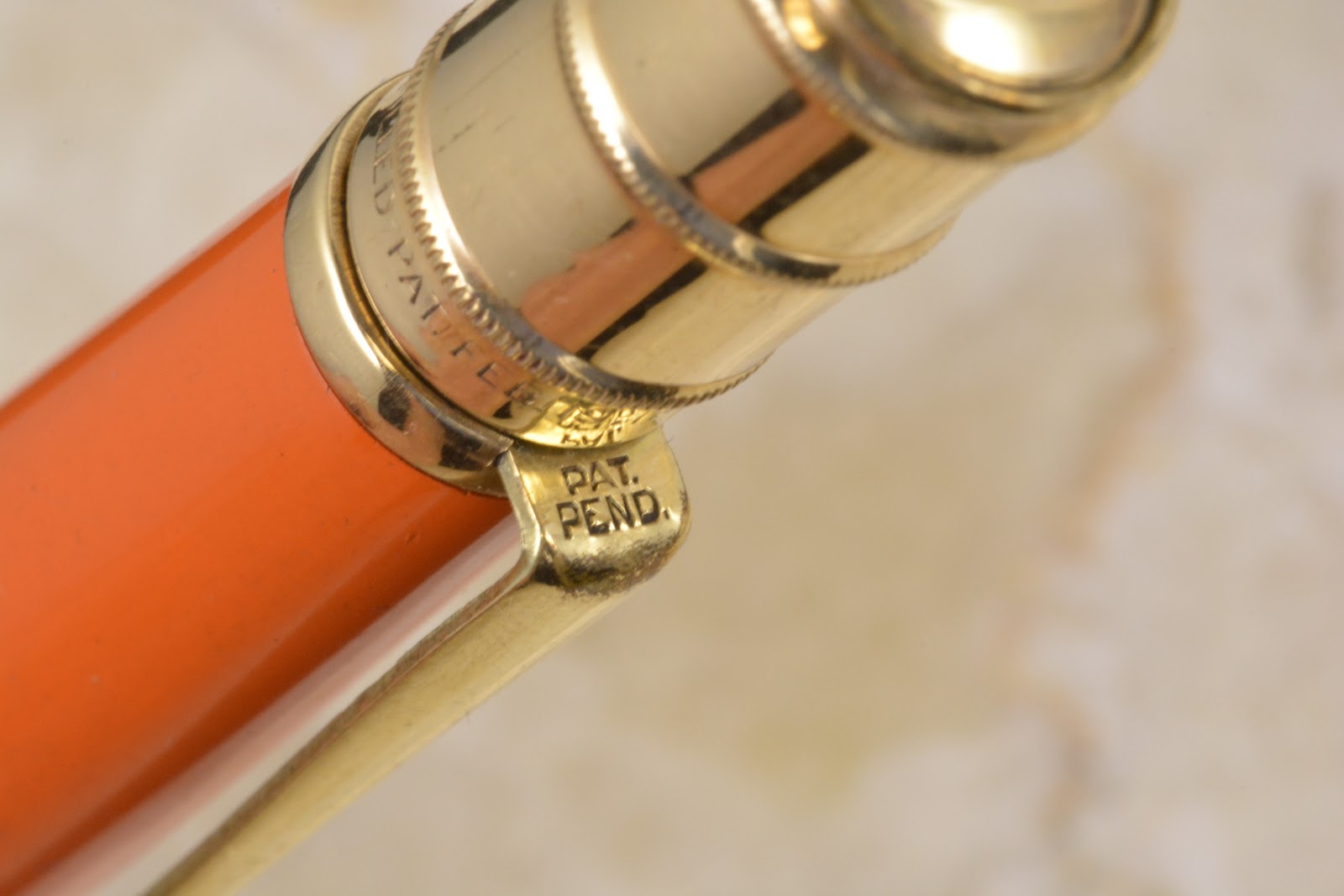
Laughlin is a cult interest of mine as well, as part of my devotion to a different cult – the Rex Manufacturing Company of Providence, Rhode Island.  Laughlin was one of Rex’s customers, and I’ve got a couple others along these lines.  One, an earlier model, appeared here with a “Pat. Pend.” stamp I haven’t found elsewhere on the clip (see “Three Interesting Rex Patent Pencils” at https://leadheadpencils.blogspot.com/2017/08/three-interesting-rex-patent-pencils.html):


The Pat. Pending refers to one of Rex’s “four horsemen” patents - at least that’s what I call them, since four patent dates are so often found printed on the caps of these (for the full rundown of all the Rex patents, see https://leadheadpencils.blogspot.com/2013/03/prequel-lets-make-that-birth-death-and.html):


Two of the “four horsemen” patents incorporate a washer clip just Parker’s, including the earliest of the four, issued to Charles H. Patton on August 4, 1925.  I think that’s the patent referred to as pending on that Laughlin pencil, which has the same, one-piece tip seen in Patton’s drawings (the two-stage tip came later):


I’ve got another Laughlin pencil, one which includes all four patented features on Rex pencils.  Here they are alongside one another:


Neither has any patent dates on their caps:


In fact, comparing the two side by side, the cap has been totally redesigned on the z-clip Laughlin:


And there’s something else really interesting about the z-clip Laughlin: the top turns, but doesn’t do anything.  It’s a nose drive pencil.  Every other Rex pencil I’ve seen has been rear-drive.  That’s really interesting, and suggests that someone was fabricating completely different pencils using Rex parts already on hand, without using the famous Rex clip assembly.

I know why.

At the end of 2016, I wrote about “My Working Theory” (see https://leadheadpencils.blogspot.com/2016/12/my-working-theory.html).  On December 11, 1925, the Parker Pen Company filed suit for patent infringement against Rex, claiming patent infringement of Parker’s “fountain pen cap” patent (the ubiquitous Sep. 5 ‘16 patent date found on Parker washer clips):


We know the litigation was still going strong in 1926, when a published decision of an appeal in the case denying Rex permission to amend an answer.  I’ve theorized that Parker ultimately won the case, but that it took a long time to get there, since Rex pencils using the four horsemen patents are so prevalent and made for so many different customers:


Further, some of the most common brands, such as Montgomery Ward’s Gold Bond pencils, continued to use the four horsemen features through 1929, changing to the “new style” in 1930:


The only pencils I’ve seen which have the 1930-and later short tips and the old four horsemen clip assembly are directly tied to Rex: this pencil and the Triad Tubes one that proved the link between Rex’s demise and the formation of Triad (Tri-Pen):


This suggests that Rex was already playing around with moving towards the new short tip design, but during this transition the company was suddenly forced to stop using Parker’s patented clip – leaving the company with a glut of spare parts which were hastily modified into a nose-drive pencil with a cheap z-clip, stamped with the Laughlin name and shipped out to meet an order. 

I need to see that case file in Rhode Island . . .

Wednesday, August 16, 2017

Three Interesting Rex Patent Pencils

This article has been edited and included in The Leadhead's Pencil Blog Volume 5; copies are available print on demand through Amazon here, and I offer an ebook version in pdf format at the Legendary Lead Company here.

If you don't want the book but you enjoy this article, please consider supporting the Blog project here.

One of my top priorities when I reorganized things around the museum was to round up all of the pencils made by the Rex Manufacturing Company and display them all together, so that I could better track who Rex was making things for, and when.  In the course of doing so, I (re)discovered three that I’ve been meaning to write about here.

For starters:


This one is marked “Conjeco” on the clip:


And it has the August 4, 1925 patent date on the upper section:


This one slipped into the dead letter office because I could make neither heads nor tails of the name . . . until I was researching the “Manjeco” the other day, which was a contraction of the Manufacturing Jewelers Company (see http://leadheadpencils.blogspot.com/2017/07/the-manjeco.html), and I wondered whether this might be something along the lines of “Consolidated Jewelers’ Company.”  The only reference I could find to the company comes in what google calls a snippet view from The Jewelers’ Circular in 1924 – but the index listing shows more than the view itself:


The next Rex pencil I've got to show you is the larger of the two in this next picture:


Both are marked “Edison,” and I’m only counting the larger one as one of my three interesting pencils today, since I’ve already written about the ringtop (see http://leadheadpencils.blogspot.com/2015/01/two-out-of-four-horsemen-aint-bad.html):


The larger has the “four horsemen” patents on the top, indicating later production:


But what makes it noteworthy to me is the great imprint on the clip:


Unlike the block type found on the imprint, the full-sized version has Edison’s trademarked logo, which is included in American Writing Instrument Trademarks 1870-1953:


From this we know that at least in 1920, when the trademark application was filed, the president of the Edison Pen Company was George S. Bernard, and the company was already located in Petersburg, Virginia.  It was also the only trademark Bernard ever filed.

My third interesting Rex (for now) is this one:


It’s marked on the barrel: “Laughlin / Detroit, Mich.”


It’s a bit earlier than the other two I’ve shown you today, stamped with McNary’s original patent of February 19, 1924:


As with the Edison, I’ve written about the Laughlin before – in fact, I’ve written about a pencil nearly identical to this one (see http://leadheadpencils.blogspot.com/2013/04/the-long-awaited-laughlin-article.html).  However, what interested me about this one was a unique bit of stamping I haven’t run across before:


“Pat. Pend.” conspicuously stamped on the top side of the clip.

Friday, November 21, 2014

I Couldn't Have Picked a Better One

Note:  this is the fourth in a series of related articles this week.   If you're feeling like you're coming into the middle of the story, the first article is http://leadheadpencils.blogspot.com/2014/11/before-lone-horseman.html.

In totally unrelated news, which turned out to be related news, Jerry Adair approached me at the Ohio Show, while I was in the afterglow of photographing Carol Strain’s Webster set made by Rex, with a question. He had this set:


To learn more, this full article is included in The Leadhead's Pencil Blog Volume 3, available at Amazon, Barnes & Noble and everywhere else you buy books, or you can order a copy signed by yours truly through the Legendary Lead Company HERE.


Friday, April 12, 2013

The Long-Awaited Laughlin Article

I’ll admit I’ve been dreading writing this article.

Back when I posted my report on the Michigan Pen Show last summer, I posted a picture of this Laughlin set I picked up as a teaser, promising to write more about it later:


I knew that Laughlin is a "cult" brand – a relatively obscure manufacturer whose devotees are really, really, REALLY fanatical. And what have I learned?:

Never tease a cult.

To learn more, this full article is included in The Leadhead's Pencil Blog Volume 2, available at Amazon, Barnes & Noble and everywhere else you buy books, or you can order a copy signed by yours truly through the Legendary Lead Company HERE.