Showing posts with label WASP "Circuit Board". Show all posts

Thursday, May 20, 2021

Where It Isn't Supposed To Be

This article has been included in The Leadhead's Pencil Blog Volume 7, now available here.

If you don't want the book but you enjoy the article, please consider supporting the Blog project here.

I hinted at something a while ago (Volume 6 page 138), when I was discussing the sixth color of Eversharp Pacemaker pencils – an example in plastic normally found on the company’s “Varsity” line:


Hold my beer, I said in response to the challenge of finding a blue version of Eversharp’s Varsity plastic, teasing out a couple of later Eagle pencils:


There’s more to that story.  I’ve had a couple other examples of Eagle-made pencils in Varsity plastics.


The brown one is marked Trupoint on the clip – that’s a Sears store brand previously made by other manufacturers over the years, including Eclipse and Autopoint. The other is marked “Cascade”:


Here are the Cascade and Trupoint pencils shown alongside their Eversharp Varsity twins:


A search for newspaper advertisements turned up one in the Stillwater (Oklahoma) Gazette on September 15, 1939.  “Cascade” was another Rexall drug store brand, and the advertisement specifically refers to the “striped Pyralin” barrels:


Another advertisement for the Cascade, in the Fort Worth Star-Telegram on September 8, 1942, shows the Cascade in a more swirly plastic:


I’ve turned up three examples of the Cascade - one in Eversharp’s Varsity plastic, and one in that swirly plastic illustrated in 1942:


That swirly plastic matches the plastic found on most of the pencils I refer to as “Deco Eagles,” dripping with art deco style:


Then there are the more exotic Deco Eagles, in colors and patterns you don’t see very often. 


There’s examples in the “stars and moons” pattern in various incarnations, and at bottom, note that red Eversharp Varsity plastic.  

But you might have noticed that third Cascade, the one in the middle of the picture . . . seen that one anywhere before?


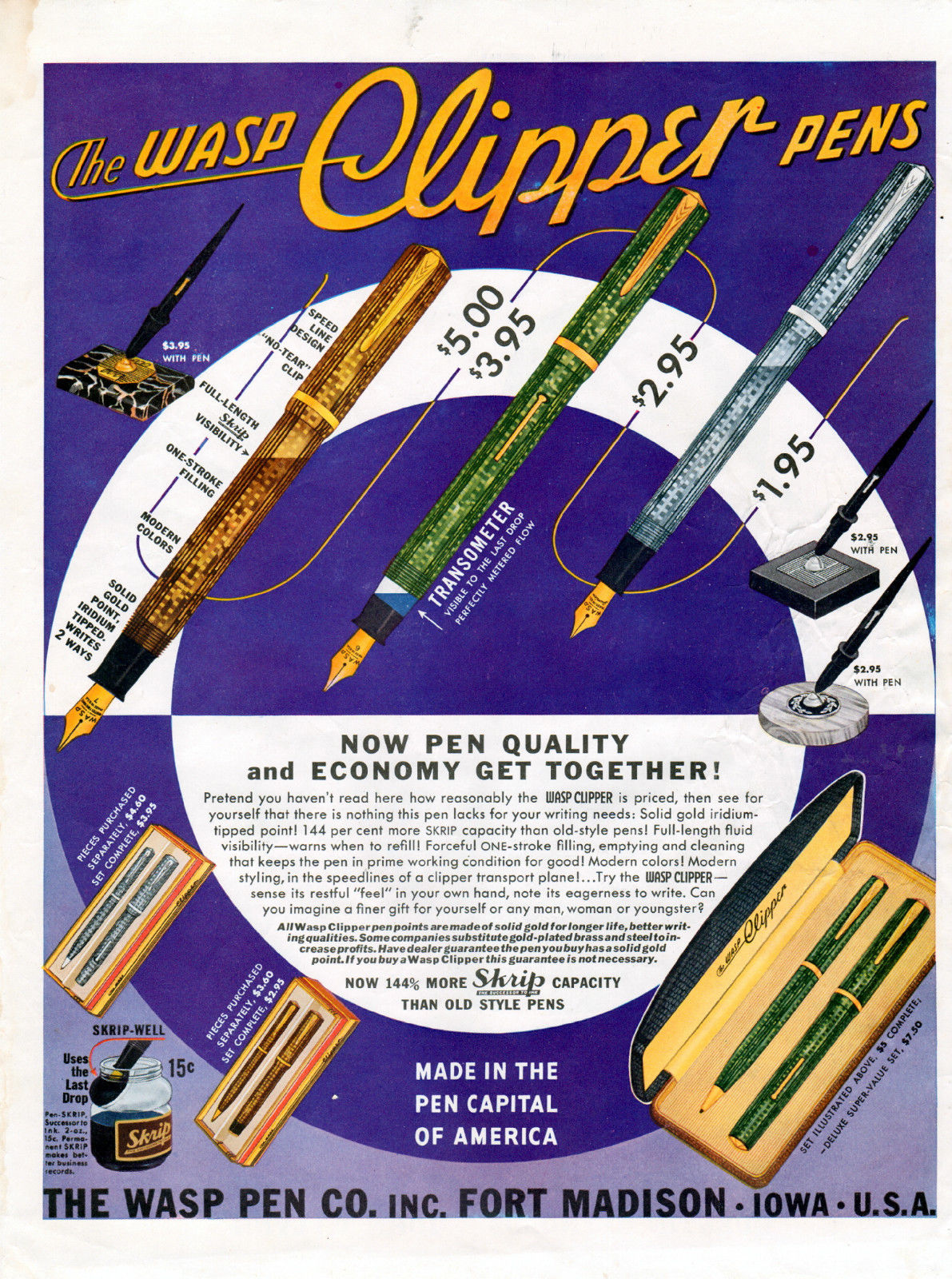
These are “circuit board” WASP Clipper pencils, made by Sheaffer.  Boy, that Cascade plastic is close . . . I recently found a “Deco Eagle” in the brown version of that plastic and – maybe because it was so far out of its element – I just noticed another brown Eagle lounging in that drawer made from the same stuff:


This Deco Eagle is the only one I’ve seen marked “Epenco” rather than “Eagle” on the clip, although the clip is the same:


I was excited to find one of these in circuit-board like plastic and posted it online - Mike Crawford saw it, and mentioned he had some Epenco pens along these lines, so we came to terms in order to add to the story I knew I would be writing here:


Eagle’s version of the WASP “circuit board” plastic isn’t exactly identical - instead of sharply defined squares, the plastic background on my Eagle-made versions have a wavy plastic background.  The colors are slightly different, and of course - the WASP doesn’t come in red:


Still, I’m sure it was no coincidence.  What was a coincidence was finding another pen in a random online auction – a brown one to match my Deco Eagle pencil:


Saturday, April 24, 2021

Square Pegs Are the Best

This article has been included in The Leadhead's Pencil Blog Volume 7, now available here.


If you don't want the book but you enjoy the article, please consider supporting the Blog project here.

Sure, there’s a great deal of satisfaction in “completing” a series.  Picking up that last color you’ve been hunting for years, so you can pose them all together in a neat little row . . . ah . . .  Happy sitcom ending.  Roll credits.

If you like that sort of thing.

I haven’t made any bones about the fact that one of the things I like about collecting is satisfying the OCD part of my psyche.  Sure, I love nice little rows of pencils with white picket fences around them as much as the next guy . . . but I’ve got this masochist little streak in me, too, that gets an even bigger kick over some monster truck knocking down that pretty fence and leaving ruts in my yard.  Figuratively speaking, anyway.

Consider the WASP “Circuit Board” Clipper, a relatively finite subject, wrapped within a subbrand, wrapped within the greater Sheaffer universe.  We know what’s “supposed” to be out there from catalogs and such, and I do have my eyes out for the examples needed to “complete” the series.  

I last ran down the model in 2017 (see Volume 4, page 342).  To recap, here is the “Type I” of the series (moniker courtesy Matt McColm), with a flat metal top.  The earliest advertisement I had found at the time I wrote that last article was from 1938, but in the current issue of The Pennant, Roger Wooten provided an advertisement from October, 1937 (see "Sheaffer's Main Sub-Brands 1928-1946," The Pennant, Spring 2021).  Advertisements in 1939 show them in the same form:


Followed by Type II, with a more rounded metal top (my earlier article included a page from a 1941 Bennett Brothers catalog which shows the Type II alongside Type I models, but they may have been introduced earlier).  The Type III added blue to the lineup, and the metal tops were replaced with black plastic ones (I don’t think anybody knows exactly when that happened):


Oh, and incidentally, I’ve since found an example of the Syracuse Knife Company pocketknives in green.  Since I’m in the neighborhood, thought I’d mention it . . . 


This is easy going forward, right?  Fill in the missing colors, then freeze frame mid-air during a celebratory leap accompanied by a laugh track, and roll credits. Cut, print and tell that OCD gremlin in the back of your mind to take a hike.

Or . . . 


Say “what the f...?” but not in a bad, what-the-heck-are-you-doing-mowing-down-my-fence-with-that-monster-truck way, but in a wait-a-minute-let-me-get-another-beer-and-let’s-see-how-this-plays-out kind of way.

Let’s start with the obvious.  Obviously, this is the exact same clip found on the WASP “circuit board” Clipper pencils, and the cap most closely resembles the more domed, metal Type II, although the edges are sharper:


The barrel, however, is one solid piece of sterling silver, with a nose-drive mechanism press fit into the lower end.  And then, for the coup de grĂ¢ce, a brocaded message:


“The Travelers / Belleair, Fla. / 1954"

Wait . . . what?  1954?

The only other clue is the initials J.M.C. mid-barrel, and I have no idea who that is.


Dang, I don’t even know whether to put this in the same drawer with my WASP Clipper circuit board pencils, but I have no idea where else to put it.   

Monday, January 9, 2017

Sharp In More Ways Than One

This article has been edited and included in The Leadhead's Pencil Blog Volume 4; copies are available print on demand through Amazon here, and I offer an ebook version in pdf format at the Legendary Lead Company here.

If you don't want the book but you enjoy this article, please consider supporting the Blog project here.

Sheaffer’s WASP subbrand (for those who don’t know, WASP is an acronym for W.A. Sheaffer Pen) appears on pages 142 and 143 of The Catalogue.  One of the more interesting patterns, nicknamed “circuit board” by collectors, appears on page 143.  Here’s an updated (and better quality) family picture of the ones I’ve found:


The proper name for these was the “Clipper,” but Sheaffer applied hat name to several different styles of WASP products, including birdseye (“screaming souls”) pencils, lahn-patterned pencils and more.  Matt McColm has done a great job analyzing the pens and pencils in these series, and he’s noted his observations over at fountainpenboard.com (the best post to look at, which references his other posts, is at http://fountainpenboard.com/forum/index.php?/topic/5768-circuit-board-wasp-clipper-generations/.   I’m not able to add much in the way of observations regarding the pencils themselves.  One quirky thing about these is that the trim bands on the smaller sized pencils are on the lower barrel, while the bands are on the caps on the larger ones:


And, as you can see, the plating quality wasn’t as good as what you’ll find on Sheaffer’s regular line, and WASP pencils are just as prone to the separation that occurs between the upper and lower barrels as their Balance cousins.

Matt divides the series into three “generations.”  The first has a nearly flat top piece, and note how the clips have a little bevel right at the top:


The second has a more pronounced cap with more of a pointed taper, and the sides of the clip are straight:


The third replaces this metal top “jewel” with a black plastic one – very poorly (note how awful the fitment is):


You can debate all day long whether these are generations, or subgenerations, or eras or epochs. Matt identifies three, which I can live with, but I’d note also that within that third group, there was a change in the plastic, from little cubes accented by four scribbly stripes to little cubes separated by wide bands.  Call it a fourth generation or what have you:


The earliest advertisements I’ve found date from 1938, and these show Matt’s “type I” pens and pencils:


Advertisements in 1939 show the same product lineup, augmented by the WASP version of Sheaffer’s “working togs” pencils:


In 1941, Bennett Brothers advertised WASP products.  Note that in this advertisement, type I pens and pencils are advertised alongside type II pens and pencils:


The type II style is most evident in the set shown at the bottom, but you can also see the straight sided clips in the more obliquely displayed sets on the left:


I’m not aware of any catalogs or advertisements showing the black plastic top jeweled models.  It would stand to reason, if in 1941 Sheaffer was advertising type II pencils for the first time, that the plastic jewels would have come later.  The wide band plastic appears to have been added at the very end, since green and brown pens with either plastic have been found with the plastic top end.  Blue, an uncataloged color, I’ve only seen with the wide bands and plastic jewels, suggesting they were at the end of the line, and reducing the metal content in its writing instruments might have been a priority after America entered the Second World War.  Evidence may surface in the future to fill in these blanks.

What I do know is that the WASP plastics were not exclusive to Sheaffer – or even to pens and pencils:


The plastic also occurs on pocket knives made by the Syracuse Knife Company.