Showing posts with label Gold Bond. Show all posts

Friday, September 8, 2017

Thoughts Regarding a Few Connections

This article has been edited and included in The Leadhead's Pencil Blog Volume 5; copies are available print on demand through Amazon here, and I offer an ebook version in pdf format at the Legendary Lead Company here.

If you don't want the book but you enjoy this article, please consider supporting the Blog project here.

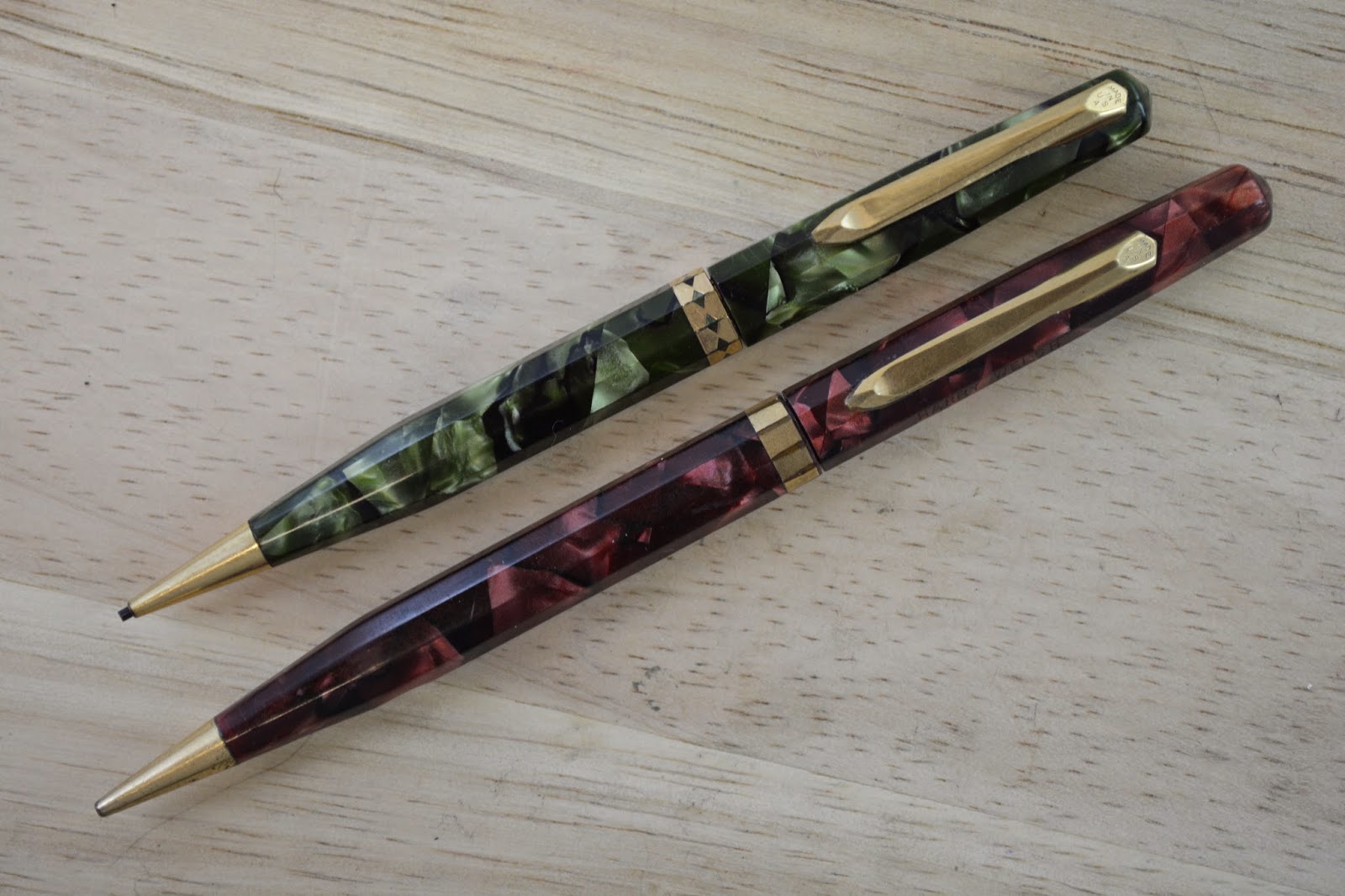
I’ve had this one laying around for a long time, trying to make some sense out of it:


The celluloid has some great depth, and the clip is marked “Deluxe” in a nice, Old-English style script:


It is clearly from the same product lines as the Gold Bond.  Here it is alongside two examples, one in almost the same (but not quite as “deluxe”) color, and another sporting that same clip.  Note that the Deluxe has an extra trim band at the top, and all three have that black top piece with some nice detailing traditionally attributed to C.E. Barrett and National Pen Products:


However, the evidence I pieced together suggests that if these weren’t made by Rex, who clearly made earlier models of the Gold Bond, they might have been made by Sheaffer, which appears to have very quietly turned out Gold Bonds before later models were introduced which were clearly rebadged Eversharps and Watermans:


(For the whole scoop on that story, start with http://leadheadpencils.blogspot.com/2016/08/maybe-big-three-out-of-four.html . . . from there, you can hop back to the first part of that series).

Now let’s turn the conversation up a notch:


Note that same black end with detailing at the top end?  These are essentially thinner versions of the Gold Bond, with different clips.  Two of these pencils – the longer ones – are ones you are probably familiar with.   They are imprinted “The Monogram Pen / Unbreakable / Sold Only at the Rexall Store.”  But that shorter one – like the Deluxe, with an extra trim ring at the top, says something entirely different:


The Joseph Lipic Pen Company of St. Louis.

I don’t know what all of this means.  Lipic clearly made some pens and pencils, but the company may also have acquired product for a short time from Sheaffer, Rex or whomever was turning out Monogram Pens.  As for Rexall, the United Drug Co. acquired product from DeWitt-LaFrance (remember the Signet?) as well as from Moore and Eagle, so it’s entirely possible to throw Rex or Sheaffer into the mix.

Chalk this article up as throwing out one piece to a giant puzzle and hoping someday I figure out at least which puzzle it’s supposed to fit in.

Wednesday, August 31, 2016

More Clues Than Any Other

This article has been edited and included in The Leadhead's Pencil Blog Volume 4; copies are available print on demand through Amazon here, and I offer an ebook version in pdf format at the Legendary Lead Company here.

If you don't want the book but you enjoy this article, please consider supporting the Blog project here.

I forgot all about this example of a Gold Bond when I posted those other articles recently – I apparently overlooked it because it was in a box:


This example, like the other transitional members with Sheaffer works, has some unusual design features: note the odd placement of trim rings:


The barrel is stamped with the usual “Gold Bond / Stonite” imprint . . .


 . . . but this clearly isn’t the same material.  The usual robust plastics used on Gold Bonds don’t crystallize like this:


I bought it knowing about the damage, partly because the pencil is so unusual for a Gold Bond and partly because you never see these with the original paperwork:


Huh.  The pencil pictured doesn’t resemble the pencil that came in the box – or any other Gold Bond I’ve seen, for that matter.   I am sure based on outward appearances that the mechanism inside this pencil was made by Sheaffer, although I’m not going to try to extract it as fragile as this material is.  If Sheaffer had greater involvement in the manufacture of these, supplying whole pencils to National Pen Products, I’d expect to see some similarities between the pencil instruction sheets for a Sheaffer Balance and this – if not identical pictures of the products, at least I’d expect to see identical language.

Come to think of it, though, I haven’t seen an early Sheaffer Balance instruction sheet . . . anyone have one we can compare to this?

Friday, August 12, 2016

Maybe Big Three Out of Four?

This article has been edited and included in The Leadhead's Pencil Blog Volume 4; copies are available print on demand through Amazon here, and I offer an ebook version in pdf format at the Legendary Lead Company here.

If you don't want the book but you enjoy this article, please consider supporting the Blog project here.

Note:  this is the fourth installment in a series - it might make more sense if you start here.

Montgomery Ward’s Gold Bond brand took a markedly different evolutionary path than did other store brands, such as Gold Medal, Diamond Medal and Webster, the latter three of which evolved directly from Rex-made (or at least Rex patent) mechanism to rebadged Parker products.  Some Gold Bonds, other the other hand, are just as clearly rebadges made by Eversharp and Waterman:


At the top, we have three examples which, for the time being, I attribute to the Rex Manufacturing Company of Providence, Rhode Island.  The bottom three are clearly rebadges of the Eversharp Doric, the Eversharp Junior, and a Waterman (the Eversharp Gold Bonds I’ve written about a couple years ago at http://leadheadpencils.blogspot.com/2014/10/the-answer-that-raises-question.html, and the Waterman I wrote about just yesterday).

Side note: I theorized last year that “National Pen Products” wasn’t the grand puppetmaster behind everything flattopish and Chicagoish, but was instead a wholly owned subsidiary set up exclusively to supply Montgomery Ward’s writing instruments, incorporated by a Montgomery Ward executive, C.E. Barrett’s sister-in-law and a third person about whom I haven’t found anything yet (“What About the Boogeyman,” at http://leadheadpencils.blogspot.com/2015/07/what-about-boogeyman.html).  The fact that post-Rex Gold Bonds were made by different companies than contemporary Gold Medals, Diamond Medals and Websters supports this.

But . . . I’m getting off topic.   This article is about the “middle children” from that first picture, and particularly that grey marbled example.  It just doesn’t match the profile of either the Eversharp Junior rebadges (the closest Eversharp-made relative I can find) or the Waterman rebadge:


Yeah, it has three bands like an Eversharp, but much thinner.  And both the Eversharp and Waterman models are nose-drive pencils, fundamentally different inside regardless of outward appearances.  If you can look past those outward appearances, in fact, this weird Gold Bond looks a lot like the other middle child from that first picture:


Both are middle-joint, rear drive pencils, and note how similar the tips are?   As I was trolling around the museum comparing that very odd Sheaffer pencil to Diamond Medals and Gold Medals, that caught my attention . . .


and sure enough . . .


There’s no question in my mind: no matter what you see on the outside of these Gold Bonds, what’s inside is all Sheaffer.  Sheaffer also might be the answer I never thought to look for when it comes to that bizarre clip, which I haven’t seen on anything else:


It clearly isn’t derived from either the Eversharp or Waterman clips, but when I turned my attention to the Sheaffer wing of the museum, I noticed something from which it might have been derived:


That plastic, whether you call it “birdseye,” “screaming souls” or what have you, is a Wasp (acronym for W.A. Sheaffer Pen) Clipper pencil, a Sheaffer subbrand which falls chronologically into the exact same slot as when I suspect the Gold Bond was made (1933-1934).

Note that both clips are the same length, both have a flat face, and the tops of each share a gothic arch sort of profile.  A few minor modifications to existing tooling would turn a Wasp clip into a goofy Gold Bond one.  And while I’ve never been able to wrestle a lower barrel off a Wasp Clipper before, I was now determined to see exactly what was inside one of these.  A few choice words (and a bruised knuckle) later, I had my answer:


I believe my goofy grey Gold Bond was made by Sheaffer, outer appearances notwithstanding, and Montgomery Ward was being supplied with writing instruments made by Eversharp, Waterman AND Sheaffer – everybody BUT Parker.

Thursday, August 11, 2016

The Waterbonds

This article has been edited and included in The Leadhead's Pencil Blog Volume 4; copies are available print on demand through Amazon here, and I offer an ebook version in pdf format at the Legendary Lead Company here.

If you don't want the book but you enjoy this article, please consider supporting the Blog project here.

If you haven't read the last two days' posts, you can start this story here.

About four years ago, I wrote an article about a goofy Gold Bond pencil that I couldn’t fit neatly into either the Rex family of oversized flattops or the Eversharp Doricesque or Junioresque lines (“Neither Dis One Nor Dat One” on September 28, 2012 at http://leadheadpencils.blogspot.com/2012/09/neither-dis-one-or-dat-one.html):


In that article, I’d noted that while this one is made of a plastic vaguely reminiscent of a Parker Zephyr and it has thin bands vaguely reminiscent of a Wahl Junior and bands that might be Parker (I had incorrectly noted that Parker might have made some Gold Bonds, an assumption derived from lumping together everything under the National Pen Products umbrella), it didn’t directly match any known manufacturer’s fingerprints.

At the time I wrote the article, I didn’t know that there was a third family to consider.  A couple examples appeared on the cover of the fall 2013 issue of The Pennant:


The golden colored Gold Bond shown in the box is obviously a Waterman, and the pen directly to the left of it appears to be another Waterman-made Gold Bond based on the Lady Patricia - and apparently made in the same grey plastic as my “Udder One” from that article I posted four years ago.  There’s also two pens with the same goofy clip as my pencil, one in marbled burgundy and black like you’d see on a Parker (hmmm... and with thin gold bands like my goofy pencil, too), and the other in what looks very similar to Eversharp’s “cathay” celluloid used on the company’s Doric line.

I haven’t posted an update about this development for two reasons: (1) the picture mixes things up even more than they were before, and I was even less sure than before what was going on with my weird Gold Bond, and (2) I had never seen an example of a Waterman-made Gold Bond pencil.

Tackling these two problems in reverse order, Myk Daigle solved the latter of these issues when he made this one available:


The wide, poorly-plated band is anomolous for a Waterman, but otherwise I had no doubts about who made this one - it even featured the same sprung tip that kept falling off!  The imprint is located on the back of the cap, in exactly the same place you’d find a Waterman imprint:


Here it is shown with the closest Waterman relative in my collection:


Note that the comparable pencils were stamped “Watermans” on the clip:


Now that I’ve introduced the Waterman Gold Bonds, I’ll be able to delve into the brand’s development tomorrow without getting sidetracked . . .

The story continues here.

Thursday, October 2, 2014

The Answer that Raises the Question

About a year ago ( http://leadheadpencils.blogspot.com/2013/08/a-few-good-pencils.html ), I showed off a couple new pencils I’d picked up, including the larger red one shown in this picture:


These were made by Eversharp, as you can tell by their close similarity in appearance to Eversharp’s Doric line of pens and pencils. Close, that is, but not exact: the bands are a little thinner than what you'll find on a Doric, and the cutouts aren't the same, either. If you really know your Dorics, you wouldn’t need to turn over the pencil to see what’s imprinted where you’d expect to see the word "Eversharp" on the back side:


These pencils were made by Eversharp for Montgomery Ward and were imprinted with Montgomery Ward’s "Gold Bond" brand name. This red example has a curious feature, which I had casually noted in my previously article here: it lacks the diamond-shaped cutouts:


I didn’t say what I was thinking at the time. That’s because, with all the conflicting information I had about this feature rattling around in my head, I wasn’t really sure what I thought. All doubt was resolved in my mind with the publication of an article written by David Isaacson in the Fall 2013 issue of The Pennant, journal of the Pen Collectors of America ("Fountain Pens from the Monkey Ward," starting on page 27). This Gold Bond advertisement appears on page 32, dated 1935 by the author.

To learn more, this full article is included in The Leadhead's Pencil Blog Volume 3, available at Amazon, Barnes & Noble and everywhere else you buy books, or you can order a copy signed by yours truly through the Legendary Lead Company HERE.


Monday, August 12, 2013

A Few Good Pencils

I’ve picked up a couple tidbits of information concerning Eversharp-made Gold Bonds.  Gold Bond was a Montgomery Ward store brand, and over the years they were made by National Pen Products, then by Wahl-Eversharp , then by Parker.  When I last visited the topic, the family portrait looked like this:


To learn more, this full article is included in The Leadhead's Pencil Blog Volume 2, available at Amazon, Barnes & Noble and everywhere else you buy books, or you can order a copy signed by yours truly through the Legendary Lead Company HERE.


Friday, July 26, 2013

Rex Repaired

This article has been a long, long time coming.

Every time I circle back around to talk about the Rex Manufacturing Company, I’m reminded how all of that research started with this pencil:


The pencil – or rather what was left of it – was proudly featured on page 125 of The Catalogue. Unfortunately, while it has served valiantly as a great conversation piece, it has not been able to serve as well as a pencil:


In all the years I’ve had this little guy, I haven’t tried to repair it for one simple reason: I’m a stickler for originality and correctness, and I won’t do anything to restore a pencil unless I’m absolutely certain I am bringing it back to its original condition.

This Rex pencil is obviously different from its later progeny.  Here it is, shown next to the Gold Medal I was discussing just the other day (“Rex Redux” on July 23, 2013), with the earlier single piece tip and only the McNary 1924 patent date imprinted on it.


To learn more, this full article is included in The Leadhead's Pencil Blog Volume 2, available at Amazon, Barnes & Noble and everywhere else you buy books, or you can order a copy signed by yours truly through the Legendary Lead Company HERE.


Friday, September 28, 2012

Neither Dis One Or Dat One

If you ever get the chance to go to Newfoundland, take it. It’s not a glitzy place, and my trips there have been hunting trips – woodland caribou and moose. But it’s home to the best people on earth, with the best sense of humor to match.

There’s two major airports on the island. One is in St. John, the only metropolitan area in the province. The other is Gander, which more towards the center of the province. While at most airports you fumble around trying to find the right gate, you won’t have that problem in Gander, because there are only two – which the airport workers refer to, in their Newfoundland dialect, as "Dis One" and "Dat One."

Incidentally (I’m getting a little off topic with this, but it’s a great story that should be remembered), on September 11, 2001, Gander is the airport to which all of the large international planes that were in the air were diverted and grounded, because while it lacks a lot of amenities it has several large runways that could handle them. That tiny airport in that small town suddenly had dozens of planes on its runway and thousands of terrified and uncertain people with only two small hotels to house them.

So how did so many of us get through that darkest day in modern times? Through an amazing display of kindness and love in a place none of them ever expected to visit. Hundreds of Newfoundlanders from the surrounding area showed up in their cars at the airport that day. They each picked up as many complete strangers as they had room for, and they took them back to their own homes. They fed them, housed them and let them call their loved ones so they would know they were safe. Gradually, things calmed down and they brought them back to Gander airport, to see their new friends off, waving best wishes as they left from either dis gate or dat one.

That’s what Newfoundlanders are like, and I still get choked up when I tell that story. So if you ever feel the need to make fun of Canada – and Newfoundland in particular – don’t. Particularly in front of me. They are my friends and they should be yours too.

OK, end of sermon and back to the story at hand. The reason all this came to mind was as I was thinking about the Gold Bond pencils (Montgomery Ward’s store brand), I was thinking about the two types I’ve seen. There’s dis one, the kind made by National Pen Products under the Rex Patents . . .

NOTE:  This article is now included in the print version of The Leadhead's Pencil Blog, available anywhere you buy books, or also from The Legendary Lead Company.

To order, here's the link:  Volume 1 at Legendary Lead Company


Saturday, January 28, 2012

They Are Really Bonding Now

At page 90 of The Catalogue, you'll find a picture of the Wahl-Eversharp made pencils marked "Gold Bond," which was Montgomery Ward's store brand of pens and pencils.  Since the book was published, a couple other examples have found their way to me . . .

NOTE:  This article is now included in the print version of The Leadhead's Pencil Blog, available anywhere you buy books, or also from The Legendary Lead Company.

To order, here's the link:  Volume 1 at Legendary Lead Company