Showing posts with label Welsh. Show all posts

Sunday, July 4, 2021

That's All I'm Going To Say About That

This article has been included in The Leadhead's Pencil Blog Volume 7, now available here.

If you don't want the book but you enjoy the article, please consider supporting the Blog project here.

When I sit down to write one of these articles, my method of picking the topic of the day is very non-scientific:  I open the file folder containing all the pictures I’ve taken, and I scroll through until I find something that I think would be fun to write about.  As the more meaty subjects get pulled out and placed in the “published” file, what's left behind are the brisket tips -- good stuff, worth photographing and definitely worth noting here, but more of an appetizer than a meal.  While each of these notes might not be enough for a complete article, today I'll string a few of these little notes together into a little tune.  

The Colorgraph:

I haven’t written about the Colorgraph for some time, most recently in Volume 2, page 95.  Since I’ve found so few of these duplex pencils over the years, it’s one of those brands I’ll chase even if I think I already have one, in the hopes there will be some tiny difference that will add to the story.  Recently, I chased and caught an example in black:


Unfortunately, it was identical to my other examples (and I still haven’t found an intact earlier model, with the longer nose).  So . . . all I have to tell you is that they also come in black.


The Ruxton:

The 1,000th post here at the Blog (Volume 4, page 351) covered the Ruxton well, including the company’s archive of prototype and shop models as well as production examples – including some boxed ones.  I bought this one because the box was different - the other examples in my collection are dark blue with black lettering, but this one you can actually read:


The pencil is extremely clean, but unfortunately there’s nothing different about it from what I’ve shown you already:


The Welsh Manufacturing Company:

This one was in a box lot of junk that came my way, and it wasn’t my intended target.  
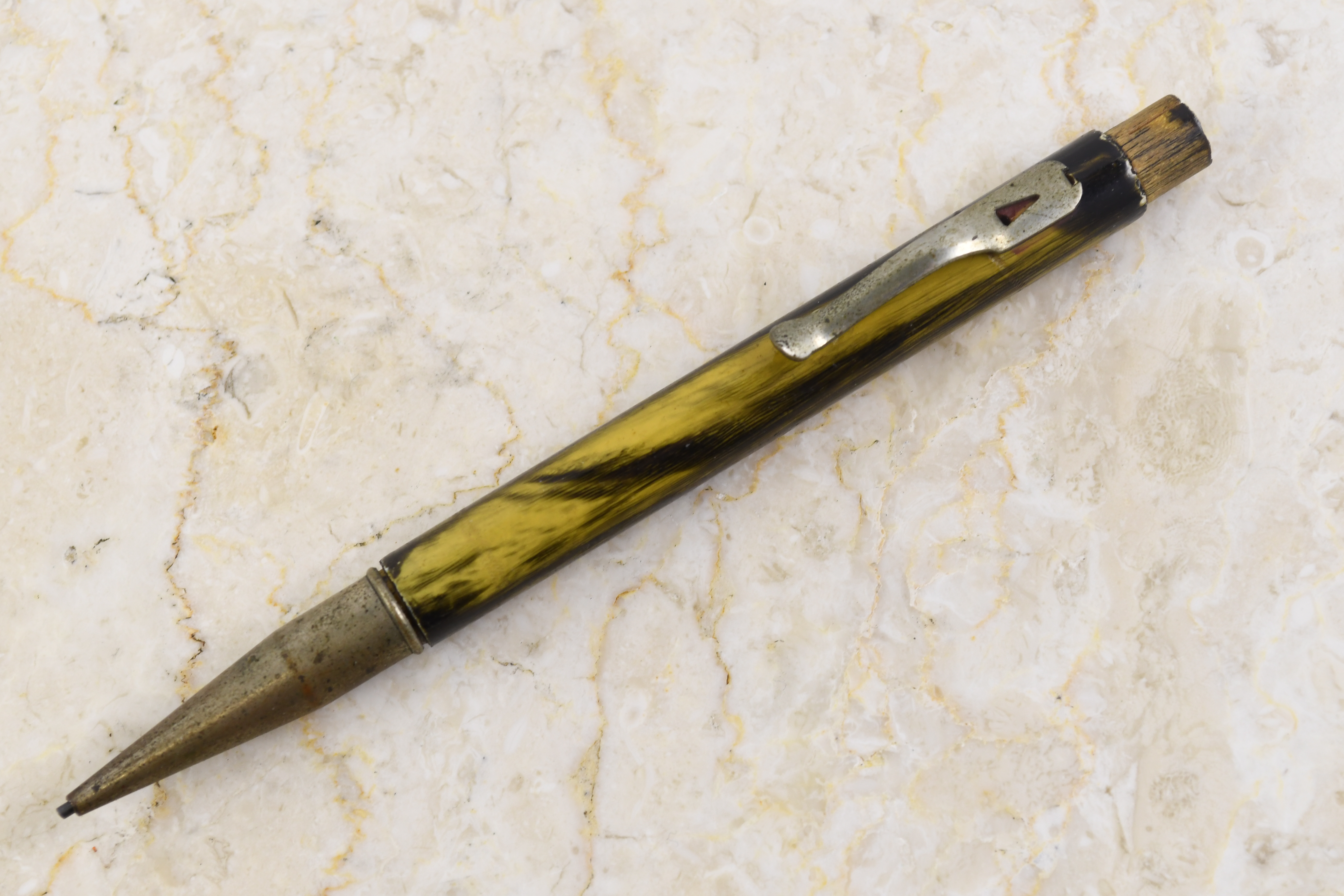

From the clip and the nose, I knew it was made by the Welsh Manufacturing Company of Providence, Rhode Island.  Here it is shown alongside other variations on the theme:


I would have just put it in the Welsh drawer without photographing it, except for one small detail:


This one has a painted wood barrel.


The “Arrow Double”:

I’d never heard of this one before:


It nearly identical to one already in my collection, with two exceptions:


First, it lacks that great arched “14kt Gold Plate” imprint on the clip:


And second, the producer’s imprint on the top is different.  I say producer, because I don’t know who manufactured either one:


The one I had is an Ajax; this new one is marked “Arrow Double.”  I haven’t been able to discover anything about the Arrow Double in the year since I found it.


The Bridge Set:

I had such high hopes for this next find:


This nice box contained a beautiful set of sterling pencils marked with card suits:


I wrote about a similar set in a recent article about bridge pencil sets in Volume 6, page 194.  On page 196, I showed an English set by William Manton along the same lines that Joe Nemecek had given to me; it was newer than I had hoped, bearing a hallmark dating it to 1979.


This set appears to be older, and I expected hallmarks that would be a bit more . . . well, a bit more vintage than me, anyway.  Alas, there are no hallmarks and it appears to have been made for export to the United States, marked only “Made in England / Sterling Silver.” 


An Interesting Sheaffer Sharp Point:

This Sheaffer Sharp Point is on the early side of production, with a bowler clip and that zigzag-with-dots pattern:


What’s inside isn’t what I would expect.


The earliest Sharp Points look like this inside (see Volume 4, page 324):


While later Sheaffers (early 1920s on) look like this:


I’m not sure where this one fits in.


Cross-Built:

Here’s three very similar pencils . . . the bottom one is a typical Cross Century:


Two are marked on the clip: the Cross, and one marked “Swank.”


The Swank brand appeared in Volume 1, page 345 – on a ruler pencil/tie clip pencil.  Swank, Inc., as reported in that previous article, survives as a division of Randa Accessories.  The third pencil has a plain clip, but a nice imprint on the barrel:


It’s a “PAT One Twenty.”  PAT was a trademark of Ketcham & McDougall, Inc., better known for making those pencils attached to a pin by a retractable chain.  The company claimed to first use the mark on September 18, 1936, according to the trademark registration:


All three of these pencils share very similar features, and my suspicion is that Cross made all three.  The Swank and PAT One Twenty share another element - that black plastic ring in the middle:


Welty’s

At the Krinke auction, one of my impulse buys was this fountain pen, complete with the box but with a conspicuously absent pencil:


The imprint is on the barrel, concealed under the cap when closed:


The pen was made by DeWitt-LaFrance, and I wasn’t planning on chasing it until I saw how small it was:


I wrote about the Welty’s DeWitt-LaFrance pencils in Volume 3, page 158; I came across the pen at some time since.  If the matching Welty’s pencil surfaces, it would be about the smallest DeWitt-LaFrance pencil I’ve seen.


The Baby Jumbo:

The Baby Jumbo is in Volume 1, page 373, and it’s not really “mechanical.”  A wood pencil is wedged in the neck of a glass bottle containing candy:


There was another example up for bids at the Krinke auction; I took “just in case” pictures of it before the auction started, because this one had the original paper label on it:


It would have been nice to bring this one home, but the pencil was identical to what I had, and the only thing the label provided was a cute admonishment to “Write your mother a letter today.”  When the bidding got a little crazy on this one, I couldn’t justify spending what it would take - so my “just in case” picture will have to do!

Sunday, March 18, 2018

Trick Pencils . . . For Tricks

This article has been edited and included in The Leadhead's Pencil Blog Volume 5; copies are available print on demand through Amazon here, and I offer an ebook version in pdf format at the Legendary Lead Company here.

If you don't want the book but you enjoy this article, please consider supporting the Blog project here.

Sometimes “trick” pencils, in addition to writing, help you calculate tricks, as in bridge hands.  As I was cleaning up around the museum a few months ago, I finally got around to photographing three examples I’ve had laying around for awhile:


The top one doesn’t have a clip, but it does have a hexagonal bushing under the cap which keeps it from rolling off of the table.  The name on the pencil is “Vanco”:


I’ve got a few Vanco pencils, but they are all Japanese-made duplex pencils, meaning that they contain two leads inside so that turning the cap one way advances one color lead, and turning it the other way withdraws that one and advances another color.  This one isn’t anything like that – in fact, if it weren’t for the name I’d think it was made by Ritepoint. 

In fact, there is no connection between this pencil and the Japanese company.  I found an advertisement for the Vanco Bridge Scoring Pencil in the June, 1936 edition of Popular Mechanics, providing an address of 210 South 16th Street, Philadelphia:


As for that middle example, I don’t have any idea who made it.  There were two of these that came my way in a collection, the second of which was missing a cap.  There might have been a clip under that cap which has gone missing:


The third one is a bit easier to figure out.  That clip and the rosette molded into the top of the cap are calling cards of the Welsh Manufacturing Company of Providence, Rhode Island:


Monday, March 23, 2015

The Nicholson Mystery Solved

This article has been edited and included in The Leadhead's Pencil Blog Volume 3; copies are available print on demand through Amazon here, and I offer an ebook version in pdf format at the Legendary Lead Company here.

If you don't want the book but you enjoy this article, please consider supporting the Blog project here.

I don’t remember which mess o’ pencils these three came in with, but I do remember pulling them aside and thinking to myself, “one of these days I’m going to figure out what these are all about.”


Ordinarily I don’t care much for those plastic-tipped nose drive mechanisms.  On these, however, they just work.  The clips closely resemble those found on later pencils made by Artcraft, a company out of Birmingham, Alabama – however, I can’t rule out that the clip was jobbed out to any number of firms.  The part that I wanted to figure out, though, was just below the clip:


The words “Nicholson USA” flanking a crossed pair of what look like cannon.  On more than one occasion, I’ve seen these sold as military items; at one point I thought someone said it was a military school, and at some other point, a firearms manufacturer or distributor – and of course, let’s not overlook the possibility that there’s a “Nicholson Pencil Company.”  Every lead I chased down proved to be a dead end, and these slipped into the dead letter office for a while.

The plot thickened a couple of months ago, when Mike Little asked if I had any interest in this one:


Obviously I did.  This one is marked “Welsh” on the clip, but with that same logo enameled under the clip:


The Welsh name, I assumed, signified the Welsh Manufacturing Company of Providence, Rhode Island – that probably rules out the existence of some “Nicholson Pencil Company.”  My interest in this pencil was twofold: first, it added a bit more to the Nicholson story, but also, I knew what I would find imprinted on the barrel:


Patent number 2,358,091: Charles Lovejoy’s 1944 patent for a repeater pencil, original assigned to Moore, and licensed out to Eversharp and Dur-O-Lite:


And also, apparently, to the Welsh Manufacturing Company:


It was nice to fill in a bit more of the Lovejoy Patent saga, but Mike’s pencil left me no closer to unraveling the Nicholson mystery.  My big break, and the one that solved this one once and for all, showed up in a recent online auction and arrived in the mail last week:


Yeah, I know.  The clip is broken.  But I’d never seen this variation of a Nicholson-marked pencil, and sometimes you’ve just got to bid on something so you can get it in your hands for a closer look.  Besides, the online seller showed pictures of this one with the top pulled off to reveal a nail file, and I’m a sucker for a pencil with any on-board gizmo:


Also, the seller indicated that there was a patent number on the barrel, and I’m a sucker for a good patent number:


In this case, the patent number proved that Mike Little’s Welsh pencil was no fluke.  Patent number 2,110,999 for a “pocket implement” was applied for on April 14, 1936 by Raymond B. Miga, and issued on March 15, 1938.  Miga’s patent was assigned . . . dum da da dummmmmm . . . to the Welsh Manufacturing Company:


However, there was one detail the seller left out, and it was the one detail that solved the Nicholson riddle once and for all.  In this case, the Nicholson logo didn’t appear just on the barrel:


It’s also on the tang of the file.  While an imprint on the barrel could mean anything, a logo in that location on the attachment is almost certainly a manufacturer’s mark, and when I shifted my search to “Nicholson File,” all was revealed just as fast as Google could deliver me a list of search results:


According to the Nicholson File Company’s website, the company was founded in Providence, Rhode Island in 1864.  The trademark for the logo found on all of the pencils in this article, “in which there is a representation of two crossed files,” was filed on June 12, 1905 and was registered as number 50,882 on April 3, 1906:


According to the registration, the company first used this mark in 1899.  A revised version of the trademark, filed in 1959, dropped the “USA,” apparently a harbinger of things to come.  While the company remains in existence today as part of the “Apex Brands,” I noted online grumbling about the inferior quality of the foreign-made files now being sold under the name.  Unfortunately, it appears we can chalk Nicholson up as yet another American manufacturer that no long manufactures and whose products are not American.