Showing posts with label Eversharp Dollar Pencils. Show all posts

Thursday, October 9, 2025

Diamonds . . . But Not In the Rough

Diamond Medal was the top-of-the-line store brand name used by Sears, Roebuck & Co., which also acquired the Webster brand name from the Rex Manufacturing Company, and Gold Medal. Sears didn’t actually make any of the pens and pencils it offered for sale under any of these names, but rather sourced them from several different manufacturers.

At least as far as mechanical pencils went, Sears is known to have sourced fountain pens in the mid-1920s from C.E. Barrett & Co. in Chicago, which in turn sourced mechanical pencils from the Rex Manufacturing Company – or at least, Barrett sourced the mechanisms from Rex. Outfitting a Rex to match a Barrett-supplied fountain pen involved nothing more than threading two ends of a celluloid tube, which might have been done by Barrett in-house. The extent to which Barrett actually made anything, including fountain pens, is unknown.

I don’t know of any Diamond Medal-branded pencils that were clearly attributable to Rex, although Rex-made Gold Medal and Webster pencils are easy to find. These two examples were likely sourced from C.E. Barrett:


The jade example at bottom is the closest you’ll find to a Rex-made product branded for Diamond Medal, but I can’t connect the dots conclusively back to Rex; if I could, that would be groundbreaking, since identical pencils were supplied to many other manufacturers.

That black and pearl example is almost identical to another Diamond Medal in my collection . . . and I dwell in the celebration of all things “almost.”  


The flattop version was Diamond Medal’s “Standard Pencil,” and with a pointy end they became the “Diplomat,” the uberest of ubermodels at Sears. These next two examples might be a little earlier, with their stodgier bell tops:


I know that cream-colored one came from the late Tom Heath by way of his daughter Jennifer, who has been to a number of shows liquidating Tom’s collection. Tom used these half-circle tags to identify where and when he bought things; unfortunately, to my knowledge he didn’t leave behind a key to his system.


I didn’t want to highlight the imprint, but both are the same: Diamond Medal / Diplomat Pencil. These tie in well with what I last posted about the Diamond Medal, in “The Middle Children” (August 10, 2016: Volume 4, page 121). In that article, I shared this image of a trio of pencils: from top, these are the full-sized Diamond Medal Diplomat in that same cream-colored celluloid, a pencil marked Sheaffer on the clip, and a burgundy and black faceted example with Parker works inside (the material is also likely from Parker).


I’ll circle back to Parker in a minute. Bear with me.

In “The Middle Children,” I presented the evidence that the W.A. Sheaffer Pen Company supplied C.E. Barrett, or Sears directly, with writing instruments for a short time. Here is another image from that article, comparing that Sheaffer-marked example to a Gold Medal in that same, distinctive plastic:


Now lets think about that large Diplomat with its bullet-shaped top. I haven’t been able to wrestle it apart, but I bet I know what is inside:


These are Sheaffer flattop pencils, and this image was included in “Most’s Influence on Sheaffer” (September 9, 2016: Volume 4, page 161). Lucifer Most, inventor of the Salz ‘Salrite, developed this mechanism for Sheaffer, and it was used from the flattop era of the 1920s through the earliest Sheaffer Balance pencils, through 1932 or so. Note that the thinner bell-top pencil at top bears a striking resemblance to those ringtop Diplomat pencils . . . 

But wait: there’s more. Some of the most attractive Art Deco pencils ever made were this series of Diamond Medals, and I bet I know what’s going on inside these, too . . .


All of these Sheaffer-derived Diamond Medal pencils appeared around the time the Rex Manufacturing Company fades away at the end of the 1920s, likely as a result of Parker’s patent infringement case against Rex over the washer clip. Sears was apparently shopping around for other suppliers, and The Wahl Company also got a foot in the door. The Diplomat made a fleeting appearance in Eversharp: Cornerstone of an Industry. On page 164 in Eversharp, I shared images of an Eversharp Dollar Pencil from around 1930. The clip, however, is marked “Diplomat” in the same script found on the Diamond Medal above, rather than Eversharp:


This is the only example I have found of a Wahl-made product supplied to Sears; it isn’t surprising, since Wahl supplied Montgomery Ward with rebadged Doric pens and pencils. In the end, though, it was the Parker Pen Company that won the Sears writing instrument contracts, including Diamond Medal branded pens and pencils, such as these:


That top one came from Dmitry Grinberg at the Ohio Show a few years back – most of you know him on eBay as “Rare Pen” with the California license plate in his listings. It is a rebadged Parker Challenger, perhaps made at the same time Parker offered these around 1934 or so, or maybe a bit later using obsolete parts.


This one is as pristine as they come, complete with intact gold infill to accentuate the imprint:


The clip is the same, other than the substitution of that neat Diamond Medal logo substituted for the Parker name:


As for that second one down, with its faceted barrel and typical Parker Duofold burgundy and black, is a match for one I shared in “A Nice Blend” (July 31, 2017: Volume 5, page 64).


As for those other three, those striped plastics were not typically used on Parker products. Not typically, anyway . . .


The top example shown here has all of the typical Diamond Medal badging, from the clip to the barrel imprint.


The other one came to me via Eric Magnuson, who prevailed on me to take it off his hands during a visit to the museum a few years ago. It lacks a barrel imprint and is currently equipped with an ill-fitting, split-arrow Parker Vacumatic clip.


The clip isn’t correct – I checked in with David Isaacson, who said that yes, there are precious few pens and pencils made in plastics generally reserved for rebadges such as Diamond Medal, but with Parker trim. This one should have a blade-style Parker clip, like the one on that burgundy and black Parker Royal Challenger shown at bottom in the image with Dmitry’s example above. I haven’t replaced it yet - as I recall, that clip doesn’t quite fit on this one.

Speaking of unusual Diamond Medal plastics with Parker-marked counterparts . . . 


The upper example came from Gabriel Galecia Goldsmith in that bunch of stuff I acquired a few months ago. The bottom example is the Parker version, another find that came from Eric Magnuson which appeared in “Sooooo Close” (May 30, 2020: Volume 6, page 140). When that original article ran, I did not know this plastic was intended primarily for use on Diamond Medal pens and pencils; David Isaacson immediately recognized it as such, so at the end of Volume 6 I included a brief update concerning these Parker “De-Re-Badged” or “un-rebadged” pens and pencils, as David calls them (Volume 6, pages 242-243).  


David shared with me several images for use in the book of his fountain pens, including an advertisement for Diamond Medal pens in these plastics, which were offered in brown as shown, as well as grey and green.


Friday, July 9, 2021

What's Right and What Isn't

This article has been included in The Leadhead's Pencil Blog Volume 7, now available here.


If you don't want the book but you enjoy the article, please consider supporting the Blog project here.

I don’t remember exactly where or how this one came my way, just that it was stuck in the “gotta shoot this” pile for long enough to forget:


This is . . . mostly . . . an Eversharp Dollar Pencil:


That cap, however, is just ridiculous.  Given that there’s a good bit of the price sticker left, it's surprising that the cap isn't original . . . unfortunately, there's not enough left of the sticker to see what the model number was:


I ran down the chronology of the different variations of these Dollar Pencils in Volume 4, page 3.  It was an oversimplified chronology, but it was the best I could do at the time:


The caption for this image in Volume 4 was: “From the top, 1929, 1930, 1930-ish, 1931-ish, 1932, 1933-34. . ish.”  Those last three, though, don’t reflect all of the variations within these dark years lacking in meaningful factory documentation.  The ribs found on the barrel ends of today’s subject are not a one-off: this is an established variant:


The red example at center, I believe, represents what the cap should be.  The green one has an advertising logo on it and is likely specially made for one customer, and that black cap is . . . yeah, “ridiculous” is the best word for it:


I count six distinct variations of Eversharp Dollar Pencils with plastic caps, shown from top in chronological order of production:


I think I have this right, subject to better documentation surfacing in the future.  From top, the first one has a vestigial button to conceal the vestigial bolt hole from the earlier flattop series (I’m assuming as leftover barrels were exhausted).  Second from top would be the next logical step.

Everything else is conjecture as to what came first.  I’d assume ribs were a design feature that was added earlier, then dropped to cut costs as the Depression deepened.  The fourth and fifth ones down appear to be the variation illustrated in Eversharp’s 1932 catalog:


Cataloged colors in gold fill trim included jade and “silver ebony,” while chrome trim models included “plain green,” “plain red” and “jet black.”


Wednesday, June 23, 2021

More Than a Buck These Days

This article has been included in The Leadhead's Pencil Blog Volume 7, now available here.


If you don't want the book but you enjoy the article, please consider supporting the Blog project here.

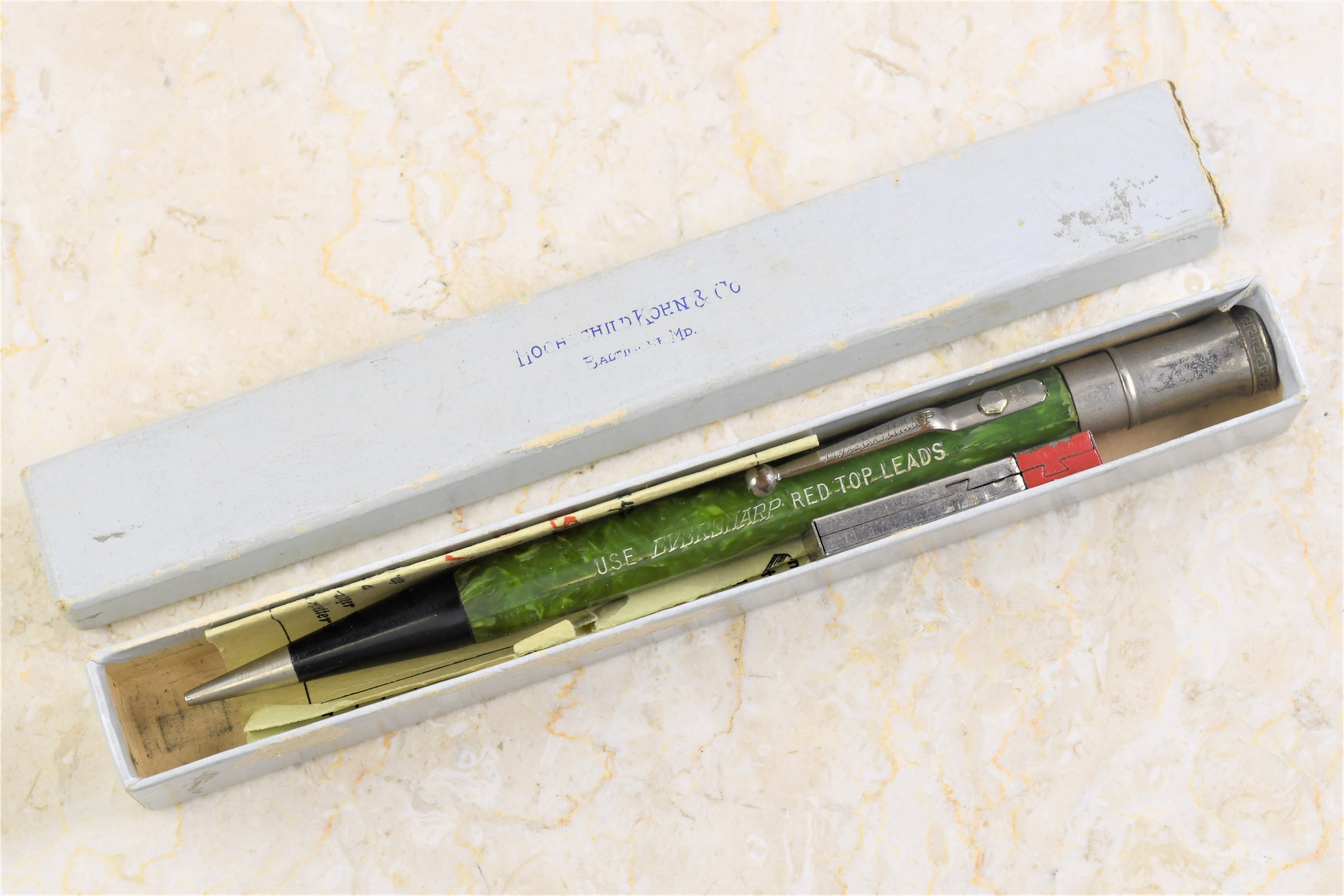
This Eversharp Dollar Pencil has appreciated over the last 90 years:


This particular model was made in 1930 or 1931, according to the timeline I’ve assembled (the full story is in Volume 4, page 3).  I know that because earlier models were equipped with the improved (post-1924) Keeran mechanism.  This one sports the same mechanism found on the Equipoised, and later models – like the ones shown in the 1932 catalog – were streamlined.

But . . . unlike all the other ones I have found which hawk Eversharp’s “Red Top” leads, this one is in jade.  Pedestrian, perhaps, but more interesting than any other material on which I’ve found this imprint:


Note there were three variations:   “ Eversharp Red Top Leads,” “Use Eversharp Red Top Leads,” and “Always Use Eversharp Red Top Leads.”  The “always” variation is found on the earliest; apparently as time went one, using them every so often was good enough.

There was another reason to bite on this one.  It was visible in the auction pictures, crammed in the bottom of the box:


I’ve just got to know what every piece of paper says.  When I flattened this one out, it was one I haven’t seen before . . . Red Top leads, in those rectangular metal containers, advertised on the other side of paperwork detailing Eversharp’s “Personal Point” pens with screw-in nib units, predating the introduction of the Doric in 1931; so 1930, I’m suspecting for this one, if the paperwork has been riding alongside this pencil for the last 90 years.


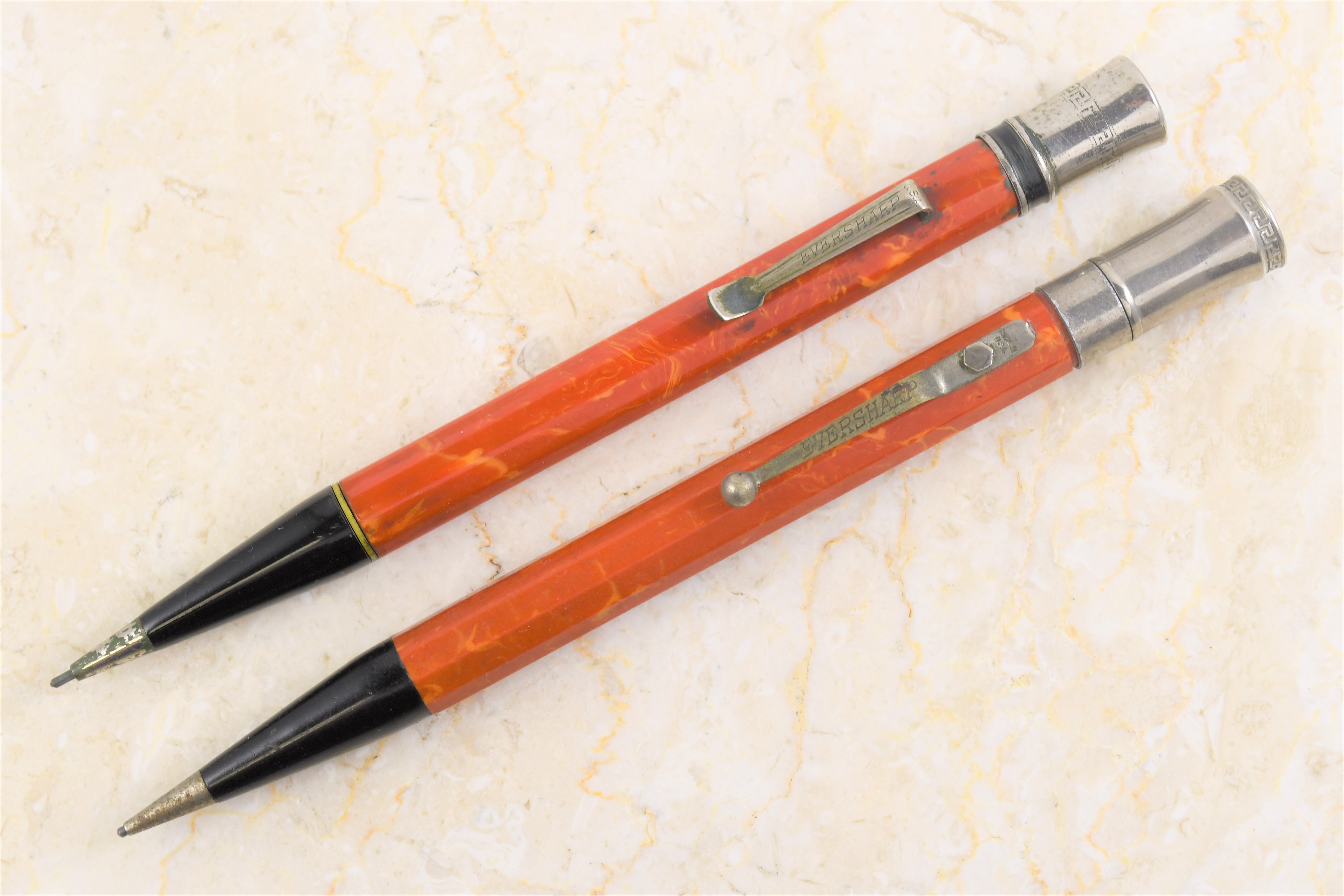
Then, just as I was ready to call it a day for this article, another Eversharp Dollar Pencil showed up in an auction over in England – I just had to bite:


The coral color is spectacular, but that isn’t what’s new.  Here it is alongside the ones you usually see in this color:


The Dollar Pencil series, as documented in my previous article, went through a linear series of developments.  First, the clip was changed from a simple z-clip to that bolted-on one . . . then, the mechanism inside was switched from the venerable Keeran mechanism (as improved in 1924) to the Equipoised mechanism. 


I haven’t found the transitional model in coral yet, with the old mechanism and the new clip.  But the coral was a welcome addition to the other Equipoised-mechanism examples I’ve found:


Eversharp is an infinity pool.  Swim as hard as I can, I still haven’t reached the opposite side.


Friday, October 19, 2018

The Minutian Empire

This article has been edited and included in The Leadhead's Pencil Blog Volume 5; copies are available print on demand through Amazon here, and I offer an ebook version in pdf format at the Legendary Lead Company here.

If you don't want the book but you enjoy this article, please consider supporting the Blog project here.

The art of noticing, I call it – the ability to look at an object and pinpoint those tiny little details that distinguish it in a sea of what appear at first blush to be the same darned thing.  We collectors dwell in minutia because it is those little details that can make the difference between just another two-dollar junker and an unusual variation costing hundreds of dollars.

The first 50 copies (now 51 – long story) of each of these volumes has been reserved for those hardcore, dedicated collectors who have supported this blog for years – good eggs I call “The Order of the Leadheads.”  These first copies are numbered and include a label inside the front cover, and volume 3, released just a couple weeks ago, commemorates what I call the “third glorious campaign into the Minutian Empire.”


Eversharps, more than any other brand in my opinion, offer an infinite pool of these rabbit holes, and over the last few month I’ve picked up quite a few examples, each of which has a tiny little twist that irk and delight me at the same time. 

First is this silver-plated Eversharp, shown next to what I consider to be its more “normal” counterpart:


Octagonal barrels on metal Eversharps were, I believed, earlier models that were discontinued before Eversharp redesigned its metal pencil line in 1924; yet this one has the longer tip, ribbed clip and redesigned guts indicating post-1924 production:


. . . along with the latest incarnation of Eversharp imprints, with the small, superscript “Wahl” preceding the Eversharp name:


Eversharp Checking Pencils have been an ongoing project here at the blog.  In Volume 4 at page 199, I showed an ultra-rare short model with military clip, along with the catalog reference to "Executive" gold filled and silver plated examples in the regular lengths.  Unfortunately, at the time I didn’t have the more normal versions to show you.  In Chicago I finally turned up the gold filled model (I don’t remember who had it), and in Raleigh Brian McQueen was able to supply a very tired looking but nevertheless heartily welcomed silver plate one:


One of these dollar pencils recently came my way, and it had what appeared to be an identical twin:


In fact, both bear advertisements for Eversharp’s Red Top Leads; but with one little difference: the slogans are different.


Eversharp Dollar Pencils have been another ongoing theme here at the blog.  By this point, color variations aren’t anything new to write home about, but this one really knocked my socks off:


On these Equipoised models, what appear to be the latest flattop incarnations abandoned the black nose cone in favor of a one-piece barrel with a longer tip:


Into the 1930s, this next shot shows another pair of coral “tempoint-styled” pencils - however, these are fitted with Equipoised mechanisms rather than the modified version of Charles Keeran’s 1913 design.  Note that the full sized version has a commemorative 1934 imprint, bordering on anachronistic rather than simply later production!


The shorter cap versions with military clips, however, seem to be even scarcer.  They appear at the top of page 61 in The Catalogue, and I reported them as “the most difficult size” to find; although at the time, I completely missed the fact that they had Equipoised mechanisms inside, and they should have been shown alongside the pencils in frame 7e. 


Coronets – more properly (and boringly) known as “All-Metal pencils” by Eversharp – have a few twists and turns of their own.  Bob Novak had to point this one out to me in Chicago, because I missed what was special:


“It doesn’t have the triangles,” Bob said.  I couldn’t remember whether I’d seen that variation, so I decided to splurge.  Bob was right:


I was thinking of the version with a simple row of rectangles at either end, not a simple row of smaller triangles.  Note that the engraving on the barrel is the same as on the “normal” one with large inserts – the inserts have simply been omitted:


The goofy repeater in the center of this next picture came my way at the DC show in August, with no trim bands at all and marked only with an Eversharp imprint on the back side.  It’s shown between an Eversharp Air-Lite, in the same repeating configuration but with a silver plated clip marked “Eversharp,” and an Eversharp Varsity, a twist-action pencil with that same unmarked, gold filled clip:


Into the 1940s, here’s a Skyline that turned up in Chicago:


I refer to these as a Skyline “Standard II,” with the striped upper barrel and thick center band.  I bought it only because it is so pristine and I thought it would be an upgrade, with two stickers, one indicating price and model and the other hawking the company’s leads:


When I brought it home, though, I found out I didn’t have one in this configuration, color and size – and speaking of size, it reminded me to tell you something.  Conventional wisdom teaches us there are three sizes of Skylines: Demi, Standard and Executive.  Conventional wisdom is wrong:


There were four.

Yeah, I know the Executive in that last shot isn’t a match, but as far as I know they weren’t offered in the Standard II configuration.  But speaking of Executives:


I’ve stumbled across something interesting about them.  While I was trying to fix one for a customer, I had reason to take them apart to see how the mechanisms were different from the standard sized pencils.  Imagine my surprise to find this:


One of my examples has a standard-size mechanism, with the quarter-inch difference in size made up with what appears to be a specially made, extra long eraser button!

Finally, into the 1950s Eversharp’s last quality effort was the Symphony line.  Towards the very end of the Symphony line, Eversharp did some weird configurations that must have cost the company far more than it could afford to specially fabricate.  This is one of them, courtesy of Robert (“Speerbob”) Speerbrecher:


The stacked coin band is a nice touch, and the silver trim and narrow Skyline-like top band are a bit different from the standard Symphony fare.  But then again, towards the end, none of these were exactly mainstream: