Showing posts with label Colorgraph. Show all posts

Sunday, August 24, 2025

Slanty, Frank!

Those who know me know that I love a good whisky, I love tipping a glass with friends old and new, and I’m not one who’s much for pomp and circumstance. That results in my awkward relationship with whisky connoisseurs: I’m happiest when I am enjoying good company and good drinks. However, I enjoy both a little less when I am tipping a few with someone who thinks I’m obsessing less than I should over the subtle nuances of what I am drinking.

A few years ago I was taught proper Scottish manners, which requires proper pronunciation of “Sláinte” whilst hoisting a glass.  “Schlon-jay,” is the closest I can come to describing how the anointed will say it with their pinkies extended. 

“Slanty,” I’ll often respond in my finest Appalachian drawl. That’s a test: those who are offended will likely walk away to seek out more genteel alcoholics. Laugh along with me and we’ll while away a few pleasant hours.

I’m convinced that in another age, Frank Furedy and I would have wiled away many such hours. In addition to all of his other exploits, he drove a car like a bat out of hell: newspaper reports of turbulent life and career are punctuated by at least three reports of fines for reckless driving – one of which reported that he failed to appear in court. Furedy likely would have appreciated a “slanty” toast in commemoration of his “slanty” Colorgraph pencils. 


Those angled tops were a unique design feature for which Furedy secured Design Patent 82,821 as discussed in yesterday’s article (posted here). As we left things, Colorgraph pencils were not advertised after 1930, when Furedy filed his last patent application for an improved version of the pencil. At the time, he was being prosecuted for securities violations connected with his sale of stock in his U.S. Colorgraph Corporation without a license.

As the Colorgraph faded into obscurity, Furedy was not quite done in the writing instrument business – although he apparently kept a much lower profile with his next endeavor. He surfaces in 1932 with a patent application for a “self inking fountain pen” that manufactures ink from a concentrated dye cartridge located in the feed, underneath the nib: just add water, and the pen was designed to write for months. Furedy’s application was filed on April 14, 1932 and was issued on September 27, 1932 as number 1,880,128.


Although this patent was originally issued only in Furedy’s name, his patent was reissued on December 20, 1932 (RE 18,702), and when it was reissued it includes a notation that it had been assigned to the Inkpak Manufacturing Company.

Ahhhh... that makes sense.

I’ve seen Inkpak pens, and they have slanted caps reminiscent of Furedy’s Colorgraph pencils. When I stumbled across the Furedy connection, I went shopping for Inkpak pens, and I found two to include in this article for discussion:


Well, one and a half examples, anyway. The combination pen and pencil may or may not be a legitimate Inkpak Manufacturing Company product; even though the cap ring is imprinted “Inkpak Kromium,” the nib, feed, and barrel lack all of the Inkpak’s special features. It was still worth buying just for the cap, to show there were nickel-silver and gold filled trim models, both of which shared a familiar profile:


Slanty, Frank . . . downright slanty. The more intact version has an unrelated Eversharp nib in it – a definite improvement over the Inkpak’s original “Kromite” steel nib, underneath which is Furedy’s patented inkmaking device:


The cap on the butt of the barrel unscrews, revealing a chamber containing spare ink cartridges and a note:


I’m not sure to what extent Frank Furedy was involved with the Inkpak Manufacturing Company, outside of his patent and perhaps contributing whatever design patent rights he could claim for slanty tops. Once again, Frank Furedy’s personal issues may have cut short his business venture. On March 25, 1932, the Norristown Pennsylvania Reporter published news that Furedy’s wife Rosalie, who had married him in 1927, had filed for divorce, claiming unspecified “indignities.”


The following advertisement, from the New York Daily News on December 4, 1932, advertises both the Inkpak pen and its accompanying “Leadpak” pencil. I hope at some point a pencil marked “Leadpak” will surface, but it is possible if not probable that they were unmarked:


The Inkpak was advertised in its flattop form between 1932 until 1934, almost exclusively in New York, and I did find a snippet view of a writeup in Geyers’ Stationer in 1933, which identified Furedy as the president of Inkpak Manufacturing Company. I did not find a trademark registration for “Inkpak” in the course of writing American Writing Instrument Trademarks 1870-1953, either just as a word or in connection with the logo seen on these clips:


However, the word “Kromite” - the name Inkpak used on the steel nibs found on many of its pens – does turn up in the trademark records.  Unfortunately the Patent Office has lost the trademark registration certificate, and all that remains is this notice in the Official Gazette, stating that the rights to the name were assigned by the Inkpak Manufacturing Company, Inc. of New York to the Inkpak Pen Company, Inc., also of New York. The applicant claimed that the mark had been in use since September 1, 1932:


I found some curious references suggesting that by 1936, pens marked “Remington” were fitted with Inkpak Kromite nibs. That detail, for our purposes, is best put off for another day. According to Richard Binder’s Pen Glossopedia, the Inkpak Pen Company was formally dissolved “by proclamation” on Dec. 15, 1938, by which time the company had abandoned all of the features that made the Inkpak different in favor of plain lever fillers with ordinary feeds.

But there is one other detail about the Inkpak that was rattling around in my brain . . . I remember seeing another Inkpak pen that wasn’t like these . . . years ago . . . 

I’m better known for my work in mechanical pencils, but there have been times such as these when I can’t resist picking up a fountain pen when it registers high readings on my weird-o-meter. When I do, and it isn’t something that fits into my pencil collection, they end up in a drawer full of things that are cool enough that I have to have them, but not cool enough to archive and organize as well as my pencils:


There it is, where it has been in storage for ten years or more: I remember buying it for a buck or two at the Don Scott Antique Show, just because I couldn’t figure it out:


Now I understand that hole in the feed was for Furedy’s patented ink cartridges, and that empty compartment under the blind cap held the spares. The “Pat. Pend.” reference confuses me: what connected Furedy to the Inkpak in the first place was the assignment of his filed patent in 1932; this example is obviously later than the larger flat (slanty) top pens, so there must have been some other patent – perhaps for an improved version of the pen – that was never granted.

As the Inkpak pen fizzled away into history, Furedy’s career in writing instruments came to an end. In 1937, Furedy filed a patent application for a “spout unit for containers,” which was granted and assigned to the American Flange and Spout Company, and the 1937 Directory of New York State Manufacturers identifies Furedy as President of a “Twin-Glo Lamp Co., Inc.” Lamps would become Furedy’s next big thing: beginning in 1940, Furedy patented numerous improvements to “therapeutic lamps,” and by 1946 he had moved to Chicago, where he became president of the Sun-Craft Company. I don’t know whether he joined Sun-Craft or founded it:


Furedy apparently remained with Sun-Craft for the rest of his career, although his inventive spirit could not be contained to the field of therapeutic lamps. The Chicago Tribune published an advertisement for “Quartz Bowl” smoking pipes on June 10, 1947. The manufacturer of the pipes was identified as the “Quartz Industries division of Sun Craft, Inc.” and it includes a statement from our man Frank Furedy:


“I designed this pipe for my own smoking pleasure,” Furedy is quoted as saying, “but my friends persuaded me to make several for them. Now I want to pass these pipes on to the many men who will appreciate an entirely new kind of smoking experience.”

Furedy may have “designed” the pipe, but from what I can tell he did not receive a patent for whatever new kind of smoking experience he had created. One source indicates that Frank Furedy was born on May 23, 1892 and died in Chicago in April, 1964, although I haven’t found his obituary – it as if he simply drifted off into history. Neither did I find any pictures of our man, but I like to think that the artwork in that Quartz Bowl advertisement might be him:


That looks about right – relaxed, unflappable, and persevering, despite all the troubles swirling around him . . . and smiling like he’s still got something up his sleeve.

Stay slanty, my friend.

Saturday, August 23, 2025

More Than I Expected to Learn

Jennifer Heath was on hand at the Chicago Pen Show this year, liquidating more of her father Tom Heath’s collection. She had quite a crowd, attracted by the sound of hands plowing through plastic bins of stuff – items were marked with a colored dot to denote the price.

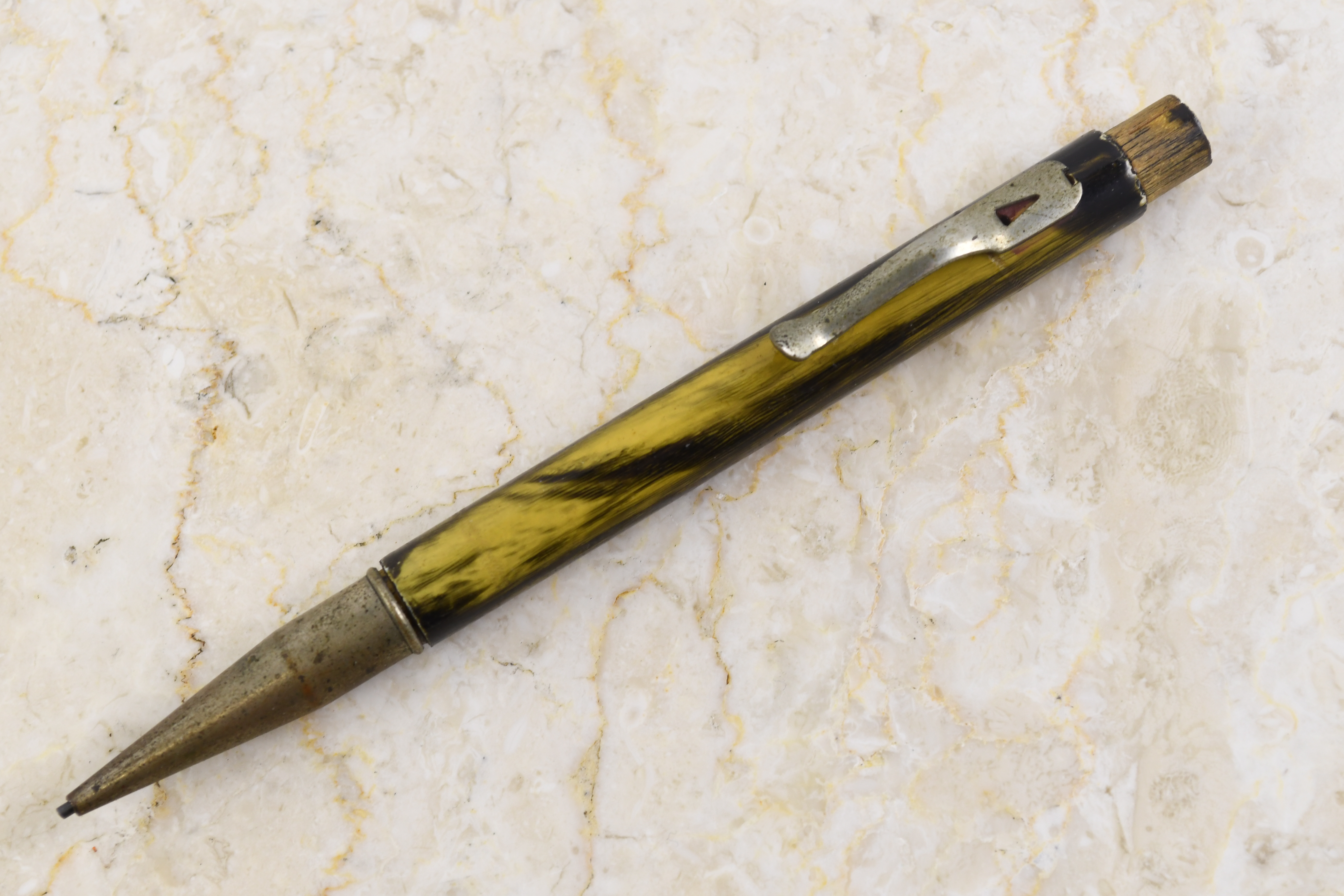
One of the cheaper items was an example of the Colorgraph pencil, and I couldn’t resist at that price even though I had one in black and pearl. The Colorgraph was a duplex pencil – turning the cap one way advanced a black lead, and turning it the other way retracted that lead and advanced a red one (or whatever other colors you wanted).

Right after I got home, another example popped up in an online auction – the opening bid it was too cheap to resist, and my opening bid carried the day. Weeks later, as I was going through things, I had forgotten which one was which.


Was I stupid bidding on things I thought I already have? No . . . what would have been stupid would be assuming that I already knew what I have because, so often, I do not. Here’s the two new examples shown next to the first one I acquired so many years ago:


Nice - the longer noses on these new additions are a little older, I believe. But that still leaves two duplicates without a purpose, right? Not so - here’s the entire spread of Colorgraphs in my custody:


At some point, if I can ever figure out how to take these things apart, I’m going to transplant the clip from one of these onto that example at the top.

I haven’t thought about the Colorgraph for a long time, and the long nose/short nose difference made me dive back in to see if I could date these more precisely. I couldn’t find that bit of information, but I did find other things to tell you about. 

Lots of things.

The bulk of what I had learned about the Colorgraph before now was published in “A Colorful Mystery Is Solved” (March 15, 2013: Volume 2, page 95). I had at the time just stumbled across some of Frank Furedy’s design and utility patents for the Colorgraph in George Kovalenko’s patent book, just before I started working on my own two-volume set. George’s book yielded four patents: the first, number 1,638,026, was applied for by Frank Furedy on July 22, 1924, when he lived in Brooklyn, New York. It was issued on August 9, 1927:


Both of Furedy’s other utility patents that Kovalenko listed, 1,664,071 and 1,664,166, were issued on March 27, 1928. The latter was applied for on July 22, 1924, the same date Furedy applied for his first pencil patent and references an even earlier application by Furedy, serial number 694,990, which was applied for on February 25, 1924:


Finally, Furedy (who by then was living in Penn-Wynne, Pennsylvania) applied for a design patent for what is obviously the Colorgraph on September 17, 1930. The design patent was issued on December 16, 1930 as number 82,821.


A lot has happened since 2013: as mentioned earlier, I wrote a couple patent books of my own, and in the process of writing American Writing Instrument Patents Volume 2: 1911-1945, I found three more patents with Furedy’s name on them. The first, number 1,536,430, was serial number 694,990 referred to earlier, applied for on February 25, 1924 and issued May 5, 1925. This was his earliest patent, with drawings made before Furedy had the great idea to put a slant on the caps.


Another pencil patent that turned up when I wrote the book was number 1,679,566, applied for on and issued August 7, 1928. What makes this one interesting is that Furedy had two collaborators: Charles Schroth and William Favini, both from Bloomfield, New Jersey. This patent was assigned to Bushwick National Bank, and it is the only appearance Schroth or Favini made in my book. As I tunneled in to learn more about them, I found nothing newsworthy to report.


Office Appliances introduced the new Colorgraph to the trade in November, 1925, with this formal writeup appearing in December 1925: note the shorter, more refined nose illustrated.


The Colorgraph was first advertised in newspapers in early 1928, but advertisements were nondescript. This one appeared in the Grand Rapids Press on January 3, 1928:


Frank Furedy was plagued with financial problems; a foreclosure notice against Frank Furedy Holding Company, Inc. was published on January 18, 1928 in the Montclair (New Jersey) Times: Furedy’s mortgage on his New Jersey property was delinquent, and the notice cites other of Furedy’s creditors who had secured judgments liens against his real estate:


Furedy, however, didn’t miss a beat: on July 27, 1928, the Wilmington Morning News reported that a new Delaware corporation called the Furedy Holding Company, Inc. had been formed to hold, obtain and develop patents. Frank was keeping a low profile: the named incorporators were Frederick Jaspersen, George McQuilkin, Jr., and Elizabeth C. Wright, all of Philadelphia:


The Colorgraph pencil, however, was not a product of either of Furedy’s holding companies – at least, not according to the imprints found on the pencils’ barrels. Earlier examples are marked only on the clips, but the later ones sport an elaborate script imprint attributing the pencils to the “U.S. Colorgraph Corp.”


Furedy had formed U.S. Colorgraph Corporation in 1928, right when the first advertisements for his pencils were first offered on the market, but he quickly ran afoul of securities regulations. On April 17, 1930, the Philadelphia Inquirer reported that he was arrested for selling $20,000 in shares for the corporation without a license. He was held on $1000 bail pending trial:


Furedy’s legal troubles might have caused him to circle the wagons in his business dealings. On September 6, 1930, Furedy filed a trademark application for the Colorgraph mark; in his application he claimed to have first used the mark on November 15, 1925, around the time the initial trade announcements for the pencil appeared, but three years before advertisements for the pencil were published in newspapers.. Trademark registration was granted on July 19, 1932 as number 296,000, and it was assigned to George M. Hessdoerfer of Philadelphia:


Newspapers report nothing about Hessdoerfer, other than his 1940 obituary, so he may simply have been a straw man for Furedy, given Furedy’s legal troubles. There is one other detail about him, which I missed when I wrote my patent books. Frank Furedy filed an application to patent improvements to the Colorgraph pencil on October 22, 1930:


Patent number 1,918,464 was issued on July 18, 1933, and it is reported in my book – but I did not catch that a one-half interest in the patent was assigned to George Hessdoerfer.  Mea culpa. If it is difficult to sort out all of Furedy’s business associations today, it may be due to the fact that Furedy was covering his tracks while he was under indictment nearly a century ago.

I found no reports concerning the outcome of Furedy’s case; if he was convicted, it does not look like he spent any significant amount of time in prison. I found no evidence that the Colorgraph remained in production after 1930, but Furedy wasn't quite finished in the writing instrument industry . . . 

Sunday, July 4, 2021

That's All I'm Going To Say About That

This article has been included in The Leadhead's Pencil Blog Volume 7, now available here.


If you don't want the book but you enjoy the article, please consider supporting the Blog project here.

When I sit down to write one of these articles, my method of picking the topic of the day is very non-scientific:  I open the file folder containing all the pictures I’ve taken, and I scroll through until I find something that I think would be fun to write about.  As the more meaty subjects get pulled out and placed in the “published” file, what's left behind are the brisket tips -- good stuff, worth photographing and definitely worth noting here, but more of an appetizer than a meal.  While each of these notes might not be enough for a complete article, today I'll string a few of these little notes together into a little tune.  

The Colorgraph:

I haven’t written about the Colorgraph for some time, most recently in Volume 2, page 95.  Since I’ve found so few of these duplex pencils over the years, it’s one of those brands I’ll chase even if I think I already have one, in the hopes there will be some tiny difference that will add to the story.  Recently, I chased and caught an example in black:


Unfortunately, it was identical to my other examples (and I still haven’t found an intact earlier model, with the longer nose).  So . . . all I have to tell you is that they also come in black.


The Ruxton:

The 1,000th post here at the Blog (Volume 4, page 351) covered the Ruxton well, including the company’s archive of prototype and shop models as well as production examples – including some boxed ones.  I bought this one because the box was different - the other examples in my collection are dark blue with black lettering, but this one you can actually read:


The pencil is extremely clean, but unfortunately there’s nothing different about it from what I’ve shown you already:


The Welsh Manufacturing Company:

This one was in a box lot of junk that came my way, and it wasn’t my intended target.  


From the clip and the nose, I knew it was made by the Welsh Manufacturing Company of Providence, Rhode Island.  Here it is shown alongside other variations on the theme:


I would have just put it in the Welsh drawer without photographing it, except for one small detail:


This one has a painted wood barrel.


The “Arrow Double”:

I’d never heard of this one before:


It nearly identical to one already in my collection, with two exceptions:


First, it lacks that great arched “14kt Gold Plate” imprint on the clip:


And second, the producer’s imprint on the top is different.  I say producer, because I don’t know who manufactured either one:


The one I had is an Ajax; this new one is marked “Arrow Double.”  I haven’t been able to discover anything about the Arrow Double in the year since I found it.


The Bridge Set:

I had such high hopes for this next find:


This nice box contained a beautiful set of sterling pencils marked with card suits:


I wrote about a similar set in a recent article about bridge pencil sets in Volume 6, page 194.  On page 196, I showed an English set by William Manton along the same lines that Joe Nemecek had given to me; it was newer than I had hoped, bearing a hallmark dating it to 1979.


This set appears to be older, and I expected hallmarks that would be a bit more . . . well, a bit more vintage than me, anyway.  Alas, there are no hallmarks and it appears to have been made for export to the United States, marked only “Made in England / Sterling Silver.” 


An Interesting Sheaffer Sharp Point:

This Sheaffer Sharp Point is on the early side of production, with a bowler clip and that zigzag-with-dots pattern:


What’s inside isn’t what I would expect.


The earliest Sharp Points look like this inside (see Volume 4, page 324):


While later Sheaffers (early 1920s on) look like this:


I’m not sure where this one fits in.


Cross-Built:

Here’s three very similar pencils . . . the bottom one is a typical Cross Century:


Two are marked on the clip: the Cross, and one marked “Swank.”


The Swank brand appeared in Volume 1, page 345 – on a ruler pencil/tie clip pencil.  Swank, Inc., as reported in that previous article, survives as a division of Randa Accessories.  The third pencil has a plain clip, but a nice imprint on the barrel:


It’s a “PAT One Twenty.”  PAT was a trademark of Ketcham & McDougall, Inc., better known for making those pencils attached to a pin by a retractable chain.  The company claimed to first use the mark on September 18, 1936, according to the trademark registration:


All three of these pencils share very similar features, and my suspicion is that Cross made all three.  The Swank and PAT One Twenty share another element - that black plastic ring in the middle:


Welty’s

At the Krinke auction, one of my impulse buys was this fountain pen, complete with the box but with a conspicuously absent pencil:


The imprint is on the barrel, concealed under the cap when closed:


The pen was made by DeWitt-LaFrance, and I wasn’t planning on chasing it until I saw how small it was:


I wrote about the Welty’s DeWitt-LaFrance pencils in Volume 3, page 158; I came across the pen at some time since.  If the matching Welty’s pencil surfaces, it would be about the smallest DeWitt-LaFrance pencil I’ve seen.


The Baby Jumbo:

The Baby Jumbo is in Volume 1, page 373, and it’s not really “mechanical.”  A wood pencil is wedged in the neck of a glass bottle containing candy:


There was another example up for bids at the Krinke auction; I took “just in case” pictures of it before the auction started, because this one had the original paper label on it:


It would have been nice to bring this one home, but the pencil was identical to what I had, and the only thing the label provided was a cute admonishment to “Write your mother a letter today.”  When the bidding got a little crazy on this one, I couldn’t justify spending what it would take - so my “just in case” picture will have to do!