Showing posts with label Slencil. Show all posts

Tuesday, August 3, 2021

The Skinny (Skinnier) On the Slencil

This article has been included in The Leadhead's Pencil Blog Volume 7, now available here.

If you don't want the book but you enjoy the article, please consider supporting the Blog project here.

With auction pictures being what they are, and online sellers sometimes garbling their descriptions, I bid on this lot for a closer look:


The seller described them as "Slimcil" pencils.  I assumed the seller meant "Slencil," but still . . . these looked different from the early Slencil pencils I've seen.  It has been years since I've posted about Carl Harris' early Slencil pencils, because I haven't had anything new to add to the discussion since Volume 1.  Here's the image from Volume 1, page 163:


In 2015, I revealed that at some point, the Moore Pen Company was producing the Slencil -- "producing," not necessarily manufacturing, since the tooling was unique to this pencil and if Moore didn't acquire Harris' machinery, Moore was sourcing them rather than making them (see Volume 3, page 236):

I picked up another example along these lines from David Silber at the Raleigh Show this year - the pencil fits nicely into the small Cross box in which it was housed, but without any comparable "Slencil by Cross" sticker, I don't give much weight to any speculation that Cross ever offered these:


Early metal Slencils consistently bear the Slencil name on their reversible eraser retainers, accompanied by two patent numbers: 


The first is a design patent for the unique appearance of the pencil.  Design patent 93,476 was applied for by Carl C. Harris on July 16, 1934; it was issued October 2, 1934:


The other is patent number 1,975,788, applied for by Harris on April 13, 1933 and issued October 8, 1935:


On May 1, 1936, Harris applied to reissue patent 1,975,788, which was granted on August 24, 1937 as Reissue Patent 20,481.  The reissue patent appears on later, conventional "Stag Slencil" pencils, even though the ordinary nose-drive mechanisms in these plastic, rectangular pencils has nothing to do with Harris' patents (see Volume 2, page 247):


Which brings us to this trio of "Slimcil" pencils.  When they arrived, I couldn't wait to pull out my loupe to read whatever might be imprinted on them.  The seller was correct:  "Slimcil / Pat. RE20,481" is imprinted on the clips:


Compared to all the other metal Slencils in my collection, these "Slimcils" are an entirely different animal.  Harris' patent drawings show a single piece of metal, folded in half and then folded again at the edges to form a thin barrel.  None of my other metal Slencils have this feature, but these Slimcil pencils do (minus the pronounced medial rib to accommodate the mechanism):


While Slencils are slender, Slimcils are skinnier still:


Exactly how these pencils fit into the Slencil story remains an open question.  Harris never registered a trademark for "Slimcil" as he did for "Slencil," and all of my searching for when or by whom the name was used are at a dead end.    These Slimcils are more true to Harris' original design, but the Reissue patent rather than the original patent number might suggest it was made later -- perhaps after Harris turned over the rights to make his pencils to Moore, he wanted to make some on his own account, changing the name and appearance of the pencil so he wouldn't run afoul of whatever his contractual obligations with Moore might have been.  

It is also possible that Harris did not begin production immediately after securing his patent in 1934; perhaps he began production in late 1937, and he filed to reissue his patent to restart the clock for the term of his patent.

Tuesday, June 16, 2020

Coincidence No More

This article has been edited and included in The Leadhead's Pencil Blog Volume 6, now on sale at The Legendary Lead Company.  I have just a few hard copies left of the first printing, available here, and an ebook version in pdf format is available for download here.

If you don't want the book but you enjoy this article, please consider supporting the Blog project here.


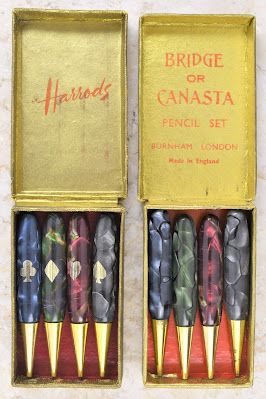
There’s two types of “bridge pencils.”  In America, they usually took the form of pencils with on-board scoring “cheat sheets,” like those ones bearing a seal of approval from Ely Culbertson, bridge-playing rock star of the 1930s (see "Bridge Player of the Century").

Overseas, bridge pencils were less gimmicky and more genteel sets of four pencils, representing the four card suits, one for each player in a game of contract bridge.  They were typically packaged in nice cases, to be brought out ceremoniously like fine china for a more formal sort of social occasion.  

And, since they typically aren’t American, they fall outside my self-imposed collecting bailiwick.  “Two’s a coincidence and three’s a collection” has been my mantra, which is why as late as 2015 I was still counting these as “two” (see"This Counts as Two, Right?"):


These sets were made by English maker Burnham; the Canasta set is so marked, and the set marked “Harrod’s” inside the box lid was marketed by the London department store by that name.

The fiction that I don’t collect these has long since collapsed, and I’m keen on finding nice bridge sets regardless of their country of manufacture.  The first picture in this article is from the box lid of a set that recently came my way via Jerome Rosenthal:


While Mabie Todd & Co. is a firm with American origins, the “Ltd.” at the end designates its British operations, and the pencils are clearly continental.  They have triangular barrels, and the colors are just spectacular:


And unlike the Burnham sets, these pencils sport imprints.  Even if they didn’t I wouldn’t question whether these are Mabie Todds, but it doesn’t hurt to have that extra little bit of confirmation:


“‘DACE’ / Mabie, Todd & Co. Ltd. / Registered No. 728198.”  It’s frustrating trying to find information concerning British registrations; they consider such historical information over there to be a profit center.  One day I aspire to do for British patents and trademarks what I’ve been able to do over here, where free access facilitated the creation of the reference books I needed.  Unfortunately, without spending a considerable amount of money on British records, a registration number like this is about as useful as a bicycle is to a fish, so the saying goes.

A rant for another day, I suppose.  

Here’s another British bridge set, which Joe Nemecek gifted to me:


I used to think this was a much older set which had been rehoused in something much newer, since the pencils look like something from the turn of the last century.  Quite a coincidence though, to find a perfectly sized case with four perfectly sized bands to hold these:


The hallmarks tell me that this is all original and as it should be.  It’s quite a bit newer than it looks, and newer also than nearly everything in my collection:


The three stamps in the middle are traditional English silver hallmarks, which have been in use for hundreds of years.  The one on the left is an anchor, denoting Birmingham assay office.  The lion denotes sterling silver (and is a duplicate of the more recent “925" marks on the right).  The important one is that script E, which is the date code corresponding to 1979.  

As for the “W.M” at the beginning, that is the manufacturer’s hallmark.  The only one I found operating in Birmingham in 1979 was William Manton, also known as Birmingham Gold & Silversmiths, Ltd.

The lure of matching pencils with card suits even pulls me in when they are more humble; these came in a box marked “Germany” but are otherwise unidentified:


Then there’s this set, which turned up at the DC show a couple years ago.  


There’s no markings on the pencils other than “Foreign” (meaning foreign to the UK, into which they were imported), and they combine American kitch with a bit of European flair: four pencils, each marked with all four suits and bearing on-board cheat sheets, accompanied with a nice metal plate with an “Honor Column” and brief description of penalties.  At the tops, square inserts prevent these clipless pencils from rolling, which might suggest “Foreign” meant brought back to the crown from the former colonies – that’s just like what you’ll see on the Vanco bridge pencil (see "Trick Pencils . . . For Tricks").


Here in the states, where the Slencil company turned out these “Stag Slencil” bridge sets (featured here back in 2013, see The Leadhead’s Pencil Blog Vol. 2, page 247):


Slencil was one of the few American companies turning out four pencil sets like the ones in Europe, but an article such as this wouldn’t be complete without including the American royalty on the subject:


Resting comfortably in a corner of the museum is Parker’s offerings on the subject: the bridge set consisting of four enameled and separately boxed bases, with red and black golf pencils.  I’ve written about these more continental sets before (see The Leadhead’s Pencil Blog, Vol. 1 at page 300 and Vol. 2 at page 137), and also about Parker’s scoring pencils in the foreground (those weird triangular pencils with red round tops - see Vol. 1, page 318 and more recently, at "Bridging the Gap"). 

I don’t have anything new to add about the Parker stuff – it just didn’t seem right to post an article about bridge sets without including them. 

PS - Joe Nemecek has a similar affinity for things like this - check out his post over at Joe's Pencil Pages:  Joe's Bridge sets.

Monday, February 23, 2015

I'll Bet You Didn't Know This

This article has been edited and included in The Leadhead's Pencil Blog Volume 3; copies are available print on demand through Amazon here, and I offer an ebook version in pdf format at the Legendary Lead Company here.

If you don't want the book but you enjoy this article, please consider supporting the Blog project here.

I was pretty excited when Rick Krantz had this unmarked pencil on his table at Philly – it was the missing piece I knew was out there that connected two interesting dots:


I had always heard that this clip was associated with the Moore Pen Company, and this example seems to prove the point. Here it is flanked by a couple others along these lines:


Note the overall shape and size, the two center bands, and the identical tips on the green and burgundy examples.


But connecting this clip to Moore isn't what had me excited about this one. It was connecting Moore to something else. Here’s the new Moore next to a couple of metal Slencils in my collection:


Slencil was headquartered in Orange, Massachusetts, not far off from Moore’s operations in Boston. You are justified at this point to be suspicious if I suggested there was some connection between Moore and Slencil – after all, Slencil was a one-trick pony turning out flat pencils, while Moore offered a wide range of high (and not so high) quality writing instruments. It’s possible, you might think, that similar clips might be all these two have in common.

But I’ve got something else up my sleeve to show you.


The clip on this one also looks Moore-ish, but that’s not what’s important about this one. Did you see the sticker on the side of the box?


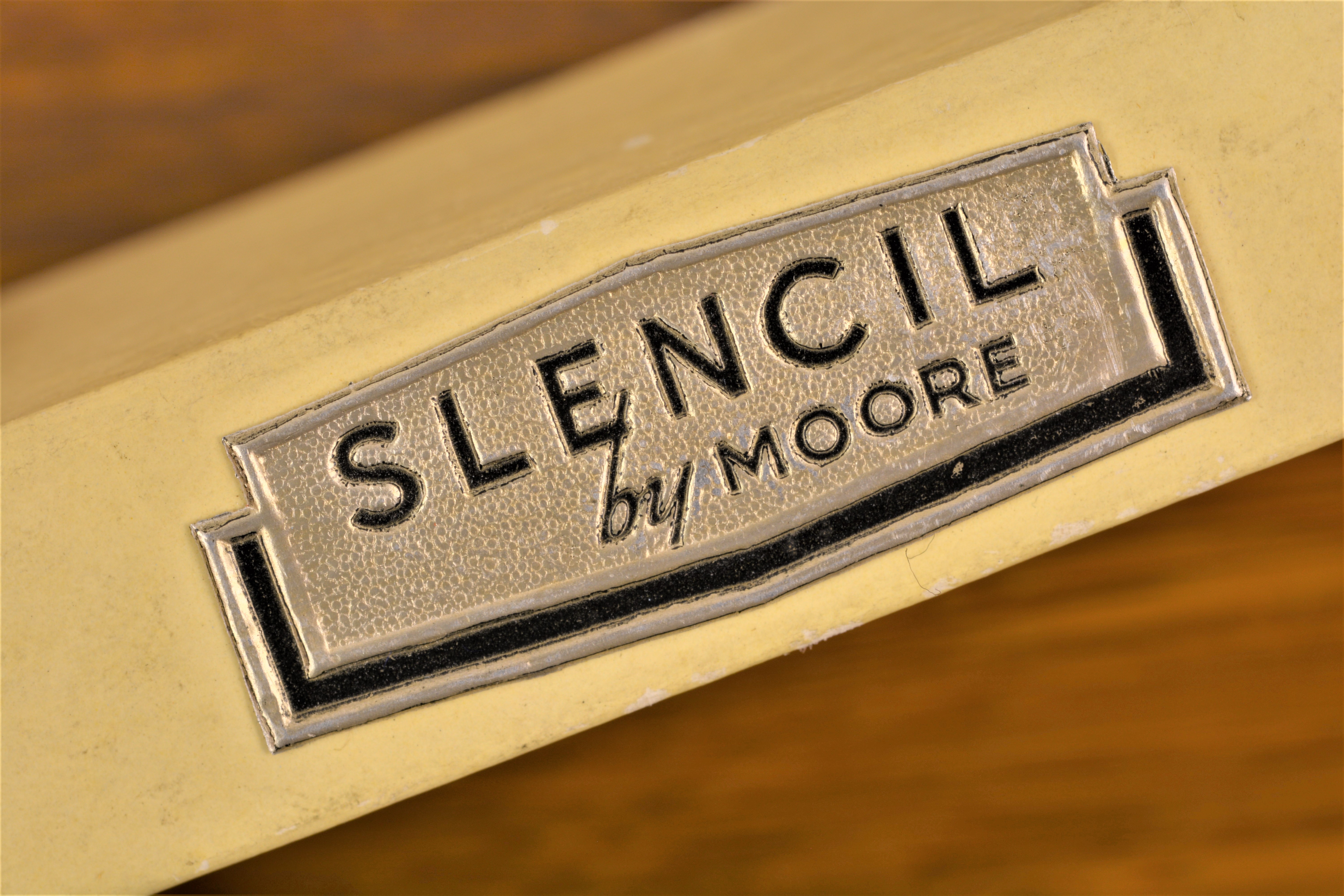
"Slencil by Moore."

At this point, you can ask me any question you want – other than "yes, at some point there was some connection between Slencil and Moore," the answer is "I don’t know."

Monday, September 9, 2013

Yammerworthy

I can’t remember which of my collecting friends once asked me why I’m always yammering on about Slencils.  I didn’t think too hard about the question – after all, I don’t want to risk having an existential moment during which I wonder why I yammer on about any of the things I write about here – but I think the answer is easy.  When it comes to the Slencil, there’s a lot to yammer on about, and no one’s really yammered about it before.

Carl Harris, inventor of the Slencil, supposedly came upon the idea when he was riding on a train, and his pencil kept rolling off the table.  What may seem today as a single idea – a flat pencil that won’t roll – proved to be fodder for Harris to invent and patent dozens of improvements, attachments and accessories over a period of decades.

In the Slencil’s last incarnation, Harris’ interesting mid-barrel knurled mechanism was abandoned in favor of a conventional nose drive, inserted into a plastic rectangular barrel which was intially marketed as the “Stag Slencil.”    The design patent, number 119,263, was issued on March 5, 1940:


A few months ago, this turned up in an online auction, and since I’m a sucker for pencils with a card-playing theme, and I was hunkerin’ to do some yammerin’, I couldn’t resist:


To learn more, this full article is included in The Leadhead's Pencil Blog Volume 2, available at Amazon, Barnes & Noble and everywhere else you buy books, or you can order a copy signed by yours truly through the Legendary Lead Company HERE.


Tuesday, April 3, 2012

The Early Slencils

Since The Catalogue was published, I've found a few other neat examples of the early metal Slencils shown on page 150.  Note that while two of these have a conventional nose-drive mechanism, the remainder have Harris' unique mid-barrel mechanism, for which he applied for his original patent in 1933.  However, this group of pencils showcase several of his other innovations, mostly involving the clips . . .

NOTE:  This article is now included in the print version of The Leadhead's Pencil Blog, available anywhere you buy books, or also from The Legendary Lead Company.

To order, here's the link:  Volume 1 at Legendary Lead Company


Thursday, December 22, 2011

The Indian the Wife Doesn't Mind Too Much

When it comes to the Slencil, there are two basic types.  The first are the quirky little metal pencils which come in a wide variety of styles and options, invented by Carl C. Harris in 1933.  The second variety, while still unique, is the rectangular plastic pencils which have a  more conventional nose drive mechanism . . .

NOTE:  This article is now included in the print version of The Leadhead's Pencil Blog, available anywhere you buy books, or also from The Legendary Lead Company.

To order, here's the link:  Volume 1 at Legendary Lead Company