Showing posts with label Chilton. Show all posts

Thursday, November 20, 2025

The Friendly Reminder

Many of the pictures in my “to be written about” folder were taken so long ago, and they have spent so much time living rent-free in my head, that I’m sure that I had already written about them . . . so sure that when one of Gabriel’s care packages had a Seth Crocker pencil in it, I was convinced I would be updating a previous article and picking up where I left off.


I was absent longer than expected to write the Sheaffer and Eversharp books, and a few years later, I had circled back around to find good and bad news. Bad news first: Gabriel’s example of the Seth Crocker is a duplicate of an example I have: it’s a black two-band example, just like the one at top here:


No worries about that, though – should a Seth Crocker limp into the museum in a really wild color but missing a thing or two, it will be good to have one that can share custody of its bits and pieces. As I compared it to what was in my photo archive, I stumble across some pictures of another one, which David Nishimura had brought to the Baltimore show several years ago.


The good news was that Gabriel’s example nudged me to take a few do-over shots of this one; what was in my head never made it onto paper because the photos I shot did not turn out as well as I hoped, and with those updated pictures I can push this one across the finish line. The clip on this one is marked “Sears” rather than the usual Seth Crocker:


I believe “Sears” is a reference to Seth Chilton Crocker’s father, Seth Sears Crocker, owner of the original Crocker Pen Company – a happy coincidence that likely didn’t sit well with Sears, Roebuck & Co. See “It Isn’t a Race, But If It Were . . .” (June 14, 2020: Volume 6, page 185). Joe Nemecek has a Sears-marked Seth Crocker, shown on page 187, but his has the typical three narrow trim bands. This Sears has a little something extra:


Despite the deluxe trim, there’s no imprint on the barrel, but removing the nose reveals that it has the same mechanism inside.


The Seth Crocker pencil was designed by Ambrose Fleming: his patent 1,886,333 was applied for on May 12, 1931 and was issued November 1, 1932; see “The Patent Book Passes a Harsh Test (November 4, 2014: Volume 3, page 84):


Page one of the drawings isn’t particularly helpful, but there’s a couple figures on page two of the specifications which clearly show the Seth Crocker’s unique internal lead tray.


At that same Baltimore Show, George Rimakis tracked me down with a little pile of goodies he’d set aside for me, including these two:


At the time, I had recently written about the “Pencil Knife” in “What They Looked Like and Why Most Don’t” (May 30, 2021), and I thought these might be a little less “knifey” version, with that distinctive lower trim band.


Alas, there isn’t enough there to connect the two - the placement of the trim band is all that the two have in common. On the Pencil Knife, that’s just the joint where the top pulls off, and it has a conventional nose-drive mechanism. George’s pencils, however, have tips that unscrew to reveal something far less conventional.


Hmm . . . a nose that unscrews to reveal a weird mechanism . . . 


On a hunch, I browsed American Writing Instrument Patents Volume 2: 1911-1945 to see if Ambrose Fleming designed any other pencils. He’s credited with nine inventions in the book for patents issued between 1921 and 1932, with the Seth Crocker pencil being the last of them. One of his earlier inventions was patent 1,674,357, applied for on March 22, 1926 and issued on June 19, 1928.


That’s it.

There’s no markings on George’s pencils - no branding and no “Pat. Pend.” or other information. In 1928, when Fleming’s earlier patent was issued, the Crocker/Chilton saga was at a transition point: the Crocker Pen Manufacturing Company (in its later years, under the direction of the colorful George Zain) had failed in 1926. The Chilton Pen Company was formed in 1926 by Seth Chilton Crocker; his father Seth Sears Crocker died in 1927.  Seth Chilton Crocker was then given the boot from Chilton in 1932, at which time he formed the Seth Crocker Pen Company. See “Three Missing Years” (June 15, 2020: Volume 6, page 187).

That is a lot going on in a few short years. This story continues to inch forward one step at a time, and now I would like to learn more about our man Ambrose Fleming: no, I don’t think he’s the same guy as John Ambrose Fleming, the English inventor, and I don’t know what if any relationship our Ambrose had to Seth Chilton Crocker, Chilton, or the Seth Crocker Pen Company. 

Are George’s pencils “Seth Crocker” pencils? It’s possible, but I don’t think so, because they are not so marked. Maybe he was an independent inventor who sold his last invention to Seth Crocker, and maybe there is more to be learned about the story.

Friday, November 14, 2025

"Stealth Wealth"

Several years ago on the old Fountain Pen Network Forum, user “Pepin” started a thread titled “Which pen is the epitome of stealth wealth?” to discuss pens that are much more expensive than one might initially think – sort of an IYKYK sleeper show.

No, I don’t always talk in acronyms . . . but when I do, I’m proud to show off that stodgy old guys like me still have the capacity to learn new things, such as IYKYK means “if you know, you know.” For . . . you know . . . those who don’t know.

Mont Blanc doesn’t cut it in this category, because that snowflake or “bird splat” on top is deliberately intended to draw attention, and everybody knows there’s no stealth in parading around that wealth. That’s true of the genuine ones, anyway – the fake ones scream stealth poverty. “Stealth wealth” implies something that is so understated that the average person would have no idea how expensive they are.

Richard Binder was among the first to jump into that discussion with his images of a Chilton Golden Quill. As mentioned yesterday, this was the Chilton Pen Company’s last model, introduced by Chilton at the New York Worlds’ Fair in 1939. Richard Binder’s thorough profile of the Golden Quill (the full link is https://www.richardspens.com/ref/profiles/golden_quill.htm) is an invaluable research tool, and it is what I turned to immediately when I found this unmarked pencil in a junk box full of random stuff. 


This was one of those boxes that had come to me years ago, and I only recently got around to going through it; there must have been just one thing in there that I really wanted, but I had to buy the box to get that one thing. Maybe someone convinced me to accept a donation of stuff because they had heard I like pencils. If it was the former I got my money’s worth, and if I was charitable in bringing in a box of stuff I didn’t want, at least my good deed finally went unpunished.

What struck me about this one was that it was heavier than I thought it would be when I picked it up. Despite its drab maroon color and the poor condition of its trim, it just felt better in the hand than I expected, with a smooth and slop-free mechanism. The barrel is unmarked and is in decent shape, but there is a canyon stretching across its rounded top. 


It looks like a crack at first glance, but it’s an odd place for a crack to develop. When I examined it more closely, it looks like it had been deliberately molded or cut into the barrel. That, and a clip shaped so much like that one Chilton Wingflow from yesterday’s article, sent me Richard’s way to explore whether this junk box interloper might actually be much stealthier and wealthier than it appears.When the Golden Quill was first unveiled in 1939, the clips sported quill-like adornments on either side and they had a strip of gold-filled adornment set into the end of the cap resembling, as Richard Binder so aptly suggests, a mohawk haircut. This image was from an online auction many years ago and is preserved by Worthpoint on its website:


As Binder notes in his writeup, Chilton’s Golden Quill lasted for only a couple years before the company finally succumbed. His article includes this image of an example in maroon, and it best illustrates why I thought my pencil might be the pen’s match:


Towards the end of Richard’s article, I found enough to suggest to me that this might be a Golden Quill, even though my clip lacks the Golden Quill’s adornment and I would assume the mohawk was never installed (I’d expect to find some damage if it had one that had been removed or fell out). Binder notes that as Chilton circled the drain towards the end of its existence, Golden Quills were jobbed out to retailers - he notes how some were marked for Montgomery Ward. 

And then came the end of the company, when leftover parts were cobbled together and sold off in an effort to make use of whatever remained in stock.

We know from yesterday’s article that identical clips were used on the Wingflow series, even if only on my example. We know that both the Wingflow and the Golden Quill represented shifting consumer tastes during the late 1930s towards more minimalist design.

We also know that many other pen companies copied that minimalism, partly because imitation is the best form of flattery but more because they were cheaper to make with injection-molded thermoplastics.

But most of all, we know that Chilton made damn nice pens and pencils, and despite outward appearances what’s inside this one reflects the level of quality Chilton produced, even in its dying days. For that reason, I keep this one in the Chilton wing of the museum – unless evidence surfaces that conclusively establishes that I need to toss it back into that junk box.

Thursday, November 13, 2025

Still Neck and Neck

My friendly competition with Joe Nemecek over who has more variations within the Chilton/Crocker family continues . . . I last updated you in “It Isn’t a Race, But If It Was” (June 14, 2020: Volume 6, page 185), and I have a few updates to report - from both of us.

Gabriel Goldsmith’s first care package (see “All Boxed In” on August 27) contained more Chilton pencils than anything else, including one that I believe I’ve handled before.


The last time I saw one of these was  at the Ohio Pen Show, in the hands of the colorful Steve Overbury. It must have been ten years or more ago, right before the “Gang of Five” of prominent pen collectors partnered to purchase Steve’s entire collection. Steve chastised me in a highly vocal and dramatic fashion for taking the top off as I inspected it. Don’t disassemble my pencil, he said, and he refused to even tell me how much he wanted for it. “No pencil for you,” to riff on Seinfeld’s Soup Nazi. 

(As recently as a couple years ago, I could have written that, everybody would get the joke, and move on. These days, as alleged Nazis abound, a disclaimer is in order; maybe I should get a red hat that says “Make Seinfeld Funny Again.” I digress . . .) 

Steve’s pencil may well have been included in the big purchase by the Gang of Five, and his Chilton may have eventually filtered down from there into Gabriel’s hands. Regardless of whether this is that same pencil, I was thrilled to finally acquire one of these leather-covered Chiltons. They are something of a grail find among Chilton collectors, and maybe, I thought, I might finally have the edge on my buddy Joe.

I was wrong. As I was browsing around Joe’s Pencil Pages looking for his Indian combo to share with you the other day, I stumbled across Joe’s picture of just a few of his Chiltons:


Advantage Joe with his three variations . . . and I’ll circle back to that ringtop Wingflow at the bottom in just a moment.  

The next item that arrived from Gabriel is this flat green example with a bolted-on clip. I believe these were intended as student pencils.


I’m sure Joe has a few of these too, but this makes four here at the museum:


Chilton’s “clown” pencils are a collector favorite: it is another one of those plastics, like the Indian plastics, that was almost entirely exclusive to Chilton – when I say “almost entirely,” I haven’t heard of any other manufacturer using it – although I’m all ears if anyone has seen it elsewhere. I managed to add an example to my collection in Chicago, via Pete Kirby, that had a little something special imprinted on the barrel: “Compliments of Chilton Pen Company.”


That makes three over here; I don’t know if Joe has one like this, but I know he’s got the larger example I haven’t been able to scrounge up - Joe’s example was featured in “A Carload of Clowns” (November 24, 2014: Volume 3, page 115).


I took a few shots of some other random Chilton finds a while ago – these are Boston era Chiltons, with their squared off tops.


The second and third ones down make for a nice pair, with bands of black on the jade on one and jade ones on the black.


The biggest uptick in my Chilton collection from Gabriel’s care package came with the four Chilton Wingflow pencils it included.


Chilton guys go crazy for these, with all the different inlay variations they offer; they especially value those with silver metal inlays, which are not nearly as common. Here is an updated shot of my Wingflow spread; Joe has me beat again – his ringtop shown earlier alongside his leather pencils is the only ringtop Wingflow pencil I’ve seen.


Note the clip on that top example – it is different from the others, and appears to be the same clip found on the “Golden Quill,” Chilton’s last gasp introduced in 1939. 


And that leads me to something I found recently as I was cleaning out a junk box so humble that I don’t recall when or from where it arrived . . . 


Monday, June 15, 2020

Three Missing Years

This article has been edited and included in The Leadhead's Pencil Blog Volume 6, now on sale at The Legendary Lead Company.  I have just a few hard copies left of the first printing, available here, and an ebook version in pdf format is available for download here.

If you don't want the book but you enjoy this article, please consider supporting the Blog project here.

I’ve waited a long time to find one of these – luck turned my way at the 2019 Baltimore Show, when Don Haupt decided to part with it (along with the 1931 Chilton in yesterday’s article):


Yeah, I know there are those who turn up their noses at highlighted imprints, but this one looks so cool with the white lettering ... besides, someone else can deal with de-highlighting it after I croak, because it isn’t going anywhere before then:


“Crocker Ink Tite Boston Pat. Jan. 30 17.”  The name is ridiculous yet accurate – no way will this pencil ever leak ink.  Even more ridiculous is the patent reference, which has absolutely nothing to do with the pencil; Stormount Josselyn applied for patent number 1,214,310 on September 18, 1916, for Crocker’s distinctive fountain pen:


The Crocker has an unusual distinction here at the blog: out of more than 1,300 articles, the last article I posted about Crocker is one of only two articles here that I didn’t write.  After the google disaster wiped out images here at the blog, I didn’t restore them (for fear another glitch would have me doing it all over again) – but I made an exception for Joe Nemecek’s fine article.  It’s posted at https://leadheadpencils.blogspot.com/2013/09/joe-couldnt-lose-on-this-one.html and details the story of the Crocker Pen Company and the ill-fated Kant-Luz-It Clip Company, which made the unusual clips found on Joe’s example of the Crocker pencil, as well as an accommodation (slip-on) clip version:


This is one of those times when a follow up article has percolated in my head for years.  When you read Joe’s article, in which the Crocker Pen Company was planning to move into Kant-Luz-It’s factory in 1926, that doesn’t make sense in light of the version of the story that has been handed down to us (and summarized in the Chilton article I posted on April 27):

“What I knew of Chilton’s chronology is in The Leadhead’s Pencil Blog Volume 3, page 84.  Seth Sears Crocker ran the Crocker Pen Company until his death in 1920; sometime between then and 1923, his son Seth Chilton Crocker orchestrated the formation of the Chilton Pen Company in 1923.”

That nagging thought became much more pronounced after I researched that April 27 Chilton article, since I could not find a single reference to the Chilton Pen Company earlier than 1926.  Something is wrong with this picture: if Chilton was formed in 1923 there should be some evidence of it prior to 1926, and if Chilton succeeded Crocker, it couldn’t have been in 1923 because Crocker was still alive and ticking in 1926.

Was the date wrong, or are there three missing years?

Both.  Three years of the Crocker/Chilton story are seriously out of whack, and after a few days of heavy duty research I can tell you why: not one statement in that summary I provided is correct.

Let’s back up a little further and start in 1921, when the Crocker Pen Company and its namesake were both very much alive and well.  This advertisement from The Braden (Vermont) Union on January 14, 1921, includes the same logo found on my pencil and shows the January 30, 1917 patented pen in action:


On March 20, 1921, the Boston Globe reported that the company had moved into a new facility in Everett, Massachusetts.


The factory was touted as “the first factory to be built in New England for the exclusive production of fountain pens,” and the building was designed so that two additional floors could be built on top of the existing structure “which will, judging by the past rate of growth, be needed within a short time.”  

That never happened.  Crocker was declared bankrupt just one year after moving into the Everett factory, as announced in the Boston Globe on March 5, 1922:


A receiver was appointed for all of the company’s assets just a couple days later:


On May 11, 1922, the receiver auctioned off all of the Crocker Pen Company’s stock and equipment.


The Crocker Pen Company started by Seth Sears Crocker in 1902 ceased to exist when the auctioneer’s gavel banged in May, 1922.  All that remained of Crocker was liquidated and divided up amongst the company’s creditors.

An obvious possible reason for Crocker’s demise was the forgotten financial slump of 1921 which crippled American industry for much of the year, particularly in the area of luxury goods such as quality fountain pens.  In the case of the Crocker Pen Company, though, it was a bit more sinister than that.   The evidence points towards an inside job. 

Crocker’s treasurer, Edward S. Foster, held numerous executive and financial positions.  On January 10, 1922, Foster was promoted from Vice President to President of the Winchester National Bank.  He was removed from that position just a few weeks later, on February 2, 1922, but not before doing significant damage to the bank and to other companies with which he was involved. 

On January 16, Foster used his position to clear a check drawn on Crocker’s already overdrawn account, and bank examiners swiftly determined that he had been involved in a conspiracy, using his positions at several companies to fleece those companies of more than $100,000.00.  On June 3, 1922, the Boston Globe reported that Foster and his fellow conspirators had been indicted on twelve counts:


Foster would never see his day in court.  After his assets were seized and distributed to his creditors and he himself was also adjudicated bankrupt, he died before trial at the age of just 50 years old.  An article published on October 16 indicated that he died of a stroke (apoplexy), but given the circumstances in his personal life one must wonder whether his passing was entirely a natural occurrence:


As 1922 drew to a close, both Foster and the company for whose finances he was responsible were dead . . . or so it seemed.  On July 23, 1923, the Bridgeport Telegram reprinted a full page advertisement for the Zain Adwriting Contest:


The piece contains copy for advertisements which the judges of the contest “considered good,” including one for the Crocker Pen Company . . .


“Worthy and Dependable.”  Oh, the irony.  Zain Adwriting Contests were advertised all over the country by the Zain Advertising System, founded in 1912 by George Kalil Zain.  Entrants were invited to write copy advertising various products; winners would receive a cash prize, and presumably the companies that lent their names to the contest would have rights to the award-winning efforts. 

The Crocker Pen Company was a frequent guinea pig for Zain’s contests, appearing in advertisements in the Boston Globe in April, 1921 - just after relocating to its lavish new factory in Everett:


The July 1923 inclusion of Crocker Pen Company in one of the company’s advertisements was not, as it appeared, a post-mortem textbook example of salesmanship.  In September, Zain ran another announcement regarding his upcoming contest in the area, including a promise that everyone who entered would receive a coupon redeemable towards the purchase of a Crocker Fountain Pen.  The article further proceeds to extol the virtues of the Crocker – not in the past tense, but in the present – and with typical Zain exhuberance, claims that the Crocker “has been sold by first class dealers for over sixty years.”


(Note: sixty years earlier Seth Sears Crocker was fourteen years old.)

Another contest announcement which ran on September 10 adds one important detail.  The “main feature” of Crocker pens is how it fills – “By turning the top to the left a lever is released.  Press this lever once and the pen is filled.”


That isn’t a description of our “Ink Tite” pens patented on January 30, 1917; it does, however, perfectly describe a patent issued two weeks earlier, to Seth Sears Crocker on January 16, 1917.


The Josselyn patent issued on January 30 was assigned one half to Seth Chilton Crocker (Seth Sears’ son), but this patent was issued to Seth Chilton’s father – could it be that this Crocker design was kept outside the bankruptcy proceedings so that a new company could rise from its ashes when the dust had settled?  Perhaps . . . a “Crocker Pen Manufacturing Company” (note the slightly different name, denoting a different company) was advertising for salesmen in the Boston Globe in January, 1924:


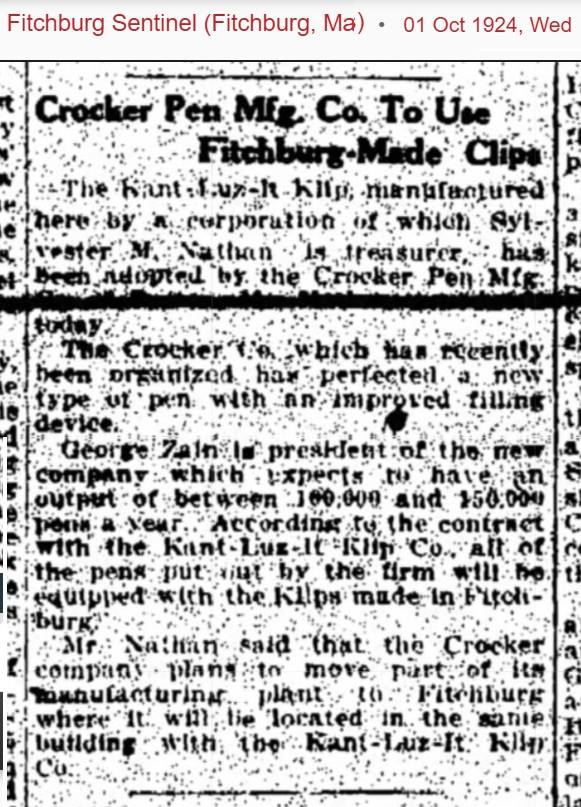
And, we know from the Fitchburg (Massachusetts) Sentinel on October 1, 1924 that George Zain was the president of this new incarnation of Crocker:


In this article, Zain announced that Crocker had adopted the Kant-Luz-It clip for all of its production models. 


For the Christmas 1924 shopping season, Crocker pens featuring the familiar January 30, 1917 design were being advertised as “Zain-Crocker” pens, not with Kant-Luz-It clips, but with ball clips marked with the name “Zain”:


At that time, the City of Fitchburg was pitching to Crocker the idea of relocating to Fitchburg, where the Kant-Luz-It clips were being made.  This announcement encouraged everyone to do their part to entice Crocker by buying their pens – although the announcement looks to have more of George Zain’s typical exhuberance than official backing:


Note that while the announcement says the pens have Fitchburg-made Kant-Luz-It clips, the pen in this announcement sports the same plain ball clip with “Zain” imprinted on it.  Nevertheless, whatever enticements were offered by the good folk of Fitchburg eventually persuaded Crocker to relocate there when, as Joe Nemecek indicated in his article, tragedy struck and a large fire wiped out several buildings in the industrial district in January, 1926, including the Kant-Luz-It factory.


“Whether the fire will delay the move [of Crocker to Fitchburg] or not is unknown today,” the article suggests, and by all appearances, the loss of a place to go was the last straw for the company.  I find no references to the Crocker Pen Manufacturing Company after this date, but advertisements for the new Chilton Pen Company begin just a couple months later, almost as if on cue. 

The following year, Seth Sears Crocker passed away announcements were published across the country, including this one in Lebanon, Pennsylvania on August 15, 1927.


George Zain went back to running advertising contests, and in 1927 he was in Los Angeles, conducting another one.  The Los Angeles Times indicated that his wife thought his fountain pen “squeaks a little”:


Zain went on to Coral Gables, Florida where he started a new career as a real estate developer and created the Miracle Mile Shopping Center.  His eyesight failed him in the 1940s, and he died in 1966.

So to rewrite the summarized history, Seth Sears Crocker ran the Crocker Pen Company until 1922, when the company was bankrupted and liquidated, the likely result of embezzlement by the company’s treasurer.  By January, 1924 a new company, the Crocker Pen Manufacturing Company, was formed by advertising expert George Zain.  Zain-Crockers were still in production until January, 1926, when a fire disrupted plans to move the company into the Kant-Luz-It Clip Company’s facilities; after the fire, Zain apparently sold whatever was left of his company or simply quit the business.  Chilton advertisements emerge two months later, in March, 1926.  The founder of the Crocker Pen Company, Seth Sears Crocker, died a year later in 1927.

UPDATE: this article promoted lively and productive discussion when it was published.  Daniel Kirchheimer produced an invoice from the Crocker Pen Company dated October 25, 1918 which brings some more details of the Crocker story into sharp focus:


As of 1918, the officers listed on this letterhead were Seth Sears Crocker, President; Edmands P. Lingham, Vice-President; and Seth Chilton Crocker, Treasurer and General Manager.  I found it interesting that Stormont Josselyn, inventor of the Ink Tite pen (patent 1,214,310 illustrated early in this article) served as Secretary of the company; Josselyn was an active participant in Crocker’s daily affairs, not just the mere contributor of the patent.


Note also the description of products sold –   “1 Doz. Chilton Pens”:


One of the premises of this article was a lack of references to a Chilton Pen Company prior to 1926, and while that premise is true, it requires clarification: while there’s no evidence that a “Chilton Pen Company” existed prior to 1926, Daniel’s invoice proves that the Crocker Pen Company was using “Chilton” as a brand name on some Crocker pens much earlier than 1926.

Hirsch Davis also peppered in that there are even earlier “Chilton” pens made by the S.C. Crocker Pen Company in New York, sharing this image of an early eyedropper pen made by this previous incarnation of the company:


According to Hirsch, these eyedropper pens were advertised between 1906 and 1910, after which Seth Chilton Crocker apparently organized, joined or rejoined the Crocker Pen Company in Boston.

Hirsch says there are also blow-filler fountain pens stamped “Seth Sears Crocker Pen Company” which appear to have been made after Crocker Pen Company’s collapse in 1922, and just before the appearance of the Chilton Pen Company - in fact, he reports an example with parts that are interchangeable with an early Chilton.    Whether S.S. Crocker’s association with Zain was exclusive isn’t known as of this writing.