Showing posts with label Wahl Co.. Show all posts

Tuesday, May 4, 2021

Lore Galore

This article has been included in The Leadhead's Pencil Blog Volume 7, now available here.
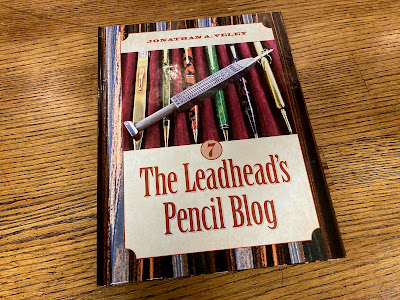

If you don't want the book but you enjoy the article, please consider supporting the Blog project here.

Yesterday’s Weidlich pencil isn’t what jostled me into exploring the entire history of the Cincinnati manufacturer - at least, not directly.  It reminded me that I’ve been meaning to try to solve a mystery that has been bugging me for more than ten years.  


Shown here are, from top:

1. The pencil I attributed to Weidlich in yesterday’s article – probably made during the wartime years. I make this attribution based on the clip, which might have been outsourced but appears to have been produced solely for Weidlich.

2. Another pencil sporting that same clip, which appears to be earlier – this one is a rear drive, higher quality piece.

3. A pencil in that identical celluloid, imprinted “The Pick Pen Co. / Cincinnati, O.”

4. A nearly identical pencil, but marked “S.W.P. Co.”  The distinguishing feature of Pick pens and pencils was the flourish at the top end – a top which rounds to a stubby, flat cylindrical top.  

In The Catalogue on page 121, I discussed these SWP pencils: “The example stamped "S.W.P. Co." has to be a Pick, as it shares the identical and unique shape,” I said.  “however, the exact meaning of the S.W.P initials is unclear. We do know that Pick was started in 1920 by a man named Arthur Schoenberger, and there is conjecture about a connection with another Cincinnati pen manufacturer, Weidlich.”

The fact that the SWP imprint is instead of – rather than in addition to – a Pick imprint suggests that this is a manufacturer’s (or producer’s) imprint; the “conjecture about a connection” that I referenced was a rumor that it stood for Simpson-Weidlich-Pick, neatly tying together the two Cincinnati pen companies.  

I knew even then how thin that theory was, and after researching the Weidlich story, I think it is wrong.  None of the Weidlich enterprises went by “Simpson & Weidlich,” because Otto Weidlich’s name had top billing on every one of the companies with which he was associated – WSP would make more sense, for Weidlich-Simpson-Pick.  In addition, the Simpson name was dropped in 1924 when the Weidlich Pen Manufacturing Company was formed.  So actually, “W.P. Co.” would make the most sense, if these pencils actually represent any connection between the two.

Now that Weidlich’s history has been documented from start to finish, I researched the Pick Pen Company looking for any ties between the two companies other than their common residence in the Queen City.  I started, as I always do, by rechecking what I said in The Catalogue: that we “know” the Pick Pen Company was founded in 1920 by Arthur Schoenberger.  That was a sloppy comment on my part -- I was deferring to the late Dennis Bowden, who made that statement on the original Fountain Pen Network on July 17, 2010 and added that Schoenberger named the company after his cousin, Ed Pick.  “At least that’s the lore,” Bowden added.

I wish Bowden was still alive, so I could ask him what parts of his comment were “lore” - that Schoenberger founded the company, that he did so in 1920, that he named it after his cousin, or all of it.  

Over at Badger & Blade, there is still a comment preserved by user “Nemo,” published the same week I published The Catalogue, on November 7, 2011.  Nemo adds details that give the “lore” more teeth: “Arthur Schoenberger started the Pick Pen Company in Cincinnati in 1920 at 2100 Reading Road,” he wrote.  “He knew nothing about pen making, so he hired a fellow named Weidling who had worked for the Weidlich Pen Company to set up the machinery and get the plant going, according to his son Eckbert Schoenberger. They produced pens at that location for 13 years.”

A date, an address, and a firsthand account by Schoenberger’s son – now that adds some credibility.  Hmm... “Schoenberger-Weidling-Pick”... now that might make some sense.

I’ve taken my fair share of knocks for rocking the boat of “collector’s lore,” but when as thorough a researcher as Dennis Bowden resorts to the use of the word, that’s an invitation to start from scratch. The story Dennis tells, and “Nemo” amplifies, is about half right on each of its details – and contains a blockbuster of an omission.

The Cincinnati Public Library now has a collection of city directories available online, and the detail these directories contain provides all the information necessary to clarify what really happened.  The 1919 directory has no listing for the Pick Pen Company, but it does have listings for the two names in Dennis Bowden’s account . . . sort of.

Ed G. Pick is listed with an occupation of “salesman” at 111 E. 4th Street, 9th floor.  There is no “Arthur Schoenberger” listed, and with good reason . . . our collector’s lore has garbled his last name.  Arthur W. Schoneberger was a bookkeeper by profession, at the northwest corner of Central Parkway and Jackson:


The 1920 directory adds a new business: the “Pick Manufacturing Company” is reported as a partnership of E.G. Pick and A.W. Schoneberger, at an address of 214 East 9th Street, Cincinnati . . . not at 2100 Reading Road, as lore has it (we’ll get to that in a minute):


So our collector’s lore had a little bit of basis.  A guy named Arthur W. Schoneberger (not Schoenberger) went into business with Ed Pick (not by himself) in 1920 (that part was right) as the Pick Manufacturing Company (not the Pick Pen Company) at 214 East 9th Street (not 2100 Reading Road), Cincinnati.  Of course, the directories don’t confirm Bowden’s statement that Schoneberger and Pick were cousins - that might be a nice thing to know, but it isn't really all that relevant.  

I then tackled the next part of Nemo’s account: that Schoneberger (and Pick) had no idea how to set up a pen company, so they hired a guy named Weidling, formerly with Weidlich Pen, to set up the machinery and get the plant going.

The Pick Manufacturing Company did bring a Weidling on board, and yes, she (not he) was formerly associated with Weidlich-Simpson (as it was known at the time).  However, she wouldn’t have any idea how to set up the tooling and plant for a pen company either.  That isn’t a sexist statement – it is a factual one.

Although there was a W.C. Weidling Manufacturing Company was listed in city directories prior to 1920, it made baker’s equipment and other wood specialties, and there were no individuals by the name of “Weidling” listed until the 1919 directory.  In 1919, several persons suddenly appear who are listed by that surname, including W.C. Weidling himself for the first time.  

Another Weidling listed in 1919 – Ruth Weidling – is described as a stenographer with a business address of the northwest corner of Central Parkway and Jackson.  That was the same address for Weidlich-Simpson at the time (and given their alphabetical proximity, conveniently found on the same page):


The following year, Ruth C. Weidling is identified as a bookkeeper for the Pick Manufacturing Company in 1920:


The foreman of the Pick Manufacturing Company, according to the 1920 directory, was Albert J. Aufdermarsch, a name that doesn’t square with the tale told by Schoneberger’s son to Nemo:


But wait . . . the 1920 Directory lists two foremen for the Pick Manufacturing Company.  The other one is a name well known in the pen manufacturing industry, and he would have been uniquely qualified to help start up a new pen manufacturing company.  However, he didn’t come by way of Weidlich . . . he was an independent penmaker who appears in Cincinnati directories for the first time in 1917: Charles R. Brandt.


Charles Brandt is well-known by pen historians as the owner of the Boston Fountain Pen Company since 1904, and he had contracted to sell his company to the Wahl Adding Machine Company in 1916 amidst the hurricane of a chess game between Walter Sheaffer, Wahl, and Col. William B. Smith (see “Wahl, Sheaffer and the Race for Boston,” starting in Volume 4, page 300). 

Brandt is listed in the 1917 Cincinnati directory simply as “penmaker” with no business address, which is unusual, since even stenographers like Ruth Weidling had a business address . . . so he can’t be associated with any of the Cincinnati manufacturing firms.  In the 1920 directory, however, Brandt is identified as a second foreman for the Pick Manufacturing Company:


In the 1921 directory, Brandt is still listed as “foreman.” His affiliation with the Pick Manufacturing Company is dropped, but his address is still listed at Pick’s factory at 214 E. 9th.  This appears to confirm part of Nemo’s account, that an expert was brought in, just to get things started up for the new company:


The same listing was published in 1922.  For 1923, Brandt is still listed as a foreman, but only his home address is listed, and that listing remains unchanged until the 1930-1931 directory, which lists a Charles R. Brandt as a “salesman” with a different home address, at 4121 Runnymede Avenue.  His business address in 1930 was occupied at the time by the John C. Mandery & Son Company, a local milk dealer, and in later years Brandt was listed as an advertiser for the company and last, as a driver for it in the 1949 directory.

Now that’s a blockbuster of a story: Charles Brandt signs a contract to sell the Boston Fountain Pen Company to Wahl in 1916, moves to Cincinnati in 1917, helps set up the Pick Fountain Pen Company, and then retires to a quiet life as a milkman.

That would be a blockbuster . . . if it were true.  There’s a problem.  

As I searched forward looking for Brandt’s obituary, I found a piece in The Cincinnati Enquirer on August 22, 1943.  The story includes a photograph of four generations of Brandts:  Charles Barry Brandt, his father Calvin W. Brandt, his grandfather Charles R. Brandt and his great-grandfather, Charles W. Brandt:


The Charles Brandt who owned the Boston Fountain Pen Company would have to have been old enough to have purchased the company in 1904; even if he was a precocious businessman, he wouldn’t have been of legal age to buy anything unless he had been born in 1886 or earlier.  Charles R. Brandt should have be Charles Barry Brandt’s great-grandfather, if he was the same person I thought and hoped it was.  

Perhaps the 1943 news article had confused Charles R. with Charles W., I thought, and Charles R. was the great-grandfather in the 1943 story.  Both were identified in the piece as residing at 4121 Runnymede, so I looked them up in the 1940 Census. 


Nope.  The news story was right.  Charles R. Brandt was 48 years old in 1940, meaning that he was born in 1891 or 1892 and he was only 12 or 13 years old when the Charles Brandt I was thinking of acquired the Boston Fountain Pen Company.  The Charles R. Brandt who initially helped the Pick Manufacturing Company set up shop is not be the same man as the Charles Brandt who owned the Boston Fountain Pen Company.

I still don’t believe this is simply an extraordinary coincidence.  Three out of the four Brandts in that family photo were named Charles . . . it was a proud German tradition to give male decendants the same names as other family members – remember how many people were named Lothar Faber or Eberhard Faber in the Faber story?  

It is simply too perfect that a Charles Brandt signs a contract to sell Boston Pen in 1916 (most assuredly containing a noncompete clause), and then another Charles Brandt just happens to show up as a penmaker in Cincinnati the following year, unaffiliated with any of the local manufacturers, quietly making pens until 1920 when he serves as the first foreman for the Pick Manufacturing Company.  If I had to guess, the Boston Uncle quietly trained his Cincinnati Nephew in the business.  

We’ll call that the new lore for now.

Thursday, April 9, 2020

"Snappy Service When You Want It"

This article has been edited and included in The Leadhead's Pencil Blog Volume 6, now on sale at The Legendary Lead Company.  I have just a few hard copies left of the first printing, available here, and an ebook version in pdf format is available for download here.

If you don't want the book but you enjoy this article, please consider supporting the Blog project here.

Joe and I like to joke that there are some times we buy things on eBay just because we are tired of looking at them.   I’ll admit that’s why I finally bought this one:


The pencil is unmarked as to manufacturer, but I knew it was a Swanberg, and a somewhat tired looking example at that.  Nevertheless, every time this listing made another trip around the horn, I ended up clicking on it and seeing that yes, in fact, it was the same thing I’d seen a dozen times.  This last time, whether the price had been reduced to the point of irresistible or whether I had been reduced to the point of “preview no more,” I finally pulled the trigger.

Here’s the new addition between an earlier (I believe) aluminum model and a later (I believe) hard rubber edition:


Note that the new one shares design elements from both.  The lower one is marked “Swanberg” on the clip:


That’s what makes me think the marked version is later.  That clip is actually a generic Van Valkenberg accommodation clip, marketed as the “Holyoke B.”  A copy of the 1931 VV catalog is in the PCA’s online library, and it shows these clips, named for the company’s location in Holyoke, Massachusetts:


Since the first pencils Swanberg turned out were the thin aluminum pencils with crown tops, I theorize that a hard rubber pencil with a generic, unmarked accommodation clip and crown top preceded the one with a straight top and a clip that was custom-imprinted.  If documentation ever surfaces, I may be proven wrong (this is the part where you, dear reader, are supposed to say “challenge accepted”).

I’ve got other examples of this, but there was a reason I thought it interesting enough to buy, outside of the fact that I was tired of looking at it on eBay.  Note the advertising imprint:


“Washington Tire & Vulc. Co. / Snappy Service When You Want It.”  I really like that last line – like there would be times when you don’t want snappy service.  But what about that Washington Tire and Vulcanization Company?  Was that just a customer Swanberg made some hard rubber pencils to promote, or was it also a supplier of hard rubber parts as well?

That piqued my curiosity, since our collectors’ lore tells us the Wahl Company purchased a “Washington Rubber Company” to secure supplies of hard rubber tubing for pen and pencil barrels, which it later divested in 1926 (I covered that in A Century of Autopoint, on page 80).  Worth digging a little bit more, I thought.

Washington Rubber came up in A Century of Autopoint in connection with a trademark filing for the company, which I had run across in the course of writing American Writing Instrument Trademarks 1870-1953: “Olympian,” a name hitherto considered a “Wahl Subbrand,” which appears on pens identical to the Keeran Indestructo. 

The trademark registration, however, doesn’t support the subbrand moniker.  The Olympian name and logo wasn’t registered by Wahl – it was issued to the Washington Rubber Company.  The Olympian is more accurately described as a brand produced by Washington Rubber, but manufactured by Wahl:


The Washington Rubber Company was, at the time this was signed on April 2, 1926, located at 1800 Roscoe Street, Chicago (that was Wahl’s address as well), by its vice president Michael J. Moriarty.   Moriarty claimed the use of the logo since January 26, 1926.

Was Washington Rubber Company the same as the Washington Tire and Vulcanization Company advertised on my hard rubber Swanberg?  No – but in the course of trying to find out if there was a connection, I found a few things that don’t make sense with our collector’s lore.

The incorporation of Washington Tire and Vulcanization of Chicago was reported in The Accessory and Garage Journal in February, 1918: the incorporators were Abraham Seelig, I. Morris Amter and Leo Seelig:


In 1923, the Illinois Secretary of State’s report showed both Washington Rubber Company and Washington Tire and Vulcanization of Chicago.  Washington Rubber is shown at 1401 S. 55th Court, Cicero, with Wahl President C.S. Roberts also serving as president of Washington Rubber and C.J. Frechette as its Secretary.  Washington Tire and Vulcanization is shown as a different company, located at 640 West Washington Blvd, Chicago.  Jacob Seelig was reported as the company’s president, and Leo Seelig was the secretary.


So these were two different companies and the Swanberg advertiser is just a coincidence, right?  That would be simple. . . but a few things don’t add up.

Moody’s Manual of Railroads and Corporate Securities, published annually, reports detailed information concerning company financials.  Wahl’s acquisition of Washington Rubber was picked up by Moody’s in the 1924 edition:


“In July, 1922 acquired the Washington Rubber Co. of Chicago, an Illinois Corporation, manufacturing hard and soft rubber products,” the report states.  But there’s inconsistencies in this version, starting with the fact that prior editions of Moody’s, including the 1921 edition just before the sale, make no mention of any Washington Rubber Company manufacturing any rubber products.

A search of newspapers reveals that The Washington Rubber Company and The Washington Tire and Vulcanizing Company were both located on Washington Avenue in Chicago, and there’s no evidence that either was making rubber products – both were distributors of all sorts of automotive products, as advertisements such as this one show, from the Chicago Tribune on July 10, 1921:


Van Kerr Transformers were sold by numerous “west side” dealers, including both these Washington companies:


Here’s another detail that doesn’t make sense: Washington Rubber Company is shown in advertisements as distributors of all sorts of car parts, at that same Washington Street address, throughout the time Wahl owned the Washington Rubber Company.  I can’t find anything to suggest the company made rubber or ever moved to the address reported by the Secretary of State in Cicero: in fact, 1401 S. 55th Court, according to Google maps, is a railroad shipping yard, not a manufacturing facility.


I don’t think Wahl bought Washington Rubber as a manufacturing concern.  I think Washington Rubber was a local Chicago car parts dealer which had distribution contracts with manufacturers entitling the little shop to acquire product at cost.  Wahl wasn’t moving towards vertical integration – it was only securing contract rights to acquire product made by others, using Washington Rubber as the conduit.

That might explain a few otherwise weird things about Eversharp.  First, there was the company’s weird little diversions into automotive parts, such as the Wahl Universal Heater, the Wahl Spring Brake and the Wahl Two-Way Shock Absorber  (see http://leadheadpencils.blogspot.com/2016/10/wahls-extracurricular-activities.html and http://leadheadpencils.blogspot.com/2016/12/wahls-car-parts-business.html).  All these products were introduced shortly after Wahl sold off Washington Rubber in 1926.

It also likely explains the odd number of “tire pencils” out there – Eversharp-made (but not marked) pencils advertising various brands of tires.  Wahl would have made a lot of contacts through all the tires Washington Rubber was acquiring and distributing.

All I wanted to know when I started this story was whether Washington Tire and Vulcanizing and Washington Rubber were the same.  Now I think Washington Rubber wasn’t the same as what I thought it was.  Call it a bad bounce!

Friday, December 30, 2016

Wahl, Sheaffer and the Race for Boston - Part Five

This article has been edited and included in The Leadhead's Pencil Blog Volume 4; copies are available print on demand through Amazon here, and I offer an ebook version in pdf format at the Legendary Lead Company here.

If you don't want the book but you enjoy this article, please consider supporting the Blog project here.

Note:  this is the fifth installment in a five-part series of articles originally published in The Pennant in the Winter 2015 and Spring 2016 issues.  The first installment was posted at http://leadheadpencils.blogspot.com/2016/12/wahl-sheaffer-and-race-for-boston-part.html.


The DeWitt-LaFrance “Redypoint” Is the Key

If it is true that David J. LaFrance was the inventor of the Sheaffer Sharp Point, the proof would lie in a surviving example of a pencil which is identical to the Sharp Point, lacking any indication that a patent application was filed to protect it, and traceable back to LaFrance.  Until last year, no such pencil was known to exist.

That changed at the 2015 Philadelphia Pen Show, where I acquired a hoard of several hundred early metal pencils.  One of these, in my opinion, is the proof I have sought for many years.  It is stamped “Redypoint / S. Ward Mfg. Co. / Boston,” and the barrel does not indicate that there is any patent applied for, pending, or granted.  It is, with the exception of not having a clip, identical in every respect to a first generation Sheaffer Sharp Point.

Figure 18:  A first generation Sharp Point (with clip), shown next to the Redypoint found at the 2015 Philadelphia Pen Show.
Figure 19:  Imprint of the Redypoint pencil.
Figure 20:  Detail of barrel design of Sharp Point and Redypoint compared.
Figure 21:  Crowns of Sharp Point and Redypoint.
Figure 22:  Sharp Point and Redypoint shown disassembled.
David J. LaFrance’s involvement in the invention of the Sheaffer Sharp Point is, I believe, conclusive.  Samuel Ward, a regional Boston stationer, only marketed pencils under the Redypoint name for a very short period of time (due to the conflict with the filed trademark for the “Redipoint” name), beginning in August, 1918 and ending before August, 1920.  David J. LaFrance’s activities are unknown between January, 1917 and mid-1918, when he and William P. DeWitt established The DeWitt-LaFrance Company – and Samuel Ward is known to be one of DeWitt-LaFrance’s earliest customers.  In early 1919, Kugel moves production of the Sharp Point to 440 Canal Street in New York, and shortly thereafter DeWitt-LaFrance begins to manufacture Redypoint pencils for Samuel Ward using their new, patent-pending clip and pencil design.

The Fallout 

If we can conclude from the scant evidence remaining a century later that David J. LaFrance was the man who actually invented the Sheaffer Sharp Point, or that at a minimum he was instrumental in Sheaffer’s success in entering the mechanical pencil business, it is reasonable to believe Wahl arrived at the same conclusion at the time.  David J. LaFrance, the man who invented the lever-filled pen which enticed Wahl’s directors to purchase Boston in the first place, had now slipped through Wahl’s fingers and helped Walter Sheaffer create a pencil to compete with Wahl’s Eversharp.  Wahl nether forgave nor forgot. 

In 1921, C.A. Frary penned an article titled “What We Have Learned from Marketing Eversharp,” which appeared in the August 11, 1921 edition of Printers’ Ink. Frary’s comments on the state of the industry by that point were telling:

“[I]t seems to me almost axiomatic with a new product, a specialty, which if it is successful at all is sure to be copied and imitated very soon.  For a few years, for example, we were alone.  But recently we made a canvass of competition, and we discovered that we had between eighty and one hundred competitors.  Many of the competing pencils copy our designs very closely.  In our sales department we have assembled an exhibit of competing makes, and except by examining them minutely, it is next to impossible to tell some of them from our own.”[i]  

Wahl didn’t have much of a leg to stand on when it came to preventing others from producing pencils which were similar in appearance to the Eversharp.  Crown-shaped finials had topped metal writing instruments for more than half a century before the Eversharp was introduced, and as documented by David Nishimura, the Eversharp’s external appearance was borrowed from the George W. Heath Co., the firm which first manufactured Eversharps for Charles Keeran in 1913.  Heath simply modified existing the barrels and caps Heath was already manufacturing to accept Keeran’s new mechanisms.[ii]

However, that didn’t mean Wahl wouldn’t try to bully competitors – one in particular.  Out of “between eighty to a hundred competitors,” Wahl singled out only one for the test case:  DeWitt-LaFrance.   On May 6, 1922, the Cambridge Chronicle reported that the Wahl Company had filed a bill in equity against the company, alleging that DeWitt LaFrance was engaging in unfair competition with the marketing of its “Superite” pencils.  “The bill of complaint alleges that the lettering on the Superite pencil is imitative of that on the Eversharp,” the report states, “and that other distinctive features of the Wahl company product are also imitated.”[iii] 

Figure 23:  Out of “between eighty and one hundred competitors” offering pencils that bore some resemblance to the Eversharp, Wahl singled out just one for a lawsuit:  DeWitt-LaFrance.
The suit apparently did not get very far, but whether the costs of defending the litigation were too significant to bear or whether Dr. DeWitt and Mr. LaFrance lost their appetite for competing in this arena, they sold their company’s assets, including their patents, to Carter’s Ink Company in 1925.

As the Sharp Point Rises, Keeran Falls . . . And Rises

Historians generally view Charles Keeran as collateral damage in this story, as the inventor taken advantage of by Wahl’s directors in a classic tale of corporate greed.  Maybe that is true.  But consider in light of the foregoing whether Wahl had reason to doubt Keeran’s competency, his loyalty . . . or both.

In Keeran’s 1928 letter, he claims that the deal he negotiated on behalf of Eversharp was to purchase “the whole works” of the Boston Fountain Pen Company.  Wahl’s directors, who had been reluctant purchasers at best, were finally moved to spend more than a million dollars in today’s money for a pen company they didn’t want – until they thought Walter Sheaffer might get it and they would lose the successful pairing of Eversharp pencils with Boston lever-filled pens (see part one of this article in the previous issue of The Pennant).  The pairing of the two products was critical:  sales of Eversharp pencils had increased dramatically when The Smith-Newhall Company started selling Boston lever filled pens with them, and that was the success on which Wahl’s directors wished to capitalize.

If the Boston Fountain Pen Company was preparing to introduce a mechanical pencil of its own, would Wahl have wanted it as part of “the whole works?”  Absolutely.  Even if they didn’t plan to manufacture it, they never would have wanted Walter Sheaffer to do so!

Did Charles Keeran know that David J. LaFrance had invented one?  That is a fascinating question.  Even if Keeran did not, what happened after January, 1917 looked bad for him.  He admits neglecting his sales duties after the purchase of Boston in January, 1917, to go to New York to “straighten out” patent disputes . . . “etc. etc.” in his words.  Would Wahl’s directors reasonably question what “etc. etc.” meant?  After all, Walter Sheaffer filed a patent application for a new pencil, traceable to a former Boston Fountain Pen Company superintendent, which when introduced had the same spikey Winchester-inspired lettering as Keeran’s Eversharp. 

From Wahl’s perspective, it likely didn’t matter whether Keeran was incompetent, had failed to ;exercise due diligence to discover the LaFrance pencil, or whether he had actively collaborated with Sheaffer during his trips to New York.  Keeran reports in his 1928 letter[iv] that in August, 1917, at exactly the same time Sheaffer launched its national advertising campaign for the new Sharp Point, C.S. Roberts called Keeran into his office at Wahl and informed him “curtly” that he had been replaced as sales manager.  Keeran left the company soon after.

In Wahl’s eyes, Sheaffer now had Boston’s pencil, a pencil as good as Keeran’s Eversharp.  Sheaffer would also receive royalties from Wahl for the Sheaffer lever filler.  Keeran was believed by Wahl to have had a hand in allowing all this to happen and that, I believe, is why Charles Keeran was ousted from the company.

Charles Keeran did not allow the grass to grow under his feet after his ouster from Wahl, and he continued to invent mechanical pencils and a variety of other products for the rest of his life.   In July, 1918 he claimed in his trademark registration that he first used the name “Autopoint” on a new series of pencils, and in late 1920, the Autopoint Pencil Company was formed, for which he served on the initial board of directors.   Colonel William E. Smith, “for many years with L.E. Waterman Co. and more recently with Wahl Co.,”[v] left Wahl to join Keeran, also serving on Autopoint’s board.
In 1921, also in Chicago, the Realite Pencil Company was formed to produce pencils which operated in almost exactly the same way, but with the plunger rod threaded into a removable nose cone.  Unlike the first Autopoints, which operated by a thin plunger rod operated from the rear of the pencil, Realites operated by twisting a removable nose cone.  Keeran never claimed to have invented the Realite.

Keeran was also the general manager of Realite, but he apparently was neither an officer nor on the board.[vi]  As general manager, it was Keeran who hired none other than Arthur L. Kugel in February, 1922, who had left Sheaffer after facilitating the construction of Sheaffer’s pencil works.  If we believe Arthur Kugel, David LaFrance and Walter Sheaffer pulled a fast one over on Keeran and Wahl, a maneuver which cost Keeran his job, it seems odd that Keeran would hire one of the men who got him fired just a few years later.  Maybe Keeran, unlike his former employer, did forgive and forget – or maybe there is more to the story concerning whether Keeran knew what Kugel was up to.  As of this writing, no evidence has surfaced to support either possibility.

In 1923, Realite purchased Autopoint, and the surviving company was renamed “Autopoint Products Company.”  The new company’s first president was Charles R. Keeran.  The acquisition brought together under one roof, albeit predictably briefly, three of the most influential characters in this story:  Charles Keeran, the man who guided Eversharp and Wahl into the pen business; Arthur Kugel, the man who guided Sheaffer into the pencil business; and Col. Bill Smith, the man who drew Sheaffer and Wahl into head-to-head competition in the fight for the Boston Fountain Pen Company.

Figure 24:  From left, Arthur L. Kugel in 1922; Colonel William B. Smith, at left, walking the boardwalk with three friends in 1922; and Charles R. Keeran, circa 1916.


[i] Frary, C.A., “What We Have Learned from Marketing Eversharp,” Printers’ Ink, August 11, 1921, at page 6.
[ii] Nishimura, David, “Who designed the Eversharp pencil?” http://vintagepensblog.blogspot.com/2013/12/who-designed-eversharp-pencil.html.
[iii] Cambridge Chronicle, May 6, 1922, at page 6.
[iv]Charles Keeran’s 1928 letter, which provides the backbone of the story in the first part of this article regarding the sale of the Boston Fountain Pen Company, has been reproduced by Bob Bolin at http://unllib.unl.edu/Bolin_resources/pencil_page/keeran/index.htm.
[v] Typewriter Topics, May, 1920, at page 56.
[vi] Autopoint + Realite – The Confluence of Two Pencil Companies, by James Stauffer.  http://www.vintageautopoint.com/Autopoint_Realite_beginnings_v2.pdf


Wednesday, December 28, 2016

Wahl, Sheaffer and the Race for Boston - Part Three

This article has been edited and included in The Leadhead's Pencil Blog Volume 4; copies are available print on demand through Amazon here, and I offer an ebook version in pdf format at the Legendary Lead Company here.

If you don't want the book but you enjoy this article, please consider supporting the Blog project here.

Note:  This is the third installment in a five-part series of articles, originally published in The Pennant, Winter 2015 and Spring, 2016 editions.  The first installment begins at http://leadheadpencils.blogspot.com/2016/12/wahl-sheaffer-and-race-for-boston-part.html.


The Compromise, Part Two:  as to Mechanical Pencils

Within six months of the Boston sale, Walter Sheaffer, who had never before shown any interest in pencils, filed a patent application for a fully-developed mechanical pencil and launched a national advertising campaign to market his new “Sharp Point” pencils.

Early Sheaffer Sharp Point pencils, from the author’s collection.
Did Sheaffer initiate a mechanical pencil program from scratch in such a short time?  I conclude that he did not.  Given how quickly Sheaffer is alleged to have invented, filed a patent application for and geared up production of a pencil as well-developed as the Sharp Point, it is far more likely that Sheaffer acquired an existing mechanical pencil design from someone else, filed the patent application for that design in his own name and introduced the new pencil as his own.

With all eyes focused on the Boston Fountain Pen Company at the beginning of 1917, the logical “someone else” from whom Sheaffer might have acquired this design would have been Boston.  Is there evidence that Boston – or at least one of its key employees -- was in the process of developing a mechanical pencil at the time the company was sold?  Yes, there is, and the circumstances suggest that fact was not communicated to Wahl’s directors at the time of the Boston sale. 

That evidence also reveals who, in all probability, actually invented Sheaffer’s Sharp Point pencil.

The Ghost of Boston

The sale of the Boston Fountain Pen Company was announced in the January 11, 1917 edition of Geyer’s Stationer, which identified unnamed “Chicago interests” as the purchaser.  “Mr. [C.S.] Roberts said that the company’s business would be continued as usual,” the report states, “and that the new owners would continue to manufacture Boston Safety Fountain pens at the company’s factory in Everett, Mass.”[i]  This initial report does not identify those “Chicago interests” and indicated that “the details of the purchase were not yet ready for publication.” 

In February, 1917, Office Appliances contained two conflicting reports concerning the sale.  “The Eversharp Pencil Company [controlled by at least some of the Wahl Adding Machine Company’s directors] announce that they have purchased the entire interest of the Boston Safety fountain pen,”[ii] states the more polished of the two articles.   However, a brief announcement near the end of the issue indicates that “Keeran & Co. [controlled by Charles Keeran] have purchased the business and good will, and all the physical assets of the Boston Fountain Pen Company.”[iii]  By Keeran’s own admission, it was not his money that bought Boston, and advertisements in the following months confirmed that the Eversharp Pencil Company was the actual purchaser.  If Keeran himself was the source of a report that he rather than his employer was the purchaser, this might have provided an initial spark of tension that eventually resulted in Keeran’s dismissal later that year.  If so, however, that was not the last straw.

Figure 1

Figure 2

Figure 3.  Use of the words “Eversharp” and “Wahl” in this story can be confusing.  Prior to January, 1917, the Wahl Adding Machine Company manufactured “Ever Sharp” (two words) pencils for the Eversharp Pencil Company.  In mid-1916, some of the Wahl Adding Machine Company’s directors – it remains unclear whether it was all of them or some of them -- acquired a controlling interest in the Eversharp Pencil Company.  For a few months after the Eversharp Pencil Company purchased the Boston Fountain Pen Company, advertisements such as the one shown  from the March, 1917 issue of Office Appliances (Figure 1) advertised both the pencil business and the new Wahl Pen business as owned by the Eversharp Pencil Company.  By June, 1917, Office Appliances published another advertisement (Figure 2) indicating that ownership of The Eversharp Pencil Company had formally passed to the Wahl Adding Machine Company.  By September, 1918, advertisements such as the one shown from The Saturday Evening Post (Figure 3) indicate that the company was formally reorganized as The Wahl Company.  Wahl sold its adding machine business to The Remington Typewriter Company in 1920.

Even though C.S. Roberts announced that business would carry on as usual at the Boston Fountain Pen company, it did not – not with the same people, anyway.  After the initial announcement of the purchase in Geyer’s, the very next issue, on January 18, announced that George F. Brandt had joined the American Fountain Pen Company, as it was still known at the time – the company would later be renamed after the inventor of its flagship product, the Moore Non-Leakable Pen, to become the Moore Pen Company.[iv]  An announcement published in April, 1917 indicated that Moore had also hired M.G. Sypher, Boston’s superintendent of production, and John G. Liddell, “head mechanic” for Boston.[v]  Liddell went on to patent several innovations for Moore, including both of Moore’s early designs for mechanical pencils, patented in 1922 and 1925.  Neither of those designs, however, bears any resemblance to Sheaffer’s Sharp Point.

Eversharp was able to entice “Mr. Miller,” Boston’s “gold pen expert,” to remain in their employ.  As long as Eversharp had Boston’s patent rights, equipment and nibmeister, Eversharp probably did have sufficient resources to carry on production, although the departure of so many key figures might explain why Eversharp appeared slow to ramp up production in its own name.  Colonel William Smith, the central figure from the first part of this article, also remained in Eversharp’s employ for a time after the sale.   Smith attended the 1917 Chicago Stationer’s Dinner on January 13 representing Eversharp, where he reprised his previous year’s stunt, presenting each of the ladies in attendance with a writing implement.  This time, however, he presented Eversharp’s newly-developed ringtop pencils rather than a Boston Fountain Pen.[vi]  Smith also may have been instrumental in luring one of his former co-workers from L.E. Waterman over to Eversharp:  Church Todd.[vii]

One figure central to the events leading up to Boston’s purchase is conspicuously absent from announcements, both from Moore and Eversharp:  David J. LaFrance, longtime superintendent of company as well as the inventor of Boston’s lever-filled fountain pen design.

Figure 4:  Moore’s announcement, inexplicably published in the April, 1917 issue of the Detroit, Michigan Bulletin of Pharmacy.  If M.G. Sypher was Boston’s superintendent, what had become of David J. LaFrance?  


Rise of the Sheaffer Sharp Point

In May, 1917, Sheaffer’s New York offices were moved from 270 Broadway to “newer and larger quarters” at 203 Broadway.[viii]  The American Stationer stated that the move was “owing to an enormous increase in business,” and the article contained assurances to dealers that Sheaffer would not compete with them.  “This office is maintained for the convenience of dealers and not for the purpose of competing with them in any way,” the piece recites.  “Increased facilities for deliveries from stock, and for making repairs of all kinds will be at hand in the new quarters.”[ix]

The announcement, coincidentally or not, appears on a page of Boston stationers’ news.

On July 12, 1917, Walter A. Sheaffer filed a patent application for a new mechanical pencil.  The July, 1917 issue of Office Appliances included a full-page ad by the W.A. Sheaffer Pen Company, picturing this same pencil.  “Here is the first advertisement of our big fall advertising campaign which will appear in thirteen of the country’s leading magazines between August and January, reaching over 15,000,000 people,” the ad states.  “This sales-building advertising is going to make 1917 a banner year for dealers who carry a complete stock of Sheaffer Fountain Pens and the new SHARP POINT PENCIL.”[x]  True to his word, the Fort Madison, Iowa company made a big advertising splash for the new Sharp Point beginning in August, 1917.

Figure 5: Sheaffer’s announcement of the new “Sharp Point” pencil. 

One thing Sheaffer’s advertising didn’t publicize about the company’s new Sharp Point was that it wasn’t made in Fort Madison.  In 1919, another address for Sheaffer’s New York office works its way into Sheaffer advertising as well as news accounts:  440 Canal Street.  The earliest reference to this address is a trade announcement concerning Sheaffer’s authorization “to do business in New York State” in June, 1919, and it locates Arthur L. Kugel, Sheaffer’s New York representative, at the Canal Street address.[xi]   The announcement indicates that Sheaffer was already at 440 Canal, so the move occurred earlier.   No reason is provided for the move, which is odd given that the stationers’ press routinely reported on such things, including the moves of Sheaffer.  Was 440 Canal merely another site from which the company would make repairs and “deliveries of stock?” 

No.  It was a manufacturing facility, supervised by Arthur L. Kugel.[xii]  Passing references to the use of Canal Street by Sheaffer during the time do not indicate what was made there, but Kugel’s activities suggest that 440 Canal Street was outfitted to manufacture Sheaffer Sharp Point pencils.  As soon as Canal Street was up and running, in May, 1919, Arthur L. Kugel started splitting his time between New York and Fort Madison, helping Sheaffer set up a new pencil factory in Fort Madison.[xiii]

When Walter Sheaffer returned to New York in June, 1921, he came, among other reasons, to visit what was referred to simply as “the New York factory.”    He wasn’t just visiting: at that point, Sheaffer was there to coordinate the closure of the Canal Street location, as the company prepared to move its New York quarters yet again, to a non-manufacturing, upper-floor office in the Pennsylvania Building at the corner of 7th Avenue and 30th Street.  A month later, in July, 1921, Sheaffer announced that its new pencil factory at Fort Madison was operational.[xiv] 

Kugel resigned from Sheaffer in May, 1921, just two months before the July announcement.  By then, he had irrevocably become a pencil man: his next career move was to join the newly formed Realite Pencil Company.[xv]  The resignation was a friendly one, with Kugel remaining on Sheaffer’s board through September, 1921, suggesting that Kugel had simply worked himself out of a job.  He was replaced by Leslie Blumenthal, the former Kraker man who managed Sheaffer’s Kansas City operations.[xvi]

When I put all of these pieces together, I conclude Arthur L. Kugel set up the Canal Street factory in New York at least in part to make the new Sharp Points on a temporary basis in early 1919, while he assisted Sheaffer with the construction of a more permanent pencil manufacturing facility in Fort Madison.  When the new factory was completed, so was Kugel’s mission.  But there’s one problem with this timeline:  Sheaffer introduced the Sharp Point in mid-1917.   Where were they made?  And where was David J. LaFrance during this time?

For a year and a half after Boston’s acquisition by Eversharp, David J. LaFrance, inventor of Boston’s lever-filler pen, seems to disappear.  Although one news report stated that he had been the superintendent of the Boston Fountain Pen Company for 15 years,[xvii] Moore’s April 1917 announcement identifies M. G. Sypher as Boston’s former superintendent.  The facts that someone other than LaFrance was identified as Boston’s superintendent, and that neither Eversharp nor Moore announced that LaFrance had entered their employ, suggests that LaFrance might have left the Boston Fountain Pen Company before the sale to Eversharp was finalized. 

Another later report stated that LaFrance previously “had an experience of 21 years in the manufacture of fountain pens, including the Waterman, Moore and others,”[xviii] but this leaves open the question of whether LaFrance’s service at Waterman and Moore was before or after his time with Boston – as well as who the “others” were.  Was LaFrance working for Sheaffer, ramping up production of a new pencil he had invented, the rights to which Sheaffer acquired? 

I believe so – though whether or not David J. LaFrance knew it, only for so long as Walter Sheaffer needed him.

Walter Sheaffer was not a man to make the same mistake twice.  In 1913, his partner George Kraker and salesman Harvey Craig left his company while Sheaffer’s patent application for the double bar lever filler was still pending, leaving open to conjecture whether in fact he was the true inventor.  Any deal Sheaffer might have negotiated to bring David J. LaFrance and his pencil design into the fold would have ensured that LaFrance would remain under Sheaffer’s thumb until the issuance of his patent was all but secured.

On November 5, 1918, a date mechanical pencil collectors know by heart, Walter Sheaffer was issued patent 1,284,156 for the mechanical pencil that we know as the Sharp Point.  At almost exactly the same time, David J. LaFrance reemerges with an old friend and a new enterprise.

Figure 6:  Sheaffer’s patent number 1,284,156.


[i] Geyer’s Stationer, January 11, 1917, at page 22.
[ii] Office Appliances, February, 1917, at page 33.
[iii] Id. at 182.
[iv] Geyer’s Stationer, January 18, 1917, at page 36.
[v] The Bulletin of Pharmacy, Detroit, Michigan, April, 1917, at page 67.
[vi] Office Appliances, February, 1917, at page 41.
[vii] Office Appliances, February, 1917, at page 33.
[viii] Walden’s Stationer & Printer, April 25, 1917, at page 82.
[ix] The American Stationer, May 5, 1917, at page 6.
[x] Office Appliances, July, 1917, at page 109.
[xi] India Rubber World, June, 1919, at page 504.
[xii] Office Appliances, July, 1921, at page 20.
[xiii] The American Stationer, February 4, 1922, at page 32.
[xiv] Office Appliances, July, 1921 at page 170.
[xv] id.
[xvi] Geyer’s Stationer, August 18, 1921, at page 18.
[xvii] The Cambridge Tribune, October 16, 1920.
[xviii] The Cambridge Chronicle, January 1, 1921.