Showing posts with label Aikin (J.C.) & Co.. Show all posts

Thursday, July 1, 2021

Aikin Lambert Update

This article has been included in The Leadhead's Pencil Blog Volume 7, now available here.

If you don't want the book but you enjoy the article, please consider supporting the Blog project here.

I wrote about the early history of Aikin, Lambert & Co. in Volume 4, page 50, and Loyal Knight David Nishimura has ably documented J.C. Aikin’s asssociations with D.F. Foley (see http://vintagepensblog.blogspot.com/2012/06/dissolution-of-d-f-foley-co.html) and Aikin Lambert’s later transition from independent company to Waterman subsidiary (see http://vintagepensblog.blogspot.com/2012/12/waterman-and-aikin-lambert.html).

Aikin Lambert is one of those companies whose story intertwines with so many others.  The firm has wormed its way into several articles here, including those about the Chicago Gold Pen Company (Volume 6, page 114), L.C. Hardtmuth (Volume 6, page 218) and even Samuel Kanner and his flip-top Nupoints (Volume 5, page 111) – in each case,  Aikin Lambert made a quick cameo appearance, then darted back into the shadows.  

In recent months, a few more Aikin Lamberts have arrived which add a few more insights into the firm’s complex story.  This first one has a distinctly European look, perhaps somehow connected to the firm’s Hardtmuth connections:


There’s a nice monogram on the barrel that ends with “A,” but I’m not going to suggest any Aikin family connection.  Not that I didn’t go through my notes to see if any Aikins associated with the firm’s history went by the initials “E.K.”:


The trim on this hard rubber pencil is a little different, with more of a copper color than gold.  The firm’s name is imprinted around the nose:


This next one forced me to bid on a box lot of absolute junk, solely in order to get a closer look.  It was shown in partially closed position, but for what I paid I figured it was worth a shot trying to get it going again:


When it arrived, I was pleased in two respects.  The lighter fluid trick worked like a charm and I was able to get it working smoothly again, although there’s not much that can be done about the wear and dents.  I was also pleasantly surprised to see the ALCO hallmark on the barrel.  


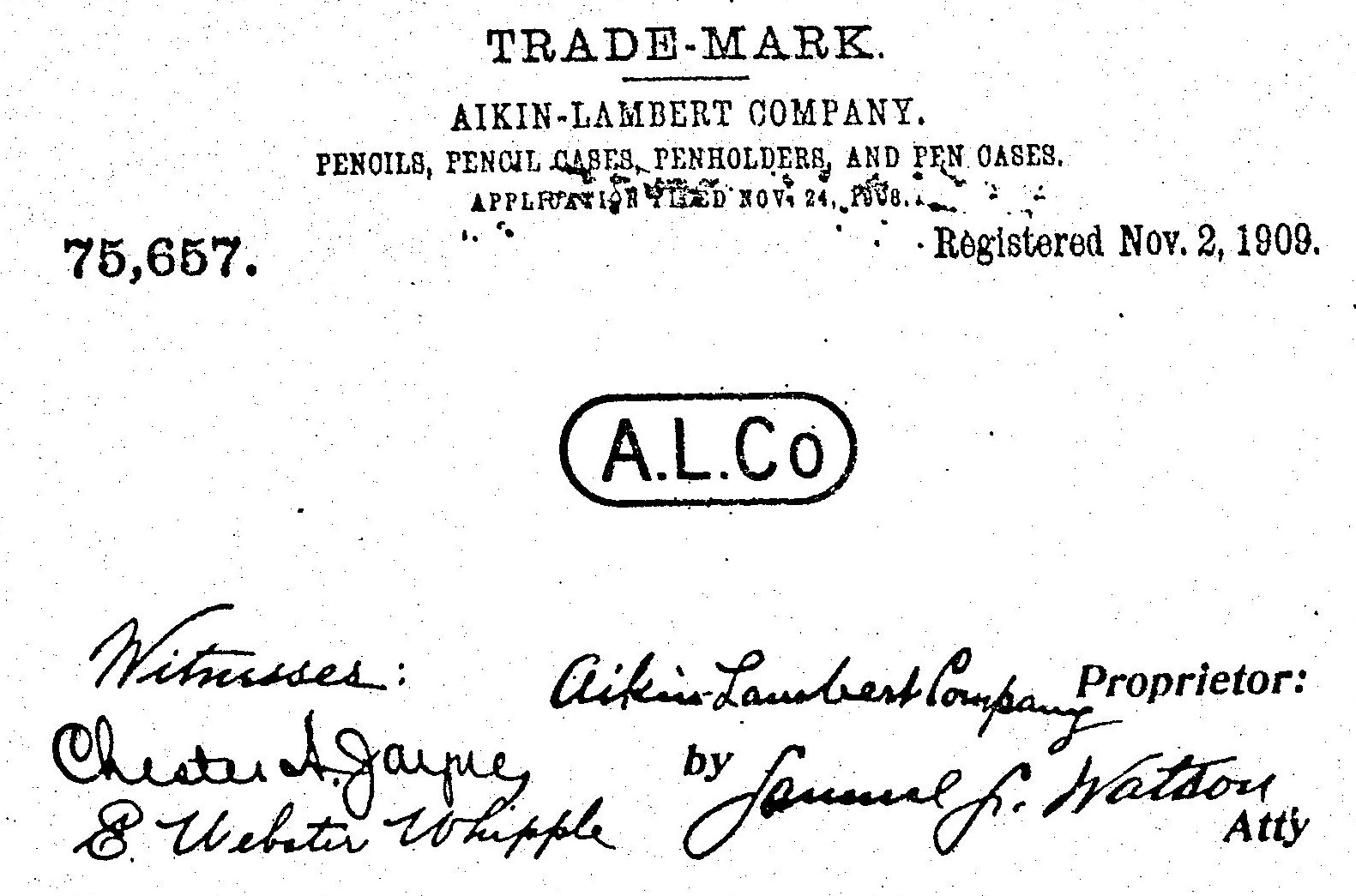
This mark appears in American Writing Instrument Trademarks 1870-1953, registered for pens and pencils by the company on November 2, 1909.  The application was filed on November 24, 1908, but unfortunately at the time it was filed, the date the firm first claimed to use it was not typically reported:

I suspect this was made later, perhaps in the late teens, after the firm was absorbed by Waterman.  Since Waterman was so resistant to the notion of offering mechanical pencils, its earliest “sets” consisted of Waterman pens paired with Aikin Lambert pencils – it would be nice to find documentation of a Waterman set including a magic pencil like this one, but I haven’t seen anything like that.  

Here’s another “junker” that came my way.  The seller properly disclosed that the upper barrel was split:


The seller did not mention how heavy it is, and from the weight I surmise this piece is almost certainly at least 9k gold.  I have several of these extending combination pens and pencils; all were based on Albert Bagley’s patent of January 1, 1850, but I’ve found examples marked with the names of several New York firms.  I was hoping when it arrived I would find another maker’s name on it, but if nothing else it would be good for parts:


And perhaps a nib:


J.C. Aikin.  The holder itself is unmarked, and nibs are readily swapped out, but I’m inclined to think the nib is consistent with the holder: as documented in Volume 4, page 50, J.C. Aikin & Co. was founded in 1864 – on the late end for these fluted combination pen/pencil outfits, but still plausibly within the window during which these were made.

The machining on the barrel is a little different than what is normally found on these, and this is typical of the sort of patterns Aikin Lambert used.  Maybe another one will surface in this pattern, but marked on the instrument itself with Aikin’s name.  For now, at least, this one is staying just as it is, and exactly where it is: in the Aikin Lambert section, where the firm connects with yet another family of pencils.

Tuesday, December 22, 2015

In a Tasteful Manner in Harmonious Colors

This article has been edited and included in The Leadhead's Pencil Blog Volume 4; copies are available print on demand through Amazon here, and I offer an ebook version in pdf format at the Legendary Lead Company here.

If you don't want the book but you enjoy this article, please consider supporting the Blog project here.

Bill Bender met up with me at the Ohio Show, with a few a few goodies in his backpack to share.  This one I had to have:


The top is separated a little bit – I’m not sure whether the barrel has shrank or whether the top retainer has pulled out a little bit.  On the extender is a patent date of January 21, 1879:


What had me intrigued, though, was the inlaid design on the barrel:


Turns out that design explained the patent date.  James C. Aikin applied for a design patent on November 2, 1878 for an ornamental design, “consisting of flowers, insects, leaves and vines, grouped in a tasteful manner in harmonious colors, and arranged in straight lines along the barrel, to produce a good aesthetic effect.”  The patent was issued as design patent 10,984:


The picture is useless.  The description is no better, since he says the design may be made “by painting, or with pearl, gold, silver, plate, stone, glass, turquoise, diamonds, separately or blended, to produce harmonious effects of coloring, &c.” and purports to cover any design “substantially as described.”  Apparently Aikin was trying to sew up the market on anything frilly in the Victorian age.

Wait a minute . . . was it Aikin, or Aikin Lambert?

At the end of the day, it was Aikin, Lambert & Co., but our collectors’ lore is now perpetuating the myth that Aikin, Lambert & Co. was founded in 1864.

It wasn’t.

There’s a nice biographical sketch of James Cornelius Aikin in The National Cyclopaedia of American Biography, published in 1910:


According to this, Aikin got into the pen business in 1862, when he entered into a partnership with Edward D. Valentine.  In 1864, he founded J.C. Aikin & Co., and  Aikin, Lambert & Co. was not incorporated until May, 1889.

Well, that can’t be right, either.  There’s a plethora of advertisements earlier than 1889 for Aikin, Lambert & Co.  Here’s one from 1881, just as an example:


So I did some poking around to see if the real story was out there in contemporary accounts, and it was.  Two accounts published in 1919 contain a few more details, the first of which was included in Henry A. Lambert’s obituary, published in The Jewelers’ Circular on May 21, 1919:


According to this, Lambert first became associated with Aikin as a traveler, when Aikin was a partner in a firm named McConnell, Valentine and Aikin sometime prior to 1861. When McConnell and Valentine withdrew in 1861, this account states that Aikin and Lambert formed a partnership making gold pens as well as jewelry and watches trading under the name “Aikin Lambert & Co.” that “the gold pen business” was incorporated about 25 years before the article was published – putting that date at 1894 – and that the gold pen business was later absorbed by L.E. Waterman.

The other account was published just a few months earlier, on February 5, 1919, also in the Jewelers’ Circular.  This account is a little different:


According to this version, Aikin went into business in 1862 with Valentine as “Valentine and Aikin.”   In March, 1864, J.C. Aikin & Company was formed, “H.A. Lambert being the company.”  In 1867, the pen manufacturer J.B. Shea joined the firm, which was then renamed Aikin, Lambert & Co.

This is the version of the story I was mostly able to verify – all, that is, except the very first part.  The only reference I have been able to find to “McConnell, Valentine & Aikin.  Maybe it was more shortlived than the later accounts state, and maybe it wasn’t in New York City, but the only reference I found to such a partnership is in Henry Lambert’s obituary.  It’s entirely possible that there was a “Valentine and Aikin,” and it seems likely given that all of the later accounts agree on this point; however, if that partnership operated in New York, it might have been formed after  Trow’s Copartnership Directory for 1862-1863, which list New York partnerships, went to press in July of that year.

Remember also that Aikin’s biographical sketch indicates that Aikin enlisted in the 7th Regiment at the outbreak of the American Civil War in 1861, and he didn’t return to New York until 1862.

However, the next edition of Trow’s Directory (by then called “Wilson’s”), released in 1864, matches exactly the Aikin biography and the February, 1919 account published in The Jewelers’ Circular:


There’s J.C. Aikin & Co., a partnership comprised of Aikin and Lambert, at 14 Maiden Lane.  The 1866-1867 directory, which went to press before Shea reportedly joined the firm, says the same thing:


The 1868-1869 directory squares perfectly with these accounts, with J.B. Shea joining the ranks and the partnership renamed “Aikin, Lambert & Co.”


On September 15, 1871, Aikin, Lambert & Co. applied for one of the first American Trademarks on its name, which was issued as number 472 on October 17, 1871:


The date of first use claimed would have been helpful, but in 1871 such things were not reported, and the Patent Office simply provided Congress with an index of all patents and trademarks issued that year.  Volume 1, number 1 of the Official Gazette of the United States Patent Office, which would have included that helpful tidbit of information, wasn’t published until January 3, 1872.

By 1883, D.F. Foley had joined Aikin Lambert & Co., and the firm started another business in Chcago, which they named the “Chicago Gold Pen Manufacturing Company.”  In 1887, they sold their interest to W.H. Burton:


This report, with the added detail that D.F. Foley was with Aikin Lambert, probably confirms that Aikin Lambert & Co. was formally incorporated in 1889, as Aikin’s biography states.  David Nishimura has done some extensive research concerning D.F. Foley & Co., which he documents in an article over at his blog (see http://vintagepensblog.blogspot.com/2012/06/dissolution-of-d-f-foley-co.html); he found a reference that D.F. Foley & Co. was founded in February, 1888.


Under general partnership law, if D.F. Foley left Aikin Lambert & Co. to start his own business in February, 1888, his withdrawal would have technically dissolved the partnership.  That would have triggered the necessity for Aikin Lambert to reorganize, so once again the Aikin account appears to be correct – Aikin, Lambert & Co. would have been incorporated in 1889 or thereabouts, to protect what was by that time a valuable trade name.  Unlike a partnership, corporate shareholders can come and go without affecting the continued existence of the business.

Also in the 1880s, Lewis Edson Waterman went into the pen business, and one of the suppliers of his nibs was Aikin Lambert.  As Waterman’s business took off, Aikin Lambert’s customer increasingly became the tail that wagged the dog, and Waterman gradually assumed control of its supplier.  Again, David Nishimura has documented well this process, and his article (http://vintagepensblog.blogspot.com/2012/12/waterman-and-aikin-lambert.html) picks up nicely where this one ends.