Showing posts with label Parker Parkette. Show all posts

Saturday, April 17, 2021

Whole Lotta Love

 This article has been included in The Leadhead's Pencil Blog Volume 7, now available here.
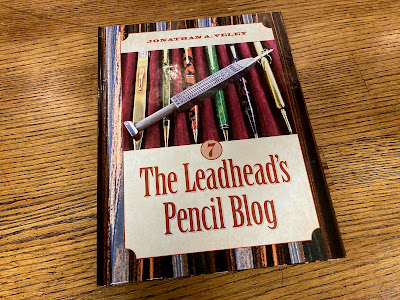

If you don't want the book but you enjoy the article, please consider supporting the Blog project here.

Ah, those halcyon days . . . early in our collecting, when we thought if the word “Parker” turned up on something in a flea market cigar box, we’d hit the jackpot.   We all have paid our tuition at some point, paying too much for that golden ticket only to learn that, as is the case with all other brands, not all Parkers were created equal.  

Many of us learned that lesson paying too much for a Parkette – one of Parker’s budget lines of pens and pencils from the 1930s.  I know I did . . . I don’t remember which Parkette pencil it was as I look at the spread today, but I do remember thinking I’d thrown away $20 after I excitedly showed it to a more experienced collector and received a derisive snort rather than a “way to go.” 

Times have changed, and Parkettes receive more love these days than they once did.  They are still cheaper than more expensive lines, but there’s enough varieties on the theme to keep collectors interested.  Over the years Parkettes have checked in at Leadquarters but they haven’t been checking out, unless they are exact duplicates of what I’ve already found.  Recently, I’ve been making more of a point to find examples that fill gaps in my little hoard.  

Take this grouping, for example:


I’ve known for years that sometimes you’ll find these marked “Parkette,” and other times marked “Parco.”  I went a little crazy bidding when the black Parco turned up in an online auction, because I thought that completed a nice little set . . . until I pulled all of these together for a family photo and recalled that the grey/red plastic is out there.  Now I’m going a little more crazy thinking there’s another color Parco out there to chase.  


That green one is kind of fun, with its reverse trim nose cone and a double imprint . . . definitely a measure of Parker’s somewhat lax quality control with this series.  


I don’t know what the “Pat. Pend.” means, since the pencils are unremarkable nose-drive affairs.  Either a patent never issued, or it was for some general manufacturing process not filed in Category 401. 

There’s plenty to explore in the Parkette series, as far as variants go – and when I’ve got more information, I know I’ll circle back around for at least two follow up stories about the ones in this next picture:


My favorites in this group are the top two, with those arrow clips.  They are really close to the arrow clips found on later Weidlich pens and pencils, and I’d like to know whether Parker sold leftover clips to Weidlich, or whether there was a mini-turf war over Weidlich’s use of them.  There's follow up number one.

My other question is how Parker managed to get away with producing streamlined writing instruments at a time when Sheaffer was so aggressively litigating with companies who dared round off the ends of their pens and pencils.  Was there gentleman’s agreement with Parker, or did Sheaffer simply decide Parker was too formidable an adversary to arm wrestle?  I’m sure there’s more out there to learn on that subject, too.

From this small sampling, I’m deducing that the “Parkette Deluxe” had a single wide band.  That’s the only difference, at least as far as the pencils go:


Unlike that first group, these are generally imprinted with date codes which specify the date the barrels were made, and Parker switched the way they were coded during the run.  That top example has a 9, for 1939; the other two are imprinted 26 and 16, for the second quarter of 1936 and the first quarter, respectively.

Continuing down, the next one lacks a date code.  The black one has a 17 code and the red one, with an imprint like the ones in that first Parkette/Parco image, is marked 25:


The last two are interesting.  The grey/red one has a 16 date code, but it also has two dots, reminiscent of how Parker added dots around date codes on the Vacumatic series, which doesn’t make sense . . . two dots didn’t mean first quarter in Vacumatic-ese.  I like the bottom one because it is made from the same burgundy/black celluloid used on the earlier Duofolds.  It has a 9 code with three dots, signifying first quarter 1939, during Parker’s parts blowout that year (see the “Class of ‘39" in Volume 5, page 281):


Given all of the variations, and the way Parker mixed and matched different elements on the Parkette series, assembling a truly comprehensive collection of these would be both demanding and infuriating, since online auction pictures rarely capture all of these subtle nuances.  

I’ve saved my favorites for last, when “Deluxe” meant more than just a wide band:


I’m always drawn to these neat fluted barrels, and the black ones with nickel-plated trim really pop.  I kept both black ones because there’s a subtle difference you can see in this picture: some of these with the metal top ring have flatter ends, and it appears to be deliberate.  Date codes on these range between 1937 and 1939.


At some point in this series, Parker made similar Parkette Deluxe pencils with a white plastic ring at the top, rather than matching metal.  These came in two sizes and . . . gulp! . . . very rarely, in ringtop configuration:


These don’t have date codes, so I am not sure whether these were made before or after those with metal rings.  I am sure, however, that the teal plastic on those bottom three examples is about my favorite color on any pencil, so I was thrilled when Brian McQueen was willing to part with the ringtop.

Since I’m so enamored with that color, and there seems to be an almost infinite range of variations, when another teal Parkette Deluxe happened my way, I was looking for an excuse to keep it here:


It’s the smaller of the two sizes, but when I compared it to the other example, I noticed something:


The top just doesn’t look the same as any of the other Parkette Deluxe pencils . . . it’s definitely more tapered at the top, and it looks to be intentional.  Also, the black top piece is decidedly thicker than any of the others I’ve found in this series:


Maybe I’m just wanting to find a subtle difference so that I have an excuse to keep what would otherwise be a duplicate:


But then again, maybe there’s a reason it was made that way, and there’s an entire subseries, within a subseries, within a subbrand to explore.


Sunday, June 21, 2020

Party On, Jack

This article has been edited and included in The Leadhead's Pencil Blog Volume 6, now on sale at The Legendary Lead Company.  I have just a few hard copies left of the first printing, available here, and an ebook version in pdf format is available for download here.

If you don't want the book but you enjoy this article, please consider supporting the Blog project here.

I’ll admit to having more fun than usual on eBay during this whole virus thing.  With no pen shows to go to, no flea markets to attend, no Springfield Extravaganza . . . gotta get my fix somewhere, I suppose.

I’ve taken a bit of lighthearted heat from the wife whenever a little pile of packages appears on my doorstep.  In the days when I would arrive home before Janet, it was easy to have all the packages opened, the boxes discarded and the pencils squirreled away into the museum before I’d hear the garage door go up.  These days, however, she’s working from home and whenever all my little packages don’t fit in our mailbox, the dogs announce the arrival of our mailman right outside her “office” window with every load of illicit goods.

Not that I’m doing anything wrong or spending all that much money . . . I’m just on the receiving end of a comment here and there regarding how many pencils one might “need” in order to survive a nuclear holocaust and repopulate the planet’s shirt pockets with adequate writing gear.

I’m relieved whenever I get to tell Janet that not all these boxes are crazy little trinkets upon which I’ve squandered the kids’ inheritance, and lately there’s been a lot of other packages arriving.  Without the usual socialization at shows, people have been sending pencils to fix, stuff to photograph – not everything that arrives is completing a one-way trip to Leadhead’s Leadquarters.

A couple weeks ago, however, one package arrived that was making a one-way trip – but it wasn’t anything I was expecting:


Apparently a few stragglers didn’t keep up with the march of the penguins, and there were a few other things in Don Jacoby’s stuff that Jack Leone wanted to catch up with the rest of the flock (if you're just now tuning in and that doesn't make sense, see "Penguins in the Barnyard").  “Party on!” Jack instructed.

“Party on, Jack” I titled the email to thank him, along with the observation that if I had not FINALLY  gotten a long, long, LONG overdue haircut the preceding day, I would be playing air guitar and headbanging to Bohemian Rhapsody right along with him.

For all you kids out there who have no idea what I’m talking about . . . sigh . . . just go ask your parents.  I keep forgetting what’s obvious to me is inevitably becoming the wisdom of the ancients.

There were a couple neat things in Jack’s care package worth sharing.  First is this pair of Eversharp “4 Square” pencils (these actually have the imprint on the caps) – see "Making Sense of the Square 4" for the full rundown on these:


Well look at that – this subseries came in both nickel plated and gold filled trim!  My example, in nickel plate, wasn’t nearly so nice, so both of these have found a comfortable place alongside their counterparts.  

The rest were a few lower-level Parkers - Parkettes and such.  Nothing much to write home about here, although I’ve had a single band example like that lower one which has been missing a clip:


I’ve had a green one just like that one which has that same clip, but I was never comfortable it was right.  Now that Don’s example has made it to me, with the same clip as found in the wild (or to carry on the theme of the weekend, waddling around in the barnyard), I happily invited this one into the fold.

And then there’s that Parker Liquid Lead pencil . . . there’s something a little bit odd about it.  It took me a while to find where I keep my other Liquid Lead pencils to compare it.  What I remembered them looking like was more along these lines:


I think the ones like that lavender example were later, though . . . or maybe for the lower tier lines, like to match the 21 or such.  I dug a little deeper and found a few Parker 51 Liquid Lead pencils, and they share that same shorter, ribbed tip:


And in the case of that lower example, a hefty price tag of $10!  

As you’ve probably guessed by now, I’ve settled into an uneasy peace with Parker’s grand experiment to load up a ballpoint cartridge with graphite paste and call it a “pencil.”  Yeah, I’ll keep them around the museum as “close enough to being a pencil” (after all, look how hard I stretched to accommodate those chalk holders the other day).  But no, I just haven’t been able to get too excited about them because the damned things never work (but then again, look how many goofy ideas that never worked well are proudly represented in the museum).  

I’ve come to adopt the Don Jacoby philosophy.  I like them just because I do, and I don’t like them just because I don’t.  So sue me.  

I will admit that on those rare occasions when you find one that works, they are kind of cool - lead flowing out of a pencil like ink and all.  Plus, that cartridge looks a bit shorter and different from the other Liquid Leads I’ve got around, so I thought this might have been some weird experimental thing Parker did that may have worked a bit better.  I turned Jack’s “Party On” instruction sheet over to see what it would do . . . 


Whoa.  It works, but I’ve never heard of a Parker Liquid Lead that wrote in purple!  Of course that meant I had to take it apart . . . 


From the other room Janet heard me burst out laughing.  Yes, Virginia, you can fit an ordinary Pilot ballpoint cartridge in a Parker Liquid Lead pencil and it will work just fine as a pen – thanks to Don Jacoby I finally have a way to bring all those dead Liquid Lead paperweights back to life!

Party on indeed, Jack.  Party on, Don!  Climb on into that blue AMC Pacer and crank it up . . . 

(Dooo do do doo do-do-do . . doo doo do dooooo... oh come on, I know you know this song.  Bang your damned head!)

Saturday, February 10, 2018

Flavor of the Month

This article has been edited and included in The Leadhead's Pencil Blog Volume 5; copies are available print on demand through Amazon here, and I offer an ebook version in pdf format at the Legendary Lead Company here.

If you don't want the book but you enjoy this article, please consider supporting the Blog project here.

I can’t remember which pen book author it was – probably Paul Erano – who cautioned against buying pens (or pencils) that were the “flavor of the month.”  A couple collectors take a sudden interest in a particular brand or model, and after they ask enough dealers at a show if they have any (or after a couple online bidding wars lead to some peculiar closing prices), it doesn’t take long before dealers at the shows are dusting off the examples they haven’t been able to sell for years, updating their price stickers and watching them fly off the tables.

Sometimes the sudden uptick in prices is the beginning of sustained interest, and those who speculated early or had a bunch of the latest hot commodity on hand will profit handsomely.  Just as often, though, the interest quickly burns out and it’s easy to find yourself kicking yourself in the pants for paying too much at the peak.  With luck, if you’re in the latter bunch you still are able to enjoy that run-of-the-mill Parker 51 you paid a couple hundred bucks for.

Recently a few of the younger Parker collectors have been scooping up a model that hasn’t attracted much collector interest, at least in the time I’ve been collecting (going on about 20 years now): the Parkette Deluxe.  Interest spread to these naturally from the attention drawn in recent years to Parker’s manufacturing of “rebadged” Parker products under department store names such as Diamond Medal, an admittedly fascinating sideline the company engaged in during the Depression.  Some Diamond Medals and others shared the fluted barrels found on the Parkette Deluxe, and next thing you know we’re all combing through our junk boxes trying to keep up with the requests for these things. 

The down side is you pay too much during these times, but on the upside, people think to get them out and more variations are available.  This is one I’ve been sort of trying to find for a number of years, and yes I paid more than I would have normally for it:


I say “sort of” because I wasn’t actively hunting for these, but I knew the green ringtop was out there because I had a cap for the pen (which ended up in Brian McQueen’s hands at DC this year, I think).  I like the color, and the ringtops you just don’t see:


This had me pulling out my other examples and organizing them.  From my limited assortment, there appear to be two types: those with a gold upper trim ring and a “PATO” clip patented by Harry Esterow (the “PATO” is actually “PATD,” as in covered by a design patent), and those which have a white upper band. 


Now that we’ve got a few guys out there actively chasing them, I imagine it won’t be long before we know whether the gold band versions also came in a larger size, and what other colors and configurations are available!

Tuesday, January 20, 2015

Better than "Innie" and "Outie"

Parker 21 pencils don’t get a lot of attention, due to "matching pen syndrome." Some pencils, like Waterman Patricians, are worth a lot more than they would be otherwise solely because of the pens they match. Others, like Parker 21 pencils, are worth less than Parker 51 pencils – even though they are exactly the same on the inside.

Until recently, about all I could tell you about the Parker 21s was that some of the clips were convex and others were concave – or, since no one gets too upset if you trivialize a 21, I called them "innies" and "outies," to borrow a belly button reference.

At the Raleigh show last summer, I was offered this grouping of pencils, and I had to accept for no reason other than that they took my vocabulary up a few notches:


To learn more, this full article is included in The Leadhead's Pencil Blog Volume 3, available at Amazon, Barnes & Noble and everywhere else you buy books, or you can order a copy signed by yours truly through the Legendary Lead Company HERE.