Step one: observe. Step two: compare what you observe to what you know. Step three: draw reasonable conclusions that flow from the first two steps.
When step two is a big fat goose egg, my reasonable conclusion is that all I can do is throw out there what I have observed in the hopes that someone – maybe next week, maybe in ten years or so – can help me connect the dots. Most of these images are several years old and have been sitting in the dead letter office, because I'm stuck.
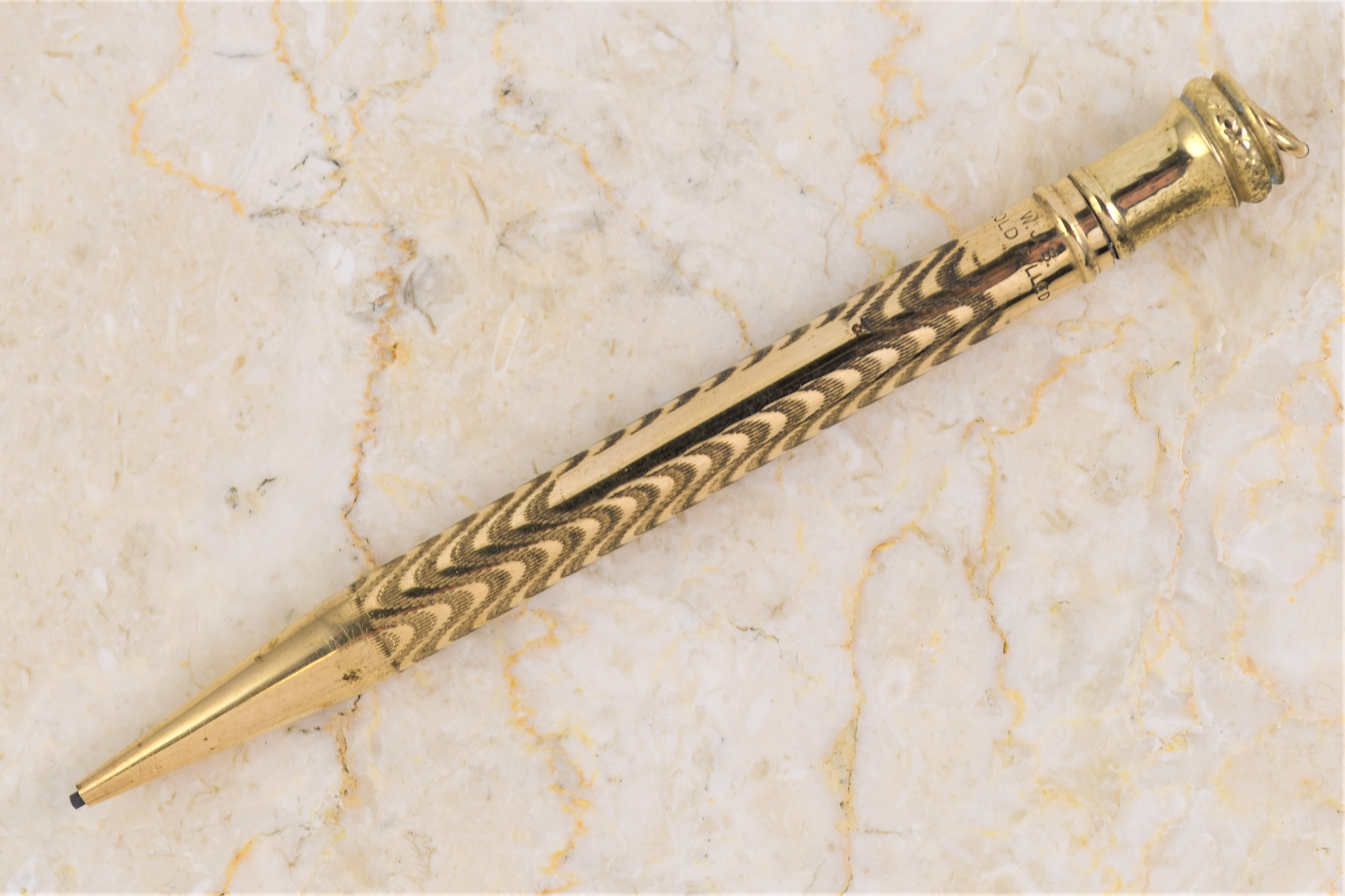
This Victorian pencil is marked “J.A.B. & Co.” Unfortunately, the pencil is generic and is not marked with any patents that might be helpful.


This next one was my only purchase when Janet and I stopped in Lebanon, Ohio on our way back from that big Eagle Pencil Company purchase. It was two dollars:

The lettering on the side interested me – “Guys Dropper Lamp” didn’t ring a bell, but the Shanklin Manufacturing Company did.

The name Shanklin on a pencil reminded me of this Shanklin Sure Sharp pencil, which appeared on page 19 in A Century of Autopoint.

The Shanklin Sure Sharp was invented by George Bergen, an early inventive collaborator with Charles Keeran as Keeran developed the earliest versions of the Autopoint. Alas, the Shanklin behind Guys Dropper Lamps was a different Shanklin. Wrong city, wrong industry. The only marking on this pencil that resembles some sort of model or manufacturer’s name is above the clip – “Poor,” I think it reads, in script lettering?

The best clue that might unravel this one is that distinctive cap. We’ve seen it before:

Here is our mystery pencil in the company of pencils marked “Thatpencil.”

That connection is only slightly helpful, though, because not much is known about the “Thatpencil” either - all I knew about it went into a very early article here, “No Really . . . ‘That Pencil’” (February 24, 2012: Volume 1, page 126), and I haven’t learned anything new about them in the years since.
Up next is something that I had to buy in an online auction just to get my paws on it to see what was going on.

The pencil is nested in that ringtop case.

Around one side of the cap are those tantalizing words, “Pat. Apld. For”:

However, the only other clue is on the other side - H.F.B.

I have been unable to track down any patent that was ultimately issued to someone with those initials. This one looks a lot like something Bates & Bacon might have made, but none of the principals in that organization had the initials H.F., either.
This next one might not be American, but it might have an American connection.

The clip is a standard issue 1915 patent accommodation clip marked for the Eagle Pencil Company - while it looks like it has been there for some time, since it is a clip that just slides on, I’m confident but not certain that it came with this pencil.

An Eagle clip would be consistent with what is written around the cap: “D.R.P.” stands for Deutsches Reichspatent, meaning German patent. “Made in Germany” in English suggests that it was made for the American market. Eagle also sometimes stamped early Eagle Stop Gauge pencils with the German patent number.

The cap pulls off, and underneath it is an odd mix of word salad: “Depose” suggests a French connection, as in “registered,” and there’s a specific German patent - number 331474, I think it reads.

I’ve tried to look up a German patent number 331,474, but all roads lead to some random Norwegian patent having nothing to do with pencils. There have been a few other examples of these pencils that have surfaced in recent years online, and in each case people have marveled about their weird mechanisms. Under that cap is a hole, maybe just a place for spare leads or maybe they were intended to feed automatically.

And on the top, both on and under the cap, the word “JACO.”

I’m sharing this next one as a second cry for help - one every seven years or so, I suppose:

It’s marked “L Pen Co.” on the clip, and it joins another example that turned up back in 2018 - see “The L Pen” (April 22, 2018: Volume 5, page 240). I fingered at the time that Diamond Point was the likeliest suspect to have made it.

I didn’t know anything about the “L Pen Co.” then, and I haven’t figured anything else out about it in the years since.

Hard rubber pencils like this next one look European, and my eyes tend to glaze over when I see them.

This one, however, had a very faint but interesting imprint on the barrel:

“The Rosemady That’s For Remembrance” it reads - there’s a lot of excess China Marker on here, because every time I tried to clean off the extra white stuff it all came off and you couldn’t read it. I have no idea who or what “Rosemady” is.
Along those same lines is this “Rufford”:


That’s a very British-sounding name, and this one fooled me when I found it on Rob Bader’s table in Chicago a few years ago. It’s not even a pencil, I learned during shooting . . . it’s a stylographic pen. What the heck - it’s my blog and I’ll share a stylo if I want to. Besides, I’d like to know more about who made the “Rufford.”
Matt McColm pointed this next one out to me when it showed up in an online auction:

“Statter Bros. / Buffalo” reads the imprint. I did find one reference to Statter Brothers as a manufacturer of numbering machines in the July 1931 edition of the Rand McNally Bankers Directory, but I don’t know whether the company also sourced pencils to offer under their name as another line of business.

I had this one photographed, but the images didn’t turn out very well the first time:

After a trip to the buffing wheel, the second photo session was more fruitful . . .

I’ve seen a few of these “M Co.” pencils over the years. My best guess is that M is for Morrison . . . except Morrison was never bashful about emblazoning its full name on its products. Was Morrison being uncharacteristically understated, or is this something else?

Myk Daigle bequeathed me this next one a couple years ago. I think it was keeping him awake at night, and he figured better me than him:

It looks a little bit European, but the imprint is partially in English:

“Skopeographe / Pat Applied For Bte S.G.D. . . .” something. Looks like it might end with another G. I hoped that I might learn more by taking it apart, but alas . . .

Hmm. Looks like a continuity tester, sort of like the Kastar . . . although I’m not sure how you’d know if there was continuity without any window in the barrel.
My internet searches were at the same time refreshing and infuriating. When I typed “Skopeographe” into a Google search, there were no best guesses, no random suggested result; only results akin to “Did you mean ‘waterbeds?’ Here’s a zillion people who might sell you one of those.” Just . . . nothing. Google Books yielded the same result. It’s rare that no intelligence, human or artificial, even hazards a guess, and I have fared no better.
This last mystery pencil – for now – is one of those that has me taking out my loupe to over and over. It’s such a high quality pencil that it should be marked somewhere.

Geez . . . it even has a “Pat. Applied For” imprint which will be impossible to track down without breaking a solder weld or two to tear it apart.

My best guesses, based solely on a flimsy comparison of external similarities, had me posing this one in between a Century at top, and a Henber at bottom.

“Dorothea” is the only name on it – if it’s a personalization, it’s the most elaborate, hand engraved personalization I’ve ever seen.

Maybe like John Foley’s “Madeleine” pencils, it’s more than just the owner’s name. All I know is that it wasn't my mother-in-law’s -- that’s the only other Dorothea I’ve met.