Showing posts with label Banker. Show all posts

Monday, September 8, 2025

Worth a Second Look

In yesterday’s installment, I introduced a fountain pen marked “Worth” with a nib marked “Keystone.” It was the first of several dominoes to fall connecting different producers.


That tied nicely into a discussion about who made pens and pencils marked “Keystone,” but with an underlying assumption that the nib is original to the pen. I agree that sometimes people put too much weight on what nib is in a particular pen, since nibs can be and often were switched out by repairmen over the last century.

In this case, I fully believe the nib is original. First, this Worth pen appears to have been made by the Eagle Pencil Company, given its similarity to other known Eagle pens:


Second, the word “Keystone” was a registered trademark owned by the Blaisdell Pencil Company. Blaisdell, by the time the trademark was applied for, was controlled by the Berolzheimer family, which also owned the Eagle Pencil Company.

All roads leading from Worth and Blaisdell point to Eagle. As I mentioned earlier, when I bought that Worth pen I didn’t even check to see if there was a nib in it – it was cheap, and the fact that I suspected it was Eagle-made without even removing the cap was all that I needed to add some fascinating context to one of our most celebrated pen history. A Keystone/Blaisdell/Eagle connection adds even more fuel to that fire. 

The Worth Featherweight Pen Company is best known today for being the loser in Walter Sheaffer’s landmark patent infringement case over Sheaffer’s design patents for the Sheaffer Balance. Daniel Kirchheimer wrote an excellent article on the litigation titled “Featherweight vs. Heavyweight” (posted here). The case is notable for the information in trial transcripts detailing the development and history of the Sheaffer Balance. 

Here at the blog, the Worth Featherweight Pen Company last made an appearance in “Worth Something” (July 24, 2021: Volume 7, page 282). In that piece, the evidence was presented that Nathaniel Worth, who tried to secretly sell his shares in New Diamond Point Pen Company to Marx Finstone’s Eclipse Pen Company, was the man behind the Worth Featherweight Pen Company. Both were represented by the same attorney, Charles Greenwald.

“One could argue that it’s a coincidence that there were two guys named Worth [Nathaniel and his brother], and a pen company called the ‘Worth Featherweight Pen Company,’” I wrote. “Slimmer still is the possibility that all were in New York City, and that Nathaniel Worth had been recently relieved of his duties at another pen company shortly before this one emerges.

“But could it still be a coincidence now that we know the same New York lawyer was representing both Nathaniel Worth and the Worth Featherweight Pen Company, in two complex cases, both of which would likely consume nearly all of his time? No, I believe this eliminates all reasonable doubt.” 

OK, so now we have Diamond Point, Eclipse, Keystone, Eagle, Blaisdell, and Worth in the mix. Hang in there . . . it sorts itself out.

I took a more significant dive into Sheaffer’s litigation to protect its design patents for the Balance in A Field Guide to Sheaffer’s Pencils (2023). “Worth was an ideal defendant for Sheaffer to attack,” I wrote on page 40, “since it was a small concern with limited resources with which to defend itself. Worth’s conduct was also intentional and flagrant: the company even marketed its pens as the ‘Safer Fountain Pen,’ and one of Sheaffer’s undercover operatives reported that Worth’s president admitted the name was chosen because the name sounded like ‘Sheaffer.’ Predictably, Sheaffer outgunned this tiny adversary, resulting in a decision upholding the validity of Sheaffer’s design patents.”

Once that judgment was secured, Sheaffer set his sights on the Eagle Pencil Company, whose products had been introduced in evidence during the Worth litigation for the proposition that Eagle had been making streamlined writing instruments like the Balance since Walter Sheaffer was in diapers. In this instance, though, Eagle was one of the more blatant of the copycats, offering metal pencils and pens painted in a faux black and pearl, shaped exactly the same as the Balance. A couple examples turned up in Susan Wirth’s belongings, in this tray of “Susie’s Eagles” with which John Martenson parted:


The Balance-like offerings in this tray filled out what I already had in the collection nicely:


The Court was quick to mete out justice against Eagle: the Court issued a preliminary injunction against Eagle as well, in a published decision filed on December 3, 1931 (W.A. Sheaffer Pen Co. v. Eagle Pencil Co., 55 F.2d 420 (S.D.N.Y. 1931)). As a result, Eagle was forced to modify the shape of some of its products and add a disclaimer to the company’s 1931-1932 catalog:


Now let’s take a step back for a second and take a breath. Yes, it makes sense that Sheaffer would first target a weaker opponent to get a favorable precedent set that his Balance patents were valid. Yes, it also makes sense that Eagle would be in Sheaffer’s sights, since Eagle was one of the more blatant copycats.

With the additional insight that Eagle was supplying the Worth Featherweight Pen Company with at least some of the company’s products, it makes even more sense. After all, if Eagle was supplying one competitor with Balance-shaped products, taking down Eagle would knock out both a direct competitor as well as a supplier.

Which got me to thinking . . . in the Field Guide I brought up another competitor who was restrained by the Courts: the Pick Pen Company of Cincinnati, against whom Sheaffer won a preliminary injunction on December 2, 1931 – the day before the injunction was issued against Eagle.

I wrote up the history of the Pick Pen Company in great detail in Volume 7 (see “Nobody’s Luck Is That Band” on May 5, 2021: Volume 7, page 88). Now that we know that Worth might have been targeted by Sheaffer because Worth was a customer of the Eagle Pencil Company, I wonder: does that suggest Eagle actually made this Pick pen?


Maybe . . . it does share the general lines of Eagle products, and Pick didn’t do much with streamlining. It is an interesting hypothesis. With my head about to explode with adding yet another company into this story, I’ll wait to circle back on that point until I have more evidence.

Now to bring this long, complicated story full circle. This all started with a discussion of James Kelley’s Keystone Banker. In those earlier articles I included this image of three combination pens and pencils, all fitted with Gordon’s “fanged” clips:


These clips are marked “Banker,” “Safer,” and “Gordon.” Gordon is easy to explain: the fanged clips were patented by William Gordon of Union, New Jersey. There were three patented versions of the clip (all three patents were discussed in “Always a Crowd Pleaser” on March 17, 2015: Volume 3, page 263). I’ve never seen the earliest version of Gordon’s clip in the flesh, and I’ve only found one example of the third. All of the other examples I have found are the second incarnation, the patent application for which was filed April 3, 1930 and granted as patent number 1,834,151 on December 1, 1931. 


As for the Banker, these combos were produced (not manufactured) by our friend James Kelley. But what of the “Safer?” Was that meant to comfort the public into believing a writing instrument with built-in spikes wouldn’t harm your shirt pocket? Perhaps . . . but I doubt it.

In Daniel Kirchheimer’s “Featherweight vs. Heavyweight” article, he discussed how Walter Sheaffer’s undercover detectives had learned that the Worth Featherweight Pen Company sold pens under the name “Safer” – not because they were less dangerous, but because “Safer” sounded a lot like “Sheaffer.” Daniel included this image of a Worth box, which was introduced at evidence during the trial:


I’m not sure how all of this fits together, and the only thing of which I am certain is that James Kelley and Nathaniel Worth both sourced these combination writing instruments with Gordon patent clips from the same supplier. Was that supplier Eagle? Maybe. Were Nathaniel Worth and James Kelley involved in some way other than buying stock from the same supplier? Maybe.

Good journalists, I was taught forty years ago, do not tell you what to think – they tell you what to think about. 


Saturday, September 6, 2025

The Real Deal

Something else occurred to me as I was rereading the two previous articles I discussed yesterday (“Captain Obvious” on January 24, 2016: Volume 4, page 109 and “A Death Most Untimely” on July 23, 2021: Volume 7, page 280). These two articles, posted six years apart, reveal something interesting.

Yesterday I discussed the connection between the New Diamond Point Pen Company and the Eclipse Pen Company. The Court case discussed in “A Death Most Untimely” discussed Marx Finstone’s desire to consolidate Eclipse with his competitors: not just with Diamond Point, but also with two other New York pen companies, Salz Brothers and J. Harris & Co. Only Diamond Point was at issue in the litigation, so there’s no information regarding whether his other merger attempts were successful. 

At the end of “Captain Obvious,” I shared a stationer’s advertisement published in the Wilkes-Barre (Pennsylvania) Record on April 18, 1925:


At the time, I mused whether Diamond Point was also responsible for the Ambassador and “Banker’s Special” brands in addition to the Collegian, since this advertisement says all three are “Guaranteed by manufacturer,” not “manufacturers.”

That hypothesis is thin, and I knew that at the time; however, since I had forgotten that detail by the time I wrote about the Diamond Point/Eclipse litigation, I do think it bears a closer look now. “Ambassador” is well-documented as a J. Harris & Co. brand, so Marx Finstone’s interest in J. Harris may well have been for the same reasons as he was pursuing Diamond Point.

As for the “Banker’s Special,” I’m not so sure. In “Banker and the Specialty King” (July 25, 2021: Volume 7, page 285), I laid out all of the sordid details surrounding James Kelley, the flamboyant self-promoter. Kelley engaged in a cross-country cat-and-mouse game with the newly formed Federal Trade Commission, which hounded Kelley for his flagrant violations of laws regarding unfair and deceptive practices. Most notably, the FTC targeted Kelley’s trading on the good name of the L.E. Waterman Company by adopting the name “Waterson” in connection with pens and pencils.

Perhaps the FTC was being overly aggressive with Kelley to teach him a lesson, since Kelley was flagrantly thumbing his nose at the new agency. After all, as I noted in that article, any consumer who bought one of Kelley’s low-grade Waterson pens thinking it was a Waterman was a fool who should be parted with his money.

I didn’t find any evidence that James Kelley was responsible for any pen or pencil formally called the “Bankers’ Special.” He did, however, appropriate the “Banker” name from a Banker’s Pen Company that failed by 1922 and traded under the names “Banker,” “New Banker,” and “Kelley Banker.” He referred to his Banker pens and pencils with pointy or “gothic” top ends as the “Keystone Banker” in advertising.

As for that Keystone name . . . we’ll get to that one tomorrow. 

For our purposes today, the conclusion at which I had arrived in my earlier article was that the “Banker” and “New Banker” pencils with which we are familiar were products of James Kelley’s ventures. Kelley had appropriated the name from the original Bankers’ Pen Company, which had shuttered sometime in late 1921 or early 1922, likely a casualty of the brief but sharp 1921 economic slowdown. 

It is of course possible that there was another huckster who had also appropriated the “Banker’s Special” name – no honor among thieves and all. Had that been the case, I would have expected to find something marked “Banker’s Special” or some reference to the name other than in this lone stationer’s advertisement. Eliminating that possibility would be nice, but I’m inclined to “bank” on what is probable rather than what is possible. I don’t believe that in 1925, Kelley’s Banker pens and pencils were in any way connected with whoever was manufactured and warranted the Collegian or the Ambassador brands.

Neither did I believe that the original Bankers’ Pen Company made any pencils at all, because I didn’t know things like this existed at the time:


This hard rubber pencil turned up in an online auction, imprinted “Bankers Pen Co., Inc. / New York Pat.”:


Kelley’s Banker and New Banker writing instruments came in pretty colors, but they were not technically very sophisticated - none of their features were anything that would have been the subject of a patent. Also, Kelley’s Banker products are not known to exist in hard rubber. I am convinced this is the “real” Banker, made prior to the original Banker’s Pen Company’s failure sometime in 1921 or 1922.

What of this “patent” nonsense suggested by the imprint? There’s two suspects, one at either end of the pencil. At the nose, it has a “catch and release” leadholder configuration – unscrewing the nose a bit releases the lead, while tightening causes it to clamp down on the lead to secure it.


That was a patented innovation, but it was another New York manufacturer, not Banker’s, which laid claim to it:


Egon L.  Schmitz applied for patent number 960,588 on December 21, 1909, and when it was issued on June 7, 1910, it was assigned to the Eberhard Faber Pencil Company. I think this is most likely the patent referred to on this Bankers’ pencil – the time and the location fit what we know about the company well.

At the other end of the pencil, there’s another interesting feature that may have been patented somewhere along the line:


Those little prongs are pretty effective as a pencil sharpener. I checked that outstanding reference,  American Writing Instrument Patents Volume 2: 1911-1945, and nothing struck me as applying to this doohickey. However, since it is an attachment rather than a writing instrument itself, it might have been filed away in some obscure patent category I wouldn’t have thought to search. 

That’s possible, but as I mentioned earlier, I’d rather bank on what is probable rather than what is possible. My money is on old Egon until something like this turns up with an actual patent date or number.   

Monday, July 26, 2021

All the King's Horsemen, Part One

This article has been included in The Leadhead's Pencil Blog Volume 7, now available here.


If you don't want the book but you enjoy the article, please consider supporting the Blog project here.

James Kelley, the self-described "Specialty King," was making good money and he wasn’t about to let smug Washington bureaucrats tell him how he was going to do business.  In his mind, if the Federal Trade Commission was going to try to stop him, he would find other ways to continue earning his living.  There’s a fine line between plausible deniability and obeying the letter of the law, and Kelley walked that fine line about as gracefully as a drunk being pulled over and ordered to walk straight and true. 

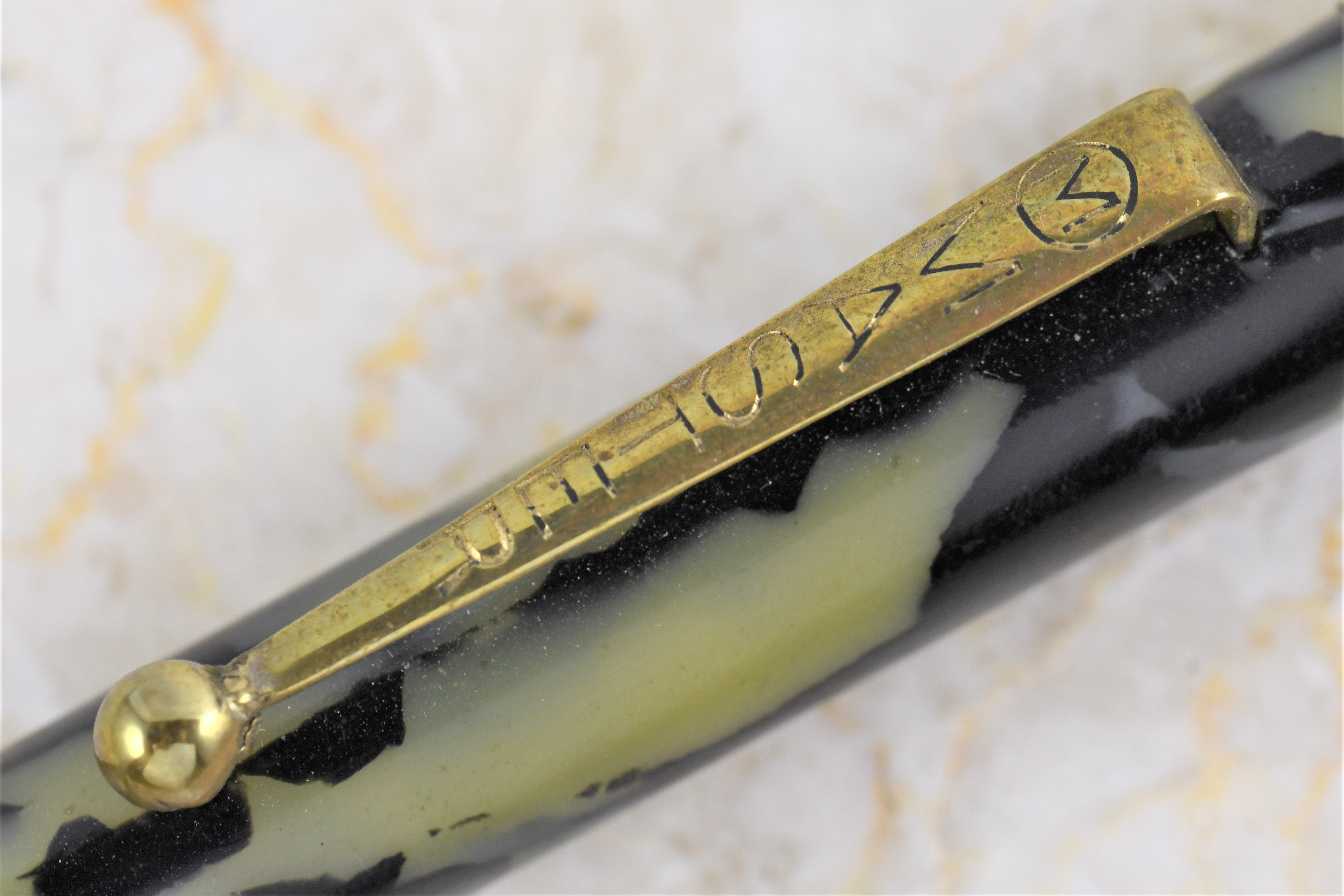
Let’s revisit this pencil, marked “Master” on the clip:


Above the word “Master,” there’s an M within a circle:


I wrote about this pencil in Volume 1, page 333, and I dutifully noted the connection between “Master” and the Bankers’ Pen Company - in an endnote on page 435, I indicated that matching pens were imprinted “The Master Pen / Banker’s Pen Company / New York.”

That endnote was partly right, but the pens I referred to were not “matching pens.”  As yesterday’s article establishes, those pens were made by the earlier “Bankers’ Pen Company” which folded before 1922 – much earlier than this pencil was made in the late 1920s or early 1930s.  In addition, these cheaper pens and pencils with a circle M mark, like most third-tier writing instruments, didn’t have imprints.  

Taking the evidence as a whole, it is obvious to me that this pencil is a James Kelley production.  If he was restrained from appropriating the name of other manufacturers, he must have reasoned, nothing in the order would prevent him from appropriating the name of a model used by a defunct manufacturer. Letter of the law . . . plausible deniability.

That conclusion is further supported by other details.  While the Federal Trade Commission’s injunction preventing Kelley from marketing pens or pencils marked “Waterson” was issued in April, 1930, that injunction didn’t happen overnight.  Inquiries and investigations by the FTC (and perhaps from L.E. Waterman) would have started months earlier, which explains this:


During the latter part of 1929, several newspapers out west ran this advertisement for “Genuine Waterson Self-Filling Fountain Pens” (this one is from the Great Falls (Montana) Tribune on July 2, 1929).  The advertisement states that orders are filled by mail order, but customers are invited to see Waterson pens in a window display:


At the “Nassau Pen and Pencil Corporation,” 311 Central Avenue, Great Falls, Montana.  The Nassau is another third-tier brand with which even beginning collectors are well familiar, and a connection between Nassau and Kelley’s Waterson explains something I’ve always wondered about.  Nassau pencils come in Welsh-style bell top models, just like the Banker and Waterson:


But in all but one case among those I’ve found, above the word Nassau is an M within a circle, rather than the letter N:


Transitional models and those with cutout bands that appear to have been supplied by David Kahn share that same anomaly:


Later models, however, universally sport an N in a circle above the word Nassau:


Something else is amiss with the Nassau Pen and Pencil Corporation: no, its offices were not in Great Falls, Montana – at least, not exclusively.  The earliest mention I found for the company was this advertisement in the Wilmington, Delaware Evening Journal on April 17, 1929, which provided an address of 814 Market Street, Wilmington, Delaware:


An advertisement in the Bridgewater, New Jersey Courier News on September 13, 1929 provides no address, but it looks suspiciously like one of James Kelley’s promotions:


On December 4, 1929, this advertisement in the Harrisburg, Pennsylvania Evening News identified a “Nassau Fountain Pen Company, New York City”:


The advertisement published by Inglehart’s Drug Store in the Oshkosh Northwestern on March 6, 1930 reprinted the company’s warranty papers, providing an address of 116 Nassau Street, New York:


Another advertisement in The Morning Call in Allentown, Pennsylvania on September 25, 1931 is revealing: no address is provided for the “Famous Nassau Pens,” but the text describes the large, clunky flattop pen as “the latest 1931 Balanced Master or Bankers’ size.”  Master, Banker, and another assault on Walter Sheaffer’s Balance, all rolled into one:


Since Nassau was running a mail-order operation, either the company was moving around rapidly or was opening storefronts across the country, literally as a front for where the operations were really located.  The Federal Trade Commission finally caught up with the Nassau Pen and Pencil Corporation on April 22, 1938, issuing an injunction to prevent Nassau from using the term “Life Time Guarantee” in an order nearly cut and pasted from the order against James Kelley.  The FTC apparently never figured out who was really behind the company, since orders typically named the principals involved.  I’m sure to a moral certainty, had the FTC done a little more digging, they would have found James Kelley behind it all.


Sunday, July 25, 2021

Banker and the Specialty King

This article has been included in The Leadhead's Pencil Blog Volume 7, now available here.


If you don't want the book but you enjoy the article, please consider supporting the Blog project here.

Sometimes all it takes is a bit of persistent tugging at that one loose thread on a sweater, and the whole thing unwinds.  

After I finished yesterday’s article linking Gordon’s “fanged” clips marked “Safer” with the Worth Featherweight Pen Company, something nagged at me.  Since Gordon’s clips also turn up occasionally marked “Banker,” I wondered if there might be any connections between the Banker-marked Gordon clips and the Worth Featherweight story.  


Spoiler alert: there wasn’t – at least, none that I was able to find.  What I did find, however, answered questions that I’ve had since I first started collecting more than twenty years ago now.

“Banker” – at least, on pens and pencils like my Gordon-clip example – is a brand collectors refer to as “third tier”:  lower quality pens and pencils which were typically more colorful than functional.  We all cut our collector’s teeth rounding up these cheaper brands in pretty colors – names like Banker, Keystone, Waterson. “No-names” is an accepted collector’s term for cheaper writing instruments such as these, even though you’ll find literally hundreds of different names on their clips.  “No name of significance” would be more accurate, I suppose.

Who made these “no-names’ (or produced them) is usually lost to history, just because nobody has taken the time to go gravedigging for them.  By the time we graduate to the point where we are doing this level of heavy-duty research, we’ve also graduated to the point that we don’t care about these lowly brands as much as we once did.  Now, however, I had a reason to dig a little deeper into my old third-tier, no-name stomping grounds, looking for the proprietors of the “Banker.”

There was a “Bankers Pen Company” in New York during the teens that receives some collector interest.  That company is best known as maker (producer) of the “Master Pen,” at 1 Madison Avenue - the Met Life building, as most people know it.  David Nishimura has posted articles on the subject – the early Bankers Pen Company was apparently supplied by Julius Schnell (of later airplane-clip “Penselpen” fame), and in 2017 David found a boxed example a few years ago suggesting that the Master Pen (at least at some point) was manufactured by Salz.  For David’s story, see https://vintagepensblog.blogspot.com/2017/05/the- master-pen-salz-connection.html.

There’s a more detailed history of the Bankers’ Pen Company in Walden’s Stationer and Printer, published on January 10, 1919:


According to this account, a man named Joe Walsh put together a new kind of pen around 1910 or 1911 (“about eight years ago,” according to the article).  He mailed out “about 500" pens to bank officials unsolicited, asking them to try it out and to send him $2.00 if they liked it.  Nearly all of the 500 were sold, followed quickly by another 50,000 in short order – thus, Walsh’s pen became known as the “Banker’s Pen.”  

According to Walden’s, William P. Chase bought the company from Joe Walsh in 1915 and added “a complete line of office supplies” to the company’s offerings. The 1919 article was published on the occasion of the company’s reincorporation as the “Bankers Pen and Office Supply Company” and notes the company had increased its capitalization from $25,000.00 to $250,000.00 in common stock.  Chase is identified as the company’s treasurer, while Louis A. Pinon (a “capitalist” who had spent the last 34 years in Havana) was the company’s president.  R.C. Hay, a recent Yale graduate, was the company’s vice president and general manager.

Other sources partly confirm the Walden’s account: Polk’s 1914 copartnership directory lists a Bankers’ Pen Company at 1 Madison Avenue, but it associates the firm with someone else – John J. Kilcoyne:


No patents appear to have been issued either to Joe Walsh or John J. Kilcoyne, and neither registered a federal trademark for the Bankers’ name.  However, consistent with the Walden’s article, Polk’s copartnership directory for 1915 lists a Bankers’ Pen Company, Inc. with Chase serving as secretary to the company.  Clifford B. Harmon is listed as president, with James K. Duffy as vice president and Wilson C. Reed as treasurer.


By 1919, Polk’s Copartnership directory lists the individuals identified in the Walden’s article . . . mostly.  Hay isn’t listed (perhaps he was brought into the firm after the directory was published) and three other individuals appear as directors: Lewis M. Symms, W.J. Keely, and Albert A. Ochs:


On August 8, 1920, the Bankers’ Pen Company advertised for salesmen in the New York Herald:


Then . . . the Bankers’ Pen Company vanishes.  The company isn’t listed in the New York City Directory for 1922-1923; perhaps it was renamed, but if the company’s bread and butter was supplying the banking industry, the mini-Depression of 1921 which resulted in the failure of so many banks may also have triggered an abrupt end to those who sold them office supplies – other than red ink, I suppose.  William P. Chase is listed in the 1922-1923 directory, but as president of the “Kor-Nut Company, Inc.”  In the 1925 directory, he is president of the Chase Candy Company, Inc. 

Meanwhile, a man named James Kelley appears in the 1922-1923 directory.  Was this the same man as “W.J. Keely,” listed as a director of the Bankers’ Pen Company in 1919?  Perhaps – as will be discussed later, Kelley had good reason to use aliases.  In 1922, however, James Kelley listed an occupation as flamboyant as the man himself must have been: “Specialty King.”


I’m reminded of the time I was contacted by a local community college to see if I would be willing to teach a business law class – for free, of course.  I said I would because I thought it would be fun . . . until they put me through a rigorous application process for the privilege of volunteering and they refused to accept my “application” until I provided my title with my current employer.  

I’m a sole practitioner, I replied.  No, they said.  You must have a title.  “Fine,” I said.  “Put down ‘God’ and ‘Emperor.’”

I did not get the job.

By the time the 1925 directory was published, James Kelley provided a more traditional description of his occupation, identifying his profession as “novelties and fountain pens” with a business address of 407 Broadway.  His residence was reported as being in East Orange, New Jersey:


Kelley had been in fountain pens for several years.  In 1915, he was just one of several New York pen companies who drew the attention of the newly formed Federal Trade Commission, which instituted proceedings against James Kelley in one of its earliest complaints – number 670, as itemized in the FTC’s first annual report in 1915.  The Commission took on the New York pen industry at large for “fictitious pricing” on boxes, intended to mislead the public that the pens were higher quality pens being sold at a discount.


Kelley later operated as the “James Kelley Fountain Pen Company,” although there’s no listing for a company by that name in the directory.  On November 12, 1931, Anderson’s Drug Store in Mattoon, Illinois advertised in the Mattoon Journal Gazette that it would be introducing the new “bullet shape” Banker fountain pens and pencils, made by “the largest manufacturer of fountain pens and pencils in the United States.”


The advertisement, however, includes illustrations of a flattop Banker pen and a bell-top pencil with a Welsh-style nose. But wait a tick . . . what’s that say on the clip?


Waterson, with a K within a circle above the name.  I have a few Waterson pencils, and just as shown in that 1931 advertisement, all have that K above the name within a circle. 


I had always suspected that the K within a circle stood for Kahn, as in David Kahn, Inc., makers of the Wearever, but I had my doubts.  Kahn’s other brands had “DK” in a circle, not just the letter K:


Yes, Virginia, we finally have the answer now - that K stands for Kelley, and the Waterson brand was made (or produced) by the James Kelley Fountain Pen Company – which, incidentally, was spelled “Kelly” in his advertisements, whether by accident or obfuscation.

Kelley was likely trying to keep a low profile as he peddled his Watersons under the watchful and litigious eyes of the L.E. Waterman Company.  Nevertheless, his stunt did draw attention – if not from Waterman, from the Federal Trade Commission for a second time.  

On April 7, 1930, the Commission issued several orders against James Kelley (13 F.T.C. 284), including orders prohibiting him from representing that he was a manufacturer of pens unless he really was; from supplying fictitious price tags to retailers so that they could offer his pens at an equally fictitious “discount”; and last but most revealing, from “using as a tradename for fountain pens or for pencils the name “Waterson” or any other name in sound or appearance simulating the name “Waterman,” or the name of any other manufacturer of fountain pens or of pencils, or any trade name under which any other fountain pens or pencils are commonly known and sold by any other producer of, or dealer in, fountain pens or pencils.”


The Federal Trade Commission’s order didn’t slow James Kelley down much, since the 1931 newspaper advertisement he printed a year after the Commission’s decision stated he was “the largest manufacturer of fountain pens and pencils in the United States” and illustrates a Waterson pencil.  Kelley, it appears, simply fled out west, where he must have thought he would be out from under the watchful eyes of Federal regulators  – and those pesky other manufacturers he was copying, such as Walter Sheaffer.

Perhaps the illustration of a Banker pencil with a Waterson clip was a gaffe – albeit a telling one.  There are Banker pencils which, other than the clips, are identical to the Waterson pencil shown.  However, they have Banker clips which are pressed into the barrel rather than Z-clips like those on the Waterson:


In the spring of 1932, advertisements appeared in the western United States, from Nevada to Idaho, announcing “the new 1932 gothic model Keystone Banker,” which looks remarkably like a Sheaffer Balance.  This one appeared in the Nevada State Journal on April 3, 1932:


The announcement is described as a “manufacturers’ advertising offer,” but at the bottom, the manufacturer is identified not as the James Kelley Fountain Pen Company, but as the “Banker Pen Company” located at 417 Governor Building, Portland, Oregon.

These “gothic model” Bankers are advertised in french onyx, mottled green or black and white.  Here’s the examples I’ve found:


Those butterscotch-swirl pencils might be “french onyx” I suppose, which brings me back around to the Banker “gothic” pen with a Gordon clip that started this inquiry.  I’ve recently picked up a second one:


The nib on the new one says “Bowl 14k Gold Filled M.B.” As for the other, it makes more sense now, since I know the James Kelley Fountain Pen Company was offering these for sale.  “Kelley Banker,” it reads:


The “gothic” shape was apparently abandoned.  Bankers appear with a more rounded than tapered profile:


There are also squared off models, some of which are marked “New Banker.”  Perhaps Kelley reorganized the company for financial reasons, or perhaps he was trying to evade his competitors and regulators:


These are all marked “New Banker”:


And this last group has “Banker” written in a font and style which is very similar to pencils sold by another rascal, Joseph Starr:


In 1935, the Federal Trade Commission was knocking on Kelley’s door again, since he was required to report back to the commission in writing on or before August 7, 1935 to establish that he had complied with the order.  Although he filed an answer, the existence of a 1931 advertisement would have made it difficult for Kelley to argue that he had in fact done so.  In 1937, a Federal court affirmed an order from the FTC compelling Kelley’s compliance with the terms of the 1930 order.

In 1939, the Federal Trade Commission pursued James Kelley for a third time.  Kelley, “sole trader, trading as James Kelley Fountain Pen Co. and also as The Banker Pen Co.,” was slapped with his third injunction on August 11, 1939.  He was prohibited from using words like “Durium Pointed” or other words implying that his nibs “are made or tipped of any purported substance, fanciful or real, when such is not the fact.”  Likewise, he was restrained from using the mark “14k” or any similar marks suggesting there was 14k fineness of gold used; and third, he was prevented from continuing to use the words “Life time guarantee” on products if the customer had to pay additional money to have it honored. 

The libertarian and me chuckles at how James Kelley ignored the Federal Trade Commission.  He had a great scheme going, selling cheap fountain pens and pencils to drug stores with grossly exaggerated prices on them, so that these stores could “discount” them to gullible customers.  Seriously . . . any fool dumb enough to mistake one of Kelley’s Watersons for a Waterman is a fool who should be parted with his money.

However, that 1931 advertisement is a rare glimpse behind the curtain of Kelley’s empire: yes, it flagrantly violates the terms of his 1930 Federal Trade Commission injunction, but it has elements of plausible deniability: Kelley’s name is misspelled as “Kelly,” and the advertisement doesn’t specifically offer Waterson pencils – it just includes an illustration of one.

Kelley wouldn’t miss a beat in hawking his cheap writing instruments, P.T. Barnum-style – Federal Trade Commission be damned.   He would find other ways to circumvent the injunctions issued against him . . . and the fact that the FTC never caught on to what he was doing during the 1930s explains why it is so difficult to piece things together now.  

If only Federal regulators had read the newspapers, though, they would have . . .