Showing posts with label Chicago Gold Pen Mfg. Co.. Show all posts

Monday, May 18, 2020

With a Twist . . . Just a Twist

This article has been edited and included in The Leadhead's Pencil Blog Volume 6, now on sale at The Legendary Lead Company.  I have just a few hard copies left of the first printing, available here, and an ebook version in pdf format is available for download here.

If you don't want the book but you enjoy this article, please consider supporting the Blog project here.

This was one of those poorly listed, poorly photographed and poorly described items I won in an auction, at a price so low that if it turned out to be nothing, I was out only slightly more than nothing:


My first thought was that it might be an Edward Todd combination dip pen and pencil, of the sort patented on December 19, 1871 by Joseph Moneghan and Thomas Flynn:


These examples appeared in an article I posted here a couple years ago (see https://leadheadpencils.blogspot.com/2018/03/with-couple-twists.html), and they also came in a style almost identical to this new example:


I know, I know. . . the pattern is likely generic, so it’s impossible to identify the maker without an imprint.  Unfortunately, the new one has no such imprint.  And it doesn’t work anything like an 1871 patent Edward Todd.


To advance the pencil on an Edward Todd, you pull back the extender until it stops, turn it a quarter turn, and then push it back in – that’s why the extender is always partially out when the pencil is extended: it’s only meant to be pulled all the way out when the dip pen is in use.

This new one, though, doesn’t pull out at all - I can’t get it to budge and I don’t think it’s stuck.  Twisting the top advances the mechanism into position, which  makes for a very short pencil.  The extender can’t pull out at all, so dip pen writing is no better.  Since the new example doesn’t sport a manufacturer’s imprint, so I was hoping the nib might provide a clue.  I know . . . the nibs are a highly unreliable indicator, as easy as they are to pull out and replace, but fingers crossed it might say Edward Todd . . .


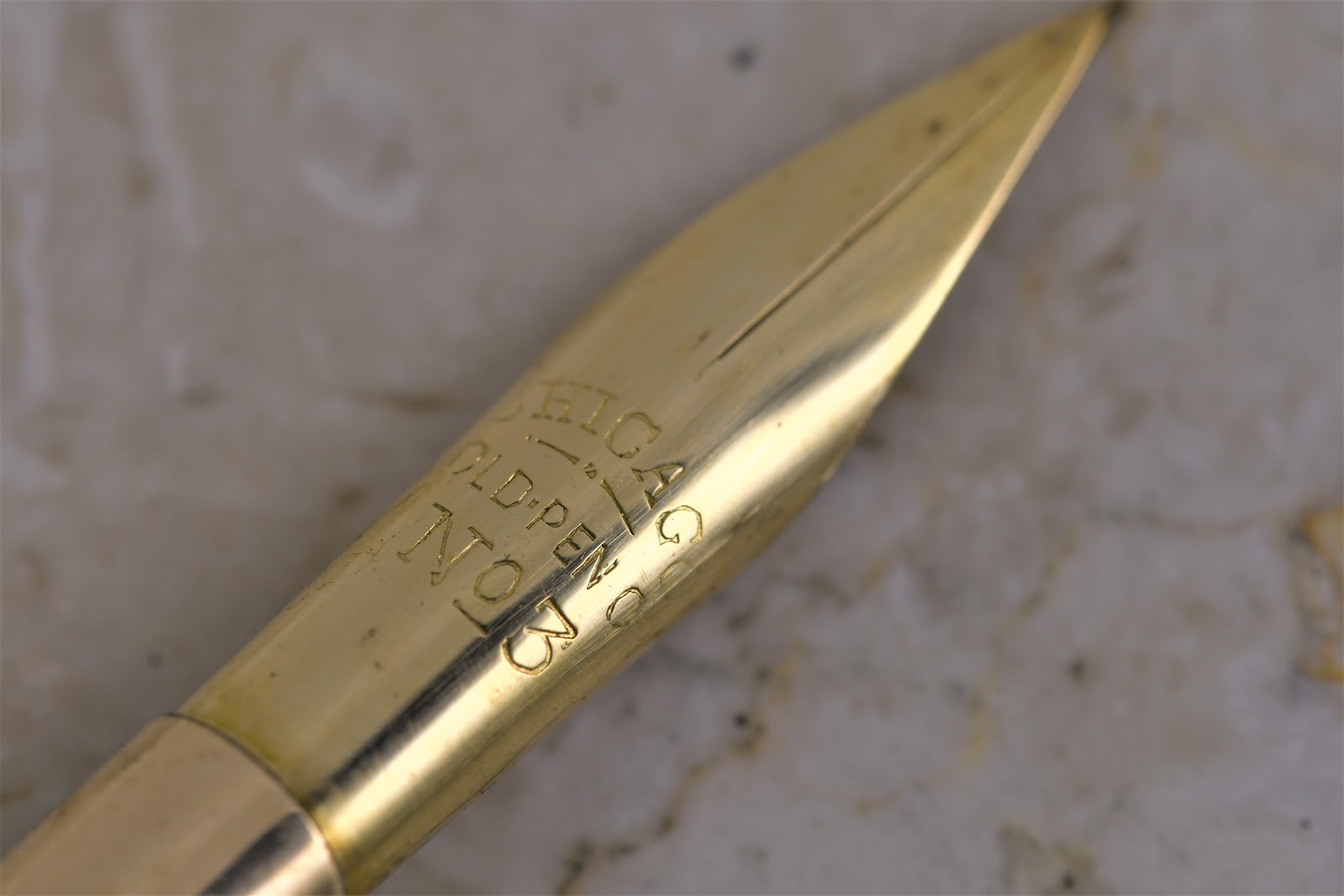
It doesn’t.  “Chicago Gold Pen Co. Chicago.”  Still pretty interesting, since most dip pen nibs like these hail from New York.  L. Michael Fultz gave his pen company the same name in later years, but this was the original - about which Fultz doubtless knew more than I do, but here’s my best shot.

The 1866 Directory and Shipper’s Guide of Kansas and Nebraska showed gold pen companies at both 123 Lake and 128 Lake, with The Chicago Gold Pen Company, Goodfellow & Trauger, located at 123 Lake:


The address might be a typo - according to the Business Directory of Chicago for the following year, Chicago Gold Pen was actually at 128 Lake, upstairs – along with the rest of the entire Chicago penmaking community:


In 1867, Chicago Gold Pen also appears in the Edwards' Annual Director to the Inhabitants, Institutions, Incorporated Companies, Manufacturing Establishments, Business, Business Firms, etc., etc., in the City of Chicago for 1867 . . . whew . . . how’s that for a title?  Seriously, that’s what it was called:


The company appears under Gold Pen Repairing and Gold Pens and Cases, Wholesale in an upstairs room at 123 Lake:


Fortunately, the Edwards . . . yada yada yada directory also has a listing for the Goodfellow & Trauger partnership, providing the full names of the principals: Isaiah Goodfellow and Frank P. Trauger:


This might have been the “Chicago Gold Pen Company” that turned out the nib on my new combo, and outside of these directory listings there isn’t much other evidence that Goodfellow and Trauger remained in business for any significant length of time.  Since relatively more modern examples of conventional fountain pens have surfaced, complete with nibs with breather holes marked with the same name, I figured there must have been some version of the company which operated later.  What I’ve found is that there were two and possibly three different companies using the same or very similar names.

The earliest mention I could find of a business holding itself out as “Chicago Gold Pen” was an advertisement in the Chicago Tribune on November 22, 1858, in which J. Higgins opened his “Chicago Gold Pen Shop” at 31 Lasalle Street:


Walter Treleaven opened his “Chicago Gold Pen Manufactory” on Lake Street around 1862; although this advertisement on April 26, 1862 doesn’t announce the opening, it was the earliest I found:


Treleaven’s Chicago Gold Pen Manufactory relocated to Clark Street in 1865:


Meanwhile, Giles, Brother & Co. had opened a jewelry store on Lake Street, and by 1865 that firm as claiming to be 'Manufacturer for the trade of the “Chicago Commercial Gold Pen'” (last line of this ad):


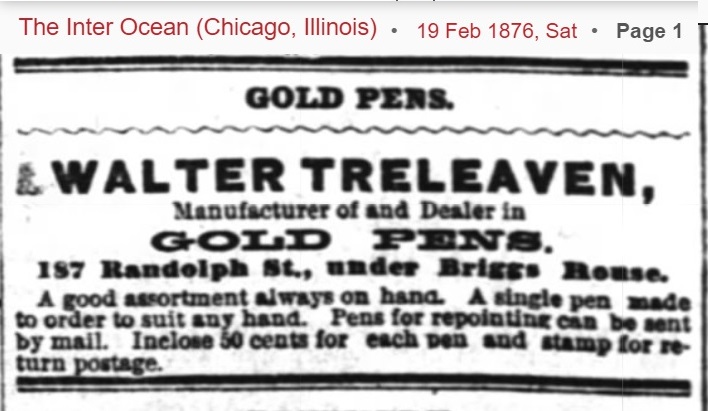
Treleaven remained in the gold pen business for many years, but he had dropped the name “Chicago Gold Pen Manufactory” by 1876:


Meanwhile, Aikin, Lambert & Co. was becoming more established in the Chicago area, moving to a prominent location on West Washington Street in 1871.  Note how this announcement in the Chicago Tribune on December 10, 1871 contains back-to-back advertisements for the firm, and it is either “Aikin” or “Aiken” depending on which ad you read:


On July 12, 1883, the Chicago Tribune announced the formation of a “new” corporation, The Chicago Gold Pen Manufacturing Company.   The incorporators, in addition to a Samuel F. Estell, were James C. “Aitken” and Henry A. Lambert.


I’m pretty certain this was yet another misspelling for James C. Aikin, and those later pens sporting the “Chicago Gold Pen” name were Aikin Lambert pens made and distributed through the company’s western operations.  So is my little combo sporting an Aikin Lambert nib marked with the name of the company's western subsidiary?  Maybe...

But then there’s this curious footnote, in the Norfolk Virginian on November 18, 1892.  Local jeweler R.L. Hyman of the local jewelry store “The Diamond Palace” announced that he had been made the southern agent for the “Chicago Gold Pen and Pencil Company, one of the largest and finest manufacturers in the United States.”


Largest, finest and most invisible apparently.  I’m assuming that Hyman cared enough about his appointment to get the name right of the company appointing him, but I can’t find any other reference to a “Chicago Gold Pen and Pencil Company.”

Tuesday, December 22, 2015

In a Tasteful Manner in Harmonious Colors

This article has been edited and included in The Leadhead's Pencil Blog Volume 4; copies are available print on demand through Amazon here, and I offer an ebook version in pdf format at the Legendary Lead Company here.

If you don't want the book but you enjoy this article, please consider supporting the Blog project here.

Bill Bender met up with me at the Ohio Show, with a few a few goodies in his backpack to share.  This one I had to have:


The top is separated a little bit – I’m not sure whether the barrel has shrank or whether the top retainer has pulled out a little bit.  On the extender is a patent date of January 21, 1879:


What had me intrigued, though, was the inlaid design on the barrel:


Turns out that design explained the patent date.  James C. Aikin applied for a design patent on November 2, 1878 for an ornamental design, “consisting of flowers, insects, leaves and vines, grouped in a tasteful manner in harmonious colors, and arranged in straight lines along the barrel, to produce a good aesthetic effect.”  The patent was issued as design patent 10,984:


The picture is useless.  The description is no better, since he says the design may be made “by painting, or with pearl, gold, silver, plate, stone, glass, turquoise, diamonds, separately or blended, to produce harmonious effects of coloring, &c.” and purports to cover any design “substantially as described.”  Apparently Aikin was trying to sew up the market on anything frilly in the Victorian age.

Wait a minute . . . was it Aikin, or Aikin Lambert?

At the end of the day, it was Aikin, Lambert & Co., but our collectors’ lore is now perpetuating the myth that Aikin, Lambert & Co. was founded in 1864.

It wasn’t.

There’s a nice biographical sketch of James Cornelius Aikin in The National Cyclopaedia of American Biography, published in 1910:


According to this, Aikin got into the pen business in 1862, when he entered into a partnership with Edward D. Valentine.  In 1864, he founded J.C. Aikin & Co., and  Aikin, Lambert & Co. was not incorporated until May, 1889.

Well, that can’t be right, either.  There’s a plethora of advertisements earlier than 1889 for Aikin, Lambert & Co.  Here’s one from 1881, just as an example:


So I did some poking around to see if the real story was out there in contemporary accounts, and it was.  Two accounts published in 1919 contain a few more details, the first of which was included in Henry A. Lambert’s obituary, published in The Jewelers’ Circular on May 21, 1919:


According to this, Lambert first became associated with Aikin as a traveler, when Aikin was a partner in a firm named McConnell, Valentine and Aikin sometime prior to 1861. When McConnell and Valentine withdrew in 1861, this account states that Aikin and Lambert formed a partnership making gold pens as well as jewelry and watches trading under the name “Aikin Lambert & Co.” that “the gold pen business” was incorporated about 25 years before the article was published – putting that date at 1894 – and that the gold pen business was later absorbed by L.E. Waterman.

The other account was published just a few months earlier, on February 5, 1919, also in the Jewelers’ Circular.  This account is a little different:


According to this version, Aikin went into business in 1862 with Valentine as “Valentine and Aikin.”   In March, 1864, J.C. Aikin & Company was formed, “H.A. Lambert being the company.”  In 1867, the pen manufacturer J.B. Shea joined the firm, which was then renamed Aikin, Lambert & Co.

This is the version of the story I was mostly able to verify – all, that is, except the very first part.  The only reference I have been able to find to “McConnell, Valentine & Aikin.  Maybe it was more shortlived than the later accounts state, and maybe it wasn’t in New York City, but the only reference I found to such a partnership is in Henry Lambert’s obituary.  It’s entirely possible that there was a “Valentine and Aikin,” and it seems likely given that all of the later accounts agree on this point; however, if that partnership operated in New York, it might have been formed after  Trow’s Copartnership Directory for 1862-1863, which list New York partnerships, went to press in July of that year.

Remember also that Aikin’s biographical sketch indicates that Aikin enlisted in the 7th Regiment at the outbreak of the American Civil War in 1861, and he didn’t return to New York until 1862.

However, the next edition of Trow’s Directory (by then called “Wilson’s”), released in 1864, matches exactly the Aikin biography and the February, 1919 account published in The Jewelers’ Circular:


There’s J.C. Aikin & Co., a partnership comprised of Aikin and Lambert, at 14 Maiden Lane.  The 1866-1867 directory, which went to press before Shea reportedly joined the firm, says the same thing:


The 1868-1869 directory squares perfectly with these accounts, with J.B. Shea joining the ranks and the partnership renamed “Aikin, Lambert & Co.”


On September 15, 1871, Aikin, Lambert & Co. applied for one of the first American Trademarks on its name, which was issued as number 472 on October 17, 1871:


The date of first use claimed would have been helpful, but in 1871 such things were not reported, and the Patent Office simply provided Congress with an index of all patents and trademarks issued that year.  Volume 1, number 1 of the Official Gazette of the United States Patent Office, which would have included that helpful tidbit of information, wasn’t published until January 3, 1872.

By 1883, D.F. Foley had joined Aikin Lambert & Co., and the firm started another business in Chcago, which they named the “Chicago Gold Pen Manufacturing Company.”  In 1887, they sold their interest to W.H. Burton:


This report, with the added detail that D.F. Foley was with Aikin Lambert, probably confirms that Aikin Lambert & Co. was formally incorporated in 1889, as Aikin’s biography states.  David Nishimura has done some extensive research concerning D.F. Foley & Co., which he documents in an article over at his blog (see http://vintagepensblog.blogspot.com/2012/06/dissolution-of-d-f-foley-co.html); he found a reference that D.F. Foley & Co. was founded in February, 1888.


Under general partnership law, if D.F. Foley left Aikin Lambert & Co. to start his own business in February, 1888, his withdrawal would have technically dissolved the partnership.  That would have triggered the necessity for Aikin Lambert to reorganize, so once again the Aikin account appears to be correct – Aikin, Lambert & Co. would have been incorporated in 1889 or thereabouts, to protect what was by that time a valuable trade name.  Unlike a partnership, corporate shareholders can come and go without affecting the continued existence of the business.

Also in the 1880s, Lewis Edson Waterman went into the pen business, and one of the suppliers of his nibs was Aikin Lambert.  As Waterman’s business took off, Aikin Lambert’s customer increasingly became the tail that wagged the dog, and Waterman gradually assumed control of its supplier.  Again, David Nishimura has documented well this process, and his article (http://vintagepensblog.blogspot.com/2012/12/waterman-and-aikin-lambert.html) picks up nicely where this one ends.