Showing posts with label Gorham. Show all posts

Saturday, May 2, 2020

Beats the Band

This article has been edited and included in The Leadhead's Pencil Blog Volume 6, now on sale at The Legendary Lead Company.  I have just a few hard copies left of the first printing, available here, and an ebook version in pdf format is available for download here.

If you don't want the book but you enjoy this article, please consider supporting the Blog project here.

My Sheaffer collection is mostly the result of fishing with hand grenades.  Sometimes I have deliberately targeted a Sheaffer specifically to add to my collection, but most of what I have came from box lots, purchased collections and such.  Sheaffers are diverted from the stream of incoming stuff, and compared to what I’ve got – any differences, no matter how small, and here they stay.  Duplicates are strictly catch and release.

Today’s subject is just such an example.  A lot of two dozen or so relatively interesting things showed up in an auction, and I’d noticed a Sheaffer in there that I knew I’d be comparing to the Sheaffer Balances I had on hand:


When it arrived just a couple days ago, diverted it was to the Sheaffer corner, where I noticed something:


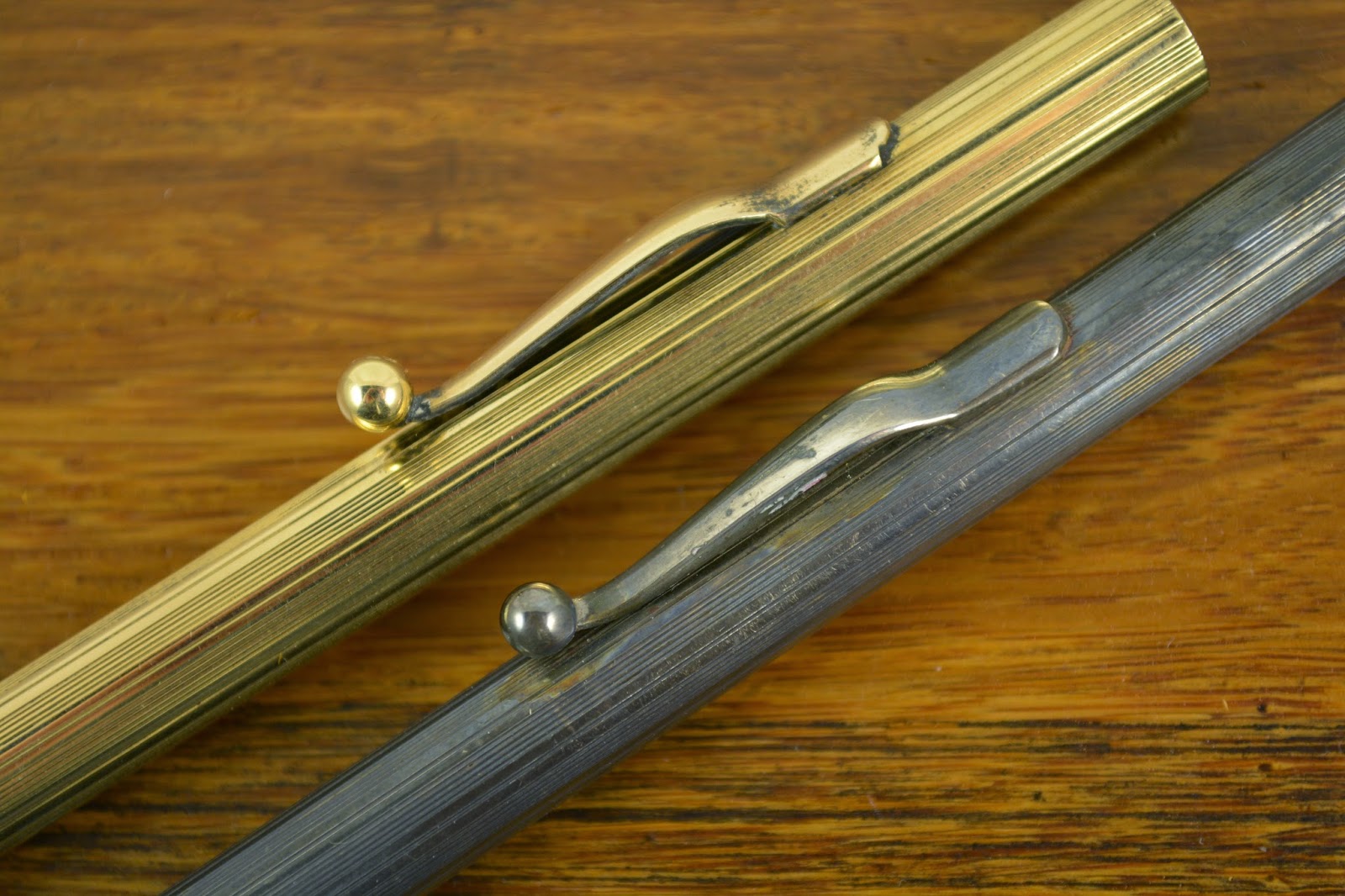
The other bandless Sheaffer Balance pencils I have sport flat ball clips like this (earlier models still have the round ball clips).  This new example has a “rigid radius” clip, introduced in 1935, and every single example of that line in my collection has a band:


(Well, they aren’t always thin bands like these, or single bands like these . . . but I digress.  There’s usually bands.)

I haven’t been turning my nose up at bandless rigid radius clip Balance pencils; I just haven’t run across any . . . and with as many hand grenades have sent hoards of pencils floating my way over the years, that probably says something.  I checked the catalogs in the PCA’s library, and all the rigid radius clip models had bands.  Bandless models from 1935 and later were a lower-priced line, paired with the earlier flat ball clips on the Junior line, through and including Sheaffer’s 1941 catalog.

So was this a factory error?  No, this was no mistake.  There was a very specific reason why the band was omitted from this one: it would have been in the way.


“The GORHAM Company,” is prominently imprinted where that band would otherwise have been, and there are traces of gold flake still visible in the letters.   This was a very special edition made for Gorham, the prominent silvermaker (and producer of some nice Victorian figural pencils, too – see The Leadhead’s Pencil Blog Vol. 2, page 245).

Initials on that clip are a turn-off for most collectors, but on a pencil like this, made for a special customer’s special occasion, I’m all in.  “S.H.” is likely the initials of a prominent person within the Gorham organization in the 1930s, sometime between 1935 and 1941.  I haven’t (yet) figured out who that was.

The time during which this pencil might have been made is also intriguing.  Gorham had been absorbed by Black, Starr & Frost around 1929, according to my research for an earlier article here (see The Leadhead’s Pencil Blog Volume 3, page 227-228), but as I scoured newspapers looking for someone connected with Gorham with the initials S.H., I noticed that advertisements simply identified it as “The Gorham Company” through 1938.  If the transfer happened in 1929, at least the buyers had the good sense to continue using the name they had paid for.

And the Gorham/Sheaffer connection has an interesting twist: both were later acquired by Textron.  That, I truly believe, is a coincidence (and that is rare for me). 

Sunday, February 4, 2018

"He Was Supposed to be Wealthy"

This article has been edited and included in The Leadhead's Pencil Blog Volume 5; copies are available print on demand through Amazon here, and I offer an ebook version in pdf format at the Legendary Lead Company here.

If you don't want the book but you enjoy this article, please consider supporting the Blog project here.

On Friday morning at the DC show, Joe Nemecek and I met with Ed Fingerman from Fountain Pen Hospital to look at a whole mess of Victorian pencils he was selling.  By the time we were finished, I bought 17 of them.  This was one:


It looks like a Hicks or maybe an Edward Todd, but what is imprinted near the nose was something I hadn’t seen before:


“John Mason.”  I suspected there might be a story behind that name, but I never suspected the story would be as compelling as it turned out to be.  Much of the following research regarding the meteoric rise and spectacular belly flop of John Mason turned up in a forum thread in one of the silver forums titled “John Mason - New York - A Shattered Dream.”  (See http://925-1000.com/forum/viewtopic.php?t=30017.)

John Mason was born April 6, 1868 in New York, the son of James Mason and Marie Louise Youngs.  John’s father must have died when he was a young man, since the 1886 New York directory lists Marie Louise Mason as a widow living at 218 East 11th Street, while the 1889 City Direcotry lists Louise M., widow of James with an address of 35 west 17th Street, where she lived with John, a jeweler whose business address was 15 Union Square.

Young John had taken a job working for Tiffany & Company in 1884, at the age of 16.  While there’s no indication that the Masons did not lead a comfortable life, young John’s fortunes were about to take a dramatic turn for the better.

John Q. Jones, the President of Chemical Bank, constructed an enormous mansion at 246 Fifth Avenue, New York in 1857, where he lived with brothers and sisters until his sudden death in 1878.  John Jones’ only heir to his vast fortune was his younger brother, Joshua Jones, a playboy who had moved out of 246 Fifth Avenue sometime around 1868 and into the New York Hotel, making a career of living comfortably as a gentleman. 

After Joshua inherited his brother’s estate, he removed everyone from 246 Fifth Avenue and refused to allow it to be occupied or rented.  When Joshua Jones died on March 23, 1888, his estate was worth seven million dollors – that’s seven million 1888 dollars.  His executors were ordered to liquidate the entire estate, including the house at 246 Fifth Avenue, which was sold to the next door neightbor at auction and was promptly demolished, replaced with the building that still stands on the site today, constructed in 1889:


One ninth of Joshua Jones’ estate was left to “the children of his cousin James Mason,” of which the 21-year-old John Mason was one:


John Mason had at least one sibling with whom he shared his slice of this enormous pie, a sister named Edith Mason Faxon.  While the amount he inherited would have supported him for the rest of his life, for John this was little more than an appetizer.  The pie Mason wanted was much, much bigger. 

After six years of working at Tiffany & Co., he hatched a plan to “out-Tiffany Tiffany,” in the words of one contemporaneous account.  He left his former employer and borrowed money from everyone who would lend to him on the strength of his new status as a wealthy, independent man.  In summer, 1890 he set up a jewelry factory with all the latest machinery at 330 Seventh Street, and he opened a brand new, elaborately decorated showroom: at 246 Fifth Avenue, New York - the very address previously occupied by Joshua Jones:


Whatever valuable experience John Mason acquired during his apprenticeship at Tiffany & Co., he left it at the door: the 22-year-old now saw himself as the prosperous owner rather than a startup enterpreneur working to carve out a niche in a highly competitive market.  In an article I recently published here about the Mauser Manufacturing Company (http://leadheadpencils.blogspot.com/2017/07/the-mauser-manufacturing-company.html), I included discussion of how difficult the early 1890s were in the silver market, with the “free silver” movement pushing prices down and driving many established firms to ruin.  The impetuous Mason, however, either had no idea or had no concern for how difficult his position was.  Even though the great panic of 1893 had yet to come, cracks in John Mason’s facade quickly became apparent.

The first sign of trouble came in early 1892.  Mason sued a supplier who had sold him $10,000.00 worth of watches on credit; after Mason had repaid $8,300.00 of the purchase price, he sued the supplier, claiming that the watches weren’t as good as those offered by Tiffany & Co.


Mason lost.  He also took another action which suggests that his situation was more dire than he let on: he abandoned the showroom at 246 Fifth Avenue, the address he had worked so hard to reclaim, moving up the street a bit to number 262:


By the summer of 1892, with other lawsuits mounting against him, John Mason had nowhere left to run.  On June 21, 1892 he made a general assignment of all his assets to his lawyer, John Oscar Ball, for the benefit of his creditors:


“He was supposed to be wealthy,” the article in The Sun read on June 22, 1892, reflecting the general disbelief the public had that someone who had inherited so much could have exhausted all of his resources in so little time.  However, as the creditors met to devise a plan for liquidating what few assets remained, it became clear that while John Mason had inherited $100,000, he had borrowed $144,000 from relatives to set up the enterprise – and then borrowed from many, many others.   His books revealed that he had 115 creditors, including minor claims from Edward Todd and W.S. Hicks (the pencil pictured at the beginning of this article appears to have been made by Edward Todd).


So strong was peoples’ faith in John Mason that many were financially ruined by Mason’s failure.  Charles Magnus, a diamond dealer who had a claim for more than $13,000, had a breakdown over the stress of Mason’s failure, leading his brother to announce publicly that while his brother was deeply concerned by these events, he was not in fact insane:


On July 29, 1892, the Jewelers’ Circular ran a story regarding Mason’s “peculiar jugglery of his inheritance” –


The British press picked up the story in the Watchmaker, Jeweler and Silversmith on August 1, 1892. 


At the meetings of creditors, Mason’s lawyer, John Oscar Ball, attempted to build a consensus among Mason’s many creditors.  It was decided to seek a buyer for the entire operation, and Ball placed an advertisement in The Jewelers’ Circular seeking interested parties:


The Gorham Manufacturing Company, which had a claim against Mason for some $7,000.00,  submitted a proposal to purchase John Mason’s enterprise, and at a meeting of Mason’s creditors on August 4, 1892, the purchase was unanimously approved.  Mason’s firm was appraised and John Oscar Ball conveyed all of the stock in John Mason’s failed enterprise to Gorham for $45,000.00, out of which Gorham deducted the $7,000.00 it was owed.

But the story didn’t end there.  One of those 115 creditors was just waiting for the ink to dry on the agreement before springing her trap. 

On August 10, 1892, John Mason’s sister, Edith Mason Faxon, obtained judgment against her brother in the amount of $80,576.60, representing the unpaid balance of money she had loaned to Mason, and on August 23, she filed suit claiming that Mason’s assignment to his lawyer, and other transfers to his wife, were made in order to evade and defraud Mason’s creditors.  The entire transcript of Faxon v. Mason is preserved from the appeal taken in that case (see https://books.google.com/books?id=OA3k7iizOp8C&pg=RA30-PA24&lpg=RA30-PA24&dq=gorham+%22John+mason%22&source=bl&ots=dyN4e9tVo1&sig=Hz17vy4Mu7Cmoi2UQYQbAPg4ckg&hl=en&sa=X&ved=0ahUKEwjUo7e3t6TWAhWF7SYKHaNYAQ8Q6AEIMTAC#v=onepage&q=faxon&f=false):


Edith was the largest creditor of Mason’s, with a claim that was nearly half the entire amount by which he was indebted.  In the end, she won her case – the judge at one point wryly noted that while Mason had assigned his cufflinks to his wife, he did not assign the shirt to which they were attached. 

From what I can tell, the sale to Gorham was never disturbed; Edith was probably just wating for the business to be liquidated so that she could pursue a pot of money rather than the assets of a failing business.  Nor does it appear to have been an inside job, by which she recovered money from her brother only to give it back to him, given the aggressive litigation between the siblings.

John Mason would never recover.  On October 20, 1899, he filed a petition in bankruptcy:


By 1900, his wife had left him and was living in Winchester, Massachusetts, while John Mason remained in New York City with his stated occupation being that of an artist, according to the census that year.  John remarried, to Effie Afton Clark, daughter of George K. Clark and Isabel Lathrop, on May 2, 1906. According to census data research posted at 925-1000.com, the 1910 census found the couple in Old Saybrook, Connecticut; in 1920, they turn up in Philadelphia.  The 1930 census shows that John’s wife is married, but John is no longer in the household, and the 1940 census indicates that Effie is widowed. 

Tuesday, September 27, 2016

Gorham's Other Precious Metal

This article has been edited and included in The Leadhead's Pencil Blog Volume 4; copies are available print on demand through Amazon here, and I offer an ebook version in pdf format at the Legendary Lead Company here.

If you don't want the book but you enjoy this article, please consider supporting the Blog project here.

Sometimes I’ll admit that I buy things online because I read the description, I think to myself “well, that can’t be right” and I think it will be a funny story seeing how things got a little mixed up in translation.  Such was the case with this one, which was described as a “Gorham Mabie Magazine”:


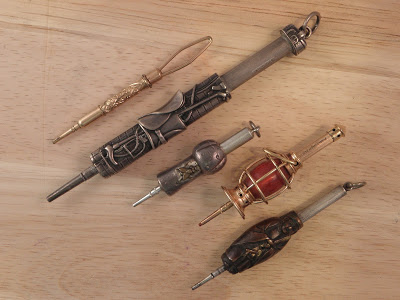
Gorham, with manufacturing facilities in Providence, Rhode Island and offices in New York, was known for its silver work.  When it comes to pencils, I featured a couple of Joe Nemecek’s early magic pencils here three years ago (see http://leadheadpencils.blogspot.com/2013/09/other-peoples-fair-children.html).  In this picture, the pencil with the saddle on it and the mushroom-shaped one are Gorhams:


Then there’s this one, marked “B S & G,” made by Hicks for a later incorporation of the Gorham firm known as Black, Starr & Gorham which was featured here last year (see http://leadheadpencils.blogspot.com/2015/02/welcome-to-family.html):


But all of these were in sterling silver, for which the company was famous. I wasn’t aware of any affiliation between Mabie, Todd & Co. and Gorham, nor of non-sterling pencils made by or for the company, so this find was doubly intriguing.  When it arrived, it proved to be exactly what the seller represented it to be -- at the nose is the imprint I would expect to see on a pencil matching this shape in connection with the Mabie name:


“Mabie Magazine Pencil / Pat. June 7, 10.”   The date is a reference to patent number 960,588, issued to Egon L. Schmitz and assigned, not to Mabie, Todd & Co., but to Eberhard Faber Pencil Company:


The Schmitz patent is an interesting one in pencil history, since it was under Mabie Todd’s stewardship that the pencil reached its greatest popularity and widest distsribution (for an example not marked with the Mabie Magazine name, see http://leadheadpencils.blogspot.com/2012/10/the-fabers-that-slipped-under-radar.html).   Just a couple years earlier, Schmitz was awarded a patent for what would become Eberhard Faber’s line of “Pony Clip” pencils (see http://leadheadpencils.blogspot.com/2012/01/this-ones-got-something-for-everyone.html), and the Mabie Magazine worked on the same principle – screwing down the nose squeezed a piece of lead to hold it in place – but the Magazine incarnation held extra leads within the barrel.  Unfortunately, after a century inside the barrel, the leads rarely fall neatly into position as originally designed, and most examples have a few in the hole but none in the chamber.

But we’re getting off track here.  The reason I bought this pencil was to write about what’s stamped on the other end:


“Gorham Co. Archtl. Bronze.”  Since this pencil doesn’t appear to have any bronze about it – wear to the high points looks like ordinary gold fill over brass – I tried a plain ol’ google search with the exact words that were on it.  All was instantly revealed:


In addition to being silversmiths, the craftsmen at the firm had an Architectural Bronze Departmenet of “bronzesmiths” which fabricated lamp posts, bronze plaques, statuary and other artistic components, none of which would fit so neatly in the pocket as this pencil.  The above is the company’s 1920 listing in Sweet’s Architectural Catalog, and I also found a 1905 catalog online:


Was there a relationship between Gorham and Mabie Todd?  In this case, I think the evidence falls far short of proving anything more than a one-time customer/supplier relationship.  My “Gorham Mabie Todd” appears to be an advertising pencil, specially imprinted for a division of Gorham which had nothing to do with making pencils.

Monday, February 16, 2015

Welcome to the Family

This article has been edited and included in The Leadhead's Pencil Blog Volume 3; copies are available print on demand through Amazon here, and I offer an ebook version in pdf format at the Legendary Lead Company here.

If you don't want the book but you enjoy this article, please consider supporting the Blog project here.

A new (to me) member of the W.S. Hicks / Edward Todd family of pencils recently came my way that was neither marked Hicks nor Edward Todd:


I picked this one up from Tom Heath at the Philadelphia Show last month. It’s a pretty good match for a Hicks I picked up at the Ohio Show’s Saturday night auction in November:


Both share the same dimensions, pattern and that distinctive turned-up clip:


Don’t let the color fool you – these have even more in common than you might think.


That gold fill is over sterling, a material called "vermeil." As an aside, all the sources I’ve read indicate that it’s all right to pronounce that word either as "ver-meal" or "vermay," probably depending on whether you have the urge to extend your pinky as you drink a beverage. The hallmark is at the right - W. S. Hicks.

However, the all-sterling example I picked up from Tom has a different imprint:


"B.S. & G." A little snooping around suggested that the acronym stands for Black, Starr & Gorham, which according to The Online Encyclopedia of Silver Marks, Hallmarks and Makers’ Marks (http://925-1000.com/americansilver_B4.html) was in business from 1940 to 1962. One source (http://www.steinmarks.co.uk/pages/pv.asp?p=stein462) indicates that in 1929, The Gorham Manufacturing Company merged with Black, Starr & Frost to become Black, Starr & Frost-Gorham, Inc., which was shortened to Black, Starr & Gorham in 1940. According to Black, Starr & Frost’s website (http://www.blackstarandfrost.com/bsf-legacy/timeline/), Gorham parted ways with their firm in early 1962.

I was glad to see that Black, Starr & Frost has added a page with some information about the company’s history, and I like to think I might have had something to do with it. A couple years ago, I called the company to ask them what they knew about this pencil, and I was told that the new owners of the company had no company archives to consult:


This is a large, heavy pencil with great detailing at either end:


"Black, Starr & Frost" is stamped on the barrel just above the nose:


On the nose, there’s a hand-engraved serial number and a little acorn after the word "sterling" . . .


. . . just like the serial number engraved on the 14-karat Hicks I posted a couple days ago:


And the acorn hallmark was a W.S. Hicks hallmark.

Black, Starr & Frost’s website dates the Gorham merger to 1920, nine years earlier than the other sources out there; unfortunately, while I applaud BS&F’s efforts to learn about its own past, I believe the other sources I’ve read as opposed to the company’s (reconstructed) account of its history. In support of a late-1920s merger, here’s a 1925 advertisement from Country Life, which doesn’t mention Gorham:


I think my Black, Starr & Frost pencil was made prior to 1929, and my "BS&G" pencil was made right around 1940 . . . and I think all the pencils associated with Black, Starr and Frost – with or without Gorham along as a partner – were made by W.S. Hicks.

Friday, September 6, 2013

Other People's Fair Children

A few years ago I read a book titled “I Hate Other People’s Kids” by Adrienne Frost, which was an amusing hundred-page or so rant about the things other people’s children (and the parents who fail to control them) do to annoy the author.   This book is a must read for parents who think it’s cute to let their kids run around a restaurant – or a bar – while they meet up with friends.

But that’s the people sort of kids.  Yesterday I wrote about my “Fairchildren,” four examples of pencils made by Leroy W. Fairchild that I’ve picked up recently.  At the DC show, I saw quite a few examples of other people’s Fairchildren, and they don’t annoy me at all (I even secretly wished they were mine).

Here’s one that Dave Glass had on his table at the DC show:


On the one side, “L.W.F. & Co.”:


To learn more, this full article is included in The Leadhead's Pencil Blog Volume 2, available at Amazon, Barnes & Noble and everywhere else you buy books, or you can order a copy signed by yours truly through the Legendary Lead Company HERE.