Showing posts with label Sheaffer Crest. Show all posts

Wednesday, June 9, 2021

The Sheaffer-Spotter's Bible


This article has been included in The Leadhead's Pencil Blog Volume 7, now available here.


If you don't want the book but you enjoy the article, please consider supporting the Blog project here.

Trying to remember whether I have a particular post-War Sheaffer when I see one in the wild is like trying to count cards in Vegas. 

I’ve collected Sheaffers on a “catch and release” basis for so many years – whenever a group of pencils or a collection has come my way, I’d compare any Sheaffers that were along for the ride to what I already had, keep the different ones and take the duplicates to pen shows for sale.  When I was fishing with hand grenades, I didn’t really have anything in the examples I was keeping, because in my mind the money I was spending was on something else in the lot.  

Now that the collection has filled out, it’s rare for a Sheaffer that comes my way at random stays caught, and I’ve shifted to targeted hunting to fill in those last few blanks. Targeted hunting is more expensive, since I’m chasing individual pencils, and there have been a few missteps.  After about the third time I paid real money for a specific Sheaffer, only to find it was a duplicate, I thought it was time to really get my act together.

This post has been a work in progress for several months, backdated and titled “Maybe I Won’t Buy Duplicates Now.”  After input from many of those who specialize in Sheaffers, I’ve refined it into a useful guide to what these different variations were called . . . plus, it’s saved me a lot of money.

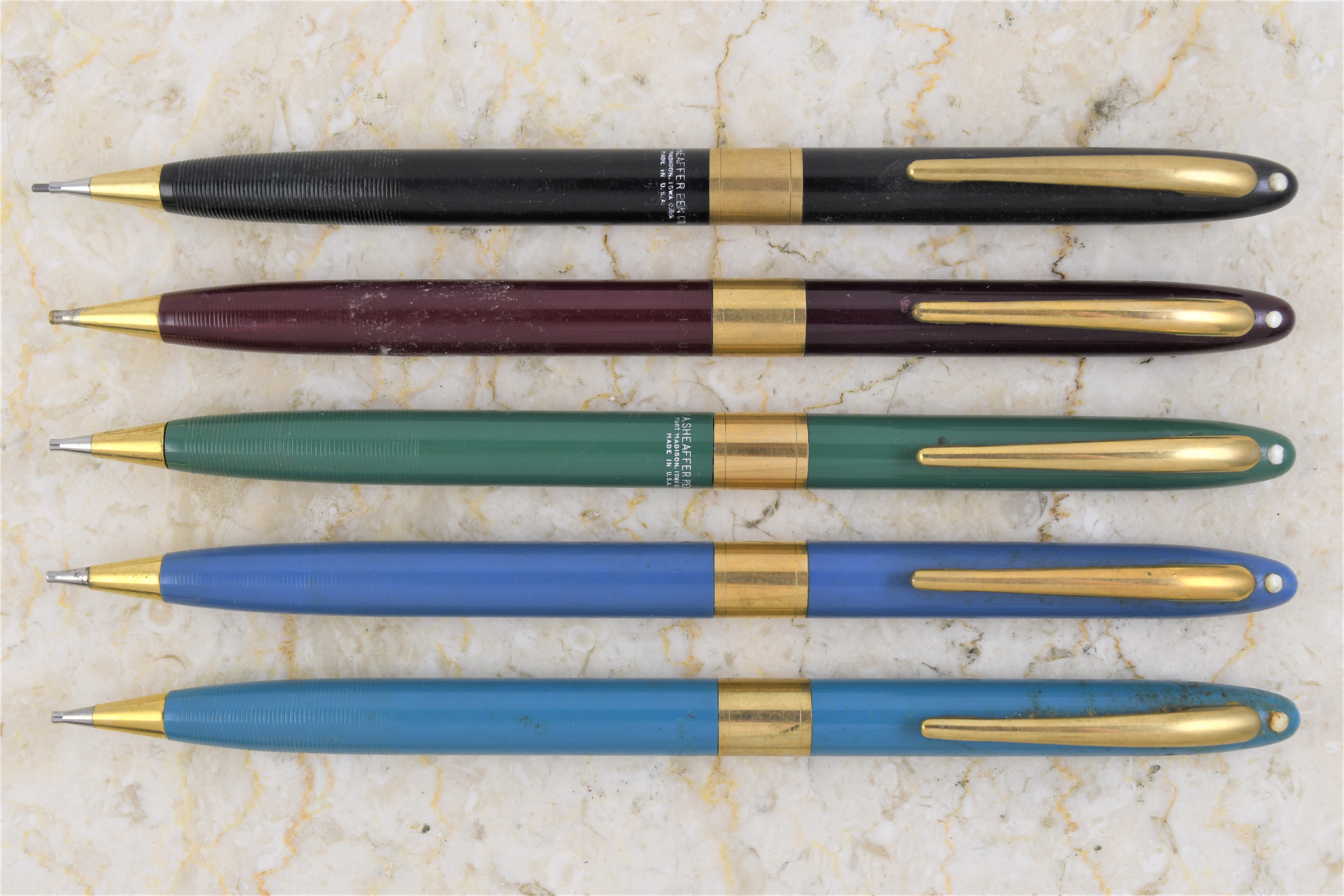
STRIATED CELLULOID MODELS (1946-1947)

FULL-SIZED MODELS

Valiant (1946)

Valiant (1947)


Statesman (1947)


Statesman (1946)

Craftsman/Admiral/Sovereign (gold filled trim)

Cadet (chrome trim)


Sentinel (note: the Crest model, with an all gold-filled cap, isn’t shown here)

FULL SIZED MODELS WITH EXPOSED ERASERS

Cadet Utility (bead band)

Sovereign Utility/Admiral Utility/Craftsman Utility (bead band, gold filled trim - not shown)

Statesman Utility (wide band)


SHORT MODEL, STANDARD NOZZLE

These are really hard to come by, and I’ve only turned up one, shown here alongside a regular Craftsman for comparison.  

Diana (with gold filled trim, as shown) or Minerva (with chrome trim)

TUCKAWAYS

Tuckaway (first year)

Triumph Tuckaway


Triumph Tuckaway, with clip – these are real oddballs, particularly the one with chrome plated “reverse” trim.

Autograph (14k trim, no ribs on band) and Valiant Tuckaway (1946)


Valiant Tuckaway (1947)

Lady Sheaffer (1947)
Tuckaway II (1946) or Tuckaway (1947)


Lady (Milady) Tuckaway
Crest Tuckaway and Sentinel Tuckaway


INJECTION MOLDING BEGINS IN 1948

FULL SIZE MODELS

Sentinel De Luxe

Crest De Luxe


Valiant

Statesman (later Saratoga)

Admiral

Craftsman

Cadet


TUCKAWAY MODELS

Crest De Luxe (gold filled cap) and Sentinel De Luxe (stainless/gold fill)


Valiant Tuckaway (1948)

Tuckaway - just plain ol' Tuckaway

THIN MODELS

The first Sheaffer thin model pencil is illustrated in the 1949 catalog.  The only model shown was all gold filled, and is shown accompanied by Sheaffer’s new Stratowriter ballpoint pens – unfortunately, I don’t have one to show you.  

The 1951 catalog lists Sheaffer “TM” thin model sets, but the "thin" reference must have been only to the pens, since the pencils appear shown appear identical to those shown above.  The PCA library doesn’t include a 1952 catalog, but in the 1953 catalog, thin model pencils are illustrated in colors.

Crest (gold-filled caps, not shown) and Sentinel or Clipper (stainless/gold-fill caps)

Sovereign (with gold filled clip) and Craftsman (all chrome cap)

Valiant and Statesman

Saratoga and Admiral

Not shown is the Cadet, with plastic cap and chrome trim.


Wednesday, May 2, 2018

The Upper Crest of Sheaffer Society

This article has been edited and included in The Leadhead's Pencil Blog Volume 5; copies are available print on demand through Amazon here, and I offer an ebook version in pdf format at the Legendary Lead Company here.

If you don't want the book but you enjoy this article, please consider supporting the Blog project here.

A few weeks ago I introduced a tipless Sheaffer Crest, with a barrel that screws directly onto the mechanism, and the new find led me into a discussion of different variations of the breed:


The discussion, though, omitted a couple important ones – two of the most important ones, in fact.  By chance, both came my way in recent weeks, the first at the Baltimore Pen Show:


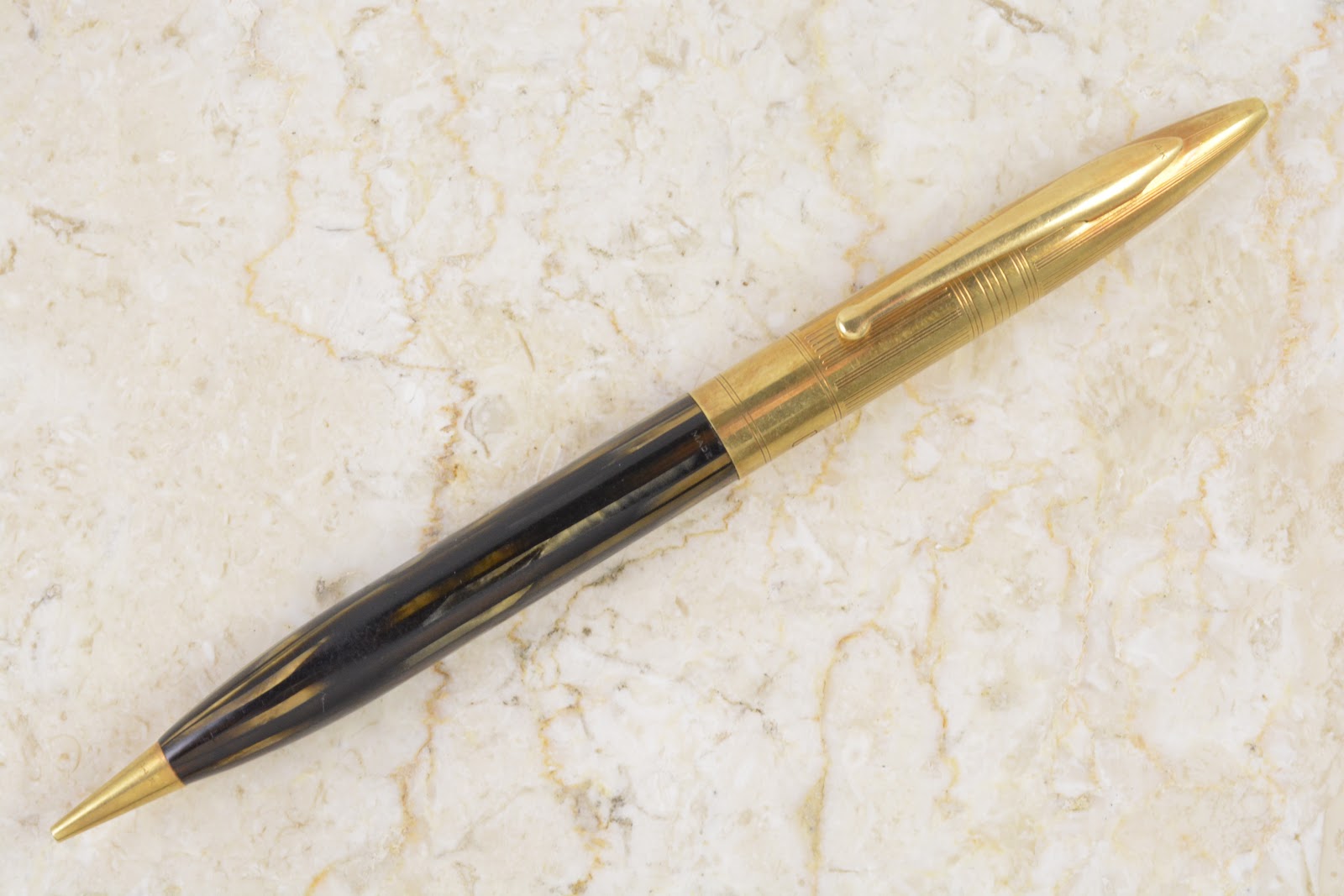
It looks very similar to what I showed you earlier, but with an important difference.  See those alternating grooves running around the center of the cap?  That can only mean one thing:


The cap and clip are 14k gold.  And so is the tip:


The imprints are slightly different, too.  “Sheaffer’s” is stamped on the lower portion of the cap, while the regular Crest series has no manufacturer’s marking on the cap:


And while the regular Crest pencils have an entire Sheaffer’s imprint on the lower barrel, the 14k model has only “Made in U.S.A.” stamped on the lower barrel – a difference due to the fact that it would be duplicative to have the Sheaffer name on both the upper and lower barrels:


I’ve harbored an aversion to buying solid gold pieces, since I prefer to buy things for their historical rather than intrinsic value.  Apparently I’ve gotten over that, since I didn’t hesitate a bit when this one came along in an online auction shortly after Baltimore:


This one has those same alternating horizontal and vertical grooves:


It’s as clean as they come, and it’s marked 14k all over the place:


“Gold-capped” and “sterling-capped” Sheaffers first appear in the company’s catalogs in 1937, with the sterling caps used only on the striated gray barreled pens and pencils – I’ve seen a set, but the price was more than I could pay at the time.  The “Crest” name first appears in the 1938 catalog in connection with the metal-capped lines. The “Masterpiece Ensemble” in all 14k gold first appears in the 1939 catalog:


Interestingly, there’s no mention that the pens or pencils could be had with 14k caps and striated bodies.  They do, however, appear in the 1940 catalog; the all 14k version was now known as the “14k Masterpiece” and the 14k cap only was known as the “14k Crest Masterpiece.”


Note there are two other variations shown in the 1940 catalog: an all-platinum version and the “Honor” pens and pencils, the latter of which was a special engraving available on both the 14k Masterpiece and Crest Masterpiece sets.


Nope.  I don’t have either of these to show you.

Friday, February 16, 2018

They Didn't Make Just One

This article has been edited and included in The Leadhead's Pencil Blog Volume 5; copies are available print on demand through Amazon here, and I offer an ebook version in pdf format at the Legendary Lead Company here.

If you don't want the book but you enjoy this article, please consider supporting the Blog project here.

Just a few days ago, I wrote about the strangest Sheaffer I’d ever seen – a Skyboy with a barrel that screwed directly onto a specially modified mechanism, eliminating the need for a separate metal tip (see 
https://leadheadpencils.blogspot.com/2018/01/a-week-or-so-ago-my-friend-jerome.html posted on January 27).

Since that pencil lacks Sheaffer’s shop markings or any other provenance to suggest it was a prototype pencil, I thought – and still think – it actually went into production, albeit for an extremely short period of time.  And if it was a production piece, that means they didn’t make just one:


Shortly after that last article ran, my friend Matt McColm emailed me with a link to another of Jerome Lobner’s auctions, with a Sheaffer Crest pencil that had that same weird end treatment.  The auction had ended with nobody bidding on it –- this was shortly before I gave up my campaign for Congress and had enough time to cruise through online auctions again.

“Maybe he still has it,” Matt suggested, so I emailed Jerome, who did have it and was only too happy to sell it to me, shipping it along with the next batch of things I purchased through his online auctions.  I asked if he knew anything more about them or had any more, but Jerome says he’s only seen these two examples and has no other information about them.  That leaves me to my own devices to see what there is to learn about them.

And when it comes to the Sheaffer Crest, there’s a lot to learn.

For starters, these two pencils are essentially identical on the lower half and mechanism.  The caps interchange, as they do between most Sheaffer models of the period.  That raises the question whether the cap might have been switched at some point over the last 75 years: on the plus side, I know Jerome wouldn’t have done that and his source, likely Edd Dawson (see https://leadheadpencils.blogspot.com/2017/08/craig-sheaffers-gift-to-edd-dawson.html) acquired a lot of weird stuff from Sheaffer as a prominent stationer.  On the down side, though, nobody can say for sure.

Back on the plus side, Sheaffer Crest pencils are inherently goofy animals.  Here’s the new one alongside my three other legitimate Sheaffer Crests:


Unlike Sheaffer pens of the period, which had manufacturer’s imprints on the barrels, Sheaffer pencils had imprints on the caps.  Since Crest caps are not marked “Sheaffer” anywhere, that meant on the Crest pencils, Sheaffer relocated the imprint to the lower barrel:


So when I tell you these are my three other “legitimate” Sheaffer Crests, I’ve left out the green one because on closer examination, there’s no Sheaffer imprint on the lower barrel.  I’ve resigned myself to the fact that it is an ordinary Sheaffer Balance pencil onto which someone has stuck a Crest cap.  Probably.  Maybe.  Ok, there’s nothing I can show you about that’s different other than it’s green and the cap is a little banged up.

On this new example, there’s no Sheaffer imprint on the lower barrel, either:


Because of the source, and the fact that the lower barrel on this thing is so utterly weird for a Sheaffer, I’m inclined to give this one a pass for now as a legitimate production piece, until such time as further documentation either confirms or refutes whether these tipless Sheaffer pencils were made for both Skyboy and Crest lines.  Since the caps on both are otherwise stock, if it ever turns out that one or both of these has a wrong cap, switching it out for something correct according to Hoyle will be easy enough.

There’s another reason I’m giving this one a temporary pass: while I’ll call my other three Crests legitimate, a look under the hood reveals that there’s no such thing as “normal” in this series, since no two of the ones I’ve found are alike:


The top example I’ve never been able to explain.  It’s the only one I’ve seen with a plastic mechanism with grooves for spare lead storage on the outside of the mechanism, rather than inside:


And while the other two share gold-plated mechanisms consistent with the Crest’s status as a higher-end model for Sheaffer, note that one of these has a bushing on the mechanism and a thin cap, while the other has the usual mechanism (except for color) and a thicker cap wall::


So yes, a tipless Sheaffer Crest pencil with no Sheaffer markings is unusual . . . but not outside the realm of possibility.