This article has been included in The Leadhead's Pencil Blog Volume 7, now available here.
If you don't want the book but you enjoy the article, please consider supporting the Blog project here.
Another evening, another online auction . . .

The finish suggests this might have been made by the Eagle Pencil Company or the American Lead Pencil Company, but the barrel isn’t marked. Other than the Jules Verne styling, I wouldn’t have anything else to say about this one, except for what’s hiding inside:

There’s a scroll peeking out from a slit in the barrel, with “Gould & Son” printed on the end. The last line is badly frayed, but I think it reads “Tailors & Outfitters.” I did find a company that matched that description, in Bath, England. The Company was founded in 1787, according to an advertisement the firm published in The Official Guide to the Great Western Railway in 1893:

The probable British origins of this didn’t bother me . . . well, my defenses against admitting non-American pencils into my collection have been beaten down to the point of only token resistance. Besides, there’s more. The scroll rolls out to reveal calendars for 1897 and 1898:

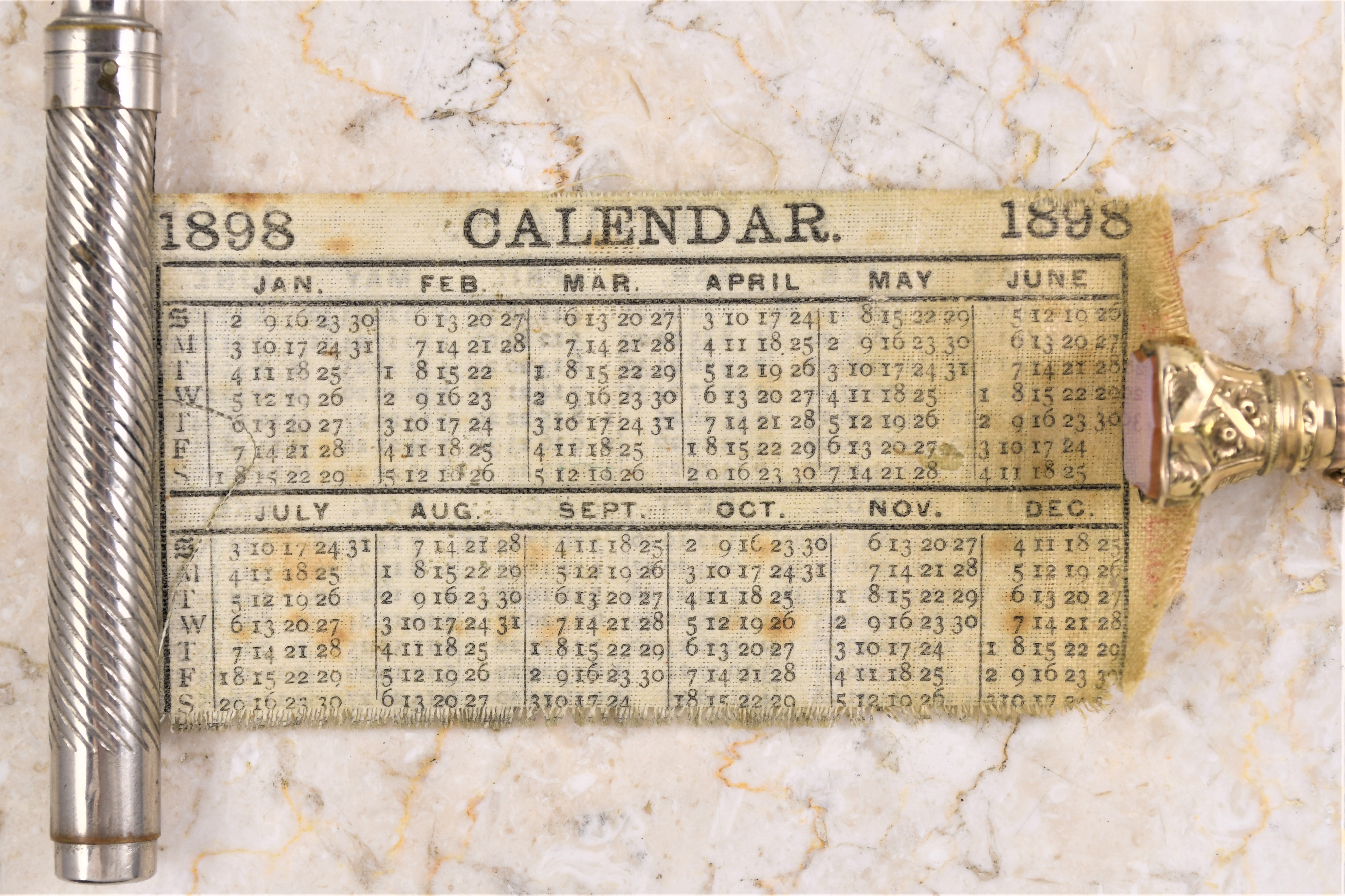


That’s the “Cal-An-Ad” pencil from Volume 4, page 5, which has the same calendar scroll as on pencils made by Mabie Todd (see Volume 4, page 225):

That same . . . patented calendar scroll:

The patent, number 2,111,362, was applied for by Joseph L. Fisher on August 26, 1936 and was issued on March 15, 1938. The patent office must have concluded that Fisher’s calendar attachment was novel in order to grant a patent, but geez . . . this pencil is a full forty years older.
The material is very fragile, but I was determined to extend the calendars as far as they would go, in the hopes of finding more clues about the pencil. I did . . . but it raises more questions than it provides answers:

“Alert” Patent. Not very helpful, without a date or a number . . . and there’s no indication whether “Alert” (in quotes) refers to an inventor’s name or is some generic descriptive term.
I had just finished the first draft of this article when Australian collector Pam Sutton posted an identical pencil in the Early Writing Instruments and Related Objects group on Facebook:

Almost identical, that is . . .

Pam’s pencil adds that the “Alert” patent was number 4,123, and further adds an American patent – number 485,261:

George W. Crowe and Walter K. Massam, both from Hull, England applied for the American patent on August 22, 1891, and it was granted on November 1, 1892. The text indicates that the same patent was granted in England on March 17, 1890 . . . as number 4,123:

No, you won’t find this patent in American Writing Instrument Patents 1799-1910, but even though the title of the patent is "Pencil Case," that’s no oversight. The backbone of the book is those patents filed in the writing instruments category, category 401. To the extent I knew of artifacts patented in other, non-pen and pencil categories, I chased down all the relevant patents in those, too – however, without looking at every single patent at the patent office, it was impossible to find everything that might conceivably have been used in connection with writing instruments.
As an example, see Volume 3, pages 24-26 for a patent that just barely made it into the book – just before I went to press, Matt McColm shared with me a pencil marked only with a patent date that was filed under classification 138/140, for “pipes and tubular conduits,” “distinct layers, bonded together.” After the patent book was published, a Mabie Todd surfaced bearing a patent date which led to a treasure trove of pencil patents filed under Class 63, “Jewelry,” subclass 22, “Bar: Devices comprising means to be passed through a buttonhole to secure the chain to the clothing” (see Volume 4, page 25).
Our “Alert” patent is another one of those that would only surface when an artifact turns up bearing that patent number, because it was not indexed in Category 401. Instead, it is filed in Category 40 (“Card, Picture, or Sign Exhibiting”), subcategory 300 (“”Check, Label, or Tag”), subcategory 335 (“Calendar indicia”). Whoever tucked this patent away in such an obscure place did make feeble attempts to cross-reference it in a more helpful place. It is also indexed under subcategory 116 (“Calendars; single reel and web”).
The third category, however, is intriguing: it was also filed under subcategory 905 – “Cross-Reference Art Collections; Pen and Pencil.” Some rainy day I’ll need to explore that category in more detail to see what other patents I would have included in the book!
American Writing Instrument Patents 1799-1910 does contain other patents along these lines which were properly indexed. In the “Patents by Description,” under “Attachment retractable scroll,” I’ve listed two. The first, issued right around the time the “Alert” patent pencil was made, was issued to Emmet P. Brewer of Denver, Colorado. He applied for his patent on December 18, 1895 and it was issued September 29, 1896 as number 568,473:

On January 29, 1902, Jackson A.M. Morris of Leeper, Missouri filed an application for a very similar attachment. It was granted on May 27, 1902 as number 701,072:

Neither the Brewer nor the Morris patent was filed in Category 401, by the way.
Pam’s pencil is also marked “D. Harper & Co., Islington, London, N.” The company made advertising specialties, staplers, and playing cards as well as coin operated machines; many of the trade tokens issued in the company’s name refer to it as “D. Harper & Co. Automatic Machine Co.” By 1913, the company also made the “Harper Electric Piano,” a player piano using music scrolls.
As for the “Alert” patent . . . I don’t know where the name comes from. Maybe the guys working the line at D. Harper & Co. drank a lot of coffee.


