Showing posts with label Hutcheon. Show all posts

Friday, November 21, 2025

More Fine Snails

The “snail” pattern is ubiquitous among Victorian makers; in “In the Company of Fine Snails” (February 15, 2018: Volume 5, page 152), I presented desk pencils with that sort of treatment made by Mabie Todd, Hicks, and Fairchild & Johnson. There were a few snails in that recent collection I recently purchased from Rob Bader, too.

The example at top is an ordinary magic pencil made by W.S. Hicks – nothing extraordinary, but very clean. It bears that acorn mark I have theorized indicated it was made by the Hicks firm for wholesale to retailers.


The second pencil down is also made by Hicks, but it has an interesting “twist.” 


The nose is fixed in position. The back can be pulled out as an extender, and twisting it advances and retracts the lead; the Eagle Pencil Company did something similar. Like the first one, this one also bears the Hicks acorn:


The next pencil down advances into position by twisting the back half of the barrel; this is the pencil part of John Mabie’s ubiquitous patent 11,762 issued on October 3, 1854, but without the nib slider found on Mabie Todd patented combination pens and pencils. It’s a chunky hunk o’ sterling, but the reason I wanted to keep it in the collection is because it bears a mark I don’t see very often:


In “Two Hallmarks, Two Connections” (June 29, 2021: Volume 7, page 227), I showed another pencil with a similar mark, which was picked up in the 1904 edition of Trade-Marks of the Jewelry and Kindred Trades as a state-protected mark by Ephraim S. Johnson & Co.


Whenever I find that sideways J in a diamond, it is flanked by the numbers 925 and 1000, denoting sterling silver. Typically, that appears on pencils made for export to the European market, but their near universal presence on Johnson pencils suggests that Johnson was simply adding a bit of continental flair to his hallmark. 

This next item isn’t a pencil at all. It is an empty container with a threaded cap – its dimensions suggest that it might be a thermometer holder. I kept it because of the hallmark on both the cap and the barrel:


The Hutcheon Brothers mark isn’t surprising on a snail-patterned piece, since Mabie Todd was a prolific user of this pattern and Hutcheon was named for Alfred G. Hutcheon, who left Mabie Todd but retained an unusually close relationship with his former firm; see “House of Hutcheon” published October 15, 2025. 

The last example isn’t quite the same level of quality; the pattern is less refined, and a couple spots of wear reveal it is plated brass rather than sterling. Still, a desk pencil like this is quite the step up from its maker’s usual fare:


The Eagle Pencil Company was a pioneer in producing less expensive writing instruments that had the look of something more exclusive – a wolf in snail’s clothing in this case.

Wednesday, October 15, 2025

House of Hutcheon

As we left things yesterday, I had narrowed down the likely manufacturer of the Mabie Magazine Pencil, including the versions marked for Salz Brothers, Hutcheon Brothers, Hallmark (United Jewelers), and the Carey Pen Company, to one of two manufacturers: Mabie, Todd & Co. or Hutcheon Brothers.

There’s good reason I can’t narrow it down more than that.

I laid out the history of Hutcheon Brothers in “The Hutcheon Brothers Sidebar” (July 12, 2017: Volume 5, page 41). The firm was originally named O’Neill & Company, and Alfred G. Hutcheon purchased the company in 1913. Hutcheon had for several years been associated with – you guessed it – Mabie, Todd & Co. The American Stationer reported Hutcheon’s departure from Mabie Todd on August 23, 1913, and Hutcheon left on good terms. “[N]aturally he leaves the old house with some regrets,” the announcement states:


In that previous article, I also included an early advertisement for Hutcheon, published in The American Stationer on October 27, 1917. It shows . . . you guessed it . . . a Hutcheon Magazine Pencil. “We also manufacture various styles of pens, pencils, pen mounts, etc.” the announcement reads; that’s terribly ambiguous. It neither states that Hutcheon made these pencils, nor understandably does it fail to emphasize, if they were supplied by Mabie Todd, that Hutcheon didn’t make these.


Alfred Hutcheon’s good relationship with his former associates at Mabie Todd means tells me that short of finding concrete documentation, we will never know whether it was Mabie Todd, or Hutcheon, or a partnership between the two firms that was responsible for making all of these Magazine pencils. The cooperation between the two firms was further illustrated here in “The Mabie Todd - Hutcheon Connection” (July 13, 2017: Volume 5, page 44), in which I noted how similar the patterns on some Hutcheon “Hutch Clutch Pencils” are to those already in use over at Mabie, Todd & Co.


The Hutch Clutch Pencil was Alfred Hutcheon’s first order of business after he acquired O’Neill & Co. This announcement for the model’s introduction was published in The American Stationer on November 15, 1913 – just three months after Alfred acquired the firm. Note that the firm was still known as O’Neill & Company, but the new pencils were named after the firm’s new owner.


Gabriel Goldsmith has been able to add some context to the Hutcheon story:


The top two examples of the Hutch Clutch Pencil were in his first care package, and the demonstrator at bottom was in the batch that just arrived last week. The clutch pencils are unusual in that the gold-filled barrels are completely unadorned.


But what is even more unusual is that these are not marked with the typical diamond-shaped hallmark Hutcheon was using by 1917, when that announcement in American Stationer was published. Instead, both of these have an H inside what looks like a house – for the “House of Hutcheon,” perhaps?


My working theory is that these Hutch Clutch pencils were the earliest ones made - shortly after August 1913, before Alfred Hutcheon brought with him his metalworking experience honed over at Mabie Todd and before he had settled on a new logo for the business he had just purchased.

And now for a closer look at that demonstrator pencil, which by all outward appearances is a Finepointer or Finer Pointe Hutcheon pencil:


Several cutouts show the internal workings of the pencil, but it’s going to take a lot of work to get all the rust removed and get it working again. Challenge . . . accepted – but not right now. That’s a good snowy day project for this winter. Although I’m certain the pencil was made by Hutcheon, the only marking on the barrel is “Nickle Silver/Made in USA”


Now to back up a bit . . . as mentioned earlier, Hutcheon pencils along these lines are found marked either “Finepointer” or “Finerpointe,” a distinction that I discussed in an early article here at the blog - see “I Say Finepointer, You Say Finerpointe, Let’s Call the Whole Thing Off (January 26, 2012: Volume 1, page 92). In that article, written before I knew a lot of things I know now, I theorized that “Finepointer” sounded so much like Mabie Todd’s “Fyne Poynt” line that Mabie Todd objected to the use of the name and forced Hutcheon to change it.

I was sooooo close . . . now that I know how close the relationship was between the two firms, I don’t think it was as adversarial as I had suggested. In the end, Hutcheon was granted trademark registration number 166,978 for a mark including the word “Finerpointe,” as included in American Writing Instrument Trademarks 1870-1953:


There’s a lot of information to digest in this registration certificate. First is that the Hutcheon Brothers numbered four: Alfred, Robert, William, and Forbes. Then there’s something of an open question as to what exactly is being registered - the name “Finerpointe,” the diamond-shaped hallmark, or the combination of those two things along with a dog (a pointer, of course). 

That exact mark – including name, diamond mark, and dog – is found etched on the Hutcheon display case that houses all of my Hutcheon pencils at the museum (see “A Box, A Display, and a Clue” (July 31, 2021: Volume 7, page 304)).


According to the trademark registration, Hutcheon Brothers first used “the mark” – whatever that means – on February 1, 1922, and since the application was filed on February 25, that’s a fairly reliable date. However, that does not adequately explain this one, at least to me:


Ringtops in this configuration are much harder to find than the full-length versions; this example is nice and clean, and while many collectors turn up a nostril or two at owners’ inscriptions, historians generally don’t have aversions to them as long as they are tastefully done – and when those inscriptions add a bit of context, they help rather than hurt. This example bears a 1922 presentation inscription.


If the trademark registration is accurate, I would expect this one to be marked “Finerpointe,” but it isn’t.


“Finepointer” it is, along with the diamond-shaped hallmark. I still lack definitive evidence that Hutcheon called these the Finepointer until February 1, 1922, then flipped a few switches to call them the Finerpointe, and the transition may have been gradual; after all, 1922 is when my ringtop was engraved for its new owner, not necessarily when it was made. 

During my discussion about the Magazine pencils yesterday, I had mentioned that Hutcheon Brothers was almost exclusively a manufacturing firm which did not buy rebadged products to sell – with the possible  exception of Mabie Todd. What would add credence to the argument that Hutcheon actually made all of these Magazine pencils would be evidence that Hutcheon supplied other manufacturers with its products.

We have that evidence.

First, there was the “ERCO” pencils made for the Eagle Regalia Company – see “The Other Eagle” (August 4, 2021: Volume 7, page 316), shown here alongside a Hutcheon Finepointer:


And then there are these . . . 


Both of these are clearly Hutcheon-made Finerpointe pencils, even though one has a little different finish on the clip.


Both are rebadged for the Edison Pen Company, one with the Edison name and the other marked “Ever Ready.”


I discussed the relationship between the Ever Ready brand in “A Pesky Brand” (June 7, 2021: Volume 7, page 173). Edison pens were sold alongside Ever Ready pencils, we know, in 1922 and perhaps a little earlier; that Edison script logo was first used in 1920. The Ever Ready brand name was passed around to other manufacturers later, after the Finerpointe and likely Hutcheon itself went the way of the dodo.

And then there is this Hutcheon-made pencil, which fits in so nicely with everything I’ve been discussing for the last couple days . . .


The cap is a bit bent up, but all I cared about was the imprint on the barrel:


Hallmark. Apparently the United Jewelers relationship ran strong with Hutcheon Brothers.

So there you have it: Hutcheon made rebadged Finerpointe pencils and supplied them to others, but there is no evidence that Hutcheon sold rebadged products which were supplied to it with the Hutcheon name . . . with the possible exception, of course, of Alfred’s old friends at Mabie, Todd & Co.


Tuesday, October 14, 2025

The More Complex Question

In “Rehabilitating a Lovely Rulebreaker” (October 5, 2025), I compared an unmarked pencil to a Mabie Magazine pencil made by Mabie, Todd & Co. I concluded that the unmarked pencil was probably made by Mabie Todd, but “the more complex question, however, is whether this is an unmarked Mabie Magazine pencil, made by Mabie Todd for its own account, or whether Mabie Todd might have manufactured it for someone else.”

Here is one of the reasons the answer isn’t as clean as it first appears:


From top, here are that unmarked sterling pencil, a Mabie Magazine Pencil with that same unusual clip patented on April 19, 1910, and what looks like a ringtop version of the Mabie Magazine, other than the imprint: “Salz Bros. Mfr. N.Y. / Pat. May 31 and June 7, 1910.”


Including the word “manufacturer” in an imprint is by itself unusual, since companies rarely drew any distinction between which products they sourced from other makers and those that were actually made in-house. The assertion that Salz actually made this is suspect: Salz Brothers and its colorful front man Ignatz Salz were on the slipperier end of the spectrum when it came to business practices – perhaps Salz was claiming to be a manufacturer, just not necessarily the one that made this particular product. 

Or it might have something to do with that second patent date of May 31, 1910. In “The Hard Proof” (July 14, 2017: Volume 5, page 46) I explored the relationship between the May 31 and June 7 patent dates. The latter date, which is the only patent date found on Mabie Magazine pencils (that I have seen anyway), refers to patent number 960,588, which Egon L. Schmitz applied for on December 21, 1909, but it was assigned not to Mabie Todd, but to another New York firm, the Eberhard Faber Pencil Company:


Sharing patent technology rather than suing each other for infringement was common among New York manufacturers, after the “Victorian Mafia” (as I’ve called it) decided such scuffles were bad for business – see “Johnson’s Influence” (August 23, 2017: Volume 5, page 94). However, the different houses typically sourced rebadged products from each other, rather than spending the money to actually make identical products in-house. 

That additional patent date on the Salz version, however, adds some spice to that equation. The May 31, 1910 date refers to patent number 959,531, applied for on June 1, 1909. The inventor was John A. Hollenberger of Hagerstown, Maryland, and his patent was not assigned to anyone at the time it was issued.


Does the absence of this second patent date from the Mabie Magazine Pencil mean that these pencils include only those features patented by Schmitz, while the Salz version adds a little Hollenberger for added flavor? Maybe. It’s also entirely possible that Mabie Todd had a license to use both patents but didn’t feel it was necessary to stamp both of them on its barrels.

In that 2017 article, I included an image of a Hutcheon Magazine Pencil. Hutcheon Brothers was another New York firm, and the Hutcheon version also has both the May 31 and June 7 patent dates:


Even though the Salz imprint includes the word “Manufacturer” while the Hutcheon version does not, I doubt that Salz actually made them and I doubt even more than Salz supplied Hutcheon with theirs. Hutcheon, to my knowledge, was exclusively a manufacturing house, and I’m not aware of any products the company offered that were made by someone else . . . unless, of course, Mabie Todd made these for Hutcheon. Also, as mentioned earlier, Ignatz Salz was slippery – and he was also cheap. I just can’t picture Salz investing the money to make what looks exactly like what Mabie Todd was making in much greater numbers right across town.

From this point, the web becomes even more tangled. Consider these pencils, all branded for “Hallmark”:


That’s not “Hallmark” as in the greeting card company, which didn’t adopt that trade name until 1927. Hallmark was a name adopted by United Jewelers, Inc. in 1916 – see “The Hallmark Mystery – Solved” (July 15, 1917: Volume 5, page 47). United Jewelers cooked up the notion of banding together in an attempt to strongarm those greedy pen and pencil manufacturers; members agreed only to carry “Hallmark” branded products, and as a group the organization would negotiate discounted prices with manufacturers. According to the trademark registration certificate for the Hallmark name, it was first used in commerce on July 7, 1916.

As these examples illustrate, Mabie Todd was one of those strongarmed manufacturers. The clips have only the Hallmark name, but they are unmistakably Mabie Todd’s ubiquitous January 19, 1915 patent clips.


Those top two examples are based on the Mabie Todd “Fyne Poynt,” and the bottom one is more germane to today’s discussion:


I’ve found another “Hallmark Magazine” pencil recently, in clipless configuration. Both of these examples have the May 31 and June 7 patent dates:


Is Mabie Todd the likely manufacturer of the “Hallmark Magazine” pencil, with both patents duly noted? I think that is a reasonable conclusion. In 1922, Mabie Todd would be strongarmed a second time by the Guild Products Corporation in a similar scheme, supplying rebadged pens and pencils marked “Guild.” See “Back to the Drawing Board” (August 26, 2013: Volume 2, page 226).

I left this subject in my earlier article on a cliffhanger, promising to return after the mailman had delivered a second care package I was expecting from Gabriel Galicia Goldsmith. I showed the entire bunch yesterday, including that Parker Scorekeeper bridge pencil, but this is the one I was talking about for our purposes today:


This one is marked for the Carey Pen Company, also of New York.


Carey, without question, sourced this pencil from whoever was making these magazine pencils for everybody and their brother in New York City. The only other Carey-marked pencils that I know of were rebadged leadholders made by George W. Heath & Co., and both of the examples I have found turned up back in 2012. See “Easy to Miss” (August 22, 2012: Volume 1, page 313) and “The Second Carey” (November 7, 2012: Volume 1, page 409). Here’s one of the images from the latter of these two articles:


Out of all of these New York magazine pencils I’ve shown you today, we can rule out Carey and United Jewelers (of Hallmark fame) as manufacturers. I think it’s safe to say Salz Bros. didn’t make them either – “manufacturer” imprint be damned. That leaves Mabie Todd and Hutcheon as my two likeliest suspects, and with Mabie Todd being the larger of the two I lean in that direction.

I haven’t leaned all the way to the point of falling over, though. I can’t discount the possibility that Hutcheon Brothers supplied not only Salz, United Jewelers and Carey, but perhaps even Mabie Todd. Hutcheon’s footprints were bigger than the shoes it appeared to wear – tune in tomorrow for more about that.

Wednesday, August 4, 2021

The Other Eagle

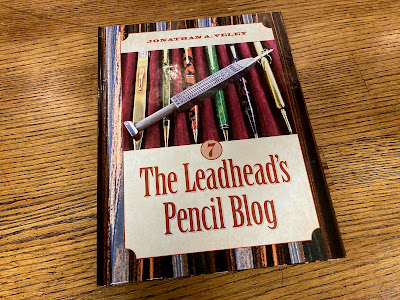
This article has been included in The Leadhead's Pencil Blog Volume 7, now available here.


If you don't want the book but you enjoy the article, please consider supporting the Blog project here.

Sometimes I get bored trolling online auctions searching for "pencils."  There are usually some 20,000 auctions at any given time, and 90 percent are modern pencils that . . . ok I'll admit it.  They bore me.

On days when I'm weary of looking at "vintage" Pentels that are younger than I am (in fact, younger than most of my socks), I'll switch things up and search for one of my favorite brands.  Searching "Gordon" might bring up one of my treasured "fanged clip" pencils, but most of what that will yield are NASCAR pencils.  I may be from Ohio, but there's no shrine to Jeff Gordon or any other driver here at the museum.   

Searching for Autopoints used to be fun, in the days when hard-to-find examples were overlooked.  Now that I've written a book about them, I've screwed the pooch when it comes to bringing home something I don't have -- at least my portfolio value is healthy.

Another of my go-to searches is for pencils (and pens, actually) made by the Eagle Pencil Company.  Sure, it turns up bunches of Eagle-motif pencils that scream "God Bless 'Merica" with a can of Busch Light in one hand, but at least it will reveal a higher proportion of pencils that might interest me than most of my other searches.  A recent search for Eagles turned up this:


The preview picture told me this was something that wasn't likely made by the Eagle Pencil Company, since it doesn't fit the shape of any Eagle product I've seen.  It does, however, fit something else perfectly.  Here it is, alongside a Hutcheon Brothers "Finepointer":


The pencil has an inconvenient dent, but since I'd never seen an imprint like this before, I bid heavy and brought it home for closer examination.  "ERCo / Eagle Regalia Co. / Sterling Made in USA" it reads:


I had never heard of the "Eagle Regalia Company," but it was one of those things that was easy to pin down, once I knew to look for it.  The company is still in business today - according to the company's website, www.eagleregalia.com, it was founded in 1910 and continues to offer flags, banners, buttons and pins.

A copy of the company's catalog is preserved at archive.org.  It is not explicitly dated, but the catalog introduction indicates it was published in the 20th year of the company's existence -- 1930, for those deficient in math skills.  The very last page of the catalog revealed all . . . or mostly all . . .


Eagle Regalia offered a full line of "ERCO Double Action Pencils" in both side clip and ringtop pencils.  While I was nearly certain the ringtop was manufactured by Hutcheon, the side clip model resolves any lingering doubt.

Since this is the first example I've seen in more than twenty years of doing this, I'm inclined to believe these are really rare.  The reason is obvious:  the Eagle Pencil Company would have no reason to challenge Eagle Regalia's production of flags, banners and buttons . . . but stamping a writing instrument with the word "Eagle," especially when both companies were located in New York?  I am sure to a moral certainty there were rapid and forceful objections to any coattail-riding on Eagle Pencil's trademarks. 

While the Eagle Regalia catalog seems to wrap this story up neatly, there were two lingering questions the catalog didn't sufficiently answer.  The first is the date -- 1930 seems late for a line of metal pencils, which were unfashionable in favor of pencils made in brightly colored celluloids.  Was Hutcheon really turning out stodgy metal pencils in 1930? 

The answer is yes.  While I was waiting for my Eagle Regalia pencil to arrive, this metal pencil surfaced in another online auction, marked with Hutcheon's distinctive diamond-shaped trademark (abbreviated to "Hutch" by that time):


I never poo-poo pencils with commemorative engraving, particularly when the message adds to the history of the pencil.  In this case, an imprint celebrating Neptune Township, New Jersey's centennial in 1929 establishes that yes, Virginia, Hutcheon was still making metal pencils as late as 1930:


The second lingering question is more difficult to answer, and it comes from the tiny lettering beneath the ERCO logo in the catalog:  "Pat. Appl'd For."


If it is unusual to see an old-style metal pencil still being made in 1930, it is even stranger to see that a patent had been applied for but not yet issued by that date.  The catalog text doesn't refer to any outstanding patent applications for the pencils themselves, and no Hutcheon-made pencils along these lines are so marked, either.

Perhaps the reference, tucked under the unique logo, is a sloppy reference to a trademark application being filed for the distinctive mark-- if so, Eagle Pencil might well have successfully objected to its registration, as well.