Showing posts with label Deacon (Edward). Show all posts

Saturday, May 15, 2021

Our Old Friend

This article has been included in The Leadhead's Pencil Blog Volume 7, now available here.

If you don't want the book but you enjoy the article, please consider supporting the Blog project here.

Before I delve headlong down the other rabbit hole from that second Victorian mini-hoard, yesterday’s article provided the perfect introduction to show you something else.  Since they come up so rarely, they don’t introduce themselves . . . so with the door opened, now is as good a time as any to walk on through:


Eric Magnuson had prevailed on me to take an Eversharp lead display off of his hands – because it was too big and bulky, rather than because he didn’t like it.  Since he was going to press his parents into service to lug it back to Columbus with them after a planned visit his new home in Illiniois, he sent me pictures of a few other items that might be good stowaways for the journey, this one included.

“It’s a Deacon,” Eric said.  That was all it took for me to book this little guy budget accommodations in the storage cabin for the ride.


“Our old friend Edward Deacon,” I referred to the maker in yesterday’s piece.  Deacon was an early New York manufacturer and an early associate of William S. Hicks (see Volume 4, page 176 – Deacon’s biography is covered on pages 177-179).  A few weeks after that article was written, I finally found my first Deacon at the Ohio Pen Show (Volume 4, page 269).

Edward Deacon was apparently a very prolific manufacturer, one of the few who was successful enough to place a flashy advertisement in the 1850 New York Directory:


Since so few examples survive which are stamped with his name, I’m assuming that most of what he made were unmarked combination dip pens and pencils, later equipped with nibs from other New York houses.  When this one arrived, I thought this might be along the same lines, but it has an interesting omission:


It has a reversible pencil section, but unlike most of what you’ll find along these lines, there’s no holder on the other side for a nib.  In addition, the barrel extends for more comfortable writing, and with good reason: when it arrived, I was surprised at how small this piece is.  My other example of Edward Deacon’s work dwarfs this new specimen . . . at least, until it is fully extended:
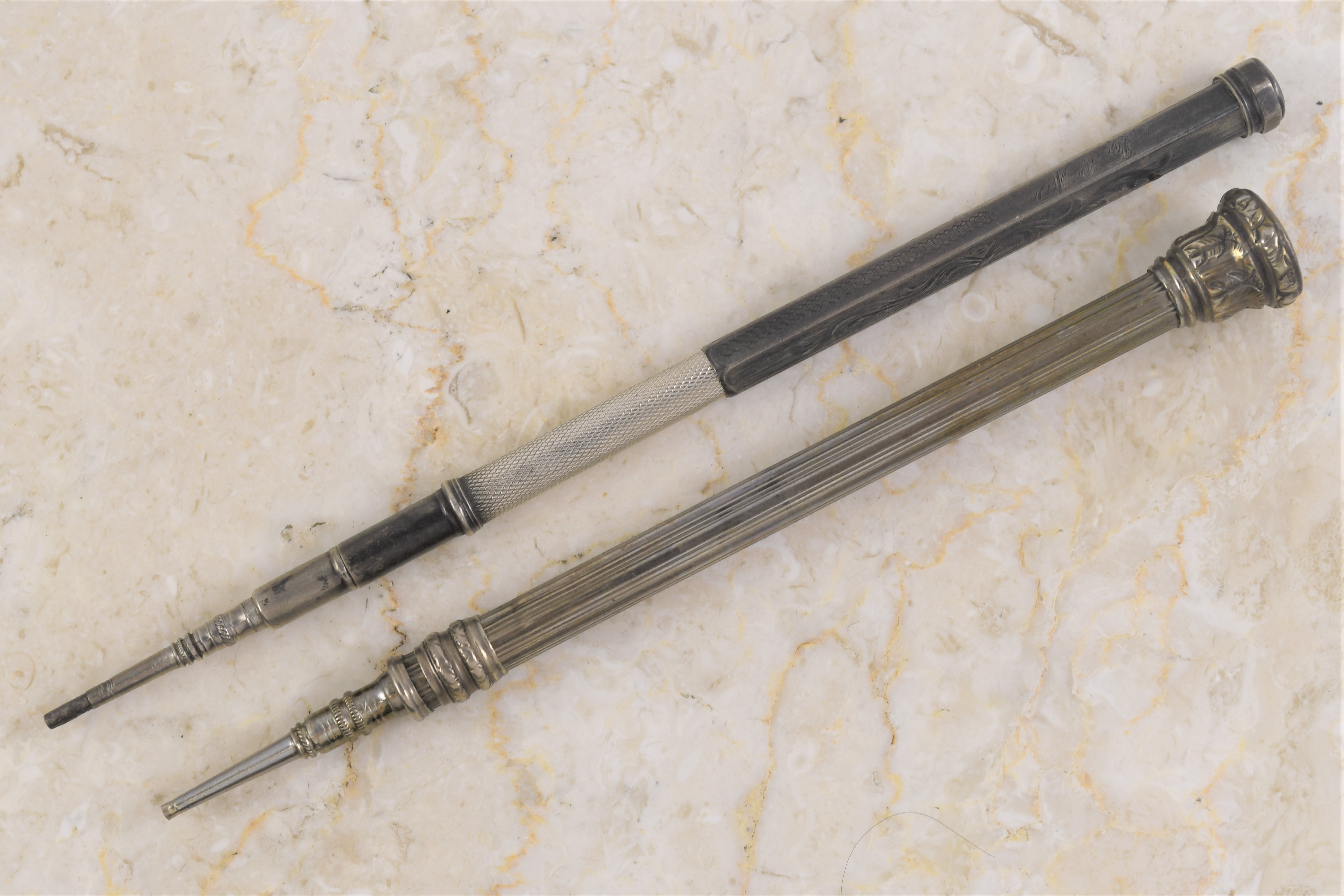

Deacon, according to my research concerning William S. Hicks, first appears in New York as a “silverworker” in 1837.  His occupation is listed as “pencil cases” beginning in 1842, and he disappears from New York directories after his listing in the 1852 directory (alongside Zachariah Dederick).  That provides just a ten-year window during which both of my Deacon-marked pencils were made.

I’m sure more interesting examples of these early pencils – and maybe a pen – will surface in the future, and as they do I’ll have to reintroduce him again.

Friday, November 25, 2016

Edward Deacon's Legacy Survives

This article has been edited and included in The Leadhead's Pencil Blog Volume 4; copies are available print on demand through Amazon here, and I offer an ebook version in pdf format at the Legendary Lead Company here.

If you don't want the book but you enjoy this article, please consider supporting the Blog project here.

A few weeks ago, I posted an article detailing the early history of William S. Hicks, one of America’s oldest and longest-lasting manufacturers of writing instruments.  The article was posted back on September 20 at 
http://leadheadpencils.blogspot.com/2016/09/the-early-history-of-william-s-hicks.html.

In that article, one of the names that emerged in connection with the young Hicks was Edward Deacon, a pencil case maker who first appears in the New York City Directories in 1837 as a silverworker, who beginning with the 1842 directory listed his occupation as “pencil cases.”    Hicks shared space with Deacon at 90 Thompson beginning in 1845, and Hicks was still at 90 Thompson in 1848, the year Hicks later claimed his firm was founded.

Edward Deacon may or may not have remained involved with Hicks at the time: while his business address had changed to a Spring Street location, another member of the Deacon family – Francis – appears at 90 Thompson.  Two years later, in 1850, Edward Deacon moves again, this time to 5 Liberty Place at the corner of Maiden Lane, and it was at that location where Hicks’ first formal partnership, Larcombe, Hicks & Mitchell, sets up shop alongside Deacon in 1852.  After that year, Deacon disappears.

Deacon appeared to enjoy considerable success during his fifteen-year career as silversmith and pencilmaker, as his elaborate advertisement in the 1850 directory suggests:


You would think that for as long as Deacon was in business, you might see a few examples of his work surviving.   I never had - I assumed that his were some of those in the vast sea of ubiquitous unmarked pencils.  Not even the late John Loring had an example among the ones he posted at his online site of Victorian pencils.

Fast forward to the Ohio Pen Show, which annually features two auctions: a Thursday night auction of lesser writing instruments and parts, and a Saturday night “main event” auction featuring higher quality pieces.   I’m usually slumming around the Thursday night one, and this year was no exception.  What was an exception this year is that there were no photographs of the auction items posted in advance, and when I slipped down to the auction preview room, I was surprised to see several lots of Victorian pencils being offered.  None of the pencils were identified by maker - all were identified in the catalog only as “Misc. Victorian” with the exception of a few Fairchilds.

I pulled out my loupe and examined each one carefully, since most of the time you can only see hallmarks or other identifying marks on these pencils under magnification.  The largest of the lots was the only one which contained a couple marked pencils: Lot 53 was described as “LOT OF TWELVE SLIDER PENCILS AND PEN PENCIL COMBOS IN ENGRAVED GOLD FILL AND STERLING. GOOD CONDITION-SOLD WITH ISSUES.”  In that lot were a pencil marked only “Addison’s” (I discussed this one with David Nishimura, who believes this one predates the issuance of Addison’s patent . . . kind of cool) and another marked “Rauch & Co.,” which was kind of interesting to me since the “& Co.” would have been John Mabie, founder of Mabie Todd.

'Kind of interesting' left me on the fence as to whether to attend at all.  Since the Ohio Show is so close to Newark, I come home on Thursday nights after early trading to pack up for the show proper, and I was more interested in getting things ready to bring over for the first day of the show than I was in hanging around until 11pm or so for things I wasn’t over the moon about.  Truth be told, the only reason I attended the auction was because the first lot was a bag of pencil leads and erasers, and I’ve been thinking about offering vintage leads and erasers through my pencil lead business, the Legendary Lead Company (insert shameless plug here).    I figured I’d bid on lot 1 when the auction started at 8, then scoot if I didn’t win.

Damned if I didn’t win lot 1.  Since I was already there and the beer was flowing in the back row, I hung around a bit to see what else might come up.  By the time the Victorians came along, I’d unintentionally bought a few other lots of stuff I didn’t need and was experiencing some regret at having bought things I didn’t really want.  That meant when lot 53 came up for bids, I was determined to win the only thing in which I had any real interest when I previewed the auction.  It cost me, but at $250 for the dozen I figured I could sell the unmarked ones for $25 apiece and keep the Addison and Rauch for free.

Well, maybe not.  Since I had previewed the auction very hastily, and the lighting in the room was pretty terrible, I went over each one in that lot more carefully and in better light to make sure I didn’t miss anything before I consigned the ten no-names to inventory.

I did miss something.  Here is one of the ones I thought was unmarked:


Sterling silver, with a nice finial:


And a tiny, barely perceptible imprint:


“E. Deacon.”