Showing posts with label Realite. Show all posts

Wednesday, August 6, 2025

The Craftsman Conundrum Solved

In 2014, I wrote an article titled “The Doomed Craftsman” (November 13, 2014: Volume 3, page 97), concerning the only example I had found of the Craftsman: 


The Craftsman was introduced in the stationers’ press in July 1922, and according to those announcements, what set these pencils apart was the material used to fashion their barrels - Redmanol.


That is what led me to describe the pencil as “doomed.” I knew that around that time the Redmanol Corporation lost a patent infringement case brought by Leo Baekeland and his Bakelite Corporation. I had assumed that any product made of Redmanol would have gone extinct once that material was no longer available. 

Realite pencils, introduced in the fall of 1922, were also made of Redmanol; I assumed that Realite only avoided a similar fate by substituting Bakelite for Redmanol, from which Realite and Autopoint pencils (after the two companies merged) would be made for decades to come.  I reasoned that the makers of the Craftsman were unable to negotiate a similar arrangement and therefore went the way of the dodo. 

I was close. Actually, I wasn’t really all that close, but at the time, this was a reasonable interpretation of what facts I knew. As I researched and wrote A Century of Autopoint, however, I learned a few more key facts that proved I was dead wrong.

Chapter Four in the book, “The Plastic War,” unveils the details of the Redmanol story.  Adolph Karpen, a furniture manufacturer by trade, was interested in the development of a more durable substitute for furniture varnish. Dr. Lawrence V. Redman developed a phenol-based substance he marketed as Redmanol, and he and Karpen established and owned the Redmanol Corporation.

Here’s the rub: yes, Leo Baekeland would sue Redmanol Corporation for patent infringement, and Baekeland would ultimately win. However, the judge’s decision against Redmanol was rendered in July 1921 – a full year before the Craftsman pencils with Redmanol barrels were introduced.

Contrary to what I believed back in 2014, Redmanol’s defeat in court was not a death knell. Redmanol was not the first competitor Baekeland had sued: the first was Condensite Corporation, which used a similar substance to make phonograph records for Thomas Edison. Condensite also lost, but after its defeat the company negotiated a license with Baekeland and continued in operation. Leo wanted royalties, not conquest.

By the beginning of the 1920s, Condensite’s fortunes looked bleak. Edison would only permit the production of records which suited his personal tastes in music – and Edison disapproved of that newfangled jazz that was taking the industry by storm, causing rapid losses in market share. While the patent litigation against Redmanol was pending, Adolph Karpen quietly bought up options to purchase Condensite’s shares from the company’s anxious shareholders.

As soon as the ink was dry on the judgment entry holding Redmanol liable for patent infringement, Karpen sprung his trap: he exercised his stock options and acquired a controlling interest in Condensite, so that what Karpen could not do through Redmanol he could continue to do as a Condensite licensee. Leo Baekeland was forced to the negotiating table, and in May 1922, the Bakelite Corporation was founded as a holding company which wholly owned the Redmanol Corporation and the Condensite Company. The three companies were formally merged in 1924.

The Craftsman pencil was introduced in July 1922, at a time when the Redmanol Corporation was operating with the full blessing of Leo Baekeland as a subsidiary of the Bakelite Corporation. The Craftsman pencil was in no way “doomed” by virtue of the material used in its construction. 

The Craftsman makes an appearance in A Century of Autopoint on page 45, but at the time the book was published I still was unsure how the pencil fit into this bigger picture. It would have been helpful to take apart my example of the Craftsman to see what was going on inside, but my only example had deteriorated so much that I feared any attempt to disassemble it might destroy it. 

The Craftsman looks Keeranesque, but I had ruled out Charles Keeran as a suspect since he had signed an exclusive contract with Realite on July 15, 1921 and the Craftsman did not debut until a year later. Therefore,  all I could say in A Century of Autopoint was that the Craftsman “bore more than a passing resemblance to Autopoint’s ‘50-cent’ number [invented by Keeran], but as of this writing no connection between the two is known.”

Again, I was close. Sooooo close . . . 

No, there is still no surviving direct evidence which connects Charles Keeran to the Craftsman Products Corporation. The 1922 Illinois Secretary of State’s Corporations lists the president as “H.K. Neinn” of Wilmette, Illinois, and the treasurer was P.W. Rice of Chicago. Both of these leads were dead ends. All trade announcements and the Illinois Secretary of State indicate the company was located at 668 Washington Boulevard, Chicago - another dead end, since that address has been wiped from the face of the Earth and is now in the middle of I-94. 

Now, the evidence I sought has finally come to light, tying together all the loose ends that have bugged me about the Craftsman as neatly as I could have ever hoped.

At the Chicago Show in 2023, Susan Wirth’s longtime companion John Martinson was liquidating much of what remained of Susan’s hoard. One of several boxes I purchased from John included was another example of the Craftsman. This one is in much better condition and has a slightly different top end:


Unlike my other example, this one disassembled easily, and what lies inside answers many questions. Here it is with the insides removed, shown along an early Autopoint “50-cent number”:


The Craftsman is an Autopoint 50-cent number wrapped in a Redmanol barrel. Now, laying out all the clues I’ve found in chronological order, we have a very different picture of what happened:

1.  Charles Keeran was ejected from the board of directors at Autopoint in April, 1921 (A Century of Autopoint, page 29).

2.  Keeran signed his exclusive contract with Realite through Michael M. Kaufmann, Frank C. Deli and John Lynn on July 15, 1921 (the contract was reproduced on page 34).

3.  On July 13, 1922 Keeran and “Kaufman” filed a patent infringement suit against Autopoint, according to a report published in The United States Patent Office Official Gazette on April 24, 1923.


“Kaufman” is almost certainly a mispelling of Michael M. Kaufmann, one of the original principals of Realite. The patents sued over were number 1,372,354, issued to Keeran on March 22, 1921 (just weeks before his ouster) and 1,400,362, issued to Keeran and Kaufmann on an application filed in 1919 (the mechanism inside the original Autopoints, including the 50-cent number).


Patent 1,400,362 was issued on December 13, 1921, after Keeran had been ousted from Autopoint and had joined Realite. I did not report the patent infringement suit in A Century of Autopoint, because I did not know how it fit into the story.

4.  The Craftsman is introduced in the stationers’ press in August, 1922 – one month after Kaufmann and Keeran filed suit, according to the notice in the Official Gazette.

Now it all makes sense. Keeran had invented the 50-cent number for Autopoint, and there was a dispute over who owned the rights to manufacture the pencil. A new company, the Craftsman Products Corporation, was established to make the disputed pencil . . . certainly not on behalf of Autopoint, but as a direct challenge to Autopoint’s claims.

Of course the Craftsman Products Corporation had no identifiable connection to Realite or Charles Keeran – had the maneuver failed, it would be Craftsman and not Realite or Charles Keeran that would take the fall.

Realite’s rapidly expanding business led it to seek out better manufacturing facilities by 1922, and there was no easier way than to take over Autopoint’s plant. Realite increased its capital dramatically in November, 1922, shortly after the Craftsman’s warning shot over Autopoint’s bow.

In April, 1923 the stationers’ press announced that Autopoint and Realite had merged; the surviving company was renamed the Autopoint Products Company, and its first president was Charles Keeran (A Century of Autopoint, page 50).

With the full story laid out, the Craftsman was indeed “doomed,” but not for the reasons I thought back in 2014. The Craftsman was doomed by its rapid success as a sacrificial pawn, forcing Autopoint into a merger. In 1923 and 1924, the Autopoint Products Company offered both rebadged Realite pencils and the original Keeran Autopoints (including 50-cent numbers), but there is no evidence that the Craftsman remained in production. With the introduction of the new Autopoint Model 1925, Keeran’s 50-cent number was discontinued.

Thursday, April 29, 2021

An Autopoint Update

This article has been included in The Leadhead's Pencil Blog Volume 7, now available here.


If you don't want the book but you enjoy the article, please consider supporting the Blog project here.

Out of all the books I’ve written, A Century of Autopoint is my masterpiece.  I’ll probably spend the rest of my life trying to write something that good again.

Of course, no book is ever complete, and fortunately I never promised that what it included was all there would ever be to discover.  Two years later, I am proud to report that no glaring omissions or errors have been brought to my attention; however, a few things have come my way that are worth mentioning.

For starters, an online auction had alarm bells ringing and emails hitting my inbox from Autopoint fans near and far.  This is something I would have liked to have included in the book:


These fill an interesting gap in Autopoint’s early history, the short version of which is as follows: Charles Keeran founded the original Autopoint in 1918, but things didn’t really get rolling until 1920.  In 1921, a series of poor decisions and unavoidable circumstances resulted in a shake-up, and Keeran left Autopoint to join a new startup, the Realite Pencil Company.  Realite’s fortunes rose as the original Autopoint declined, and Realite announced that it has “merged with” Autopoint in June, 1923.  That was a kind way of putting it – Autopoint was falling apart, while Realite needed bigger and better manufacturing facilities.  The merged company was named Autopoint Products Company, and Charles Keeran was made its first (albeit short-lived) President.

All of the evidence available when the book went to press suggested that the Realite name was abandoned immediately upon the merger, and it wouldn’t be revived as a lower-budget brand name for many years.  That’s what makes this find important: the pencils themselves are Model 12 pencils (see A Century of Autopoint, page 60), but the boxes in which they are packaged are the only known examples which have both the Realite and Autopoint names on them.

The instruction sheets are also unusual.  One has an Autopoint instruction sheet and the other features a Realite; since the sheets are otherwise identical, this further establishes that both Realite and Autopoint-branded pencils were made briefly after the merger:


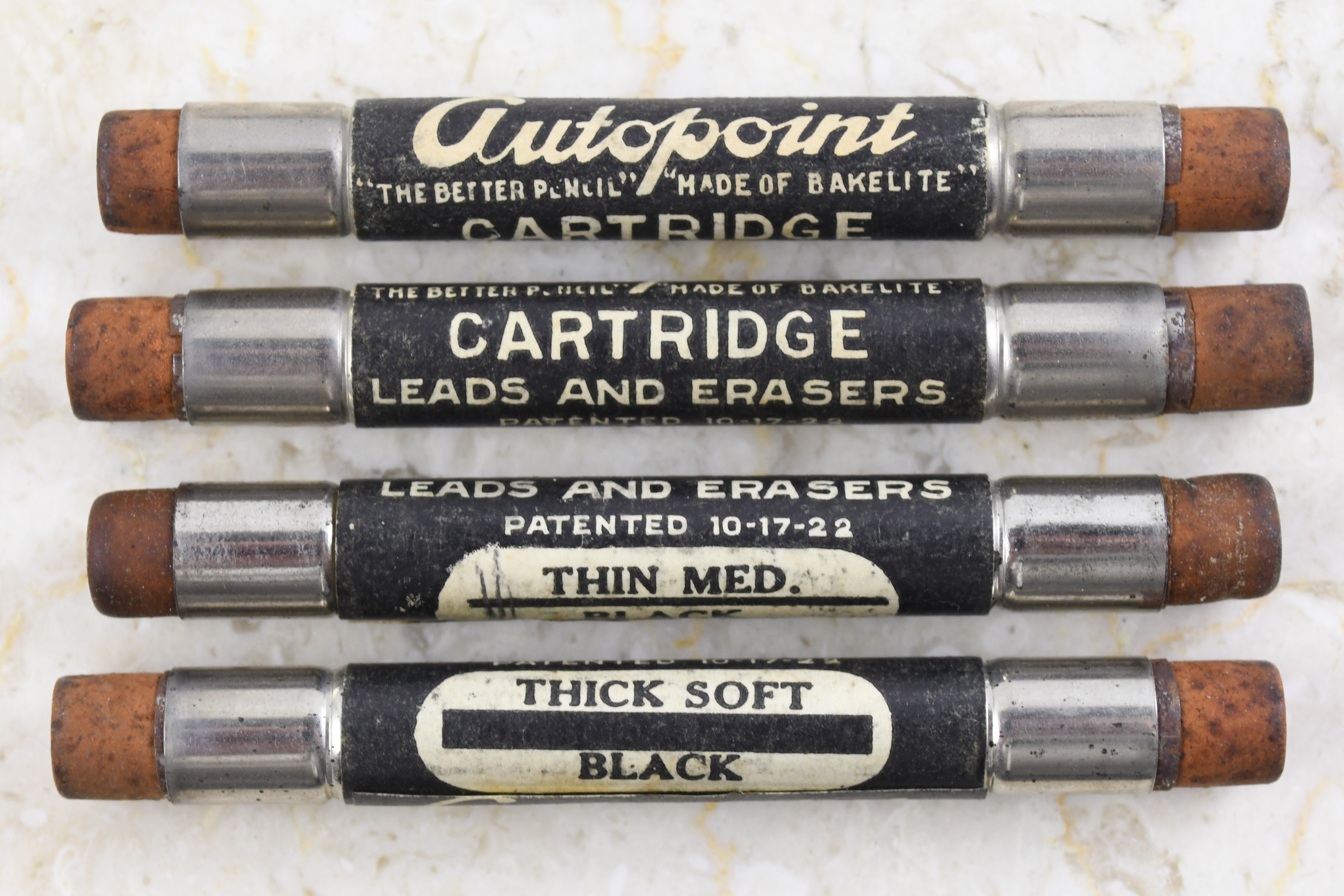
Also included in this lot were a few of Autopoint’s patented (by Charles Keeran) lead and eraser containers, which were marketed by Realite before the merger (see A Century of Autopoint, page 50).  Although Autopoint also marketed cartridge like this under its name through the 1936 catalog (A Century of Autopoint, page 188), the Realite name was thought to have been dropped from them, as well – this lot included a few of the Autopoint-marked cartridges:


Yet there were also several cartridges bearing both the Realite and Autopoint names:


Moving into Autopoint’s golden age, these two pencils also came my way in recent months.


The larger model 48 came by way of my friend Ibrahim Abou-Saad, who listed it in an online auction.  I’m always a sucker for an unusual color, and even though I have a Model 48 in white (see Figure 8-73 on page 121 of A Century of Autopoint), the large Autopoint imprint on the side of this one is worth the price of admission:


Autopoint fans will instantly recognize the other pencil as a Model 19X in Ivory, which I described as “the undisputed king of the Deluxe Autopoint line,” described (but not pictured) in Autopoint’s 1927 catalog and fully illustrated in the 1930 catalog.  The photo at the top of page 102 shows examples from my collection, but I didn’t have one in ivory – at the bottom of the page, I had to cheat and include a picture from Jim Stauffer which included an ivory example like this.  Call it greed . . . call it my OCD tendency to want one picture which included them all . . . I paid heavily but I got my wish:


This next group left a bad taste in my mouth:


These would have been included in A Century of Autopoint, had I bought them when they were first offered to me.  I was about halfway through writing and layout for the book in the summer of 2019, and I knew I would see hundreds of my friends at the DC Show that August, which would provide me with opportunities galore to photograph rare examples and acquire others for inclusion in the book.  I widely publicized that I would bringing the draft of the book and that I looked forward to seeing other examples.

One dealer, whom I won’t name, brought these along with many others, packaged in a leather Autopoint folder.  So many had John E. Horn’s name on them that it was clear this was a mostly intact salesman’s sample case – with the gaps filled in with common Autopoints you’d find for $2 at a flea market all day long.  This dealer offered it to me, but at an exorbitant price.  There was no breaking up the “set” (which wasn’t a set to begin with), there was no borrowing it to photograph the interesting specimens for inclusion in the book . . . and when I balked at the price, his response was that he’d just wait until after my book came out, then he’d be able to sell them for a lot more.

The good news - if an experience like that will yield any - is that when I declined at that price, he tried to play some good friends of mine against each other to get the best price he could out of the lot.  We all know each other.  All of his marks were people that were already contributing to the book.  We talk to each other.  By show’s end, nobody wanted anything to do with him or his folder full of Autopoints.  To quote John Hall, “I’d rather run them over in my f***ing driveway.”

By the time the Philadelphia Show rolled around in January, 2020, A Century of Autopoint was in print.  This dealer was in attendance, and he’d given up on the extortion plot.  These pencils were scattered around on his table, and for a price that wasn’t too far out of line, I finally brought them home.  

From the top, the Glidden Soya Plastic marked example isn’t completely foreign to me - a black example from Jim Stauffer’s collection is pictured on page 196 of A Century of Autopoint.  


I had to buy the next two down, in what Autopoint called “Water White” clear Bakelite, because I couldn’t remember whether the ones pictured in the book were mine or my Dad’s (we combined our collections as we shot these golden age examples).  Besides, both had Mr. Horn’s name on them.  


The thin model with a round upper ferrule is a Model 18BG “Streamline De Luxe,” and the one pictured on page 119 of A Century of Autopoint was my Dad’s.  “Diamond Cut” caps were added in November, 1937, and faceted upper ferrules to match were added shortly thereafter - and the Water White Model 58G shown on page 120 of A Century of Autopoint belonged to Jim Stauffer.

The next Model 58Gs, in that salmon-pinkish color, were ones I was particularly keen to add to my collection.  


Dad has a barrel in this color from Autopoint’s factory archive with an attached paper tag indicating that the company found the material “unsuitable” (see page 194).  On page 118, I show an earlier Model 58G from Jim Stauffer’s collection in this color, with a round upper ferrule and imprinted “BAKELITE” on the barrel, and I commented that while the color was uncataloged, “other examples have turned up with regular customer imprints.”  These two were the “other examples” I was referring to, so yeah . . . forgive, forget, and spend a bit of cash.

There was another reason I wanted to have them - there was a point I failed to make in the book.  When Autopoints had round ferrules at the top end, the company name was imprinted on that ferrule and the clips were unmarked.  After the unmarked faceted ferrules were added to match the new “diamond cut” caps, Autopoint struggled with where to mark its products. For a short time, Autopoint added an imprint next to the clip, and both of these have that feature:


The light translucent red example is a very interesting variation, but only if you really know your stuff.


On page 141 of A Century of Autopoint, there’s pictures of the Model 54, first cataloged in 1948 and sporting the later “Petau clips,” named after inventor Erik Petau:


This is no Model 54 - it’s at least 10 years earlier, in my estimation.  In addition to the bolted-on clip, long abandoned by 1948 (the Petau clips was introduced in 1941), note that trim ring where the nose meets the barrel.  That ring is found only very rarely – and without exception, on pencils made around 1938-1939.

Translucent red Autopoints in the 1930s were much darker than what you see here, and those higher end colors were associated with gold filled trim rather than what Autopoint called “silvonite.”  The Model 54 introduced in 1948 was based on a much earlier experiment with lighter red plastic paired with silvonite trim – this experiment, in fact.

Finally, for now, is this later, injection molded Model 48:


Injection molding allowed for a wider range of colors than the Bakelite Autopoint used earlier in Model 48 production.  Some of the wilder ones tend to command a premium, even though they are much later and were in production as late as 1970.  Here’s the picture from page 140 of A Century of Autopoint:


At first blush, this one looks to be just another dull, gray example from the twilight of Autopoint’s successes.  I saw just a little bit more in it, though:


Commemorative dates are always helpful in better defining the evolution of these pencils, and we have a date of 1954 as the “Silver Anniversary” of the Pennsylvania Transformer Company.  That isn’t the latest example of the script Autopoint clip, but it’s closed.  The latest I’ve found, before the introduction of the “Big A” clips, was from 1955.


And . . . that isn’t gray, as the imprint suggests.  Look closely and you’ll see subtle marbling . . . silver marbling, perhaps . . .


Thursday, June 18, 2020

Elite Company

This article has been edited and included in The Leadhead's Pencil Blog Volume 6, now on sale at The Legendary Lead Company.  I have just a few hard copies left of the first printing, available here, and an ebook version in pdf format is available for download here.

If you don't want the book but you enjoy this article, please consider supporting the Blog project here.

Writing A Century of Autopoint was a great experience.  It brought me into some really great company, including John Keeran (Charles Keeran’s grandson), author Jeffrey Meikle, who wrote American Plastic: A Cultural History, and several closet collectors of Autopoints, some of whom I knew well but never knew they collected the brand.  It was also a wonderful collaboration with the two leading collectors of Autopoints – Jim Stauffer and of course, my dad.

Dad and I live about thirty miles apart, and we both have a large number of Autopoints - to make things easier, I’d shoot images of what I had and send them over to him - he’d pick out things in his collection that weren’t represented, bring those over and we’d reshoot family photos.  Jim and the other contributors lobbed in pictures of other examples from afar.

I’ve continued to pick up variations of things covered in the book - some, like these three, were variations I would have included had I been able to lay my hands on them.  All three were in one auction lot:


The yellow ringtop is a subtle variation masquerading as something you think you’ve seen.  These were denominated Model 17XR (X for short, R for ringtop) and first appeared alongside other variations of the “Model 1925" Autopoint when introduced in 1924.  Here’s Figure 5-13 from page 59 of A Century of Autopoint:


“Ambertype,” Autopoint called the Bakelite barrels, and yellow (“Amber”) is the most commonly encountered color.  However, look closely: Autopoint’s Amber had white swirls in the yellow plastic, while this new addition is a clear yellow.  On that same page, I noted that clear yellow was not catalogued, although Dad has an example of the full length model that was included in Figure 5-12, also on page 59:


As for the other two, they were Autopoint “Streamline De Luxe” models, and in this configuration they were denominated Model 19BXG (B for slim model, X for short or vest pocket model, G to denote gold filled trim, although no “non-G” examples along these lines are known).  A previously unpublished catalog showing these appears on page 117 of A Century of Autopoint, and other examples are shown on page 119 (Figure 8-65):


Boy, I really would have enjoyed having both of these examples on hand when this picture was shot - I’d recreate it, but that will have to wait until Dad can bring his examples over for a family reunion shot sometime . . . when this stupid virus thing is over . . . 

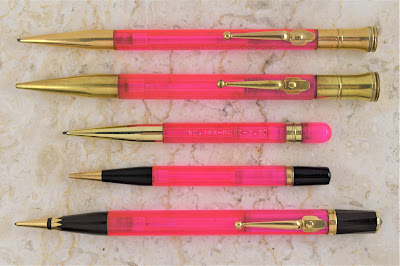
In the meantime, “Rose” Autopoints are well represented in my collection -- all but the ringtop model 17XR pictured in the book were from my collection, so I was able to add the 19BXR to the spread for a group shot:


This was another online find which augmented the book a little bit:


This is marked Realite on the clip; the Realite Pencil Company, formed in 1921, gobbled up the failing Autopoint Pencil Company in 1924, assuming the name Autopoint Products Company in the merger.  During the late 1930s, Autopoint reintroduced the name on a budget line of pencils, including these - they came in two sizes, with this being the larger of the two.  Other examples are shown on page 129 of the book, Figure 8-95:


These usually have the Autopoint name stamped inconspicuously on the back side, near the top, but this one has a bit more:


“Property of Autopoint Company,” and on the other side, a model designation I didn’t have – No. 84PB.  We even know that this green was color 3384.  I wonder what the color number was for that green and brown barbershop pole color!

The Swanberg Manufacturing Company figured into the Autopoint story as one of Charles Keeran’s landing places after he was kicked out of Autopoint – for the second and last time, in 1924.  Keeran’s activities after Autopoint were detailed in Chapter 7 of A Century of Autopoint, “Exit Stage Left,” and Swanbergs are shown on pages 78 and 79.  The “Keeran Pencil” later became Swanberg’s more upscale line of pencils, complementing the more humble aluminum Swanberg and “Tubit” pencils the company was offering.  Here’s the shot of some of Dad’s Keeran and Swanberg pencils, Figure 7-3 on page 78:


Due to space constraints, I had to cut the image of similar pencils with nickel plated trim and crown tops.  I showed a couple of them here in 2018 (see"Cult Collection"):


In that last article, I’d turned up the closest thing we’ve found to a Swanberg catalog, a 1925 advertisement listing four models: the Tubit, the number 7 (also in aluminum), the number 5 (a checking pencil) and the number 11, “the most beautiful and perfect pencil ever offered.”  Of course, there were no pictures to accompany any of these descriptions.

This one, however, was something else:


The “Swanberg Special” – maybe not as special as a Number 11, but certainly special enough to add to the collection.

These last two recent finds are things you’ve seen in the book, but both were rites of passage for me.  Jim Stauffer pointed this one out to me in an online auction, because I had commented to him several times how much I admired the ones in his collection:


It’s a Realite “blimpie,” as Jim likes to call them, and Jim’s boxed example is shown in Figure 3-13 on page 37:


Realite used a blimp in its early advertising to emphasize how lightweight its new bakelite pencils were.  I don’t think it was the company’s first logo on its pencils – Keeran’s contract with the company is written on letterhead using a baseball-jersey style script logo, which was probably the first.  The “blimpie” imprints on Realite ferrules, however, are in my experience more rare:


And last, I finally received formal admission into the Super-Duper-Serious Autopoint Collecting Society (SDSACS, or “sad sacks” as we are better known – no, that doesn’t really exist . . . I just made that up) when I got my pin:


I learned in the course of writing A Century of Autopoint that this advertising mascot was called “Autokid” by the company - see page 184 of the book and the company’s 1939 catalog.  “Creepy little dude,” I like to call him.  As the book notes, Dad and Jim Stauffer both have one of these.  Next time we’re all together, rest assured we’ll all be wearing them as the sad sacks are called to order!

Saturday, June 13, 2020

The Art (Curse) of Noticing

This article has been edited and included in The Leadhead's Pencil Blog Volume 6, now on sale at The Legendary Lead Company.  I have just a few hard copies left of the first printing, available here, and an ebook version in pdf format is available for download here.

If you don't want the book but you enjoy this article, please consider supporting the Blog project here.

In the wake of writing the Autopoint book, I’ve been a changed man.  “The art of noticing,” I call it.  Once you learn what is normal, the things that aren’t stick out like they have neon signs on them.  It quickly morphs into a curse . . . once you learn to read the signs, you can’t unread them.

When this group showed up online, it’s something that I would have sailed right on by before I wrote the book – at the time, I wouldn’t have noticed:


Here’s what I knew was normal: the proprietors of Koppers Chicago Coke were very good customers of the Autopoint Company during the 1930s.  It’s kind of neat to find a wide variety all marked with the same company’s name, but I’ve probably got at least as many lounging around the museum. 

All of these show a short tip, which tells me these are likely Realite pencils, made by Autopoint during the 1930s when the Realite name was revived as an Autopoint subbrand after an absence of a few years, when the Realite Pencil Company and Autopoint Pencil Company merged.  A group of these is pictured on page 128 of A Century of Autopoint. 


No thanks to writing the book, I knew there were a couple unusual things to see in the bunch being offered for bids online.  First, that swirled pearl barrel with screen printed rather than imprinted lettering is something you’ll see a lot on Dur-O-Lites and other advertising pencil brands – but it’s the first one I’ve noticed in this plastic on a Realite, and only the second I’ve seen with printed rather than imprinted lettering.

And then there’s that sort of sickly green with red and white swirls in it.  That’s a color that is found on a lot of different brands, both higher tier like Chilton as well as a lot of third tier stuff, but again . . . not on a Realite.


“Howling sinus infections in purgatory” as I’ve called it, a nickname that I’m glad hasn’t . . . stuck.  Eww.
 
And of course, my natural curiosity had me wondering which incarnation of the Realite clips these would sport, since the auction images showed only the imprints on the side.  There were four variations, also as shown on page 128 in A Century of Autopoint.  Here’s Figure 8-92 from the book:


The bottom variation I could rule out from what I could see, and when these arrived, four out of these five examples fit neatly within the categories shown in the book.  Three of these sport the italic script ball clips, and the fourth sports the “teardrop” clip reminiscent of a Sheaffer flat ball clip:


But then there was that fifth one. . .


Nothing at all.  This variation isn’t shown on page 128 in A Century of Autopoint because it appears elsewhere in the book, on page 123.  Here’s Figure 8-77:


Since the clip is unmarked, I knew what I would probably find on the back side of the barrel:


Like the other examples pictured on page 123 of the book, this one sports an Autopoint imprint rather than the Realite name.

And that means something else.  Note that Realite-marked pencils along these lines all have longer, more tapered caps.  Autopoint-marked examples with ball clips have stubbier, more squared off caps.  Of course caps could be swapped, either when assembled at the factory or at any point over the last 90 years or so, but when enough examples turn up in one configuration “in the wild,” I don’t think it’s a wild assumption to say that the emerging pattern is what was intended: shorter caps on Autopoints, longer ones on Realites.

That means my new swirled Realite probably has the Autopoint’s cap on it.   When I swapped it over, it fit much more tightly than usual on the Autopoint, but now that it’s on there I’m sure that’s right.


So now I’m noticing that I need another long, maroon cap, since this one is sharing custody of one with another that I really want to keep together.  And I’m also noticing something else, now that I‘ve added a sinus infection to the other Autopoints I have along these lines:


Now whenever I see one of these, I’m going to be wondering whether it’s the long, normal variety or the short one . . .