Showing posts with label Nichols. Show all posts

Thursday, April 1, 2021

Getting Unstuck

This article has been included in The Leadhead's Pencil Blog Volume 7, now available here.
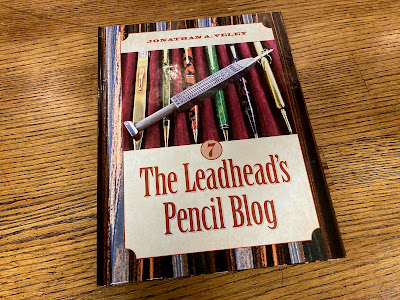

If you don't want the book but you enjoy the article, please consider supporting the Blog project here.

My longtime friend John Hall was so proud that one of his pencils was included on the cover of Volume 6.  When the book arrived from the publisher last September, I looked forward to hand-delivering him his copy, signed on the title page, “For Princess.”    

“Princess” was our inside joke: years ago, a mutual friend was getting all worked up over something trivial at a pen show – “Settle down, Princess,” I said, and the crack caught John so off guard that he guffawed, back in the days when John could muster a guffaw.  The name stuck.

As John’s COPD worsened, his belly laughs wore down to a smile and a quiet chuckle under his breath.  We still managed to attend six or seven pen shows each year together, hauling his scooter and oxygen in the back of my truck and setting up at adjoining tables.  Our last show together was the 2019 Ohio Show.  

I hadn’t seen John since, although we talked on the phone every week or so to catch up.  “I’ll bet you’re bathing in Purel these days,” I joked with him last spring, when the pandemic shut everything down.  “Boy, you ain’t a-f***in’ kidding!” he said.  If you knew John, you can hear him saying that.

When Volume 6 arrived from the publisher, I called John and offered to bring over his copy and a bottle of Scotch.  I’ll set up a lawn chair in your front yard, I said – Amy can bring your book inside along with a drink, and we’ll toast through your front window.  No, John said.  He just wasn’t feeling up to it. 

On September 25, 2020, John called me while I was with a client, so I couldn’t answer.  I assumed he’d seen something on eBay that looked interesting or there was amusing drama within our circle of pen friends, but since I don’t have voice mail set up on my cell phone John couldn’t leave a message.  I called back after things quieted down by mid-afternoon, but John didn’t answer.  John had his phone with him all the time, and I couldn’t remember a time he didn’t answer.

I tried again an hour later.  No answer.  No response to increasingly frantic texts, either.  

John’s wife Amy called me a couple hours later to confirm my worst fears.  For a couple of days John had been convinced their cat had chewed holes in his oxygen line, because he wasn’t getting any air.  

It wasn’t the cat’s fault.

I was allowed to visit John in the hospital Sunday morning.  I’d taken along a couple gifts I’d been saving for the next time I saw him:


I’d bought a pack of four of those goofy emoji pencils months earlier - it was one of those lots you buy from China for a buck plus fifty cents shipping, then a month or two later they arrive on your doorstep.  I’d originally bought them to present one to Joe Nemecek as a joke - Joe, predictably, was neither amused nor willing to add one to his collection.  I planned to give another one to John the next time I saw him . . . but I never anticipated how the different faces would so perfectly encapsulate everything racing through my head that day.

The pearl pencil on the left was something that had turned up online - and I knew it was destined for John.  These were made by the Nichols Products Corporation, best known for the Tri-Point and those goofy RCA pencils, but this one had the perfect name imprinted on the barrel: The Nichols “Princess Pearl.”

Amy was at home and John’s son was flying into town, so it was just John and I for two hours or so, accompanied by machines beeping away all around us.  I think John knew I was there as I jabbered away about the pencils I’d brought to give him, and I called a few of our mutual friends on speaker so John could hear them say hello.  I was allowed to stay in the room even after John’s family arrived, and John peacefully slipped away late in the afternoon.

It was weeks before I could even talk about John without breaking down, and I will beat myself up for the rest of my life that I didn’t take his call that busy Friday.  Paul Erano asked me to write an obituary for his Fountain Pen Journal - 150 words, he said.  If you count them, there’s exactly 150.  

I had more.

I told myself life goes on, and I started work on a book about the Dur-O-Lite archive, titled “Dur-O-Lite: The Clandestine Company”:

Chapters and photographs came together nicely at first, but progress slowed down after the holidays. By January, I would spend a couple of hours writing and have only a paragraph or two to show for it.  Then for three weeks, I didn’t touch it at all.

My friend Felix Tarasco, who had only just learned about John’s passing from the obituary in Fountain Pen Journal, sent me an email in early February to tell me how sorry he was.  In an instant, all that grief I have been pushing down roared back to the surface and I was consumed for the remainder of the day.  

In the introduction to Volume 6, I wrote that I was reviving this blog as a way to stay connected, since a complex, solitary project like the Dur-O-Lite book would have been unbearable during the isolation of the pandemic.  I didn’t listen to my own advice, just as my senses of loss and isolation went off the charts with the death of one of my closest friends.  I shut the world out.

I have never stopped photographing new finds since I last signed off.  As I pawed through them, I remembered how much I really like writing these articles, how many amazing new things I’ve learned, and how much I really, really want to share it all with you. 

I know this will help me.  I hope you’ll enjoy them, too.

Sunday, April 15, 2018

Another Nice Duet of Tripoints

This article has been edited and included in The Leadhead's Pencil Blog Volume 5; copies are available print on demand through Amazon here, and I offer an ebook version in pdf format at the Legendary Lead Company here.

If you don't want the book but you enjoy this article, please consider supporting the Blog project here.

Paul Erano had this one on his table at the Baltimore show this year:


I wasn’t sure whether I had a pearl white example of the Nichols Products Corporation’s Tri-Point, but I was sure I didn’t have one in that color with this on the top:


I’ve written about RCA Victor’s “Magic Eye” tubes here before (see https://leadheadpencils.blogspot.com/2017/08/a-trio-of-tri-points.html).  RCA Victor introduced these radio tubes in 1935, and Nichols, which supplied RCA with many of its advertising and promotional pencils, took out a design patent for the incorporation of the creepy eyeball-like device to mimick the appearance of the tubes.  So now that I have two examples:


I can do something I’ve been itching to do for some time:


I know I needed a laugh on tax day.  Hope that gave you one too!

Saturday, April 14, 2018

A Nice Duet of Tripoints

This article has been edited and included in The Leadhead's Pencil Blog Volume 5; copies are available print on demand through Amazon here, and I offer an ebook version in pdf format at the Legendary Lead Company here.

If you don't want the book but you enjoy this article, please consider supporting the Blog project here.

It seems that this blog has been promoting some interest in the Nichols Products Company’s Tri-Points lately, which is great since I’ve felt like the cult pencil’s entire fan club for so long, but it also means I face competition for nice examples these days.  I have turned up a couple interesting ones lately.  This one, for example, turned up in a dollar junk box at the Springfield Extravaganza last summer:


I’ve only seen one other all-metal incarnation of the Tri-Point, and it came from the Edgar Nichols estate (that’s the Nichols in Nichols Products Corporation).  I can’t say either way whether the cap, contrasting with the nickel plated barrel, is original:


It does fit nicely, and if it didn’t come with this pencil, I don’t know what it did come from . . . so I’ll give it a pass.  Besides, comparing it to my other, chrome-plated example, there are some design similarities, with two slightly flared rings:


But this one has a much earlier ball clip, and one other thing which sets it apart from the other examples:


Other than the earliest of Edgar Nichols’ personal prototypes I acquired from his estate, this is the only example I’ve found lacking a Nichols Products imprint.

Thursday, August 3, 2017

A Trio of Tri-Points

This article has been edited and included in The Leadhead's Pencil Blog Volume 5; copies are available print on demand through Amazon here, and I offer an ebook version in pdf format at the Legendary Lead Company here.

If you don't want the book but you enjoy this article, please consider supporting the Blog project here.

It’s been awhile since I wrote about the Nichols Products Corporation’s line of Tri-Point pencils.  I’ve had a real soft spot for the brand since I was lucky enough to have the opportunity to acquire Edgar B. Nichols’ personal stash of prototypes, shop models and experimental pieces (Nichols was the inventor of the pencil).  Here’s two out of the three new ones that have come my way recently:


The black one is interesting, not only with that color mix with the “mother of toilet seat” top, but the absence of a metal tip: it’s the first I’ve seen in the wild.  All the other examples I know of were in Edgar Nichols’ shop (see http://leadheadpencils.blogspot.com/2012/06/they-didnt-only-make-one.html), and it is nice to see my suspicion confirmed that the marbled ones were in fact production pieces:


The gray marbled example is interesting in that it’s the only application I’ve seen of Edgar’s creepiest patent, design patent 97,203, which was applied for on August 7, 1935 and granted on October 15, 1935:


Here’s the top end of the Tri-Point:


Although it would appear that Nichols had a taste for the macabre, there is a perfectly reasonable explanation why someone would want an eyeball ornamenting their pencil.   One of Nichols’ biggest customers was RCA Victor, which had the company make several variations of pencils promoting the company’s radio tubes (see http://leadheadpencils.blogspot.com/2011/12/mono-point-wouldnt-have-sold-very-well.html).  In 1932, Allen B. DuMont invented a new radio tube which had a disc mounted on the top which glowed brighter depending on the relative strength of the signal received or audio output.   These green glowing tubes were put on the market in 1935 by RCA Victor as the “Magic Eye Tube” to assist with tuning into radio broadcasts:


So if you don’t mind a goofy eyeball staring back at you from your shirt pocket, this is an interesting bit of radio history.

The third Tri-Point I’ve got to show you came my way through the auction at the Raleigh Pen Show . . . I was bidding on a larger lot of pencils, in which this one wasn’t what I was really going after.  Brian McQueen was also in the bidding – and it was what he was chasing.


After the auction was over, Brian asked if I would part with it, and I said I needed to compare it to my stash first, and after I did so, I had to tell him that no, I couldn’t part with it.  Not only did I not have that color:


I didn’t have one with that clip, either.

Friday, March 6, 2015

A LIttle Bit Different in a Couple Different Ways

This article has been edited and included in The Leadhead's Pencil Blog Volume 3; copies are available print on demand through Amazon here, and I offer an ebook version in pdf format at the Legendary Lead Company here.

If you don't want the book but you enjoy this article, please consider supporting the Blog project here.

This one came from the Philadelphia "mother lode":


I haven’t written about the Nichols Products Corporation for quite some time - Edgar Nichols was the inventor of the Tri-Point, and a couple years ago I stumbled across Edgar’s personal stash of prototypes. Nichols also made radio tube pencils like this one: here are a couple of the more normal examples:


The upper one shows a figural cap shaped like a radio tube, while the lower one has a lucite magnifier built into the top, a design Nichols patented (see http://leadheadpencils.blogspot.com/2012/01/triply-informative-tri-point.html). Like all the Nichols pencils I’ve found, the Nichols name is found next to the clip:


On the other side, this has a little different imprint:


It has both Cunningham and RCA labels on it. I was a little confused about this at first, because Cunningham was a competitor of RCA who was actually sued by RCA (and other) for flagrantly violating patents on the radio tubes his companies produced. However, it turns out that RCA’s patent suit in 1919 had an interesting outcome, by which Cunningham received a license to continue production and later, E.T. Cunningham, Inc. was actually an RCA subidiary – so I guess this does make sense.

What makes less sense, though, is that outrageous top. I think I know what it is, but the answer doesn’t make any sense, either. Here’s the Nichols in between an Eversharp Skyline and a later Eversharp, from the late 1940s or early 1950s:


The striped celluloid is exactly the same diameter, and even though the black stripes are more pronounced on the Nichols, I think that might be attributable to normal color variations within a run. As for that top cap, there’s no question that’s the same cap from a later Eversharp – it’s been furred out with a piece of clear celluloid to fit more snugly:


Is this a frankenpencil? Beats me – I suppose anyone motivated enough to want to put these things together could have sawed apart a Skyline and robbed a cap from another Eversharp to do this, but I don’t know why. Could Nichols have bought some leftover stock from Eversharp for a small run of Cunningham pencils, so the advertiser pencils for a little bit different company would themselves be a little bit different? I suppose. For now, I offer this one up as a curiosity. We’ll see what comes out of the woodwork in the years to come.

Sunday, June 17, 2012

One Last Tri-point . . . Literally

The last of the Tri-points to come out of Edgar Nichols' estate was this example. 

In a lot of ways, this looks like the Tri-point pictured in Edgar Nichols' original patent application of 1927:  the slimmer profile and flatter top all figure nicely into the original design.  However, the buttons are the later style larger buttons, and the clip is unmarked and very streamlined, lacking any trace of a ball at the end . . .

NOTE:  This article is now included in the print version of The Leadhead's Pencil Blog, available anywhere you buy books, or also from The Legendary Lead Company.

To order, here's the link:  Volume 1 at Legendary Lead Company


Saturday, June 16, 2012

They Didn't Only Make One

I have had to tell myself this more times than I can count.   I'll see something interesting, but the price is more than I want to pay (or the effort to weedle it away from its owner seems insurmountable), and all I can do is think to myself:

There's got to be more of these out there.  They didn't make only one . . . they didn't make only one . . . they didn't make only one . . .

And then I click my heels together three times and I'm no longer frothing at the mouth.  We're back in Kansas (or Ohio) now, Toto.

When Michael Little and I were discussing his Nichols Tri-point in Chicago, with the built-in magnifier (see my article on May 10), I had to do the same thing.  It was a super cool find, so I made him an offer and he said no.  So I asked him whether the offer was too low or whether he just wanted to keep it, and he said he wanted to keep it.   So I needed to respect that.

Click.  Click.  Click.  No, I wasn't wearing sparkly red shoes, but it did the trick anyway.  And we moved on.

(Turns out Michael just needed a night to think about how much he'd spent during "Hobanpalooza" that day  -- next day Michael's Tri-point was on its way back to Ohio.)

Still, the thought that there might be a few more of these Tri-point magnifier pencils out there yet to be discovered was a handy trick during those dark moments when I really wanted to bring it home but knew that it wasn't going to happen.  And it would have been even easier to walk away had I thought things like this were out there . . .

NOTE:  This article is now included in the print version of The Leadhead's Pencil Blog, available anywhere you buy books, or also from The Legendary Lead Company.

To order, here's the link:  Volume 1 at Legendary Lead Company


Friday, June 15, 2012

Now Here's What I'm Used to Seeing . . . Or Is It?

The next group of Tri-points in the collection are along the lines that are pictured in The Catalogue, and what you would "normally" see when you find one.  Note the flat ball clips with hyphenated "Tri-Point" lettering . . .

NOTE:  This article is now included in the print version of The Leadhead's Pencil Blog, available anywhere you buy books, or also from The Legendary Lead Company.

To order, here's the link:  Volume 1 at Legendary Lead Company


Thursday, June 14, 2012

More Clues

Yesterday, I was trying to pinpoint when the ball-clip Tri-points might have been made.  There was one more example of these in the bunch which answers these questions . . .

NOTE:  This article is now included in the print version of The Leadhead's Pencil Blog, available anywhere you buy books, or also from The Legendary Lead Company.

To order, here's the link:  Volume 1 at Legendary Lead Company


Wednesday, June 13, 2012

Picking up Steam

This next group of Nichols Tri-Points look more like the ones I've been familiar with.

Note that the buttons are larger and have more detail, and the bottom of the channels has a hook at the end, so the slider locks more securely into place . . .

NOTE:  This article is now included in the print version of The Leadhead's Pencil Blog, available anywhere you buy books, or also from The Legendary Lead Company.

To order, here's the link:  Volume 1 at Legendary Lead Company


Tuesday, June 12, 2012

The "Pencil in Chief"

The next group of Nichols Tri-points that came from the estate of Edgar B. Nichols is this set. 

In the evolutionary timeline of these pencils, I place these right after the flattops from yesterday's article.  Here's one of these pencils compared with a later Tri-point more commonly encountered . . .

NOTE:  This article is now included in the print version of The Leadhead's Pencil Blog, available anywhere you buy books, or also from The Legendary Lead Company.

To order, here's the link:  Volume 1 at Legendary Lead Company


Monday, June 11, 2012

Straight from the Horse's (Inventor's) Mouth

In The Catalogue, you won't find any listing under Nichols Products Company.  There's only a short article indexed under "Tri-point" and a discussion of two of the patents Edgar B. Nichols was awarded for his multi-color pencils, because at the time the book was published, I was unaware of any other models the company made.

Since then, I've had a good time learning about some of the other contraptions Edgar Nichols invented, and I've posted a few articles here about them.  Yep, I figured I had Nichols pretty well covered.

Until a couple weeks ago, when I received an email from Bill Adams in Colorado, who said he had purchased a slew of Nichols pencils recently from an estate.   Not just any estate, mind you:  the estate of one Edgar B. Nichols. 

The first picture he sent me was of a group of fifteen Tri-points, and though the picture wasn't the clearest, I could see some trully fascinating things in there.  So he told me what he wanted for them and I paid it.  Here's the group after they arrived . . .

NOTE:  This article is now included in the print version of The Leadhead's Pencil Blog, available anywhere you buy books, or also from The Legendary Lead Company.

To order, here's the link:  Volume 1 at Legendary Lead Company


Thursday, May 10, 2012

This Was Bound to Happen

Lately, I've been having a lot of fun exploring pencils made by the Nichols Products Corporation, and all of the neat patents that were issued to Edgar Nichols.  I've written articles about the Nichols Tri-Point, as well as what I've called (tongue firmly in cheek) the Nichols "Monopoint," fitted with Nichols' patented magnifier.

After a brisk day two of the Chicago Pen Show, Michael Little was basking in the afterglow of his purchasing.  He can say all day long that he just buys stuff to sell in his ebay store, but I know better -- mostly because I had a lot of difficulty persuading him to sell me this one . . .

NOTE:  This article is now included in the print version of The Leadhead's Pencil Blog, available anywhere you buy books, or also from The Legendary Lead Company.

To order, here's the link:  Volume 1 at Legendary Lead Company


Sunday, March 11, 2012

If I Had a Nickel for Every Nichols . . .

From the fuzzy picture on ebay, this looked like a perfect match for the pearl Nichols "monopoint" I blogged about a few weeks ago . . .

NOTE:  This article is now included in the print version of The Leadhead's Pencil Blog, available anywhere you buy books, or also from The Legendary Lead Company.

To order, here's the link:  Volume 1 at Legendary Lead Company


Thursday, January 5, 2012

A Triply Informative Tri-Point

After I found the Nichols "Monopoints" at the Scott Antique Market, I started keeping an eye out for other Nichols pencils.  This one crossed my radar, and since I'm a sucker for anything that has the paperwork with it, I had to splurge a little . . .

NOTE:  This article is now included in the print version of The Leadhead's Pencil Blog, available anywhere you buy books, or also from The Legendary Lead Company.

To order, here's the link:  Volume 1 at Legendary Lead Company


Tuesday, December 13, 2011

"Mono-point" Wouldn't Have Sold Very Well, I Suppose

Back we go to the Scott Antique Market, on my same swing through the larger of the two buildings that netted me that Presto box I talked about a couple weeks ago.   I ran across these two pencils, at different booths but in the same aisle . .

NOTE:  This article is now included in the print version of The Leadhead's Pencil Blog, available anywhere you buy books, or also from The Legendary Lead Company.

To order, here's the link:  Volume 1 at Legendary Lead Company