Saturday, July 10, 2021

A No, a Maybe, and a "What the . . ."

This article has been included in The Leadhead's Pencil Blog Volume 7, now available here.

If you don't want the book but you enjoy the article, please consider supporting the Blog project here.

The variety of the pencils I write about is so wide that there are times things slip in because they look like pencils when they really are not.  A good example was Birch’s watch key (Volume 3, page 154), which looked enough like a pencil that examples wormed their way into Joe Nemecek’s collection and mine before either of us realized they weren’t supposed to be here.

Here are a couple other objects that have had me scratching my head:


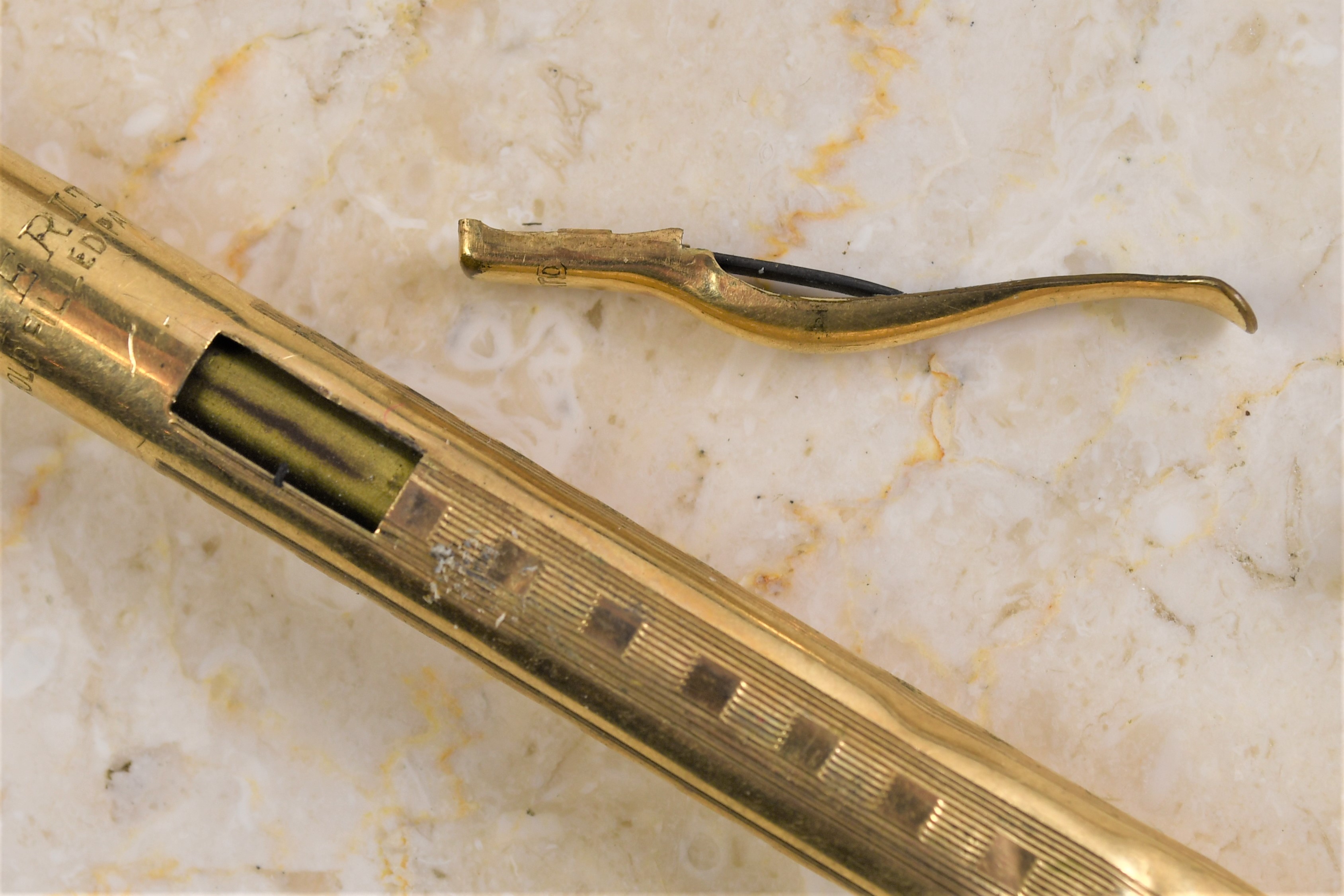
The top one is a gold colored, cylindrical and had a patent date on it that isn’t in American Writing Instrument Patents 1799-1910 – so of course I had to bid on it.  When it arrived, though, I suspected something might be amiss:


Although it operates like a leadholder, with a piece that screws down over jaws and crimps them together to hold something, the “something” this was designed to hold is very thin and flat – unless someone in the Nineteenth century was offering really skinny broad italic leads, I suspected this might not be a pencil.

Ah, the good old days of patent searching, before the book came out . . . when all I had was a patent date and no alternative but to plow through the hundreds of patents issued on that date without knowing what I was looking for . . . the date in question was February 1, 1881, and there were 275 patent issued on that date:


It was the perfect way to spend yet another pandemic evening, mindlessly looking at patent after patent, until this one finally surfaced: John H. Crowell of Providence, Rhode Island received patent 237,093 for a magazine toothpick, with replaceable picks made of “quill, whalebone or other elastic material” carved in the shapes of little flat footballs.  It’s even a “magazine” toothpick, with a place inside the barrel to store spare picks.


Cool.  But definitely not a pencil.   If it had pearl slabs like that great double-ended toothpick with  Ephraim Johnson’s “pearl patent” on it like the one I posted a few weeks ago (see page ), that would be one thing.  Since I’m not launching on a binge collecting things that pick funk from between Victorian teeth though, I’m not really sure what to make of this one.

The grey metal thing looks like a pencil, but if it is, it appears to have exactly zero moving parts: there’s a hole in the front about the size of a standard 1.1mm lead, but it is one solid piece of metal.  Maybe it’s a stylus or something with a replaceable stylus?  If so, I probed around and there’s doesn’t seem to be anything in there to latch onto anything.   On one side near the end, “Kerr 2" is stamped:


On the other, what looks like “D.D.M. Co.” – although it could be “D.B.M.”:


Until I have a better explanation, the Kerr/DDM is a solid “maybe” for inclusion in my pencil collection.  

This last one is definitely a pencil, but the “mechanical” part doesn’t relate to how the lead is propelled:


There’s a weird metal cap that looks like the end of a bullet pencil at one end, but with a loop of string attached.  In addition to the advertisement for Indianapolis stoves, this pencil includes an odd admonishment:


“If you can’t remove this otherwise, then cut the button hole, as it is seven years bad luck to cut, burn string or break pencil.”  There’s a glimmer of hope at the top, just under that metal cap:


“Magic Holetite / U.S. Pat. Off. 343067.”  Could this tell me what this is and how it works?  No, but at least it tells me who was behind it – that this isn’t a patent number, but a reference to the patent office, where trademarks are also filed.  “Magic Holetite” is included in American Writing Instrument Trademarks 1870-1953:


The mark was registered by James J. Sanders of the Sanders Manufacturing Company, 124 Fourth Avenue South in Nashville, Tennessee.  Sanders claimed to have first used the mark on both wood cased and mechanical pencils on August 7, 1936.

Sanders filed other marks on behalf of the company, for “Colofour,” “Hexagraph,” and “Promotion.”  Sanders Manufacturing Company was a game and novelty maker in Nashville for decades: they were hiring as late as 1995, and I found references to the company’s “PoW-WoW” game in 1924 - “the game that makes them all laugh”:


Like this goofy pencil.

Friday, July 9, 2021

What's Right and What Isn't

This article has been included in The Leadhead's Pencil Blog Volume 7, now available here.


If you don't want the book but you enjoy the article, please consider supporting the Blog project here.

I don’t remember exactly where or how this one came my way, just that it was stuck in the “gotta shoot this” pile for long enough to forget:


This is . . . mostly . . . an Eversharp Dollar Pencil:


That cap, however, is just ridiculous.  Given that there’s a good bit of the price sticker left, it's surprising that the cap isn't original . . . unfortunately, there's not enough left of the sticker to see what the model number was:


I ran down the chronology of the different variations of these Dollar Pencils in Volume 4, page 3.  It was an oversimplified chronology, but it was the best I could do at the time:


The caption for this image in Volume 4 was: “From the top, 1929, 1930, 1930-ish, 1931-ish, 1932, 1933-34. . ish.”  Those last three, though, don’t reflect all of the variations within these dark years lacking in meaningful factory documentation.  The ribs found on the barrel ends of today’s subject are not a one-off: this is an established variant:


The red example at center, I believe, represents what the cap should be.  The green one has an advertising logo on it and is likely specially made for one customer, and that black cap is . . . yeah, “ridiculous” is the best word for it:


I count six distinct variations of Eversharp Dollar Pencils with plastic caps, shown from top in chronological order of production:


I think I have this right, subject to better documentation surfacing in the future.  From top, the first one has a vestigial button to conceal the vestigial bolt hole from the earlier flattop series (I’m assuming as leftover barrels were exhausted).  Second from top would be the next logical step.

Everything else is conjecture as to what came first.  I’d assume ribs were a design feature that was added earlier, then dropped to cut costs as the Depression deepened.  The fourth and fifth ones down appear to be the variation illustrated in Eversharp’s 1932 catalog:


Cataloged colors in gold fill trim included jade and “silver ebony,” while chrome trim models included “plain green,” “plain red” and “jet black.”


Thursday, July 8, 2021

Chasing and Fixing Signets

This article has been included in The Leadhead's Pencil Blog Volume 7, now available here.


If you don't want the book but you enjoy the article, please consider supporting the Blog project here.

The DeWitt-LaFrance Company is one of my long-running obsessions.  Before the company was sold to the Carter’s Ink Company in 1925, DeWitt-LaFrance made writing instruments for several different companies, including “Signet” brand pens and pencils for the United Drug Company’s chain of Rexall stores.

Signet pencils - “Sold only by the Rexall Stores” – were offered in all-metal form, but it was also one of the only brands DeWitt-LaFrance made which were offered with hard rubber barrels.  Rob Bader recently had one up for bids, and I was quick to jump at it since it filled a gap:


Until this one surfaced, I had only seen Signet pencils in red or black hard rubber - never in a bit-o’-both mottled:


The two red ringtops came to me as they are shown, like little dueling pistols in a Signet box that was probably intended to contain a pen and pencil set rather than two pencils.  What the heck though . . . 


The addition of a mottled hard rubber was equal parts blessing and curse: it’s nice to know that barrel material was used -- but now that I do, there’s some other gaps to fill, like a ringtop in black and a full-sized pencil in mottled hard rubber. 


After this picture was taken, another online auction brought a little pile of parts to my doorstep, and one of the ‘also included’ things I wasn’t targeting was this:


There’s my full-sized Signet in mottled hard rubber, but with a gaping hole where the clip should be.  That is usually a death sentence and a one-way trip to the parts bins for these – I’ve got a few other clipless DeWitt-LaFrances in my bins, too. 

This time, however, I was determined.

I talk quite a bit about patents here at the blog, usually from a historical perspective because they connect inventors with the firms which made their inventions - but for this challenge, I looked up the patent for the clip to see how it was constructed.  William P. DeWitt and David J. LaFrance were awarded patent number 1,350,412 on August 24, 1920 for the clip found on pens and pencils like these:


From the drawings, it looks like all that secures these clips in place is a thin piece of metal – it’s a clip-on clip:


More helpful still is the text of the patent, which states the clip “may also be quickly detached from said cap and applied to another without injury to the clip and without necessitating the use of rivets, fasteners or the like.”

That sounded promising, so I looked for a beater DeWitt-LaFrance pencil that might serve as a donor.  I found the perfect candidate:


The barrel on this Superite looks like it was slammed in a desk drawer a few times, but the clip is in good shape and is stamped “Pat.” rather than “Pat. Pend.,” correct for the later-production hard rubber models:


Now, to read the instructions in the patent text: “to accomplish the removal of the clip pressure must be applied to the inner face of the rectangular portion . . . until said end is projected from the slot far enough to clear the end of said slot, whereupon pressure applied to the end . . . in the direction of said rectangular end will result in the withdrawal of the extremity . . . of the spring . . . from the interior of the cap.”

OK, so push the clip out and then up, and you’re done.  That might be a piece of cake for a fountain pen cap, where you have half an inch or so to work with and any number of gadgets to apply pressure from the inside, but that isn’t possible with a pencil since there’s no way to get inside it.  The mechanism is in the way, occupying nearly all the space inside, and it’s either press fit or soldered in place.

I come from the Frank Dubiel “what’s the worst that can happen” school of repair.  This was the first time I’ve tried this, so I thought my badly damaged Superite might as well give its life if I can learn something from it.  If I can’t push from the inside, I thought, maybe I can pull from the outside . . . 


I don’t remember where this plastic stick came from – maybe from a “pick up sticks” game or something – but its tapered end is perfect for things like this.  These clips are so robust that you never see one broken, so I guessed it should hold up to shoving my plastic rod underneath, then pushing down on the tang to pull the top end away from the barrel like a seesaw.  

It worked, and as I pushed down on the tang I saw a gap into which I could fit the end of a small screwdriver and work the clip upwards by pushing upward:


I’ll be damned.  It popped right out, just like the patent text said it would:


Next was the tough part.  I needed about six hands to get the clip installed, so I couldn’t take any pictures while I was doing it.  I lined up the end of that spring with the slot, bent the spring down, then pushed the clip downwards to tuck the end of the spring under the barrel material.  After ten minutes or so of fiddling, success:


In retrospect, I should have put something between the top end of the clip and the barrel to keep it from scratching the rubber – but that would have made things even tougher to get that spring underneath the barrel.  To keep the top end of the clip from gouging the rubber, I noticed a small notch in the top of the clip which is probably there exactly for this purpose.  I wedged the end of a toothpick underneath the top end of the clip, lifting it slightly away from the barrel as I worked it downwards:


Then – I’ll be damned again – as soon as it cleared the lip of the rectangular opening, it snapped right into place, and it functions in its new home every bit as good as new:


With a restored full-sized, mottled Signet pencil now in hand, I reshot a slightly less incomplete family picture:


All I’m looking for now is a black ringtop, I tell myself, trying so hard to ignore the elephant in the room . . . that other black Signet on the shelf, laughing at me:


With chased lines on the barrel.  Do these also exist in ringtops, or in red hard rubber, or in mottled?  It never ends.


Wednesday, July 7, 2021

Factory Errors

This article has been included in The Leadhead's Pencil Blog Volume 7, now available here.


If you don't want the book but you enjoy the article, please consider supporting the Blog project here.

Yesterday’s article reminded me to show you an EVRDA that I like for all the wrong reasons:


The EVRDA, like the early metal Century pencils, were made by the Blake Pencil Company.  C.E. Barrett & Co. supplied pencils to Century, but marketed “EVRDA” pencils on its own account through another Barrett company, the Chicago Safety Pen Company (see Volume 6, page 175).  I bought this example because I had ringtop examples in silver plate and gold fill, and this one was listed as being in sterling:


However, when the sterling example arrived, there was something amiss.  All the examples I had on hand – not just the ringtops, but the side clip examples too – had imprints which were neatly centered:


This sterling example, however, has lettering which is staggered – “EVRDA” is nowhere near centered over “Sterling / Pat. Applied For.”  There’s more, too . . . on the barrel, underneath the cap, there’s a duplicate imprint: the “Pat. Applied For” is clearly visible, and to the left of it you can see the very bottom of the “EVRDA” name.  Underneath the D in “Applied,” there’s a weird star-shaped indentation:


The star doesn’t appear on any of my other EVRDA pencils, or on the Century-marked ones, either.  Factory error?  Closeout model made from leftover parts?  I’m not sure there’s any way to know.  

If factory errors on pens and pencils attracted the sort of interest as double-die coins do in the numismatist’s world, I’d be even more excited about the EVRDA – and doubly so about this next one:


This is a Mabie Todd “Fyne Poynt” pencil.  I bought it for the nice engraving, and when it arrived I was surprised by the weight of it, even though it isn’t marked 14k.  The cap, which might be a replacement, proved to be the most interesting thing about it.  Instead of the typical “Fyne Poynt” imprint on one side of the cap, this one has that imprint twice, once on each side of the cap:


That’s no variation; this one is clearly a factory error – a double die, as the coin guys might say:


The two imprints actually overlap.  

Tuesday, July 6, 2021

While I'm On the Subject . . .

This article has been included in The Leadhead's Pencil Blog Volume 7, now available here.


If you don't want the book but you enjoy the article, please consider supporting the Blog project here.

Yeah, I know . . . once I start talking about the Rex Manufacturing Company, I keep talking about the Rex Manufacturing Company.  

In the last volume, I wrote about the history of The Century Pen Company (Volume 6, beginning on page 163 - the three-part series was also picked up by The Pennant magazine).  Something from that story bugged me: I had never found a Century pencil that I could conclusively attribute to Rex, and I thought they had to be out there somewhere.

Century Pen Company, according to the corporation’s own records, never actually made anything; the company only assembled pens from parts made by other manufacturers.  Early in the company’s history, the Parker Pen Company supplied all of the company’s parts, since George Parker and William F. Palmer were stakeholders in Century.  However, Parker had no officers or seats on the board of directors after 1916 (Volume 6, pages 170-173), leaving Century free to source parts from anywhere.  During the 1920s, Century turned to C.E. Barrett & Co. in Chicago; by the 1930s, Barrett was one of Century’s biggest creditors and, by 1938, Barrett’s patience ran out (as did the patience of Century’s other creditors) and the company was forced to close and dissolve.

Barrett sourced pencils (at least the mechanisms - the barrel was just a simple tube threaded at either end) from The Rex Manufacturing Company; however, I had not seen a Rex-made pencil branded for Century . . . until, of course, very shortly after that series of articles published.


Maybe the articles I wrote enticed the seller to list it. Almost certainly the recent attention Century has received drove up the price.  The trim is a bit worse for wear, but I’m not complaining:


The top was dented, but fortunately it is a generic Rex cap with the “Four Horsemen” patents listed (for a rundown on all of them, see Volume 2, page 103).  I had a spare around, and while it also could use replating, at least it is free of dents:


And, it fills in a gap in my small sampling of Century pencils:


Monday, July 5, 2021

Oh Crap! Oh . . . Wait . . .

This article has been included in The Leadhead's Pencil Blog Volume 7, now available here.


If you don't want the book but you enjoy the article, please consider supporting the Blog project here.

I couldn’t wait for this one to arrive in the mail:


It’s a Rex-made Webster, bearing the McNary 1924 patent date:


Finding Rex-made pencils with faceted barrels is a rarity - doubly so in the smaller sizes, and I knew this would fit perfectly into my group of Websters:


Webster was originally a Rex house brand (see one of my favorite articles, “Help With the Cheese” in Volume 3, page 108).  Later, Rex must have sold the rights to the name to Sears, Roebuck & Co. and continued to supply Sears with Rex-made pencils for some time, likely until the company’s patent dispute with Parker in 1929 (after which, no surprise, Parker started suppling Parker-made Websters to Sears).

This grouping shows the ringtop models, starting with pre-1924 metal pencils, 1924 McNary patent models, and “Four Horsemen” patent ringtops from 1925-1929.

Full-sized pencils were also offered, in a wide range of colors and in both hard rubber and celluloid:


Only that top example is faceted, but all have the same neat Webster imprints on the clips:


Pencil in hand, I went down to the museum to triumphantly place my new find in its proper place, only to find:


Oh crap.  Dammit . . . this is why I take all these pictures and write all of these articles, so I don’t make mistakes like this and spend good money for things I already have!

Dejected, I was, but determined to find some little reason . . . any little reason . . . to justify having two of these laying around.  I took my loupe in hand to scour the imprint for even the slightest difference.  Fortunately, it didn’t take long:


The other one isn’t a Webster: it’s marked “Y & H.”  I’d forgotten all about this one, and I’d never even photographed it after I couldn’t figure out what those letters meant.  

Whew.  The Y & H is now refiled in between Webster and “Ye Wm. Penn” where it belongs, and the Webster has now taken its rightful place.  Now the next challenge begins: figuring out what Y & H stands for – maybe “Yee and Haw?”