Sunday, July 4, 2021

That's All I'm Going To Say About That

This article has been included in The Leadhead's Pencil Blog Volume 7, now available here.

If you don't want the book but you enjoy the article, please consider supporting the Blog project here.

When I sit down to write one of these articles, my method of picking the topic of the day is very non-scientific:  I open the file folder containing all the pictures I’ve taken, and I scroll through until I find something that I think would be fun to write about.  As the more meaty subjects get pulled out and placed in the “published” file, what's left behind are the brisket tips -- good stuff, worth photographing and definitely worth noting here, but more of an appetizer than a meal.  While each of these notes might not be enough for a complete article, today I'll string a few of these little notes together into a little tune.  

The Colorgraph:

I haven’t written about the Colorgraph for some time, most recently in Volume 2, page 95.  Since I’ve found so few of these duplex pencils over the years, it’s one of those brands I’ll chase even if I think I already have one, in the hopes there will be some tiny difference that will add to the story.  Recently, I chased and caught an example in black:


Unfortunately, it was identical to my other examples (and I still haven’t found an intact earlier model, with the longer nose).  So . . . all I have to tell you is that they also come in black.


The Ruxton:

The 1,000th post here at the Blog (Volume 4, page 351) covered the Ruxton well, including the company’s archive of prototype and shop models as well as production examples – including some boxed ones.  I bought this one because the box was different - the other examples in my collection are dark blue with black lettering, but this one you can actually read:


The pencil is extremely clean, but unfortunately there’s nothing different about it from what I’ve shown you already:


The Welsh Manufacturing Company:

This one was in a box lot of junk that came my way, and it wasn’t my intended target.  
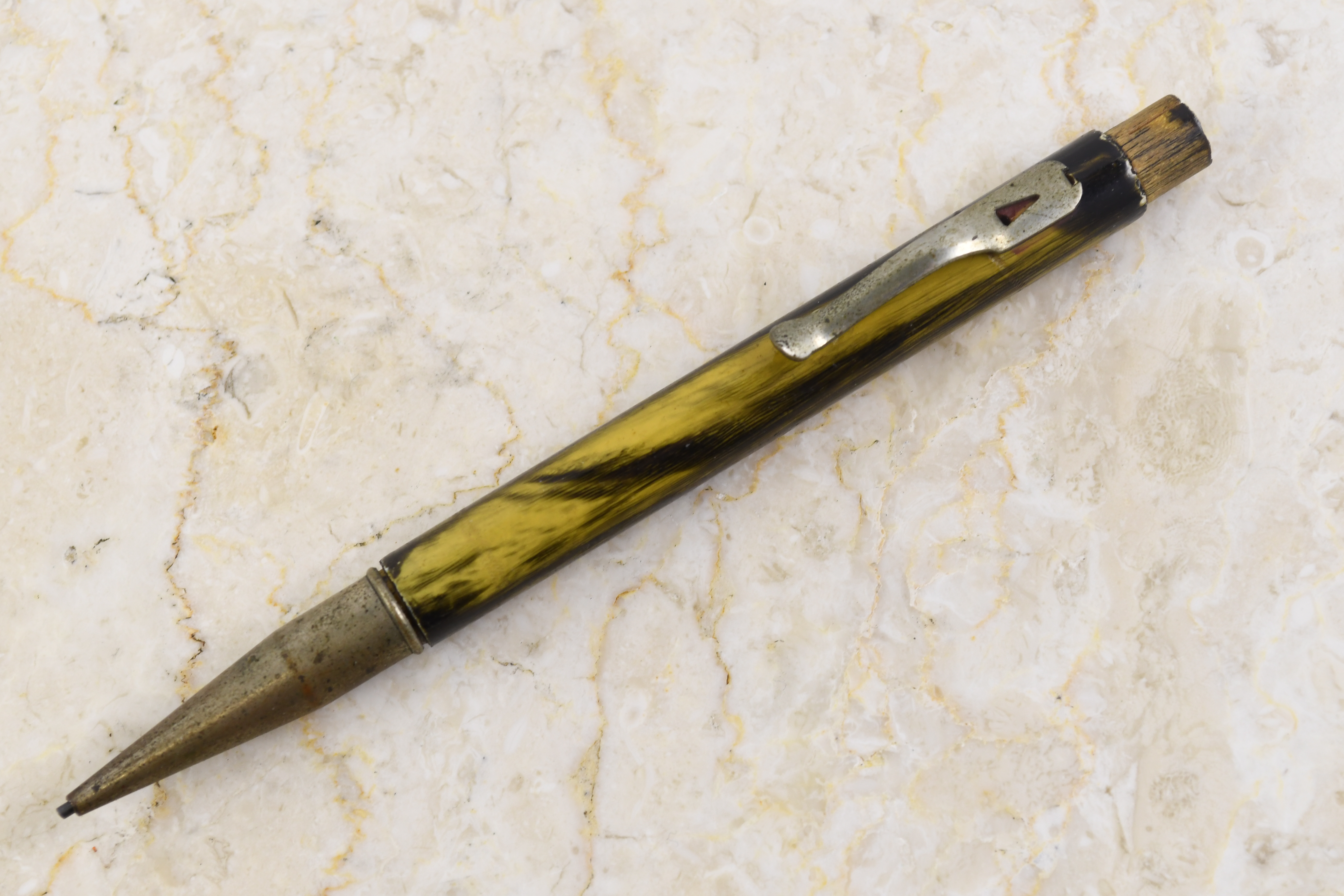

From the clip and the nose, I knew it was made by the Welsh Manufacturing Company of Providence, Rhode Island.  Here it is shown alongside other variations on the theme:


I would have just put it in the Welsh drawer without photographing it, except for one small detail:


This one has a painted wood barrel.


The “Arrow Double”:

I’d never heard of this one before:


It nearly identical to one already in my collection, with two exceptions:


First, it lacks that great arched “14kt Gold Plate” imprint on the clip:


And second, the producer’s imprint on the top is different.  I say producer, because I don’t know who manufactured either one:


The one I had is an Ajax; this new one is marked “Arrow Double.”  I haven’t been able to discover anything about the Arrow Double in the year since I found it.


The Bridge Set:

I had such high hopes for this next find:


This nice box contained a beautiful set of sterling pencils marked with card suits:


I wrote about a similar set in a recent article about bridge pencil sets in Volume 6, page 194.  On page 196, I showed an English set by William Manton along the same lines that Joe Nemecek had given to me; it was newer than I had hoped, bearing a hallmark dating it to 1979.


This set appears to be older, and I expected hallmarks that would be a bit more . . . well, a bit more vintage than me, anyway.  Alas, there are no hallmarks and it appears to have been made for export to the United States, marked only “Made in England / Sterling Silver.” 


An Interesting Sheaffer Sharp Point:

This Sheaffer Sharp Point is on the early side of production, with a bowler clip and that zigzag-with-dots pattern:


What’s inside isn’t what I would expect.


The earliest Sharp Points look like this inside (see Volume 4, page 324):


While later Sheaffers (early 1920s on) look like this:


I’m not sure where this one fits in.


Cross-Built:

Here’s three very similar pencils . . . the bottom one is a typical Cross Century:


Two are marked on the clip: the Cross, and one marked “Swank.”


The Swank brand appeared in Volume 1, page 345 – on a ruler pencil/tie clip pencil.  Swank, Inc., as reported in that previous article, survives as a division of Randa Accessories.  The third pencil has a plain clip, but a nice imprint on the barrel:


It’s a “PAT One Twenty.”  PAT was a trademark of Ketcham & McDougall, Inc., better known for making those pencils attached to a pin by a retractable chain.  The company claimed to first use the mark on September 18, 1936, according to the trademark registration:


All three of these pencils share very similar features, and my suspicion is that Cross made all three.  The Swank and PAT One Twenty share another element - that black plastic ring in the middle:


Welty’s

At the Krinke auction, one of my impulse buys was this fountain pen, complete with the box but with a conspicuously absent pencil:


The imprint is on the barrel, concealed under the cap when closed:


The pen was made by DeWitt-LaFrance, and I wasn’t planning on chasing it until I saw how small it was:


I wrote about the Welty’s DeWitt-LaFrance pencils in Volume 3, page 158; I came across the pen at some time since.  If the matching Welty’s pencil surfaces, it would be about the smallest DeWitt-LaFrance pencil I’ve seen.


The Baby Jumbo:

The Baby Jumbo is in Volume 1, page 373, and it’s not really “mechanical.”  A wood pencil is wedged in the neck of a glass bottle containing candy:


There was another example up for bids at the Krinke auction; I took “just in case” pictures of it before the auction started, because this one had the original paper label on it:


It would have been nice to bring this one home, but the pencil was identical to what I had, and the only thing the label provided was a cute admonishment to “Write your mother a letter today.”  When the bidding got a little crazy on this one, I couldn’t justify spending what it would take - so my “just in case” picture will have to do!

Saturday, July 3, 2021

Odd Ducks . . . Or Penguins

This article has been included in The Leadhead's Pencil Blog Volume 7, now available here.


If you don't want the book but you enjoy the article, please consider supporting the Blog project here.

Don Jacoby was a man after my own heart.  He was every bit as enthusiastic about the campy, the odd, and the just plain goofy as he was about things we “serious” collectors should be.  A few random things I found in his collection are worth a chuckle, but none of them merit an article all their own . . . so today I thought I’d put these odd ducks (or, borrowing from the “Penguins in the barnyard” reference, penguins) on parade today.

First up is a “trick” pencil – one that does something else in addition to writing:


The imprint on the side reads “Pen-N-Pencil Co. / New York, USA / Pat. Apl’d. For:”


It looks like a combination pen and pencil, but under the cap is something else entirely:


It’s a postal scale – hang a letter on it, and it will tell you how much your item weighs:


According to Wikipedia, the postage rates shown were in effect beginning July 6, 1932 and continued until raised by a penny on August 1, 1958; this looks to be on the earlier end, I should think.  The box adds only the location where it might have been sold - but I think given that the paperwork was still in the box, this might be how it was originally sold:


Ah, that paperwork . . . instructions for “The New Marvel Two-in-One Combination Postal Scale and Mechanical Pencil”: 


Early on here at the blog (Volume 1, page 91), I provided pictures of very similar paperwork from the Pen-N-Pencil Company, for “The New Marvel Two-in-One Save Your Eyes Combination Magnifier and Mechanical Pencil,” with a lucite magnifier on the end:


Both instruction sheets identify these as “‘Twinpoint’ Quality Products,’” and both indicate the same address, at 1 West 47th Street, New York.  Both also elicit a chuckle from me whenever I see them.

Far more serious, however, is this next one:


Serious, in that there are loads of pencils like these, with little floating (or actually and somewhat ironically, sunken) ships in the top end . . . and a person with an OCD collector gene would likely try to find examples with all the different ships.   This is a pool into which I have resisted dipping so much as a single toe, for fear that I might fall in.

The pencil is unmarked as to manufacturer, packed in a plain, unmarked box along with rudimentary instructions.  “R.M.S. ‘Queen Elizabeth’” emblazoned on the side and a tiny model of the ship in the top end:


The representation looks pretty good, with twin smokestacks and a pronounced bridge.  The Queen Elizabeth was launched on September 27, 1938 but the pencil was probably offered as a ship-board souvenir at some later time – given the outbreak of World War II, she served as a troop carrier during the conflict and didn’t enter her intended service as an Ocean Liner until October, 1946.  She was replaced by the QE2 in 1969.

As people prayed they didn’t end up underwater a ship in a pencil, this last pair also bears mention:


These little key ring pencil are readily identifiable as examples of “Lipic’s Streamlined Pencils,” from this store display featured here in Volume 1, page 230:


Each is marked with a reminder: “Jesus Never Fails”:


At least with a pencil chained to him, I’m sure he’d never fail to find it!

Friday, July 2, 2021

The Gift That Keeps On Giving

This article has been included in The Leadhead's Pencil Blog Volume 7, now available here.


If you don't want the book but you enjoy the article, please consider supporting the Blog project here.

One of my favorite pieces that came along with Don Jacoby’s collection was this one:


It’s a WASP pencil (WASP, for those who don’t know, is an acronym for W.A. Sheaffer Pen), and I’ve not seen one in this series in gray with chrome trim - and the trim on this one is much nicer than you’ll usually find:


The imprint on the reverse reads simply “WASP Pen Company, Inc. / Ft. Madison, IA USA”:


A few weeks ago I mentioned Roger Wooten’s excellent article in The Pennant, in which he outlines the history of the Universal Pen Company, organized by Sheaffer as a Delaware Corporation on July 23, 1928.  According to Roger, Universal Pen Company operated under that name, making pens and pencils marked “Univer,” until November 29, 1933, when the company formally changed its name to the “Vacuum-Fil” pen company.  Roger states that the company’s name was changed to The WASP Pen Company on May 29, 1936.

I can narrow down a production date for this pencil even more.  There were two closely related series of these pencils:


The other series is slightly shorter, and it included marbled plastics.  Clips are relocated higher on the barrel, and the stylized W is dropped:


There’s one other difference: the imprint adds the word “Crispline” on all the examples from this later series:


The stylized W clips were earlier; they showed up on the WASP version of the Sheaffer working togs pencil in the “Clipper” line in advertisements from 1939 (these WASP working togs pencils were covered well in Volume 4, page 143).  


Incidentally, the full advertisement is also shown in Volume 4, in the course of discussing “circuit board” WASPs in the article beginning on page 342.  Earlier versions of that same pencil sport the clips used on pencils marked Vacuum-fil, so the transition to that clip likely occurred sometime in 1938 or 1939:


My Crispline pencils, with their non-W clips, accompanied WASP “Addipoint” pens.  Jim Mamoulides did an outstanding writeup on Addipoint pens over at Penhero.com (the direct link is https://www.penhero.com/PenGallery/Sheaffer/SheafferWaspAddipoint.htm).  With Jim’s permission, here’s a shot he took of one in brown marble, showing the Addipoint imprint:


So how does the timeline fit together?  I answered that question – along with more than 2,000 other questions – in American Writing Instrument Trademarks 1870-1953.  Both the Addipoint and Crispline trademarks are included in the book.  Sheaffer registered the Addipoint name as number 359,075; in the application for registration, James Low indicated that the WASP Pen Co., Inc. began using the name on February 21, 1938.  Since the application was filed so quickly, on March 7, 1938, we can assume that specific date is spot on:


All of the Addipoint pens I found during my search sported these non-W clips.  Does that mean they were accompanied exclusively by pencils marked “Crispline?”  Not necessarily:


WASP’s application to register the Crispline name was also filed very shortly after the company first claimed to use it: “for fountain pens since March 27, 1940; for pencils since March 25, 1940; and for ensembles consisting of a pen and a pencil, since March 25, 1940.” 

These trademarks narrow the window, but also leave open some questions.  What did Addipoint pens look like between February 21, 1938 and March 25, 1940?  Were they the W-clip pens, and did the pencils that came with them sport the W-clip?  When was the W-clip introduced on models other than the working togs pencils?

Documentation is sparse, and when more information surfaces, with luck the answers will float to the surface.

Thursday, July 1, 2021

Aikin Lambert Update

This article has been included in The Leadhead's Pencil Blog Volume 7, now available here.


If you don't want the book but you enjoy the article, please consider supporting the Blog project here.

I wrote about the early history of Aikin, Lambert & Co. in Volume 4, page 50, and Loyal Knight David Nishimura has ably documented J.C. Aikin’s asssociations with D.F. Foley (see http://vintagepensblog.blogspot.com/2012/06/dissolution-of-d-f-foley-co.html) and Aikin Lambert’s later transition from independent company to Waterman subsidiary (see http://vintagepensblog.blogspot.com/2012/12/waterman-and-aikin-lambert.html).

Aikin Lambert is one of those companies whose story intertwines with so many others.  The firm has wormed its way into several articles here, including those about the Chicago Gold Pen Company (Volume 6, page 114), L.C. Hardtmuth (Volume 6, page 218) and even Samuel Kanner and his flip-top Nupoints (Volume 5, page 111) – in each case,  Aikin Lambert made a quick cameo appearance, then darted back into the shadows.  

In recent months, a few more Aikin Lamberts have arrived which add a few more insights into the firm’s complex story.  This first one has a distinctly European look, perhaps somehow connected to the firm’s Hardtmuth connections:


There’s a nice monogram on the barrel that ends with “A,” but I’m not going to suggest any Aikin family connection.  Not that I didn’t go through my notes to see if any Aikins associated with the firm’s history went by the initials “E.K.”:


The trim on this hard rubber pencil is a little different, with more of a copper color than gold.  The firm’s name is imprinted around the nose:


This next one forced me to bid on a box lot of absolute junk, solely in order to get a closer look.  It was shown in partially closed position, but for what I paid I figured it was worth a shot trying to get it going again:


When it arrived, I was pleased in two respects.  The lighter fluid trick worked like a charm and I was able to get it working smoothly again, although there’s not much that can be done about the wear and dents.  I was also pleasantly surprised to see the ALCO hallmark on the barrel.  


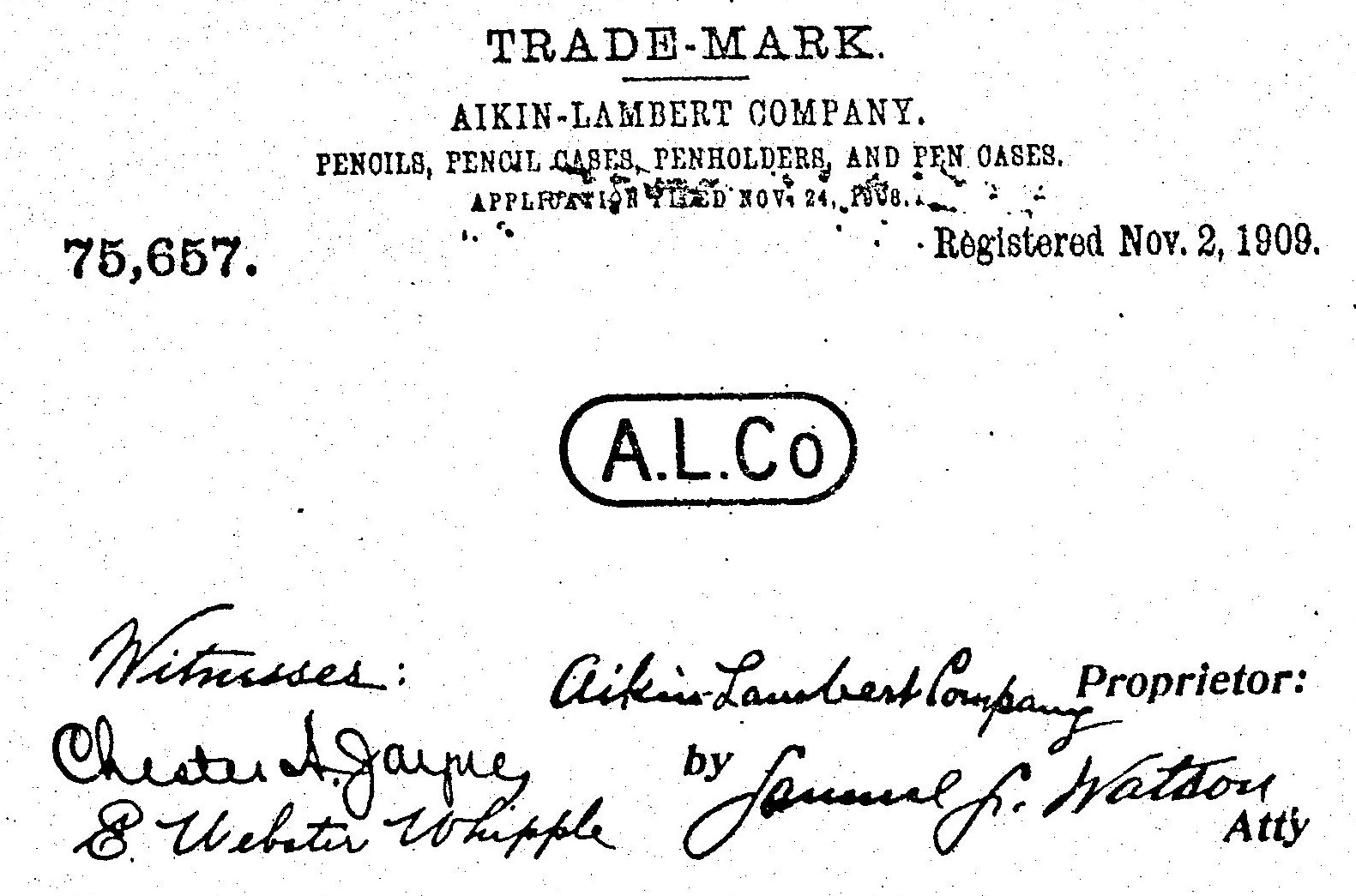
This mark appears in American Writing Instrument Trademarks 1870-1953, registered for pens and pencils by the company on November 2, 1909.  The application was filed on November 24, 1908, but unfortunately at the time it was filed, the date the firm first claimed to use it was not typically reported:


I suspect this was made later, perhaps in the late teens, after the firm was absorbed by Waterman.  Since Waterman was so resistant to the notion of offering mechanical pencils, its earliest “sets” consisted of Waterman pens paired with Aikin Lambert pencils – it would be nice to find documentation of a Waterman set including a magic pencil like this one, but I haven’t seen anything like that.  

Here’s another “junker” that came my way.  The seller properly disclosed that the upper barrel was split:


The seller did not mention how heavy it is, and from the weight I surmise this piece is almost certainly at least 9k gold.  I have several of these extending combination pens and pencils; all were based on Albert Bagley’s patent of January 1, 1850, but I’ve found examples marked with the names of several New York firms.  I was hoping when it arrived I would find another maker’s name on it, but if nothing else it would be good for parts:


And perhaps a nib:


J.C. Aikin.  The holder itself is unmarked, and nibs are readily swapped out, but I’m inclined to think the nib is consistent with the holder: as documented in Volume 4, page 50, J.C. Aikin & Co. was founded in 1864 – on the late end for these fluted combination pen/pencil outfits, but still plausibly within the window during which these were made.

The machining on the barrel is a little different than what is normally found on these, and this is typical of the sort of patterns Aikin Lambert used.  Maybe another one will surface in this pattern, but marked on the instrument itself with Aikin’s name.  For now, at least, this one is staying just as it is, and exactly where it is: in the Aikin Lambert section, where the firm connects with yet another family of pencils.