Saturday, September 2, 2017

For the Gentleman with an Envelope

This article has been edited and included in The Leadhead's Pencil Blog Volume 5; copies are available print on demand through Amazon here, and I offer an ebook version in pdf format at the Legendary Lead Company here.

If you don't want the book but you enjoy this article, please consider supporting the Blog project here.

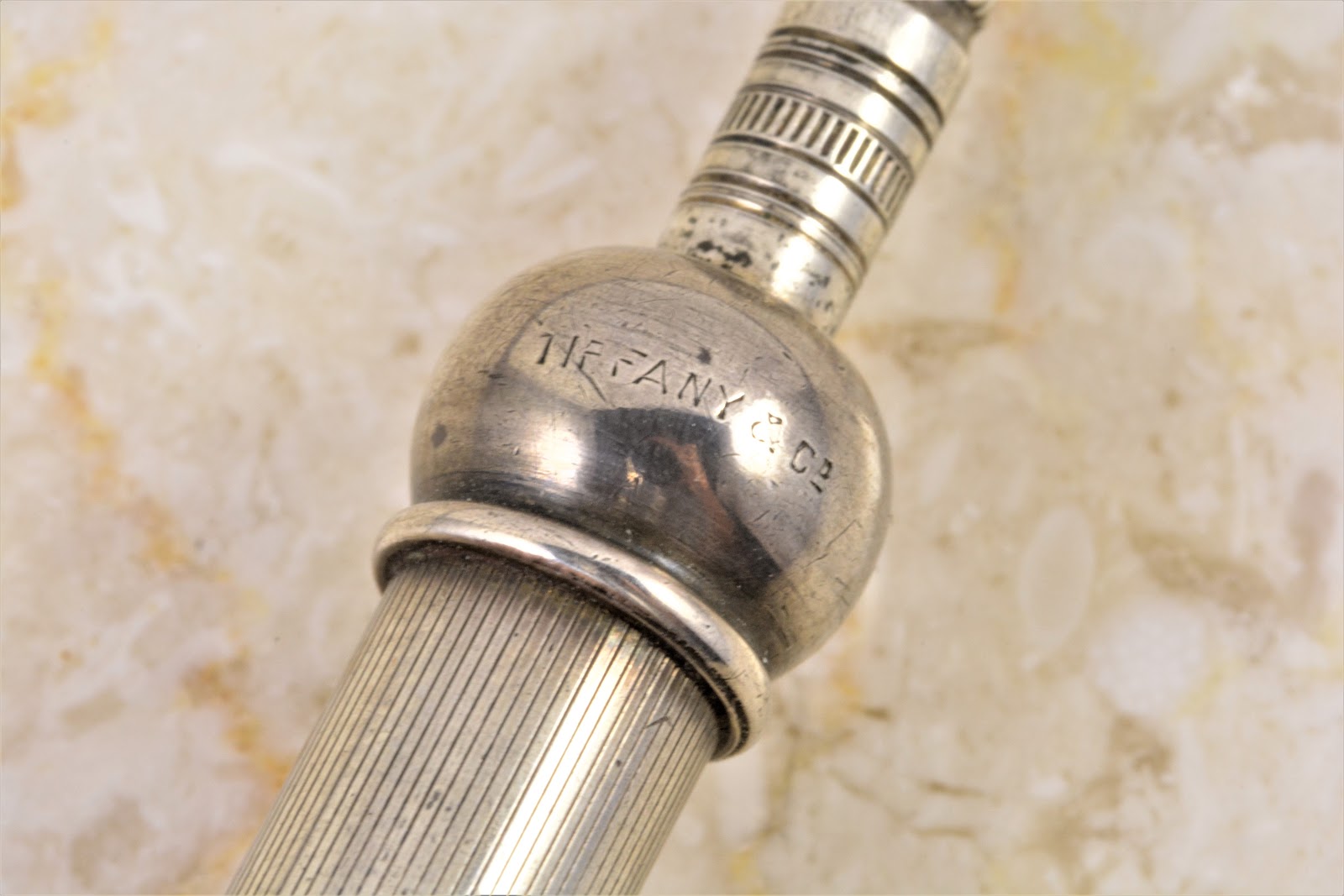
Last year I had the opportunity to buy a collection of Victorian pencils from Alan Hirsch.  For what I paid, I had to sell a few in order to keep the ones I wanted for my collection, and this was one of the keepers:


The maker’s mark is stamped on the barrel, which indicates that the piece may be Victorian in style, but it was made after 1912 according to the W.S. Hicks trademark for the big H with a W and an S above and beneath the crossbar (see http://leadheadpencils.blogspot.com/2017/08/the-big-h.html and, of course, American Writing Instrument Trademarks 1870-1953).


Best of all, this one was made by Hicks for one of its most loyal and prestigious customers:


Tiffany & Co.

Friday, September 1, 2017

An Acid-Etched Eversharp

This article has been edited and included in The Leadhead's Pencil Blog Volume 5; copies are available print on demand through Amazon here, and I offer an ebook version in pdf format at the Legendary Lead Company here.

If you don't want the book but you enjoy this article, please consider supporting the Blog project here.

This one had an appointment to meet me at the Raleigh show this year:


At first blush, it looks a lot like one of those sterling hand engraved Eversharps, but it isn’t . . .


The barrel on this one is acid etched to create that pattern, not hand engraved:


These are exceedingly difficult to find and, we know from the imprint, were a very early experiment by Wahl soon after the company took over production of Charles Keeran’s Eversharp:


The imprint is the two-word “Ever Sharp,” with no mention of Wahl.  Without the side clip, you might wonder how I could be certain this is Wahl-made: the answer is that there is documentary evidence that the ladies’ size was introduced by Col. William Smith at the 1917 Stationers’ Banquet in Chicago in January of that year . . . as reported in the February, 1917 issue of Office Appliances, at page 41.


I read this excerpt, which describes the ladies’ model as “a trifle shorter than the usual Eversharps” and . . . eequipped with a ring on the top” as an indication that these were new.  The tidbit surfaced in the course of researching “Wahl, Sheaffer and the Race for Boston,” which appeared as a two-part series in The Pennant in the winter, 2015 and spring, 2016 issues; I reformatted the article as a series of posts here, beginning at http://leadheadpencils.blogspot.com/2016/12/wahl-sheaffer-and-race-for-boston-part.html (the installment which refers to this excerpt is the third installment).

Before there were Wahl Pens, Wahl’s only writing instrument was the Ever Sharp, and the Wahl name wasn’t included.  After the purchase, for a brief time Wahl continued to market Boston Safety Fountain Pens under its original name, not adopting the Wahl Pen moniker until a short time later.

Was this one of the pencils Col. Smith handed out to the ladies in attendance at the 1917 Chicago Stationers’ Banquet?  Sadly, no.  The article indicates that those were gold filled.  Additionally, this example doesn’t have a ring on top, whether the original top was replaced with an interchangeable cap from the side clip model or whether it was specially made for a special sort of barrel.  I also wonder if that original batch from February, 1917 didn’t also have the names of the ladies in attendance engraved on their barrels – after all, that’s what Col. Smith did when he handed out Boston Fountain Pens the preceding year.

So I’m fairly convinced that this pencil was made early in 1917 – after the Chicago Stationer’s Banquet in January, 1917, but before Wahl’s name was added to the imprint later in 1917, and before”Ever Sharp” was contracted to one word in 1918.  .

Thursday, August 31, 2017

Everybody and their Brother

This article has been edited and included in The Leadhead's Pencil Blog Volume 5; copies are available print on demand through Amazon here, and I offer an ebook version in pdf format at the Legendary Lead Company here.

If you don't want the book but you enjoy this article, please consider supporting the Blog project here.

Seems like just about everybody made pen/pencil combos that look like this one:


I’ve shown you ones like this made by Mabie Todd.  Albert Bagley and Hicks also made them, although the Bagley version usually has an elaborate finial at the top.  This one, however, is marked Rauch:


The nib is a “Ruby Point.”  


And here’s another one of these, along the same lines:


The nib this one had was an embarrassing steel nib . . . we’ll just skip that part and get to the second tanagiental relationship to Mabie Todd.  The imprint indicates Kurtz & Monaghan, in addition to the 10 karat gold content:


Kurtz & Monaghan was succeeded by Edward Todd & Co. in 1871 after Todd parted ways with John Mabie.

Wednesday, August 30, 2017

The Blue-Legged Devil?

This article has been edited and included in The Leadhead's Pencil Blog Volume 5; copies are available print on demand through Amazon here, and I offer an ebook version in pdf format at the Legendary Lead Company here.

If you don't want the book but you enjoy this article, please consider supporting the Blog project here.

Before celluloid became the material of choice in the mid-1920s, if a pencil wasn’t all metal, it would generally have been sheathed in hard rubber, formulated using either Goodyear’s patent of May 6, 1851 or for a brief time, Austin G. Day’s patent of August 10, 1858 (see 
http://leadheadpencils.blogspot.com/2016/09/that-third-interesting-holland.html).  Nearly always, Nineteenth-century pencils in hard rubber were black; much less common and more desirable among collectors today is red hard rubber.  “Mottled” (a mix of red and black, which had a woodgrain or swirled look) wouldn’t come until towards the end of the Nineteenth century.

What I had never seen before the Raliegh Pen Show was this:


Paul Erano had a little pile of Victorian parts, of which this blue hard rubber pencil was the star of the show.  It was missing a nozzle and is still missing the front retainer, but . . . blue?  The only other manufacturer I can think of offhand which ventured outside red, black or mottled was Eclipse, which turned out navy blue and grey hard rubber pencils . . . but not for another half a century, in the 1920s!

The all-metal pencil at the top is marked with the WL hallmark, signifying that it was made by William Ludden, the “red legged devil” of Civil War fame (see http://leadheadpencils.blogspot.com/2015/12/the-red-legged-devil-or-is-it-devils.html):


The blue hard rubber example, though, is marked Ludden & Taylor:


Although the Luddens had a long career, their association with Taylor was extremely short-lived; in fact, the only reference I could find to the partnership was a notice of dissolution filed in 1879, when Ludden appeared to trade on his own up through 1878 (see http://leadheadpencils.blogspot.com/2015/12/the-long-way-around-barn.html).  That dates this pencil with some precision to late 1878 or early 1879.

A blue hard rubber pencil would have stood out as much in a jeweler’s cabinet in 1878-1879 as it did on Paul’s table nearly a century and a half later.  What amazes me is that if the color was produced at all, why it wasn’t produced in greater numbers?

Tuesday, August 29, 2017

A Few Hickses

This article has been edited and included in The Leadhead's Pencil Blog Volume 5; copies are available print on demand through Amazon here, and I offer an ebook version in pdf format at the Legendary Lead Company here.

If you don't want the book but you enjoy this article, please consider supporting the Blog project here.

I’ve finally gotten around to photographing and putting away a few pencils made by W.S. Hicks. For starters, there’s these three:


These are marked only with a patent date of March 21, 1871, the larger two on the extender:


and the smaller one, in tiny lettering around the nose cone:


American Writing Instrument Patents 1799-1910 makes short work of finding this patent.  The date refers to patent number 112,917, issued to William S. Hicks:


These four were marked with the Hicks name:


I don’t remember where the top or bottom examples came from, but the middle two came from a collection I purchased from Alan Hirsch.  He has a good eye for nice metal wrok:


Last is this one, which came from someone who approached me online with her father’s collection:


This one is marked “Hicks Pat. Dec. 24, 1867":


American Writing Instrument Patents 1799-1910 comes to thte rescue again, with a listing for patent number 72,684, issued to Richard H. Ryne and assigned to William S. Hicks:


Patents are important for two reasons: the March 21, 1871 patent gives us a historical connection between an otherwise unidentifiable pencil and its maker.  The December 24, 1867 patent provided me with something else: the confidence to know that I could pull on the tip of that pencil, so hard that if I didn’t know what was going on inside I’d think I was going to break it . . .


and the nose would come out to reveal a reversible dip pen nib holder.  Alas, no nib with this one.

Red hard rubber Victorians are much harder to find than the black ones.  However, both red and black are easy to find in comparison with what I’ve got to show you tomorrow . . .

Monday, August 28, 2017

A Few Heaths

This article has been edited and included in The Leadhead's Pencil Blog Volume 5; copies are available print on demand through Amazon here, and I offer an ebook version in pdf format at the Legendary Lead Company here.

If you don't want the book but you enjoy this article, please consider supporting the Blog project here.

George W. Heath & Company is one for which I’ve got a real soft spot.  The Newark, New Jersey manufacturer made really nice stuff, not the least of which was Charles Keeran’s first Ever Sharp pencils, between 1913 and October, 1915.  Here are a few things that turned up while I was reorganizing the museum:


The magic pencil at the top is a fairly conventional piece, although that silverwork is outstanding.  The Heath hallmark - an H in a square with two tabs on either side, appears on the extender:


The mark does appear in American Writing Instrument Trademarks 1870-1953, but not as a federally registered mark; at the end of the book, I’ve included an appendix containing the pen-related sections of Trade-Marks of the Jewelry and Kindred Trades, published by the Jewelers’ Circular Publishing Company in 1896, 1904, 1915 and 1922.  Of the four editions, only the one published in 1922 is readily available (there’s a copy in the PCA’s library) – the others took quite a bit of digging to find.  Heath’s mark first appears in the 1904 edition (even though the firm had been established in 1892, the book's rudimentary 1896 edition didn't include it).  The address provided is Heath's earlier address in New York:


Heath apparently used the hallmark only on the company’s silver products.  It also appears on the cedar pencil holder at one end:


However, the two gold-filled magic pencils, are marked “G.W.H. CO.”:


All three of the magic pencils came from one source at the Chicago Show in May.  I was convinced that the silver one was also made by Heath, since that Jules Verneish profile was fairly unique to the maker.  However, the barrel was unmarked, and the extender is marked only with “Compliments of Metropolitan Life Insurance Company - 1909":


I was talking about this one to someone at the show -- probably David Nishimura, since he also appreciates Heath and he has a knack for pointing out little things that I’ve missed – and he pointed out the unusual location of the hallmark on this one:


On the nose cone.

Sunday, August 27, 2017

"Just" a Few Fairchilds

This article has been edited and included in The Leadhead's Pencil Blog Volume 5; copies are available print on demand through Amazon here, and I offer an ebook version in pdf format at the Legendary Lead Company here.

If you don't want the book but you enjoy this article, please consider supporting the Blog project here.

I fear that I might be getting jaded.  In my pursuit for the super early, super weird and super . . .super Victorian pencils, I often find myself disappointed when I pick one up to find that it’s “only” a Fairchild.   Sure, Leroy W. Fairchild was one of the most prolific manufacturers of the Nineteenth Century, but they were popular because they were beautiful and well made, like these examples, all of which were lounging around in a drawer and weren’t given their day in the sun until I was reorganizing the whole museum a few weeks ago:


The one with the lizard motif is particularly nice.  Leroy Fairchild took out design patents on several of his figural designs, including design patent 11,415 on September 16, 1879:


And this one, design patent 11,433, the very next week, on September 23, 1879:


Neither is identical to what’s crawling around this one, but I guess a lizard is a lizard . . . is a lizard.