Monday, January 9, 2017

Sharp In More Ways Than One

This article has been edited and included in The Leadhead's Pencil Blog Volume 4; copies are available print on demand through Amazon here, and I offer an ebook version in pdf format at the Legendary Lead Company here.

If you don't want the book but you enjoy this article, please consider supporting the Blog project here.

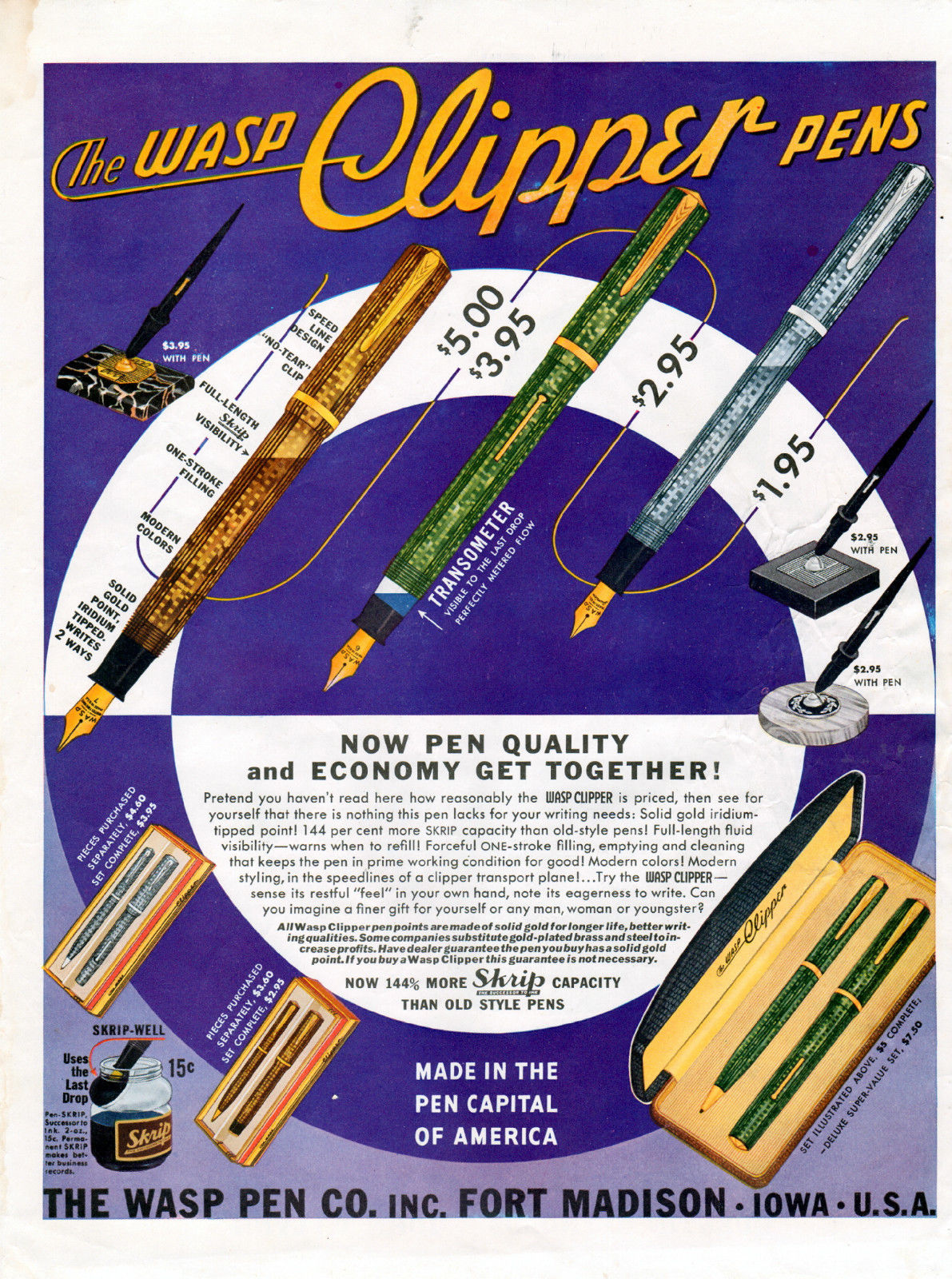
Sheaffer’s WASP subbrand (for those who don’t know, WASP is an acronym for W.A. Sheaffer Pen) appears on pages 142 and 143 of The Catalogue.  One of the more interesting patterns, nicknamed “circuit board” by collectors, appears on page 143.  Here’s an updated (and better quality) family picture of the ones I’ve found:


The proper name for these was the “Clipper,” but Sheaffer applied hat name to several different styles of WASP products, including birdseye (“screaming souls”) pencils, lahn-patterned pencils and more.  Matt McColm has done a great job analyzing the pens and pencils in these series, and he’s noted his observations over at fountainpenboard.com (the best post to look at, which references his other posts, is at http://fountainpenboard.com/forum/index.php?/topic/5768-circuit-board-wasp-clipper-generations/.   I’m not able to add much in the way of observations regarding the pencils themselves.  One quirky thing about these is that the trim bands on the smaller sized pencils are on the lower barrel, while the bands are on the caps on the larger ones:


And, as you can see, the plating quality wasn’t as good as what you’ll find on Sheaffer’s regular line, and WASP pencils are just as prone to the separation that occurs between the upper and lower barrels as their Balance cousins.

Matt divides the series into three “generations.”  The first has a nearly flat top piece, and note how the clips have a little bevel right at the top:


The second has a more pronounced cap with more of a pointed taper, and the sides of the clip are straight:


The third replaces this metal top “jewel” with a black plastic one – very poorly (note how awful the fitment is):


You can debate all day long whether these are generations, or subgenerations, or eras or epochs. Matt identifies three, which I can live with, but I’d note also that within that third group, there was a change in the plastic, from little cubes accented by four scribbly stripes to little cubes separated by wide bands.  Call it a fourth generation or what have you:


The earliest advertisements I’ve found date from 1938, and these show Matt’s “type I” pens and pencils:


Advertisements in 1939 show the same product lineup, augmented by the WASP version of Sheaffer’s “working togs” pencils:


In 1941, Bennett Brothers advertised WASP products.  Note that in this advertisement, type I pens and pencils are advertised alongside type II pens and pencils:


The type II style is most evident in the set shown at the bottom, but you can also see the straight sided clips in the more obliquely displayed sets on the left:


I’m not aware of any catalogs or advertisements showing the black plastic top jeweled models.  It would stand to reason, if in 1941 Sheaffer was advertising type II pencils for the first time, that the plastic jewels would have come later.  The wide band plastic appears to have been added at the very end, since green and brown pens with either plastic have been found with the plastic top end.  Blue, an uncataloged color, I’ve only seen with the wide bands and plastic jewels, suggesting they were at the end of the line, and reducing the metal content in its writing instruments might have been a priority after America entered the Second World War.  Evidence may surface in the future to fill in these blanks.

What I do know is that the WASP plastics were not exclusive to Sheaffer – or even to pens and pencils:


The plastic also occurs on pocket knives made by the Syracuse Knife Company.

Sunday, January 8, 2017

A Couple Autopoint Footnotes

This article has been edited and included in The Leadhead's Pencil Blog Volume 4; copies are available print on demand through Amazon here, and I offer an ebook version in pdf format at the Legendary Lead Company here.

If you don't want the book but you enjoy this article, please consider supporting the Blog project here.

As I was shooting photographs for yesterday’s article, there were two pictures that I really wanted to use, but as so often happens, in the course of writing the story, the story evolved into something into which they just didn’t quite fit. 

Since the story turned into a study of the different variations of bolted-on clips Autopoint used, this picture didn’t add anything to the discussion:


As far as clips go, this is the same, boring ol’ ball clip Autopoint had used on all of its large sized pencils from 1927 on.   But that barrel?  No, a clear barrel is something to make any die-hard Autopoint fan stand up and take notice.  This one came from Rob Bader at the Chicago show last May, and it’s a good match for the slim model my father, Roger Veley, showed to me at the 2012 Ohio Show:


I posted an article about his example some time ago (http://leadheadpencils.blogspot.com/2013/03/clear-as-they-come.html), but I wasn’t able to say much more than “ain’t she pretty.”   When it comes to rarity, I think dad’s example would be harder to find (slim models with that round upper ferrule are nearly impossible to find in any color).

The other footnote I wanted to add concerns the elusive Model S-76, Autopoint’s oversized pencils with a straight upper ferrule and exposed eraser:


The plastic nose sections were added to the Autopoint line as early as March, 1931 – at least, that’s the earliest advertisement that shows them and describes them as “new.”  Before that (an maybe concurrently for awhile, as old parts were used up rather than thrown away), these had Autopoint’s usual metal nose:


As I go on about rarity, sure we can talk about rare colors of known models we’ve seen out there, or about this or that odd doohickey that differentiates an example within a class to the handful of us on the planet who pay attention to such things.  This, however, is a different story.  This is the only pre-1931 model S-76 I have ever seen.

But who knows.  Maybe I need to get out more.

Saturday, January 7, 2017

A Tale of Three Clips

This article has been edited and included in The Leadhead's Pencil Blog Volume 4; copies are available print on demand through Amazon here, and I offer an ebook version in pdf format at the Legendary Lead Company here.

If you don't want the book but you enjoy this article, please consider supporting the Blog project here.

In a recent online auction, I couldn’t help but chase a lot of pencils, because I saw the center one in this picture lurking in the bunch:


They are just so nice looking that I couldn’t help myself, although I suspected strongly that it was a duplicate of one of these other two, but it isn’t:


The top example has the ball clip cataloged since 1927 and a round ferrule at the top end with a round top cap.  The center one has a two-faceted clip, meeting in a flat “ball” sort of area at the end; note that it also has the round ferrule, but it has the “diamond cut” cap introduced by Autopoint in October, 1937 (see http://leadheadpencils.blogspot.com/2016/09/maroon-my-butt.html).  Is this a mismatch?  I don’t believe so.  I believe during the depths of the Depression no leftover parts were wasted, so even if the faceted upper band was introduced to match the new diamond cut caps, I think the old ferrules would have been used up first.

But note something else about the clip in that lower example: It lacks the flat area at the ball end of the clip, terminating instead with two facets all the way to the end.  And the middle clip lacks any imprint, while the bottom example has an Autopoint imprint.  Is that always the case?  No:


These two “speckled green” pencils are particularly desirable among Autopoint fanatics – the color doesn’t come along that often, particularly with the matching colored ends.  But for this article, what is most interesting is the clips:


A chrome plated faceted clip, and a gold filled one with the flat ball area – and both with Autopoint imprints.

Speaking of wild colors, this one slipped under the radar online:


The plainish looking top and exposed eraser make it look later than it is, but I’d date this one to the mid-1930s.  It was cataloged in that same 1936 catalog I talked about in my last article on this as the model S-76 (I didn’t show you this page of the catalog earlier, though):


The oversized incarnations with the bolted-on clips these are hard to find . . . . let alone in a really wild bright blue!  All of these are marked only on that upper ferrule:


Which, I suppose, makes it irrelevant whether or not the clip is marked.  However, this family yields the wildest variety of these bolted clips:


From the top, a ball clip with script “Autopoint,” plain ball clip, two of the flat ball clips without imprints, a flat ball clip imprinted “Autopoint,” and a faceted clip.

Note: tomorrow’s article adds a couple of footnotes to this story.

Friday, January 6, 2017

The Real Story of Redipoint

This article has been edited and included in The Leadhead's Pencil Blog Volume 4; copies are available print on demand through Amazon here, and I offer an ebook version in pdf format at the Legendary Lead Company here.

If you don't want the book but you enjoy this article, please consider supporting the Blog project here.

Brown & Bigelow, the calendar printing company founded in St. Paul, Minnesota in 1894, began dabbling in the mechanical pencil business under the trade name “Redipoint” around 1918, as surviving examples imprinted with dates have established.   In April, 1921, however, the company got serious about its new brand, starting with this trade announcement in Office Appliances:


Note that this article indicates that the “new” Redipoints were being “placed on the market after having sold the pencil on a small scale for the past two years.”  Maybe the article has the dates fudged a bit, as I’ve written about marked Redipoints dated 1918; maybe the article is talking about the more conventional screw drive pencils, which became universally adopted and used throughout at least the end of the 1920s.

Through the rest of 1921, B&B advertised their new Redipoints, with the exclusive “Automatic Push Back” mechanism, in traditional metal barrels as well as in lightweight aluminum:


Beginning in March, 1922, advertisements indicated that the pencils are being made by the “Redipoint Pencil Division” of Brown and Bigelow:


Meanwhile, the Ingersoll Watch Company failed during the economic slowdown of 1921, setting loose three Ingersolls to pursue new careers, all of whom went into the writing instruments business.  Charles Ingersoll went into the manufacture of cheap Ingersoll Dollar Pens; Robert invented the repeating pencil which would become Esterbrook’s repeating pencil design.

The third Ingersoll, William H. Ingersoll, left for a brief stint as president for the Positype Corporation in New York; however, the June 8, 1922 issue of Printers’ Ink reported that he resigned to set up a new company to manufacture and sell Redipoint pencils, “previously made by the Brown & Bigelow Company, St. Paul.”


In July, 1922, Office Appliances reported the incorporation of the Ingersoll Redipoint Company, with capital stock of $1,500,000:


By September, 1922, the Ingersoll Redipoint Company, located at 461 Fourth Avenue, New York, had assumed at least the distribution of Redipoint pencils, as reported in Office Appliances:


William Ingersoll went into the business “whole hog,” as we say around here (I’m not sure whether that’s just an Ohio thing).  He placed a full page advertisement in the following month’s issue:


And also placed a trade announcement:


Ingersoll Redipoint advertised heavily.  While the new company continued many of the lines Brown and Bigelow had advertised prior to the sale, William had his own vision of Redipoint as  more of a luxury writing instrument brand: under his leadership, fancier gold filled and sterling pencils appear, as well as all-metal pens to match with nibs marked with a stylized “WHI” logo.

By 1924, Ingersoll Redipoint had made its own name, and Brown & Bigelow had comfortably settled back into the printing business.  I have no evidence that Brown & Bigelow was engaged in any business other than printed advertising specialties, when the press reported a bombshell:


In February, 1924, United States Attorney Lafayette French filed suit alleging that Brown & Bigelow had prepared a fraudulent income tax return which shorted the Federal Government by approximately $150,000.00 in taxes, naming all of the officers of the company including its president, Herbert H. Bigelow.   Note French’s statement at the end of the article: “Brown and Bigelow is only one of a large number of firms in Minnesota that will be charged with making fraudulent returns on their income and excess profits tax report.”

Apparently, fraudulent returns in Minnesota were so rampant that the authorities believed the most expeditious way to put a stop to it was to make an example of someone.  The case against Bigelow went to the grand jury in May, 1924:


I haven’t found any reports in the press that indicate whether Bigelow was tried or whether he pled guilty; what we do know is that justice moved at lightning speed, and Bigelow was convicted and sentenced to two years in prison.  He began serving his sentence at Leavenworth, Kansas in August, 1924.

For many, such a fall from grace would mark the end of one’s career, but Herbert H. Bigelow was an extraordinary man.  He was assigned to work in the electrical shop, in which another inmate, Charles Ward, was the inmate supervisor.  Bigelow and Ward, who was serving a one-year narcotics-related conviction, became fast friends, and Bigelow – who continued to run Brown and Bigelow in his spare time from his cell – immediately began the road to redemption.  The grace with which he was serving his sentence made national news with this human interest feature published two short months after Bigelow entered Leavenworth, in November, 1924:


Bigelow made his reputation as “Santa Claus” in December when he caused Christmas candy to be distributed to all of his inmates.  His conduct was so exemplary that he was released in April, 1925, after serving just eight months of his sentence:


Prison was a life-changing experience for Herbert H. Bigelow, but not in ways one might imagine.  He donated 500 books to the prison’s library in an effort to further education among inmates, and he became committed to providing job opportunities to former inmates released from prison, starting with his inmate supervisor Charles Ward, who he hired and made general manager of Brown & Bigelow.

Another of Bigelow’s first actions when he was released from prison was to negotiate the reacquisition of the Redipoint writing instruments brand.  This advertisement, which ran in the Chicago Tribune on January 31, 1926, indicates that the reacquisition took the form of a merger between Ingersoll Redipoint Pencil Company and Brown & Bigelow, effective on February 1, 1926:


Why did Brown & Bigelow reacquire the brand?  Given this timeline, I think Bigelow’s legal troubles arose from how he reported the sale of his “Redipoint Pencil Division” to William H. Ingersoll in 1922; that return would have been filed in April 1923, and if reviewed and questioned promptly could well have resulted in charges being filed in 1924.  Perhaps the simplest way to unwind the financial damage was to unwind the entire transaction.  Perhaps Bigelow was looking for ways to provide jobs to more former inmates, and thought buying back the Redipoint line might provide just the right opportunity.

Then again, perhaps William Ingersoll felt the brand’s reputation was tarnished by the whole affair, so he either persuaded, threatened or simply asked Bigelow to buy it back.

Once the merger was over, Ingersoll’s name was removed from the Redipoint line (score one point for the tarnished reputation theory), as indicated by this advertisement from 1927:


By Christmas of 1928, Ingersoll Redipoints were being blown out at discounted prices:


If our story ended here, it would be a happy ending, of a millionaire businessman who made a mistake, paid the price, made the most of the experience and lived happily ever after.  Unfortunately, it was not to be.  On September 18, 1933, Bigelow went on a 10-day canoe trip; during a storm on Basswood Lake, near Ely, Minnesota, the canoe in which he, his guide and “an unidentified woman” were traveling sank.  Bigelow was reported as having drowned:


There are a few oddities about this report, starting with the fact that although belongings from the craft were found floating downstream, the press immediately reported all three members of the party drowned rather than missing, and the search was on “to hunt for the bodies.”  Shortly after the initial report, the woman was identified as Mrs. Ralph J. Mather, a prominent St. Paul socialite who was thirty years’ Bigelow’s junior:


If this were a large tour with several canoes, that might explain what Bigelow was doing canoeing around for ten days with a prominent married woman and the early accounts which indicated they were drowned rather than missing; however, it fails to explain why the prominent Mrs. Mather’s identity was unknown.

Bigelow and Mather’s bodies were found two days after the incident, in sixty feet of water.  Their guide, Howard Schaeffer, wasn’t found until September 27.

Upon Bigelow’s death, Charles Ward was made president of Brown & Bigelow, and two years later, President Roosevelt directed that Ward be restored to citizenship:


Ward’s past continued to haunt him, and in 1952 it appeared he might be the second president of Brown & Bigelow to go to prison over tax issues.  Joseph D. Nunan, who served as commissioner of the Internal Revenue Service, had resigned his position effective June 30, 1947; within six month, Charles Ward paid him a $25,000.00 “stock fee” to expedite a ruling currently pending before the IRS.  Brown & Bigelow’s lawyer was a close personal friend of former Commissioner Nunan, who was in private practice at the time the payment was made.


Ward was cleared of wrongdoing for what he called the “stiff fee” he was charged, but Nunan was questioned before Congress and many of Brown & Bigelow’s dealings with him were brought into question – and Ward’s checkered past was too irresistible for the press to leave out.  Nevertheless, Ward weathered the storm and continued to serve as president of Brown & Bigelow until his death.  He died just before his 73rd birthday while on a business trip to Los Angeles, on May 25, 1959.