Wednesday, August 4, 2021

The Other Eagle

This article has been included in The Leadhead's Pencil Blog Volume 7, now available here.


If you don't want the book but you enjoy the article, please consider supporting the Blog project here.

Sometimes I get bored trolling online auctions searching for "pencils."  There are usually some 20,000 auctions at any given time, and 90 percent are modern pencils that . . . ok I'll admit it.  They bore me.

On days when I'm weary of looking at "vintage" Pentels that are younger than I am (in fact, younger than most of my socks), I'll switch things up and search for one of my favorite brands.  Searching "Gordon" might bring up one of my treasured "fanged clip" pencils, but most of what that will yield are NASCAR pencils.  I may be from Ohio, but there's no shrine to Jeff Gordon or any other driver here at the museum.   

Searching for Autopoints used to be fun, in the days when hard-to-find examples were overlooked.  Now that I've written a book about them, I've screwed the pooch when it comes to bringing home something I don't have -- at least my portfolio value is healthy.

Another of my go-to searches is for pencils (and pens, actually) made by the Eagle Pencil Company.  Sure, it turns up bunches of Eagle-motif pencils that scream "God Bless 'Merica" with a can of Busch Light in one hand, but at least it will reveal a higher proportion of pencils that might interest me than most of my other searches.  A recent search for Eagles turned up this:


The preview picture told me this was something that wasn't likely made by the Eagle Pencil Company, since it doesn't fit the shape of any Eagle product I've seen.  It does, however, fit something else perfectly.  Here it is, alongside a Hutcheon Brothers "Finepointer":


The pencil has an inconvenient dent, but since I'd never seen an imprint like this before, I bid heavy and brought it home for closer examination.  "ERCo / Eagle Regalia Co. / Sterling Made in USA" it reads:


I had never heard of the "Eagle Regalia Company," but it was one of those things that was easy to pin down, once I knew to look for it.  The company is still in business today - according to the company's website, www.eagleregalia.com, it was founded in 1910 and continues to offer flags, banners, buttons and pins.

A copy of the company's catalog is preserved at archive.org.  It is not explicitly dated, but the catalog introduction indicates it was published in the 20th year of the company's existence -- 1930, for those deficient in math skills.  The very last page of the catalog revealed all . . . or mostly all . . .


Eagle Regalia offered a full line of "ERCO Double Action Pencils" in both side clip and ringtop pencils.  While I was nearly certain the ringtop was manufactured by Hutcheon, the side clip model resolves any lingering doubt.

Since this is the first example I've seen in more than twenty years of doing this, I'm inclined to believe these are really rare.  The reason is obvious:  the Eagle Pencil Company would have no reason to challenge Eagle Regalia's production of flags, banners and buttons . . . but stamping a writing instrument with the word "Eagle," especially when both companies were located in New York?  I am sure to a moral certainty there were rapid and forceful objections to any coattail-riding on Eagle Pencil's trademarks. 

While the Eagle Regalia catalog seems to wrap this story up neatly, there were two lingering questions the catalog didn't sufficiently answer.  The first is the date -- 1930 seems late for a line of metal pencils, which were unfashionable in favor of pencils made in brightly colored celluloids.  Was Hutcheon really turning out stodgy metal pencils in 1930? 

The answer is yes.  While I was waiting for my Eagle Regalia pencil to arrive, this metal pencil surfaced in another online auction, marked with Hutcheon's distinctive diamond-shaped trademark (abbreviated to "Hutch" by that time):


I never poo-poo pencils with commemorative engraving, particularly when the message adds to the history of the pencil.  In this case, an imprint celebrating Neptune Township, New Jersey's centennial in 1929 establishes that yes, Virginia, Hutcheon was still making metal pencils as late as 1930:


The second lingering question is more difficult to answer, and it comes from the tiny lettering beneath the ERCO logo in the catalog:  "Pat. Appl'd For."


If it is unusual to see an old-style metal pencil still being made in 1930, it is even stranger to see that a patent had been applied for but not yet issued by that date.  The catalog text doesn't refer to any outstanding patent applications for the pencils themselves, and no Hutcheon-made pencils along these lines are so marked, either.

Perhaps the reference, tucked under the unique logo, is a sloppy reference to a trademark application being filed for the distinctive mark-- if so, Eagle Pencil might well have successfully objected to its registration, as well.  

Tuesday, August 3, 2021

The Skinny (Skinnier) On the Slencil

This article has been included in The Leadhead's Pencil Blog Volume 7, now available here.


If you don't want the book but you enjoy the article, please consider supporting the Blog project here.

With auction pictures being what they are, and online sellers sometimes garbling their descriptions, I bid on this lot for a closer look:


The seller described them as "Slimcil" pencils.  I assumed the seller meant "Slencil," but still . . . these looked different from the early Slencil pencils I've seen.  It has been years since I've posted about Carl Harris' early Slencil pencils, because I haven't had anything new to add to the discussion since Volume 1.  Here's the image from Volume 1, page 163:


In 2015, I revealed that at some point, the Moore Pen Company was producing the Slencil -- "producing," not necessarily manufacturing, since the tooling was unique to this pencil and if Moore didn't acquire Harris' machinery, Moore was sourcing them rather than making them (see Volume 3, page 236):


I picked up another example along these lines from David Silber at the Raleigh Show this year - the pencil fits nicely into the small Cross box in which it was housed, but without any comparable "Slencil by Cross" sticker, I don't give much weight to any speculation that Cross ever offered these:


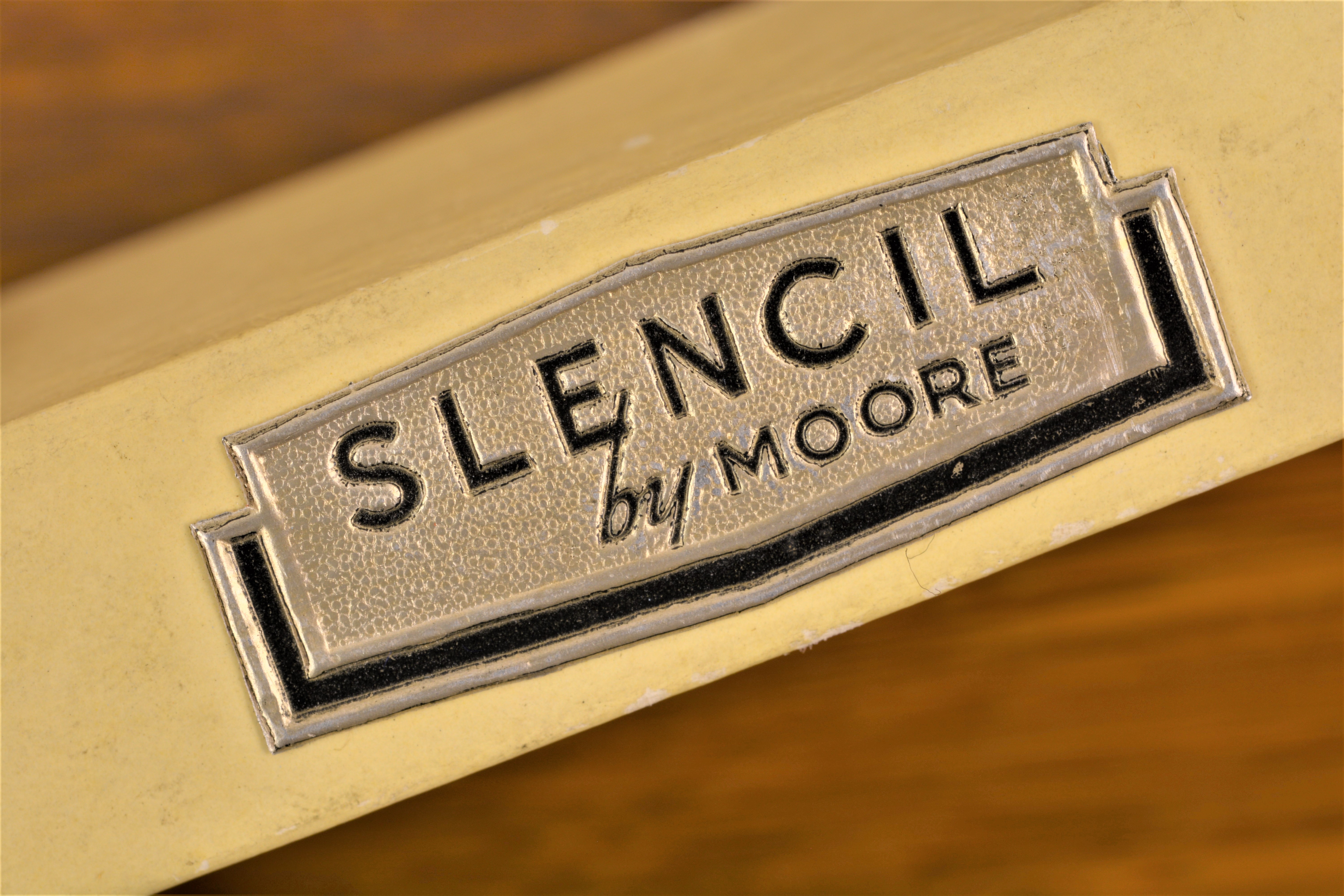
Early metal Slencils consistently bear the Slencil name on their reversible eraser retainers, accompanied by two patent numbers: 


The first is a design patent for the unique appearance of the pencil.  Design patent 93,476 was applied for by Carl C. Harris on July 16, 1934; it was issued October 2, 1934:


The other is patent number 1,975,788, applied for by Harris on April 13, 1933 and issued October 8, 1935:


On May 1, 1936, Harris applied to reissue patent 1,975,788, which was granted on August 24, 1937 as Reissue Patent 20,481.  The reissue patent appears on later, conventional "Stag Slencil" pencils, even though the ordinary nose-drive mechanisms in these plastic, rectangular pencils has nothing to do with Harris' patents (see Volume 2, page 247):


Which brings us to this trio of "Slimcil" pencils.  When they arrived, I couldn't wait to pull out my loupe to read whatever might be imprinted on them.  The seller was correct:  "Slimcil / Pat. RE20,481" is imprinted on the clips:


Compared to all the other metal Slencils in my collection, these "Slimcils" are an entirely different animal.  Harris' patent drawings show a single piece of metal, folded in half and then folded again at the edges to form a thin barrel.  None of my other metal Slencils have this feature, but these Slimcil pencils do (minus the pronounced medial rib to accommodate the mechanism):


While Slencils are slender, Slimcils are skinnier still:


Exactly how these pencils fit into the Slencil story remains an open question.  Harris never registered a trademark for "Slimcil" as he did for "Slencil," and all of my searching for when or by whom the name was used are at a dead end.    These Slimcils are more true to Harris' original design, but the Reissue patent rather than the original patent number might suggest it was made later -- perhaps after Harris turned over the rights to make his pencils to Moore, he wanted to make some on his own account, changing the name and appearance of the pencil so he wouldn't run afoul of whatever his contractual obligations with Moore might have been.  

It is also possible that Harris did not begin production immediately after securing his patent in 1934; perhaps he began production in late 1937, and he filed to reissue his patent to restart the clock for the term of his patent.

Monday, August 2, 2021

That Third Swing

This article has been included in The Leadhead's Pencil Blog Volume 7, now available here.


If you don't want the book but you enjoy the article, please consider supporting the Blog project here.

After the Baltimore 2020 Show, it had been more than a year without a U.S. pen show before Raleigh. During that time, online shopping was responsible for nearly all of the new acquisitions arriving on my doorstep; along with them came the freeloaders - other bits of collateral junk (er, little treasures) that were not the target of my bidding.

They accumulated in two small plastic totes – one contained nicer things, but duplicates of what was already in the collection, and one containing . . . little treasures.  

Both of these little totes were along for the ride as I went to Raleigh.  Once things were spread out on a display table, I knew I’d finally have the time (and space) to incorporate the items in the better tote into my show display.  As for the lesser of two totes?  To quote Rob Bader as I tend to do, I was looking for the opportunity to tell someone “I’m not taking them home with me, so the only question is how much you are going to pay me for them.”

Funny that it was Rob Bader who gave me the opportunity to say something close to that.  He had one really cool pencil that he had shown me during Thursday’s preshow trading.  We both knew I’d end up with it, and the only question was how it was going to happen.  

My goal when I go to shows is to come home with different crap, not less crap - but this time, I saw an opportunity to do both.  Since Rob and I rarely use cash as things pass back and forth between us, I put on my best Memphis drawl to make a proposal, puffing out my chest as I announced: “I . . . will trade you . . . this entire tote full of inventory . . . for just that one pencil.”  Rob liked my impression of him:


What’s so special about this one?  Give it a second . . . 


This Sheaffer Balance is outfitted for .075" checking lead, and it is only the second example I’ve seen.  The first was also at the Raleigh Pen Show, shortly after I started the Legendary Lead Company – Rob Morrison brought one exactly like this one over to my table looking for some leads that would fit it.  

I probably “shot myself in the ass” when I said that I had some, because any chance I might have persuaded him to part with the pencil evaporated once he made a few scrawls with my “Mighty 75" leads in china marker.  In fact, he scampered off so quickly to go play with his prized Sheaffer that I didn’t get the chance to take a few pictures!

Sheaffer also used the .075" mechanism – just as rarely – on earlier “Titan” flattop pencils.  A couple years ago I had a better shot at one of these, when Nathaniel Cerf had an example over at penmarket.com in jade.  Nathaniel let me share his picture of it here:


But there was a problem.  Yes, I’d seen Nathaniel’s post about the pencil on social media . . . yes, I was thinking about pulling the trigger on it . . . and yes, Nathaniel and I were talking about it.  However, while I was a’ thinkin’ about it, Matt McColm sent me an email, excitedly asking me “what the heck is THIS?”

After all Matt has done for me over the years, I wasn’t going to get in the way - Matt didn’t know Nathaniel, so I convinced myself it was better to introduce two good friends and let Matt have this one.  Besides, I'd be just as happy with Nathaniel’s picture as I would be owning an example.

OK, I’ll admit I’m lying about that last part.

Matt managed to wrestle a mechanism out of a regular-lead Titan for a better look at what's inside.  


Sheaffer pencils are among the most robust out there, but these checking pencils are really built like tanks – blindfolded, with a standard lead Sheaffer in one hand and a checking pencil in the other, you’d have no trouble telling which is which just by the weight.  

The Titan was cataloged in black with “oversize” lead as model SLCO – the “O” was for oversize – in 1930.  


Jade was also cataloged as model SJCO, although the illustration doesn’t show it that way, and “coral,” Sheaffer’s orange color, was SOCO:


A few years ago I took pictures of another, more common variety of Sheaffer’s checking pencils, in a form more like what you would expect – an all-metal utility model with an exposed eraser:


These were also cataloged in 1930 - as model SAA with standard leads, and AAA for oversized leads:


Models SAA and AAA are also found in Sheaffer’s 1935 catalog, but the AAA appears to be an ordinary bell top Sheaffer with ordinary lead.  By 1935, the “rigid radius” clips - introduced as the “First Lady Line,” were in production, but the catalogs report no pencils using thicker lead.  By 1936, neither model is listed, and whether Sheaffer’s checking pencils were geared towards utilitarian or the luxury market, all were displaced by the “Working Togs” pencils (see “Rise of Tog” at https://leadheadpencils.blogspot.com/2021/04/rise-of-tog.html).

Since these pictures of the model AAA were taken before I started the Legendary Lead Company, I didn’t have any lead to add to it at the time.  I’ve since added a piece of “Mighty 75" to it, and I’ve also managed to scrounge up a wooden tube of Sheaffer-branded checking leads.


Rob Bader’s Sheaffer was the second nicest thing I picked up in Raleigh this year.  He set up his wares on Friday morning, with boxes of pencils to paw through on his table . . . but nothing else caught my eye.  In fact, after I’d dug around a bit in one of them, I was recognizing some of them from that tote I had traded to him the day before.  I placed Rob on explicit orders to shoot me if I tried to buy something I had traded to him the day before.

Rob professes to prefer "less crap, not different crap" by show's end, but after he took my tote full o' gems he was behind in the count.  As is his habit, Rob headed home after the show closed on Saturday.  When the show reopened on Sunday morning, his table was arranged with a few dozen heavy, cast iron bits of ephemera . . . ink stand bases and such, and a sign:  first item is free, leave $5 in the cup for your second one.

He didn’t leave a cup.


Sunday, August 1, 2021

Spaulding & Co.

This article has been included in The Leadhead's Pencil Blog Volume 7, now available here.


If you don't want the book but you enjoy the article, please consider supporting the Blog project here.

Gary Weimer said it was his wife who spotted this while they were foraging around:


It’s another convertible like the ones shown in the article posted June 15.  You can use it either within the case, or it can be removed from the sheath so you don’t need to unhook it from your watch chain:


Both of the elements which make this one unusual are on the top knob: “Spaulding & Co.” and “14kt.”:


Yeah, I had to pay gold value . . . but with a name I had not seen on a pencil before, what I really paid for was the story I would get to unravel.  When I call Spaulding & Co. the “Tiffany of the Midwest,” the analogy is particularly fitting given the history of the firm.

Henry Abiram Spaulding was born in New York on November 11, 1837, according to americansilversmiths.org, which also reports that he was first employed by the New York jewelry firm of Ball, Black & Co. in 1857.  He remained there until 1864 or 1865, according to different sources, when he went into partnership with Alfred L. Browne as Browne & Spaulding.  

The 1864-1865 New York Directory lists Alfred L. Browne in “watches” at 565 Broadway, and I did not find a formal published partnership announcement in New York newspapers from 1863 through 1865 to establish exactly when this occurred.  However, I did find an announcement – in The Chicago Tribune, not New York – on September 1, 1865, in which “Messrs. Browne & Spaulding, jewellers, who have recently opened at No. 570 Broadway” had exhibited a set of jewelry specially made for presentation to Ulysses S. Grant’s wife in recognition of his victory at Appomattox:


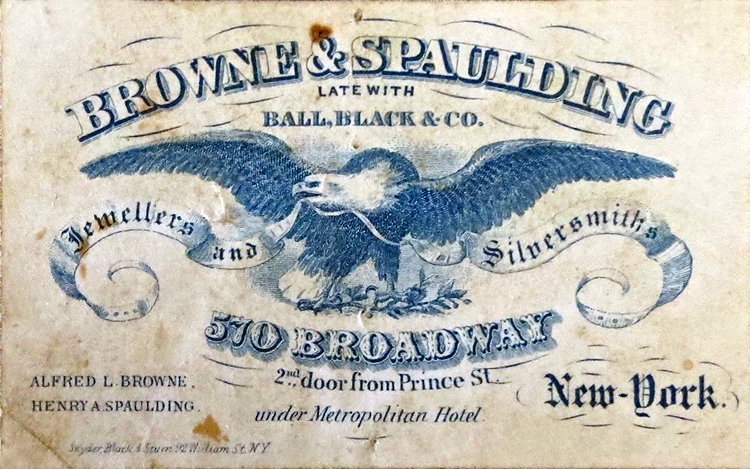
A trade card republished at americansilversmiths.org, which states that both Brown and Spaulding were “late with Black, Ball & Co.,” must date between 1865 and 1869, but the reference to their prior association suggests it would have been at the earlier end of this time period:


On August 3, 1869, The New York Times published a notice that John Howard Gray and George H. Brown had joined the firm, which was renamed Browne, Spaulding & Co.:


Several accounts, including a relatively contemporary biography of H.A. Spaulding in Industrial Chicago Vol. 4 (1894) state that Spaulding left Browne, Spaulding & Co. in 1871 to work for Tiffany & Co.  Although this history is provided more than twenty years later, it was verified by notice of the dissolution of Browne, Spaulding & Co. on February 28, 1871, published in The New York Times on March 1, 1871; Browne was left behind to supervise the liquidation of the business:


There isn’t much documentation of Spaulding’s activities for the next sixteen years, although the biographical sketch in Industrial Chicago indicates that he was Tiffany’s general representative in Europe.  When he returned stateside, however, it was not to New York: Spaulding went to Chicago, perhaps to explore a new opportunity – if not, then Spaulding was in the right place at the perfect time to do so.

Newell Matson was head of a prominent Chicago jewelry firm, N. Matson & Co.  The partnership had been organized under that name in 1867 by Matson, Leverett J. Norton and William E. Higley, according to the partnership announcement published in The Chicago Tribune on January 20, 1867:


Tragedy struck four years later, when the Great Chicago Fire in October, 1871 obliterated more than three square miles of the city.  Matson’s store and all of its inventory was utterly destroyed, but Newell Matson was a man of such character and conviction that he was determined to rebuild, declining offers to settle with his creditors for 50 or 60 percent of what he owed so that he could pay them every penny he owed to them.  On the strength of Nathan Matson’s character, his creditors accepted payments, made accommodations and by 1885 the business had recovered to the point that it could be organized as a stock company, in large part so that Nathan Matson could slow down a bit.

Matson’s struggles had taken a toll on him, but through it all he was steadfast in his determination.  “No man ever lived whose credit was better than N. Matson’s,” said one unidentified source in the Chicago Tribune on August 19, 1887.  “He was universally regarded in the business world as the perfection of business honor and integrity.  Without a dollar in the world he could have bought the earth.”

In May, 1887 Newell Matson went east to take a break from his management of the firm.  In July, his health failed and he passed away at 5:30 a.m. on July 29, 1887 in Clinton, Connecticut:


Matson’s five heirs did not share his dedication, and since the assets of N. Matson & Co. were about equal to the company’s liabilities, they refused to put any effort or capital into the business.   The Gorham Manufacturing Company, which had been accepting payments from Newell Matson on obligations that were as much as a decade old, was first of several creditors to secure judgment against the firm and secure the appointment of a receiver to oversee the orderly liquidation of the company, as reported in The Chicago Tribune on August 19, 1887:


On January 20, 1888, The Chicago Tribune reported that the receiver had nearly paid all of the judgment creditors in full; at that point, the judge ruled that the remainder of the company’s assets should also be administered by the receiver for the benefit of all of the firm’s creditors, including those who were owed money but had not yet been sued.  Creditors were given until March 1 to present their claims for verification:


By May of 1888, the receiver’s job was finished, and the entire business was offered for sale, including all of its inventory, fixtures and the firm’s lease on the building.  On May 12, 1888, the Chicago Inter Ocean published notice that sealed bids for the business would be accepted through May 17:


On May 18, 1888, the bids were opened and presented to Judge Gresham.  The high bid was $35,000.00, but the judge ordered the receiver to extend the bidding until May 24, 1888:


On May 25, 1888, the Chicago Tribune reported that N. Matson & Co. was sold for $42,500.00 to W.R. Alling, 170 Broadway in New York, and James P. Snow, 3 Maiden Lane.  The two were trustees for unnamed and unsecured creditors of the firm:


That same day, the Inter Ocean published an announcement that “Matson & Co.” had been “completely re-stocked with a larger assortment than is shown elsewhere in Chicago”:


Just a couple weeks later, The Chicago Tribune reported on June 5, 1888 that Judge Gresham had signed an order confirming the sale of N. Matson & Co. to “the creditors, who bought it in for $120,000.”


On October 15, 1888, The Inter Ocean reported that a stock company had been organized “to carry on N. Matson’s jewelry business.”  The one-line remark was unclear whether this was restructuring or preparation for an acquisition:


The question was answered the following month.  On November 29, 1888, The Inter Ocean published an announcement that the newly incorporated Spaulding & Co. had set up shop in the premises formerly occupied by N. Matson & Co.  “Mr. Spaulding, for years of Messrs. Tiffany & Co.’s establishment, Paris, France, has reached this city,” the notice stated.  “The future of this establishment should not be gauged by the present display . . . The old and inferior articles in the Matson stock have been sold to various tradespeople; nothing but goods of the highest standard will ever be shown in this establishment as now organized.”


Henry A. Spaulding organized the company along with several other businessmen, including Edward Forman – the receiver for N. Matson & Co. (according to Centennial History of Chicago, its Men and Institutions, published in 1905).  Spaulding’s marketing plan was genius: using his French connections through Tiffany & Co., he imported luxury items from the Continent and set up a branch office for Spaulding & Co. in Paris, through which he coordinated accommodations and travel plans for those attending the Paris International Exhibition of 1889.  Lavish receptions for those who wanted to see and be seen were held at the firm’s Chicago office, and the company quickly became a prominent fixture in downtown Chicago, on a par with Tiffany & Co.
It would be Henry Spaulding’s final triumph in a long career in the industry.  He retired in 1894, having invested his amassed fortune heavily in the steel and copper industries – and lost it all in the Panic of 1893, an economic depression that lasted through 1897.  Spaulding contracted pneumonia and died on February 9, 1904; a short obituary, hardly fitting of a man who had accomplished so much, appeared in the Chicago Tribune that day:


The obituary left out the tragic circumstances surrounding his death.  On February 14, 1904, the Tribune reported that before Spaulding’s body had even been put in a coffin, fire broke out at his home – firefighters were barely able to save his body before the residence burned to the ground:


The firm Henry Spaulding founded, however, survived and thrived.  I found two short bursts of advertisements which included pencils among the firm’s offerings, both published after Spaulding’s death.  The earlier series, between 1907 and 1913, did not provide much detail concerning the type of pencils the firm offered, although one particularly elaborate advertisement, published in the Tribune on December 19, 1913, indicated that “Cigar and Cigarette cases, Match Boxes, Pocket Knives and Pencils may be had in the same pattern of engine turning.”


Spaulding & Co. emphasized writing instruments among its offerings again between 1921 and 1923.  This advertisement was published in the Tribune on December 8, 1921:


Another advertisement, in the Tribune on December 9, 1923, included “gold pencils” among its “Gifts at $10 and less,” and gold fountain pens are included among those between $10 and $25:


Pencils such as the one shown at the beginning of this article are probably from the 1921-1923 era, and the insides were likely sourced from Cross (see https://leadheadpencils.blogspot.com/2021/06/rounding-up-victorians.html for others along these lines).  

Spaulding & Co. remained in business as a prominent jeweler until 1989.  While the store was closed with a sign in the window indicating the showroom was being remodeled, the Chicago Tribune reported on February 9, 1989 that Royal Copenhagen, the Danish-based porcelain and silver firm, would be opening a Chicago branch in Spaulding’s facilities.  “A Spaulding official denied the retailer was going out of business, saying the firm would be involved in a ‘partnership’ with a firm, which he declined to identify,” the report stated.

On February 14, 1989, the Tribune followed up with a report that Georg Jensen, which had been acquired by Royal Copenhagen, was also moving into Spaulding’s quarters.  “Where Spaulding fits in could not be determined,” the author wrote.

That would prove to be the last mention of Spaulding & Co., 101 years after Henry A. Spaulding founded the company from the ashes of N. Matson & Co.  Spaulding’s fate was eerily similar to Matson’s – it simply ceased to exist, with its successor assuming nothing more than its location.