Wednesday, June 24, 2020

That's My Bag, Baby

This article has been edited and included in The Leadhead's Pencil Blog Volume 6, now on sale at The Legendary Lead Company.  I have just a few hard copies left of the first printing, available here, and an ebook version in pdf format is available for download here.

If you don't want the book but you enjoy this article, please consider supporting the Blog project here.

(Originally scheduled to post May 10, 2018)

I wrote up everything I could find about the colorful Albert G. Bagley in a series of articles here a couple months ago (starting at "From Bagley through Todd").  Usually, when they turn up they are in the form of fluted-barrel combination dip pens and pencils, such as these:
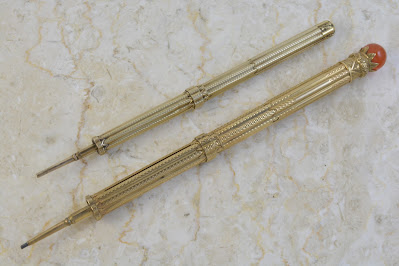

The clutched ball on that lower example is a dead giveaway of a Bagley - the top example, with the plain, rounded end is a little bit unusual.  Both of these have a top half that telescopes out slightly, to reveal the only markings you’ll typically find on these, other than on the nib if they still have the right one:


Patent January 1, 1850, a reference to patent number 6,981:


The specifications accompanying the drawing indicate that Bagley’s patent pertained to the way that upper section telescopes into position to make a longer writing instrument for writing.  

I’m no pencils-only purist when it comes to Victorian writing instruments, as many of the earliest pieces in my collection are combination dip pens and pencils - and other weird things such as letter openers and such.  But I was happy to find this one:


Bagley’s name is in the corner of the cartouche:


There’s no indication that this one is patented, but excitedly I checked American Writing Instrument Patents 1799-1910 to see whether Bagley patented a pencil only.  He did:


You’ve really got to wade through the accompanying specification to get to Bagley’s point and see what was new and different about his Patent number 4,840, issued on November 6, 1846.  His pencil mechanism (which fit into a longer barrel, to explain why this one is so short) had what was at the time a novel place to store spare leads: in grooves around the mechanism:


Unfortunately, mine lacks this feature.  Instead, it has a fixed mechanism that doesn’t pull out, with a cap that screws off revealing a more conventional lead magazine.  Oooh... maybe mine is earlier than 1846?  No way to tell for sure.

I hoped the name engraved on the barrel, H. Seybert, might be distinct enough to help, but I found records of two people that could have been the pencils owner: Horace B. Seybert and Henry Seybert, both of Wilkes-Barre, Pennsylvania, and references to their activities span the entirety of Bagley’s career in New York, from 1839 (according to Bagley himself, although I haven’t been able to confirm anything earlier than 1842) through his retirement in 1856.

UPDATE: I’m glad I didn’t post this article, because in the time since I wrote it, I've learned a bit more.  Eric Magnuson contacted me to let me know he had an 1846 Bagley Patent pencil, which wound up finding a home here:


The back half extends to make writing more comfortable:


“So where does this one say Bagley 1846?” I asked.  I never would have found it . . . 


It’s in about the worst place to put an imprint, where friction easily grinds them away over time.  


“Bagley’s Patent 1846,” the faint lettering reads – good thing Eric’s eyes are better than mine.  A tiny slot in the cap allows leads to be inserted.  Still, no lead storage around the central chamber as shown on the patent drawings, though:


So . . . I wondered . . . maybe that generic pen/pencil combo I’ve had in my parts bins for all these years isn’t so generic after all . . . 


Now that I know where to look, I won’t be stealing any parts from this one!


Tuesday, June 23, 2020

Like a Really, Really Tall Ninja

This article has been edited and included in The Leadhead's Pencil Blog Volume 6, now on sale at The Legendary Lead Company.  I have just a few hard copies left of the first printing, available here, and an ebook version in pdf format is available for download here.

If you don't want the book but you enjoy this article, please consider supporting the Blog project here.

(Originally scheduled to be published on May 9, 2018)

After yesterday’s article, I had finished writing articles about all of the pencils I had photographed . . . sort of. 

Recently I spent waaay too much time trying to find an article I just knew I’d written for the blog, so I could provide a link to it in the updated article.  After exhausting every tab under which I could think to look, it dawned on me that maybe I had only written the piece in my head, as I was photographing the pencil I was thinking of.  Sure enough, there were the images, tucked away in a huge dead letter office on my hard drive, not doing anybody any good.

Like this one:


I still remember picking this one up on Terry Mawhorter’s table at the Baltimore Show – that’s when it was still being held over at the Tremont Grand, so we’re talking five years ago at least.

“Is this what I think it is?” I said.

Terry just nodded.  And I bought it.

I wrote about the Eversharp Skyline Executive early on here at the blog (The Leadhead's Pencil Blog Vol. 1, page 337).  I did fish out the one that shows the Executive alongside its normal-sized siblings for you and adjusted the light and color a bit:


This series is what I call the “Standard I” series of Eversharp Skylines – those with the striped upper barrels and solid lower barrels, with a thin trim ring (those with a wide trim ring I refer to as the “Standard II”).   Until I found the example on Terry’s table, I did not know that they also came in the “Solid II” series - that’s all one color barrel with a thin trim ring (“Solid I” has no trim ring and “Solid III” has a wide one):


Are there other colors and configurations of the Executive?  All has been quiet on the hunting front for five years now [note: seven now!], but never say never.  

Monday, June 22, 2020

Esterbrook and the Lost Leadhead's Posts

This article has been edited and included in The Leadhead's Pencil Blog Volume 6, now on sale at The Legendary Lead Company.  I have just a few hard copies left of the first printing, available here, and an ebook version in pdf format is available for download here.

If you don't want the book but you enjoy this article, please consider supporting the Blog project here.

I am ecstatic one of these finally came my way:


It’s an Esterbrook, and for lack of a better, more correct designation, we’ll call it a “dollar pencil” – one of the earlier models with a clip sporting those two cutouts. 


I’ve got Paul Hoban’s book, Fountain Pens of Esterbrook, which was written in 1992 on an old-school typewriter.  It’s one of my favorites, harkening back to the days when everyone was writing books off the cuff.  Hoban’s work was unique, though, in that he was very careful to say when he was speculating – and in the absence of much information available at the time, he made that disclaimer a lot.  In the long run, that means (1) Hoban is reliable when he states something as fact and (2) unlike many other books of the day, time has been kind to what he wrote.

One of the things Hoban notes as fact is that by the time Esterbrook’s dollar pencils were introduced in the latter part of the 1930s, Esterbrook had mastered injection molding and incorporated it into its production methods as a means to cut costs - a brilliant strategy at a time when such measures meant survival while many others were failing.

These marbled celluloid Esterbrooks, though, were not injection molded and were made using traditional and more costly means.  Yet Hoban includes a complete copy of an Esterbrook catalog in his book, which he dates to late 1938 or 1939 - a set is pictured in the catalog, but it is identified only as a set.  No “de Luxe,” no “sooper dooper,” no nothing to set it apart from the regular line.  I know there’s a lot of guys out there who have spent more time researching Esterbrook than I have, and I’ll give credit where it is due to someone who can supply me a name for these accompanied by chapter and verse.  For now, I’ll just call them gorgeous, and I’ve been waiting to take this shot for a long time . . . waiting, in fact, for the day I’d finally cross paths with that lovely teal blue one:


Originally I planned to run this article on a lazy Sunday, since I have so little to contribute by way of original research.  But then I remembered that I have a few other Esterbrook subseries that I completed during my absence here at the blog, so there’s a bit more substance to add.  For example, I finally ran across a blue Pushmaster pencil to fill out this set:


I’ve been waiting for a brown one to come along, but as long as that may take to turn up, I’ll have to whoop and hollar about finding one another time.  

Then there’s these “doctor’s” and “nurse’s” pencils:


The little one I’ve had for awhile; the others all came from the estate of the late Jack Price, and Eric Magnuson tipped me off that this was going to be in the auction.  There are a couple other variations on this theme – I know that because Doc Liebman (or as I call him, “Larry”) and I went in on a larger grouping of these, one of which had a price band on it - Larry took that one:


And then there’s those pastels . . . those pastels . . . 

Dammit, I know I’ve shot those and I thought I posted all about them . . . 

I haven’t yet.  When I first started things back up again here in March, it was one of the first ones I wanted to circle back around to, and I just couldn’t lay my hands on those pictures.

Kudos to Joe Nemecek, who was prodding me for copies of the pages from John Loring’s old website (now long since defunct).  I knew I had pieced it together using the Wayback feature on archive.org, and like my wayward Esterbrook pictures I had no idea where I had put them.

As a last resort, I grabbed my backup storage drive and started browsing around.  Nothing, but I found a backup I had done of my entire hard drive a year or so ago.  There was a folder titled “Leadhead 6" – odd, I thought, since at the time I was sure I had concluded the blog series at five volumes.  And in that folder . . . 


The white one is the same as in the doctor’s pencils shown earlier, and I already had the middle shade of pink when all the others came my way at the 2018 Chicago show.  I also took photos to show that two of them have color-matched top “jewels”:


And three of the others had original price stickers identifying them as model TTH, for thin lead (.9mm or .036"), and listed at $2.50:


All of which I’m greatly relieved to show you . . . finally . . .as the finishing stroke to this article.  

But wait, as Billy Mays would say – there’s more.  My wayward Estie pictures weren’t the only thing in that file folder.  That Chicago Show was the one where I debuted the “Ghost Book,” now known as The Leadhead’s Pencil Blog (Volume 1).   

That book was a huge gamble – I was still stinging from the enormous cost of printing patent and trademark books that hadn’t sold very well, so I was nervous about the amount of time and money involved in printing a book containing articles people had already read – until Google wiped out all the images, of course.

I didn’t care.  I had to do it.  So I swallowed hard, printed fifty copies and divided up the printing and production cost by fifty – mine included.  If I sold out, I figured the experience would cost me a helluva lot of time and ninety five bucks.

The Chicago Show was an encouraging sign, with thirty or so copies going home with what would become Knights of the Order of the Leadheads.  Eh, it’s only money, I thought . . . a couple grand down and a great experience had in the process.  I retreated to my basement and started shooting pictures of my Chicago finds.

Then a funny thing happened.  Word got out, and the rest of them sold out within three weeks.  And many of those that bought them were demanding to know when the next volume would be available. 

I decided since  I was only down ninety five bucks, it was time to go double or nothing.  I set the blog aside for awhile, formatted a second volume of articles for print, and came back to blogging in November.

I forgot while all this was going on that I had fully researched and written eight articles in the weeks leading up to that Chicago Show, which would have started posting on May 8, 2018.  They were still a little rough, but it was all there . . . waiting for Joe to goad me into rummaging through an old backup looking for something else.

A couple of these articles ended up getting rewritten – from scratch because I couldn’t find them – and all of them are things I was positive I had written about (and did) and positive were posted at the blog (I didn’t).

So, for the next few days, I’ll be presenting the “Lost Leadhead’s” . . . 

Sunday, June 21, 2020

Party On, Jack

This article has been edited and included in The Leadhead's Pencil Blog Volume 6, now on sale at The Legendary Lead Company.  I have just a few hard copies left of the first printing, available here, and an ebook version in pdf format is available for download here.

If you don't want the book but you enjoy this article, please consider supporting the Blog project here.

I’ll admit to having more fun than usual on eBay during this whole virus thing.  With no pen shows to go to, no flea markets to attend, no Springfield Extravaganza . . . gotta get my fix somewhere, I suppose.

I’ve taken a bit of lighthearted heat from the wife whenever a little pile of packages appears on my doorstep.  In the days when I would arrive home before Janet, it was easy to have all the packages opened, the boxes discarded and the pencils squirreled away into the museum before I’d hear the garage door go up.  These days, however, she’s working from home and whenever all my little packages don’t fit in our mailbox, the dogs announce the arrival of our mailman right outside her “office” window with every load of illicit goods.

Not that I’m doing anything wrong or spending all that much money . . . I’m just on the receiving end of a comment here and there regarding how many pencils one might “need” in order to survive a nuclear holocaust and repopulate the planet’s shirt pockets with adequate writing gear.

I’m relieved whenever I get to tell Janet that not all these boxes are crazy little trinkets upon which I’ve squandered the kids’ inheritance, and lately there’s been a lot of other packages arriving.  Without the usual socialization at shows, people have been sending pencils to fix, stuff to photograph – not everything that arrives is completing a one-way trip to Leadhead’s Leadquarters.

A couple weeks ago, however, one package arrived that was making a one-way trip – but it wasn’t anything I was expecting:


Apparently a few stragglers didn’t keep up with the march of the penguins, and there were a few other things in Don Jacoby’s stuff that Jack Leone wanted to catch up with the rest of the flock (if you're just now tuning in and that doesn't make sense, see "Penguins in the Barnyard").  “Party on!” Jack instructed.

“Party on, Jack” I titled the email to thank him, along with the observation that if I had not FINALLY  gotten a long, long, LONG overdue haircut the preceding day, I would be playing air guitar and headbanging to Bohemian Rhapsody right along with him.

For all you kids out there who have no idea what I’m talking about . . . sigh . . . just go ask your parents.  I keep forgetting what’s obvious to me is inevitably becoming the wisdom of the ancients.

There were a couple neat things in Jack’s care package worth sharing.  First is this pair of Eversharp “4 Square” pencils (these actually have the imprint on the caps) – see "Making Sense of the Square 4" for the full rundown on these:


Well look at that – this subseries came in both nickel plated and gold filled trim!  My example, in nickel plate, wasn’t nearly so nice, so both of these have found a comfortable place alongside their counterparts.  

The rest were a few lower-level Parkers - Parkettes and such.  Nothing much to write home about here, although I’ve had a single band example like that lower one which has been missing a clip:


I’ve had a green one just like that one which has that same clip, but I was never comfortable it was right.  Now that Don’s example has made it to me, with the same clip as found in the wild (or to carry on the theme of the weekend, waddling around in the barnyard), I happily invited this one into the fold.

And then there’s that Parker Liquid Lead pencil . . . there’s something a little bit odd about it.  It took me a while to find where I keep my other Liquid Lead pencils to compare it.  What I remembered them looking like was more along these lines:


I think the ones like that lavender example were later, though . . . or maybe for the lower tier lines, like to match the 21 or such.  I dug a little deeper and found a few Parker 51 Liquid Lead pencils, and they share that same shorter, ribbed tip:


And in the case of that lower example, a hefty price tag of $10!  

As you’ve probably guessed by now, I’ve settled into an uneasy peace with Parker’s grand experiment to load up a ballpoint cartridge with graphite paste and call it a “pencil.”  Yeah, I’ll keep them around the museum as “close enough to being a pencil” (after all, look how hard I stretched to accommodate those chalk holders the other day).  But no, I just haven’t been able to get too excited about them because the damned things never work (but then again, look how many goofy ideas that never worked well are proudly represented in the museum).  

I’ve come to adopt the Don Jacoby philosophy.  I like them just because I do, and I don’t like them just because I don’t.  So sue me.  

I will admit that on those rare occasions when you find one that works, they are kind of cool - lead flowing out of a pencil like ink and all.  Plus, that cartridge looks a bit shorter and different from the other Liquid Leads I’ve got around, so I thought this might have been some weird experimental thing Parker did that may have worked a bit better.  I turned Jack’s “Party On” instruction sheet over to see what it would do . . . 


Whoa.  It works, but I’ve never heard of a Parker Liquid Lead that wrote in purple!  Of course that meant I had to take it apart . . . 


From the other room Janet heard me burst out laughing.  Yes, Virginia, you can fit an ordinary Pilot ballpoint cartridge in a Parker Liquid Lead pencil and it will work just fine as a pen – thanks to Don Jacoby I finally have a way to bring all those dead Liquid Lead paperweights back to life!

Party on indeed, Jack.  Party on, Don!  Climb on into that blue AMC Pacer and crank it up . . . 

(Dooo do do doo do-do-do . . doo doo do dooooo... oh come on, I know you know this song.  Bang your damned head!)

Saturday, June 20, 2020

Penguins in the Barnyard

This article has been edited and included in The Leadhead's Pencil Blog Volume 6, now on sale at The Legendary Lead Company.  I have just a few hard copies left of the first printing, available here, and an ebook version in pdf format is available for download here.

If you don't want the book but you enjoy this article, please consider supporting the Blog project here.

A few years ago, John Hall and I visited our friend Jack Leone to “play with pens” for the day.  I had my camera with me, and we set everything up and took pictures for several hours.  Jack had another friend of his over, a great guy by the name of Don Jacoby, who brought with him a few pencils to pepper in thoughts, questions and random observations about pencils, the universe, and everything over the course of the day.

Yeah.  I’m a Douglas Adams fan too, in case you caught that.

I only had that one friendly encounter with Don, several years ago as the blog was just getting off the ground.  I didn’t know, as Jack recently told me, that Don had a talent for languages, or that he served as a military intelligence officer for the Army in Germany.  I didn’t know he was on the faculty of the Cincinnati German School.

In fact, I couldn’t remember his name, but when Jack described him as a guy who was “fun, enjoyed everyday life, and always was interested in ’turning over rocks to see what crawled out from under them,’” somehow it clicked and I connected the name with the memory.

Sadly, Don passed away recently, and Jack was called on by Don’s wife, Margaret, to help with disposing of his collection.  I really hate that word – “dispose,” like you’d throw something out.  “Disperse” – now that’s better.  Move things out with the four winds, into the hands of people who will appreciate them.  Bonus points awarded if in the process the recipient remembers where they came from!

Don had a good eye for things, and when it came to the pencils he accumulated, he was a man after my own heart – he accumulated things just because they interested him, not because they were necessarily worth much.  Just . . . well, just because.  I can actually remember him saying something like “I don’t need a reason. I just like them.”

Jack figured the best place for Don’s random little assortment of pencils was here, and he asked me if I’d take them into “Jon’s Home for Wayward Pencils.”  Why of course, I said . . . and I added that I was dead sure no matter what Don had, there would be a thing or two in there I’d want to write about.

Jack told me there were some things in there that “weren’t too bad,” like an Eagle desk pencil:


These aren’t high quality.  They were made to look like more expensive, jewelry-grade pencils like those made by Hicks and others, but if you look close, they are plated brass rather than sterling:


I have a few other Eagles along these lines, but I didn’t have a desk pencil.  I told Jack I’d always kind of wanted to find one of these and write about it, so there’s the article I’ll write for Don:


Jack’s reply will stick with me for a long time.  “Glad the Eagle pencil was the ‘penguin in the barnyard!’”  I have no idea what that means, but I absolutely love that random turn of phrase.  I told Jack he’d just written the title of the article.  

When the box of Don’s pencils arrived, it turned out there were plenty of penguins waddling about in there, a few of which also found comfortable retirement around the museum.  In the Eagle department, I was particularly attracted to this one:


The story I’ve heard is that pencils along these lines got Eagle into trouble with Walter Sheaffer, after Sheaffer took out design patents for the new, streamlined Balance in the late 1920s.  The unsubstantiated story, which I’m inclined to leave alone, is that when Eagle first introduced this series, they looked like this:


But after a stern warning from Sheaffer, Eagle clipped off the tops:


And until Don’s example arrived, I didn’t have one of these in green.  Note that the bottom three examples have more intentional-looking, snubbed tops.  Also, Eagle changed the clips from a plain printed Eagle clip to one with a stylish Eagle pictured with a tiny company name at the top:


This one also waddled in.  I remember Don had it with him that day at Jack's house, and that he wasn’t parting with it:


It’s an Eagle Magnum Pointer in red hard rubber, and there’s a reason I remembered that one so clearly:


That shot is from A Century of Autopoint, on page 86.  Eagle made a cameo appearance in the book because Charles Keeran, inventor of the original Autopoint, later went on to invent pencils for others, including what appears to be the Eagle Magnum Pointer (the patent, by the way, was the only one Keeran assigned to Eagle).   Note that on the right in this picture, the only red example I have been able to scrounge up is a slightly different model with chrome-plated trim (or “platinite,” as Eagle called it).  

There’s been a few times over the years when I had hoped to find a full-blooded Magnum Pointer like Don’s.  

Now that Don’s example has made its way to me all these years later, I’m glad I never did.  It’s almost like pencils, the universe and everything have saved a place for it.

Friday, June 19, 2020

But Are They "Pencils?" Who Cares!

This article has been edited and included in The Leadhead's Pencil Blog Volume 6, now on sale at The Legendary Lead Company.  I have just a few hard copies left of the first printing, available here, and an ebook version in pdf format is available for download here.

If you don't want the book but you enjoy this article, please consider supporting the Blog project here.

When these popped up in one lot online, I worked hard to convince myself these things are “pencils”:


They are chalk holders, but they operate on the same principle as most leadholders, with a front end that clamps down around a piece of — well, around a piece of anything.  In this case, it’s chalk, so a teacher wouldn’t get that nasty white powder all over their fingers.  


At least . . . most of the ones in the lot were.  The two smallest ones were even better.  The nose unscrews to reveal a collet that can secure one of the small drill bits inside:


Perfect size for drilling leads out of jammed up pencils, and there’s even a few larger bits I can use on checking leads and Victorians!  Straight into the toolbox with these two – 

The next three were different variations of the same chalk holder, in slightly different lengths.  One has what’s left of what must have been a blue endpiece on it, but the other two I don’t think ever did - the open tops mean there’s no limit to the length of chalk they can accommodate.  Also, the “Made in USA” imprints on the clips are a bit different on each (and there’s a wide range of condition here): 


And then there’s that big beast at the bottom of that picture.


At the top end, four holes surround a little empty chamber:


And there’s a goofy trigger sticking out the side:


As I fiddled around with it, I pulled the lever down and heard a click . . . you don’t suppose:


“Strike Rite” on the clip suggests this is supposed to light something, and sure enough, with the cap unscrewed you can more clearly see a piece of wire that threads through the middle - with each click of the lever, a tiny spark emanates from the top of that wire.  


These must have been popular with chemistry teachers, who neither had to muss up their fingers with chalk dust nor reach for a lighter to get a bunsen burner fired up!