Wednesday, May 2, 2018

The Upper Crest of Sheaffer Society

This article has been edited and included in The Leadhead's Pencil Blog Volume 5; copies are available print on demand through Amazon here, and I offer an ebook version in pdf format at the Legendary Lead Company here.

If you don't want the book but you enjoy this article, please consider supporting the Blog project here.

A few weeks ago I introduced a tipless Sheaffer Crest, with a barrel that screws directly onto the mechanism, and the new find led me into a discussion of different variations of the breed:


The discussion, though, omitted a couple important ones – two of the most important ones, in fact.  By chance, both came my way in recent weeks, the first at the Baltimore Pen Show:
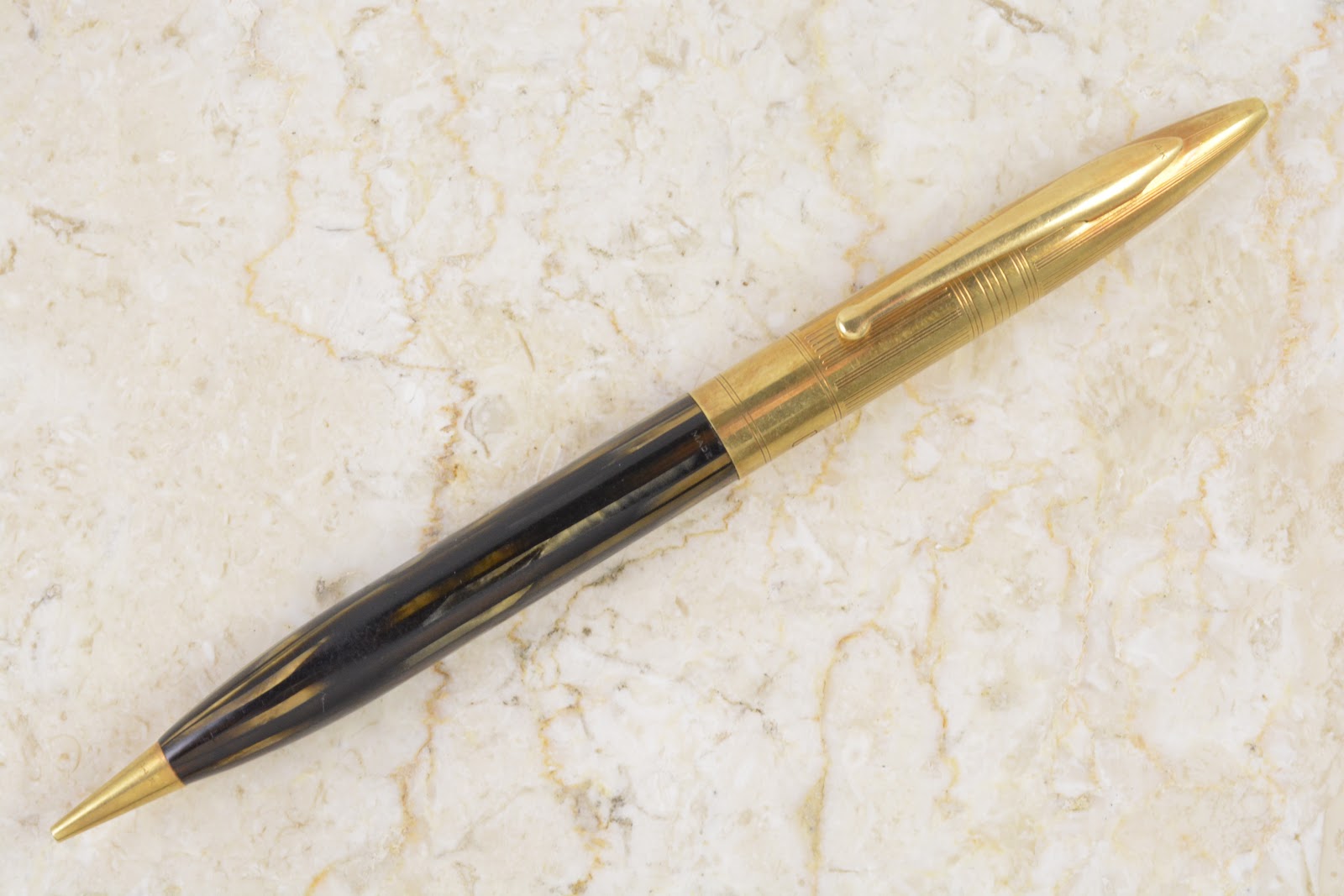

It looks very similar to what I showed you earlier, but with an important difference.  See those alternating grooves running around the center of the cap?  That can only mean one thing:


The cap and clip are 14k gold.  And so is the tip:


The imprints are slightly different, too.  “Sheaffer’s” is stamped on the lower portion of the cap, while the regular Crest series has no manufacturer’s marking on the cap:


And while the regular Crest pencils have an entire Sheaffer’s imprint on the lower barrel, the 14k model has only “Made in U.S.A.” stamped on the lower barrel – a difference due to the fact that it would be duplicative to have the Sheaffer name on both the upper and lower barrels:


I’ve harbored an aversion to buying solid gold pieces, since I prefer to buy things for their historical rather than intrinsic value.  Apparently I’ve gotten over that, since I didn’t hesitate a bit when this one came along in an online auction shortly after Baltimore:


This one has those same alternating horizontal and vertical grooves:


It’s as clean as they come, and it’s marked 14k all over the place:


“Gold-capped” and “sterling-capped” Sheaffers first appear in the company’s catalogs in 1937, with the sterling caps used only on the striated gray barreled pens and pencils – I’ve seen a set, but the price was more than I could pay at the time.  The “Crest” name first appears in the 1938 catalog in connection with the metal-capped lines. The “Masterpiece Ensemble” in all 14k gold first appears in the 1939 catalog:


Interestingly, there’s no mention that the pens or pencils could be had with 14k caps and striated bodies.  They do, however, appear in the 1940 catalog; the all 14k version was now known as the “14k Masterpiece” and the 14k cap only was known as the “14k Crest Masterpiece.”


Note there are two other variations shown in the 1940 catalog: an all-platinum version and the “Honor” pens and pencils, the latter of which was a special engraving available on both the 14k Masterpiece and Crest Masterpiece sets.


Nope.  I don’t have either of these to show you.

Tuesday, May 1, 2018

So Many Clues, So Few Answers

This article has been edited and included in The Leadhead's Pencil Blog Volume 5; copies are available print on demand through Amazon here, and I offer an ebook version in pdf format at the Legendary Lead Company here.

If you don't want the book but you enjoy this article, please consider supporting the Blog project here.

I finally got to meet Jimmy Cockburn at the Baltimore show this year - I’ve quoted the veteran collector here at the blog, and it was nice to finally shake his hand.  It was also nice to pick something fun up from his table that I knew would make for a nice article here:


I know it’s an odd looking duck, and it looks at first like the top and bottom halves don’t go together – but this pencil is so much thinner than what you’d expect, and the pieces, neither of which I’ve seen separately before, thread together perfectly.  Besides, there’s plenty of other goofiness about this one that I’m convinced this is the way it was originally put together.

Let’s start with the top end.  The clip is marked “Pencil Knife,” and the top is stepped just enough to make me think there might have been some sort of cap on top:


 – but I don’t know why there would be, since it would really interfere with how the upper business end works:


Nice “stainless” marking on the blade, and two really good clues on the tang of the blade:


“Pencil Knife Trade Mark” on one side, and “Pat. Pend.” on the other.  I’ve got two great books that might be of assistance:   American Writing Instrument Trademarks 1870-1953 and American Writing Instrument Patents Volume 2: 1911-1945.  Starting with the indication that a trademark might have been filed, I found this one:


The “Pencilnife Corporation” of New York registered trademark number 187,102 for a “pencil clip and knife combination,” claiming a date of first use of October 15, 1923.  Although I’d love to say this is it, I don’t believe it is.  First, there’s not two words and a “K” is missing in Pencilnife.  Second, it wasn’t used on a combination knife and pencil - only for a clip which doubled as a knife.  Third, the date of first use - 1923 - is too early for this thing given the celluloid, which would have been made in the late 1920s at the earliest.

Maybe there’s something in the patent history?

There’s a couple knife/pencil combinations patented in 1914 - too early for a “Pat. Pend.” imprint on something from the 1920s.  Same for number 1,444,155, patented in 1923.  There was one patented in 1930 - the date is about right, but number 1,767,948 isn’t anything like this one.

The fact that “Pat. Pend.” is stamped on the tang of the blade suggests whatever patent was applied for involved the blade itself - maybe it was a patent for the knife only rather than for its combination with a writing instrument, which would have been outside the scope of the book. Maybe the “pending” stamp was optimistic, and no patent was ever actually issued.

Maybe, I thought, it was for the pencil mechanism itself?   There is something else which is unusual about this one, at the writing end:


When you pull the nose away from the body, you can see that there is a metal bushing mounted at the end of the barrel - that’s something you don’t typically see.  Unfortunately, in an otherwise conventional screw drive pencil, I wouldn’t expect to see a patent for it, and there’s pages and pages of screw drive mechanical pencil patents listed in my book.

A search of newspapers for the term “Pencil Knife” turned up surprisingly few results – all of which turned up only advertisements for “Pen, Pencil, Kinfe” three-piece sets.

So, sadly, I’ve told you all I know about the Pencil Knife to date: so far, my best chance of telling you something more would be to find an example with a more descriptive barrel imprint;  maybe one with a patent number for a patent that was actually issued; or maybe one of the odd and distinctive features it has that might turn up on something else and suggest a connection which will unravel the history of it.

I’m as frustrated as you are!

Monday, April 30, 2018

More Mixing and Matching

This article has been edited and included in The Leadhead's Pencil Blog Volume 5; copies are available print on demand through Amazon here, and I offer an ebook version in pdf format at the Legendary Lead Company here.

If you don't want the book but you enjoy this article, please consider supporting the Blog project here.

Eversharp Dollar Pencils have been a particular area of interest for me lately.   I ran down the evolution of these in “Vestigial Eversharps” back in 2015 (see “
https://leadheadpencils.blogspot.com/2015/11/vestigial-eversharps.html”), from the early hard rubber utility pencils:


Through the later, more streamlined ones:


In 1930 or 1931 – better documentary evidence is still waiting for us out there somewhere – Eversharp transitioned from the z-clip shown in that top example to the bolted-on clip, adding some new colors to the lineup in the process.  Then the company switched out the insides, from basically the same mechanism the company had been using on all of its pencils since Charles Keeran invented it in 1913 to the Equipoised mechanism, which was a little longer and has that extra metal ring at the top (compare the second and third examples from the top in that last picture).

There were some different variations in colors withhin these variants, and I’ve been having a lot of fun tracking down all the different colors.  Sometimes surprises come up, like when this yellow example popped up online:


It was missing the clip, but what caught my eye was where the clip was: those two holes are an indication that this one had a bolted-on clip, when all of the yellow examples I had seen before were of the earlier z-clip variety, like these:


Eversharp didn’t do anything to make sure those bolts wouldn’t unscrew themselves, so these clips frequently go missing – which is why I keep a supply of the common cream-colored bumblebee examples on hand for parts.  In fact, when they are reasonable, I always pick them up, and at the same time I put in a healthy bid on the yellow example, another common one showed up as a “buy it now” for $14.99.   I picked it up solely for the clip and the bolt securing it, just so I could make the swap without diminishing my supply of clips on hand.


The opening bid on the yellow example was 99 cents plus shipping.  I won’t tell you the embarrassing bid that I put in on it, thinking someone else might notice another unusual Eversharp variant which is so easy to repair.  What’s more embarrassing is that nobody did, so I paid 99 cents for the rare pencil and $15 for the clip to go on it.

In the meantime, I decided to root around to see if there were any more bolt-on clip Eversharps out there to add to my parts bins, and I saw this one.


It had made the rounds in the online auctions a few times, never getting the opening bid of $20.  I’d let it slide a few times, since that great limeade bumblebee color is really scarce, and I already had one in the Equipoised-mechanism model . . . I picked it up for just a couple bucks in a flea market junk box.  What I didn’t have was one with the earlier mechanism like the red example at top in this next picture:


I knew they existed, because Joe has one - in fact, I fixed it for him and photographed it a while back (see https://leadheadpencils.blogspot.com/2016/09/a-few-good-clips.html and https://leadheadpencils.blogspot.com/2016/11/judiciously-mixing-and-matching.html):


So I decided to spring for that second Equipoised model to convert it into the earlier model, throwing in the $20 opening bid on what must have been its fourth or fifth time around the horn. Then. . . what the hell . . . I was bid up to $30 by the time it closed.   Sigh . . . at least I was expecting something goofy like that to happen and had bid more, and besides -- between this one and my 99 cent wonder, at least I only paid $15.50 apiece (ok, not counting the extra $15 for the clip) and that isn’t so bad.

Here’s how I converted it.  Remember, you can’t convert an earlier model to take the later Equipoised mechanism - you can only go the other way.  To remove the Equipoised mechanism, remember that the tips are reverse threaded.  When you’ve got the tip off, press the end of the mechanism on a flat surface and the whole works will pop out:


I could have shined up that cap, but I”ve got so many common cream bumblebee pencils missing clips now that it was easier to just pull a clean one out of my parts bins.  As for the earlier works, I had another Eversharp missing its clip in the parts drawer – and yes, that’s the same works inside and the top is the same as what’s under the caps on all of these:


The earlier tips have standard threading.  Remove the tip and pull the whole works out by the mechanism - I never had to pull the mechanism out of the threaded tube for the entire transplant:


Simply push the threaded tube, mechanism and all, into the new barrel and screw the tip back in place.  Earlier mechanisms fit much more tightly into the later Equipoised examples, but don’t worry - it will fit so don’t be afraid to push hard and show it who’s boss:


Dang, that clip looks nasty, and you might wonder why I didn’t do a transplant on this one.  Before I do, I’ll try to give it a buff – these are solid steel, so you can push pretty hard and unless the surface rust has pitted the surface, they usually clean up pretty nicely.  Such was the case here:


So with a clip transplant and a mechanism transplant – ok two mechanism transplants – I’ve added three examples to the Dollar Pencil array:


Ok, I know I know . . . I said I’ve been careful not to mix and match things in ways that I haven’t confirmed originally were made . . . but dammit, I love that lapis and I really wanted one.  I couldn’t resist the urge to “make” one of these, so sue me.   Maybe I’ll attach a warning tag to it so future generations know this is a Leadhead’s special.

And when you see the whole spread, you’ll understand that if this is wrong, I don’t want to be right . . .


Sunday, April 29, 2018

I Spoke Too Soon

This article has been edited and included in The Leadhead's Pencil Blog Volume 5; copies are available print on demand through Amazon here, and I offer an ebook version in pdf format at the Legendary Lead Company here.

If you don't want the book but you enjoy this article, please consider supporting the Blog project here.

When I arrived home from the Baltimore Show, I’d already uploaded several articles to run on autopilot, one of which showed off an all-metal Guild pencil made by Mabie Todd (see 
https://leadheadpencils.blogspot.com/2018/03/the-completist.html).

Unfortunately, after I got back from the show, I was too busy catching up after a few days out of the office to get things photographed.  If that Guild article had run a little later, I would have included this one:


Marc Shiman, Mabie Todd maven, had this stockbroker pencil in his pocket at Baltimore.  He asked me what I thought about it and after we talked for a bit, I was surprised that he was willing to part with it.  He didn’t tell me about the box – later in the show he swung by and casually dropped it off at my table, much to my delight. 


I might regret posting this as an update right now, because at the Baltimore show Joe Nemecek turned up the metal Guild ringtop, identical to the one shown in David Moak’s Mabie in America and also shown in my previous article here.  I didn’t take my good camera equipment with me to Baltimore, so any cell phone picture I would have taken of it wouldn’t have been any better or told you any more than what I did before. 

I imagine come November, Joe will have his pencil in tow and we’ll get a group shot of all three of these.

Saturday, April 28, 2018

The Sacrificial Bids

This article has been edited and included in The Leadhead's Pencil Blog Volume 5; copies are available print on demand through Amazon here, and I offer an ebook version in pdf format at the Legendary Lead Company here.

If you don't want the book but you enjoy this article, please consider supporting the Blog project here.

There was an amazing series of online auctions of weird Sheaffer pencils recently . . . the last of them to close was for a real gem, and I knew who my likely competition would be.  A bit of strategy was in order.

Since several of the lots leading up to the grand finale were along the same lines, I decided to put in some moderately low bids on the earlier lots – low enough to lose at a reasonable price, hoping to lure my competition into a false sense of security as I lost one after another that I wasn’t really serious about parting with the cash it would take to win the big one at the end. 

It was purely a head game. Did it work?  Well, I won the finale . . . and wondering how much more I would have had to pay if I didn’t is another case of If Dog Rabbit (if that phrase confuses you, try https://leadheadpencils.blogspot.com/2014/11/if-dog-rabbit.html).

And, unintentionally, I won three of these items with sacrificially low bids:


In all fairness, I probably would have bid on these even if they weren’t pawns in a larger game, and without my eye on the prize I probably would have bid more than I did.  All three are Sheaffer Balance pencils with wide jewelers’ bands – none too common.  The top one was in a size and color I didn’t have; the same went for the lower one, although what the seller thought was a deep scratch circling the lower barrel turned out to be a crack (this material for some reason is the most prone to deterioration).  As shown, it wears a fresh barrel from my parts bins in much better condition.

The middle example, though, has a curious detail in which I was keenly interested to have a closer look, even though it is identical to one already in my collection:


The seller had noted that the clip is a little bit odd – faceted and drawn to a point, like an Eversharp Coronet clip.  You can see it in this picture.  Was this some weird Sheaffer experiment?  On closer examination, I doubt it:


It looks more like someone has taken the time to file the sides of the clip down - you can see where the gold fill has been cut through, and you can even see tiny holes on the sides where the metal forming the ball of the clip has been folded over and formed.

The vintage of this Sheaffer is consistent with the Eversharp Coronet – maybe some random jeweler or owner thought it would be cool to see how it would look with more of a Coronetty look.

But note the initials on the band . . . L.P.S., with a more stylized “S” that looks a lot like the same letter as it is presented in the Sheaffer logo.  Was there someone in the Sheaffer family with those initials?

It’s fantasy and a longshot.  But kind of fun to think about.

Friday, April 27, 2018

Enjoy Them While They Last

This article has been edited and included in The Leadhead's Pencil Blog Volume 5; copies are available print on demand through Amazon here, and I offer an ebook version in pdf format at the Legendary Lead Company here.

If you don't want the book but you enjoy this article, please consider supporting the Blog project here.

I feel like I rented this one rather than buying it, because it doesn’t have much time left:


This is another one of those Parker Streamline Duofold pencils in experimental colors - a few of these have been trickling out in recent years.  In my collection it joins one other example which isn’t as bad, but which has voids in the plastic:


Nearly all of these have fatal flaws in their plastics.  My new one is nearly gone on the lower section, with the damaged plastic dangling around the mechanism.  The upper section also has several serious cracks, but there’s a Parker Duofold imprint plain as day to verify the authenticity of these things:


The nicest example – not to mention the one in the craziest plastic – belongs to Eric Magnuson and was featured here some time ago (see https://leadheadpencils.blogspot.com/2017/06/wildest-of-wild.html).  Eric has since picked up another one, which was interesting in a couple respects:


Third from bottom is the wild one from my previous article.  It’s that bottom example that is new to Eric.  Like the others, a portion of the lower barrel has disintegrated.


The upper barrel is largely intact, but you can see where it is delaminating between two bands just next to the words “Parker Duofold”:


David Nishimura theorizes that as Parker was experimenting with different colors, the company turned barrels out of celluloid before it was properly cured – after all, they just wanted to see what the finished product would look like, without regard for how well the plastic would hold up.  The theory makes sense. 

What’s fascinating about Eric’s new example is that the stacked alternating bands theme was later employed on the Parker Vacumatic a couple years later, but in much narrower bands. 

I’ve known about this development for years, because Parker took out a design patent for the wider band design – on a Duofold Streamline pen.  I included the patent in American Writing Instrument Patents Volume 2: 1911-1945, and even illustrated it alongside the later Vacumatic design patents on page 288.  Here’s design patent 87,792, issued to Russell C. Parker on an application filed March 2, 1932:


I’ve never seen a physical example.

Thursday, April 26, 2018

A Few WASP Variants to Report

This article has been edited and included in The Leadhead's Pencil Blog Volume 5; copies are available print on demand through Amazon here, and I offer an ebook version in pdf format at the Legendary Lead Company here.

If you don't want the book but you enjoy this article, please consider supporting the Blog project here.

A few of Jerome Lobner’s auctions recently yielded some pencils that filled in gaps in my collection of WASP pencils - that’s WASP as in “W.A. Sheaffer Pen,” a subbrand marketed by the company during the 1930s which included some really interesting features not found on the company’s regular lines.  Here’s two of them:


Let’s start with that silvery glittery one, a material Sheaffer referred to as “Lahn.” 


I’ve got nearly this exact pencil, but with a maddening little detail:


There’s the three colors, brown, green and silver; but note the clips.  The brown and green ones have a little decorative flourish on them, something I’ve nicknamed a “banjo clip” since it looks like strings on a banjo.  My silver example, however, has a plain clip that doens’t match the other two.  That’s been like having a pebble in my shoe.  This new example has a banjo clip:


So now the set exists in perfect harmony:


Not really. Although I should throw my plain clip silver lahn out the window and be done with it, now I’m going to hunt plain-clip examples in brown and green to complete the other set.  If any of these turn up in reverse trim I fear my head might explode.

As for the marine green example, at first glance I breezed on by assuming that I already had one of these, but when I thought about it some more, I remembered that isn’t quite true:


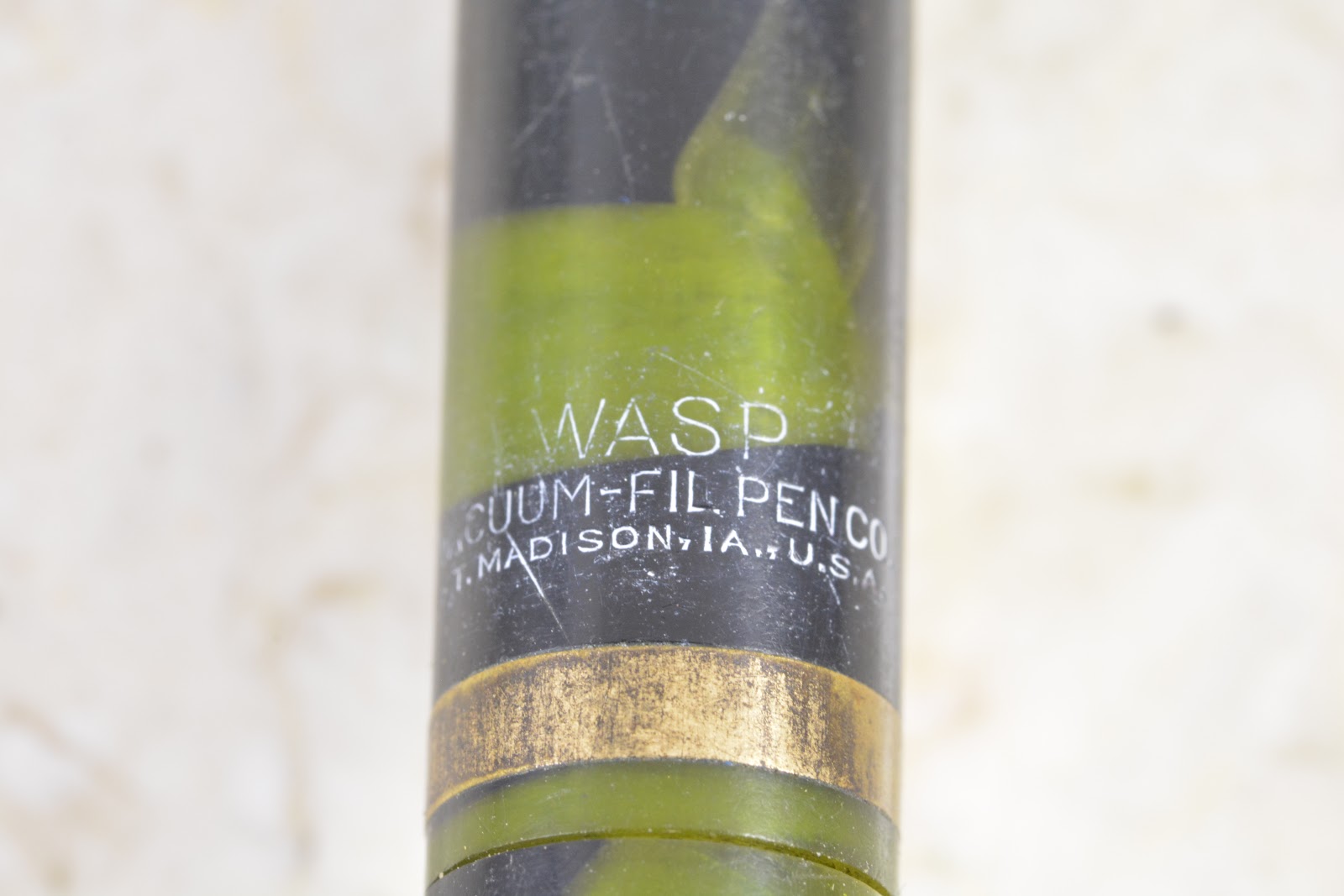
The one I was thinking of has a ball clip marked “Vacuum-Fil” as opposed to a flat clip, and note the different proportions and how the trim band is placed differently.  The green Vacuum-Fil has no imprint, while the black one is marked “WASP / Vacuum-Fil Pen Co. / Ft. Madison, IA USA”:


That’s the same imprint found on my new addition:


The profile of the new addition matches another WASP series perfectly:


Those two “lizard skin” examples appear on page 143 of The Catalogue, while the ebonized pearl example came my way some time later.  Two of them share the same imprint, with the ebonized pearl example being the odd man out:


After these two arrived and I’d already photographed them, I picked this one up too - also from Jerome:


I love that “electric green” color.  When it comes to these, I’ve noted two different styles of clips, on the copper-colored model in the same series (see https://leadheadpencils.blogspot.com/2016/08/why-i-have-so-damned-many.html):


They come in both a flat clip as well as a more pronounced clip with the letter “W” artfully incorporated at the top:


The “W” clips show up on utility pencils in WASP advertisements from 1939 (see https://leadheadpencils.blogspot.com/2017/01/sharp-in-more-ways-than-one.html), but that was the only year in which I’ve found ads which show the WASP version of Sheaffer’s “working togs” line of utility pencils.  I would suspect that the flat clips are a little bit earler, and since Sheaffer didn’t introduce this incarnation of the working togs pencil until 1938, it could be that the flat clip examples are truly first-year models.

Exciting to think about, but it could also be that Sheaffer just used up old parts however they saw fit, whether before, after or at the same time as the W clips. 

I’m not sure, and maybe it doesn’t matter.  I just kind of like having both versions when I know there’s two of them out there, and I’ve had another one of these, which I acquired from the estate of the late Frank Tedesco: