Wednesday, November 23, 2016

What Became of Dollarpoint . . . Revealed

This article has been edited and included in The Leadhead's Pencil Blog Volume 4; copies are available print on demand through Amazon here, and I offer an ebook version in pdf format at the Legendary Lead Company here.

If you don't want the book but you enjoy this article, please consider supporting the Blog project here.

At the DC Show, two of the pencils that came out of the hoard I purchased on Friday were these:


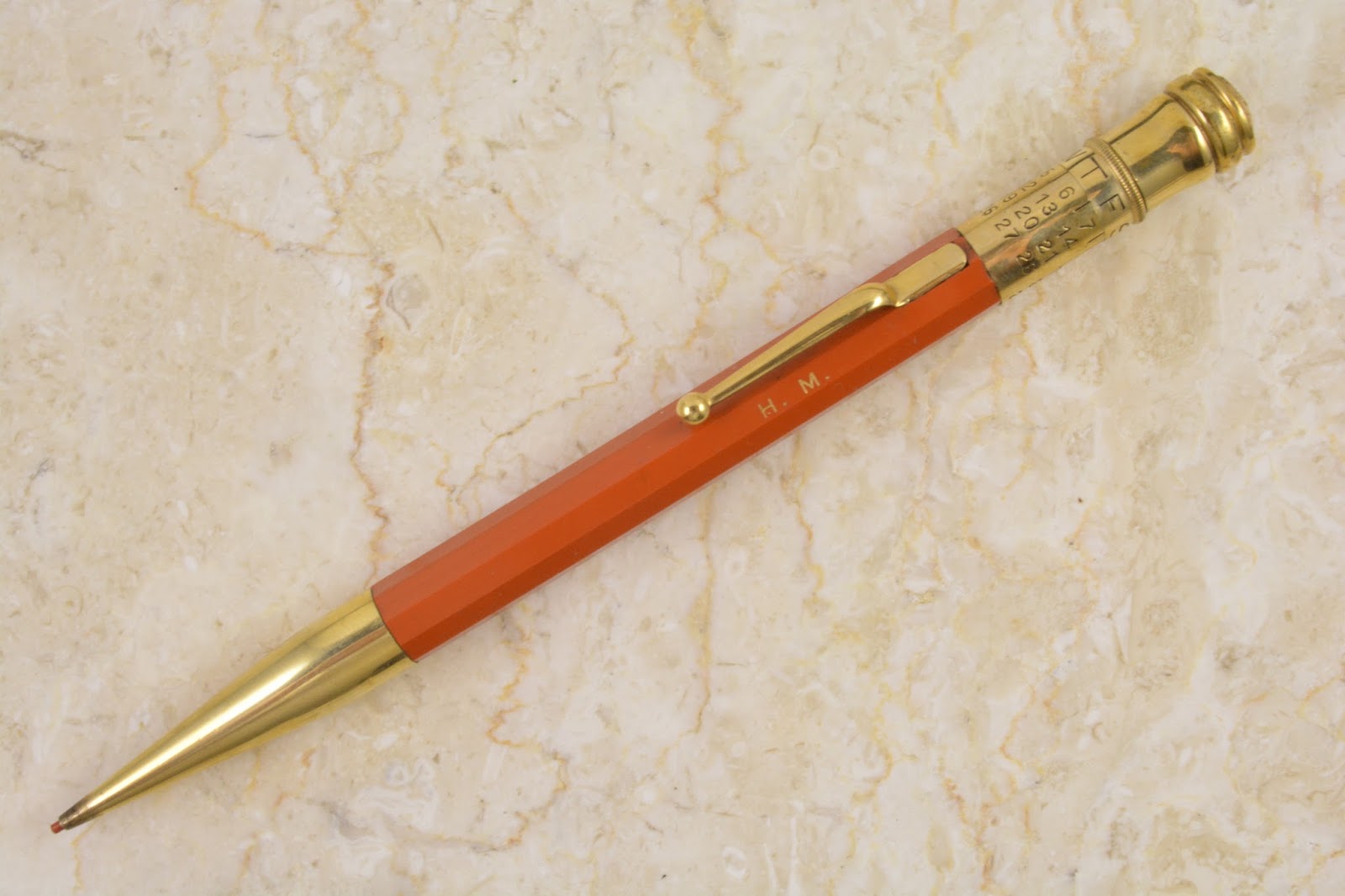
These are Artpoint pencils made by the Dollarpoint Pencil Corporation of Los Angeles, and it’s unusual to find them in finishes such as these:


Both look gold . . ish, but on close examination, one is a bright gold plate while the other has more of a bronze finish, with the recesses filled with what looks like black paint.

I wrote about the Dollarpoint Pencil Corporation here in a five-part series after I stumbled across the design patents and a couple names odd enough to unlock the company’s early history (the first in the series posted two years ago at http://leadheadpencils.blogspot.com/2014/10/artfully-to-point.html).  Missing from that series, unfortunately, was the end of the story – although I was able to find out what became of the characters behind the company after it folded, all I knew about Dollarpoint’s demise was that I could find no reference to the company after 1924.  I had found a short notice in Western Advertising that J.E. Roach & Co., the sole selling agent or manufacturer of the company’s pencils (depending on which news report you read) had retained the advertising firm of Smith and Ferris to launch a national advertising campaign, but then the trail went cold after January, 1922.

Since I was really itching to show you a couple new Artpoints – more than just a “here’s a couple more pretty colors” sort of piece – I went back and rechecked my research to see if I could find any new details.

I did.  When I wrote those articles two years ago, it was just before I subscribed to newspapers.com (mostly for the Bloomington Pantagraph, which gave me some valuable insight into the early history of Charles Keeran and his Ever Sharp).  Beginning in September, 1921, Dollarpoint placed enormous advertisements in the Los Angeles Times, starting with this one on September 11, 1921, soliciting sales representatives:


This advertisement is curious in a couple respects: note that only the lower-priced Dollarpoint pencils are advertised – even though the floral detailing shown on the pencils is clearly from the higher priced Artpoint line, the nose cones are clearly marked “Dollarpoint.”   Note also that J.E. Roach & Co. is identified only as “national distributors” in this advertisement – unsurprising, since the focus of the advertisement is to attract sales representatives rather than to advertise the product itself, even though J.E. Roach had been incorporated as a “manufacturer” in May, 1921 and the company by December was identified in various accounts as the manufacturer, rather than just the distributor.

On November 6, 1921, the Dollarpoint Pencil Company’s new advertising agents went to work in the Times with this fantastic half-page advertisement for the new pencils, “right out of our own Los Angeles”:


Note that again, there’s no mention of the Artpoint line, notwithstanding the fact that the Artpoint had been announced in the stationers press a year earlier. Also, Dollarpoint Pencil Corporation and J.E. Roach & Co. are listed side by side, with Dollarpoint being identified as the manufacturer and Roach as the “national distributors.”

The new advertisement must have been a stretch for the fledgling company, as it wasn’t followed up with more advertising for the Christmas, 1921 season.  For the following year, there were a few more modest Christmas advertisements for 1922, including these:


Note that in the latter advertisement, the Sun Drug Company provides the most detailed listing of Dollarpoint’s products.  The lower priced Dollarpoint pencils were offered in nickel plate, while the more detailed Artpoints were offered in triple silver, “statuary bronze” (that must be what my bronzish looking one is), gold plate and “green gold.”  Obviously since the last two were the same price, the green gold is filled or plated, not solid gold:   as heavy as Artpoints are, a solid green gold piece would be something!  

In January, 1923 the company ran this nice ad for “a wonderful product of a wonderful state”:


In June, 1923, the company engaged in another campaign, including these two advertisements:


In a brazen attempt to take on the Eversharp and Autopoint on their home turf, Dollar Point placed a large advertisement in The Chicago Tribune on June 5, 1923, identifying “M. Mundell” in care of the Warner Hotel at the corner of Cottage Grove Avenue and 33rd Street as the point of contact for those interested in becoming dealers


Note the oblique swipe at Autopoint, which had adopted “The Better Pencil” as its slogan: although the Artpoint is touted as “The Non-Plug Pencil,” this advertisement begins with “The better metal pencil has come to town!”

The Dollar Point Pencil Corporation overextended itself in its bid to take over the pencil world.  Cracks were beginning to show at the end of June, when in this June 30 advertisement the top end prices for Artpoint pencils was reduced from $3.50 to $3.00:


On July 24, the Los Angeles Times reported that an earlier report (one which, unfortunately, I have been unable to find) suggesting that Dollar Point was bankrupt was false – one of Dollar Point’s creditors has executed on the firms assets at the factory, but this account reports that the attachment was released:


Although this report indicates that the company planned to “expand its operations with the aid of additional working capital,” it appears that the writing was on the wall for Dollar Point.  In October, 1923, the company published want ads in papers all across the company offering to sell territorial distribution rights.  This one appeared in the Baltimore Sun:


Note that these advertisements contain the only reference I have found to an “Artpoint Pencil Company,” suggesting that there may have been some corporate as well as financial restructuring.  At any rate, the bid to expand failed.  In late 1924, it appears that The Los Angeles Times took a significant portion of the company’s remaining stock as payment for the generously-sized advertisements the paper had been running for the company.  Advertisements such as this one began to run in November, 1921, offering a free Artpoint pencil to anyone who sold a subscription to the paper. Note that the pencils are said to retail for $1.50, half off the already reduced prices advertised in mid-1923:


The Times must have inherited a substantial supply of Artpoints, since advertisements continued to offer free Artpoints as a prize for securing new subscribers as late as this one, from the May 1, 1932 issue:


The January 5, 1925 edition of the Santa Ana Register contains a discount advertisement for Artpoint pencils, marked down to prices ranging from 39 cents to 99 cents – and to add insult to injury, the pencil pictured isn’t even an Artpoint: it’s a Sheaffer Sharp Point (note the “bowler clip”):


It was over for the Dollar Point Pencil Corporation.  On February 8, 1925, it was announced that all the remaining assets of the company would be sold at auction on February 12, 1925.  The firm was still located at the 16th Street address, clarifying that the company’s plans to build an enlarged factory never materialized.  “The entire plant, equipment, etc. will be offered as a whole and in the event that a satisfactory bid is not received will be sold by the piece or in lots to suit those present.”


On February 12, I think there was a satisfactory bid, and I think that bid was from agents of what would become the Western Pencil Company.  More on that tomorrow . . .

Tuesday, November 22, 2016

Two Interesting Brown & Bigelow Pencils

This article has been edited and included in The Leadhead's Pencil Blog Volume 4; copies are available print on demand through Amazon here, and I offer an ebook version in pdf format at the Legendary Lead Company here.

If you don't want the book but you enjoy this article, please consider supporting the Blog project here.

Michael Quitt brought this one to me at the DC show:


While I recognized it as a Brown and Bigelow lighter pencil, this one has two things which interested me.  First is the way it’s put together – you’d expect to pull the cap off and there’s your lighter, but no . . .


The lighter is in the middle of the pencil, facing away from the clip


Now before you think I’m a complete idiot and you write me to tell me “why don’t you just take out the lighter and put it in the other end,” that’s not a possibility.  The bushing at the top is necked down to clear where the clip assembly protrudes into the barrel at the top end and prevents the lighter from being inserted from the top.  Nope, this is the way this one was made.

The other thing I liked was the imprint:


It’s got a Brown and Bigelow sales sample imprint.

The other one along these lines I’ve got to show you today is another “trick” pencil - this one with a knife built in:


On the clip is the telltale “BB”:


The imprint on the barrel resolves any doubt concerning it might be some other B and some other B:


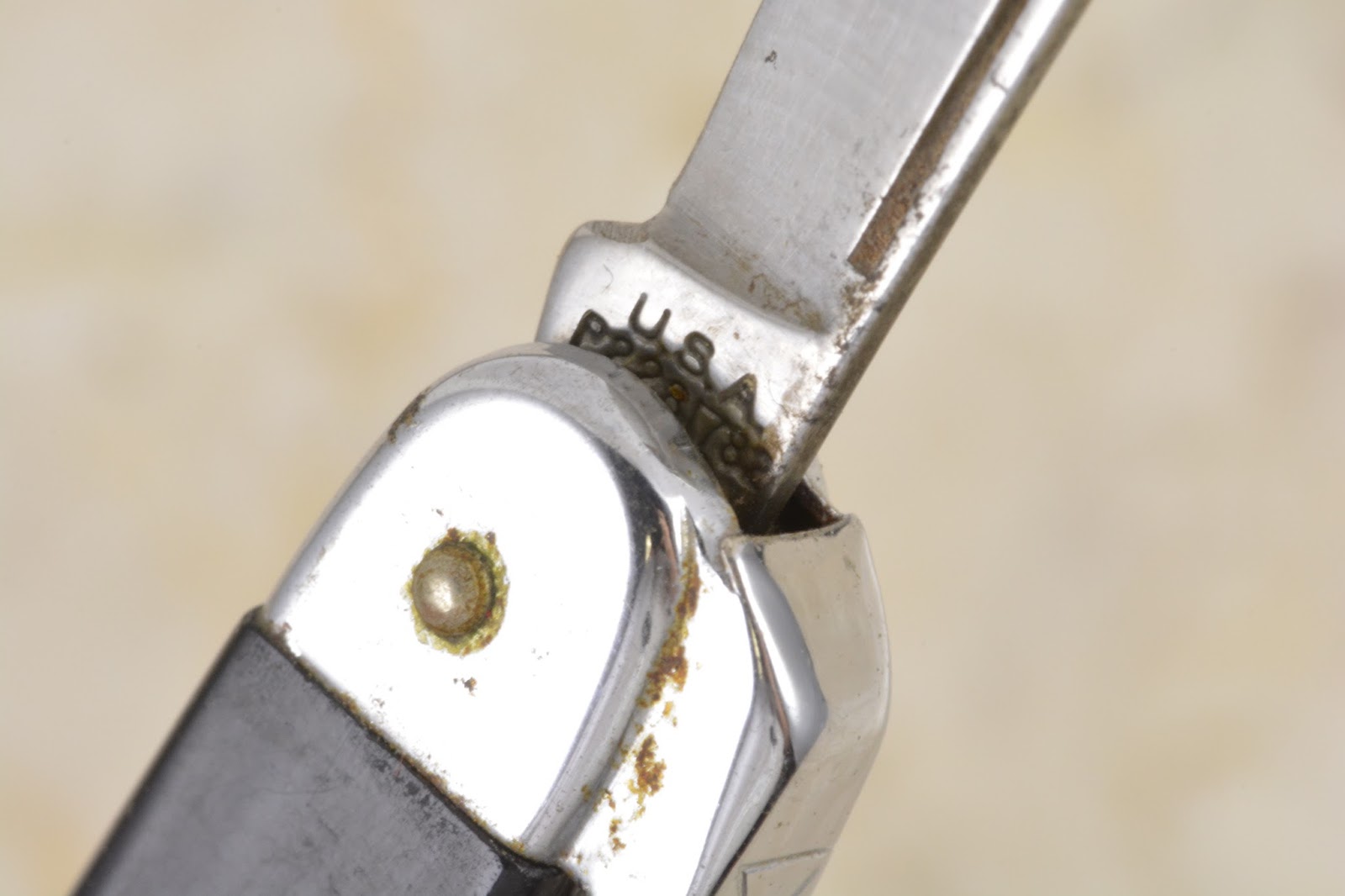
I always check the tang of the knife blade whenever I see one of these . . . you never know what you’ll find:


“P2281782.”  I thought this might be a patent number, and it was:


Feliz A. Mirando applied for this patent for a folding knife on March 10, 1941, and it was issued on May 5, 1942.  Mirando assigned his patent to the Imperial Knife Company of Providence, Rhode Island.

Monday, November 21, 2016

Over the Top

This article has been edited and included in The Leadhead's Pencil Blog Volume 4; copies are available print on demand through Amazon here, and I offer an ebook version in pdf format at the Legendary Lead Company here.

If you don't want the book but you enjoy this article, please consider supporting the Blog project here.

You don’t see these very often:


Sheaffer’s lowly “Working Togs” utility pencil line was sometimes dressed up a bit with a gold filled domed cap to cover the eraser, rather than the built-in exposed sort.  It’s taken me some time to find examples in good condition, since these caps are usually found dented:


Note that the chasing is different, with breaks between the lines on the version with the all-black barrel.  These were listed in Sheaffer’s 1940 catalog, found in the Pen Collectors of America’s website (what?  You haven’t joined yet?), as modlels JLE (with the gold center barrel) for $2.50 and KLE (with an all-black barrel) for $1.85:


But the catalog doesn’t show this one:


Dan Reppert has had this one, and I’ve admired it for years – I finally had to bite at the Michigan Show.  This pencil combines the deluxe cap treatment of the model KLE with an ordinary brown pearl-center pencil, an uncatalogued variant made specially for one significant cutomer:


W.E. Buhler, “That Sheaffer Salesman,” ordered a run of these, with his name and a picture of Sheaffer’s Fort Madison facility.

Joe Nemecek shared another uncataloged variant on the JLE at the DC Show:


In a demi size.  Maybe a JLEv?

Sunday, November 20, 2016

For Those Who Like Advertisers

This article has been edited and included in The Leadhead's Pencil Blog Volume 4; copies are available print on demand through Amazon here, and I offer an ebook version in pdf format at the Legendary Lead Company here.

If you don't want the book but you enjoy this article, please consider supporting the Blog project here.

I almost cast this one aside when it popped out of the boxful of pencils I bought in DC: sure, it’s a neat graphic of a clothespin, I thought, but do I really need to start collecting those?


Fortunately, curiosity drove me to see what was inside.  While the pencil is unmarked, it is without doubt a chubby version of the Eagle automatic, printed with the same graphics from the box lid:


Saturday, November 19, 2016

Three More Interesting Dur-O-Lites

This article has been edited and included in The Leadhead's Pencil Blog Volume 4; copies are available print on demand through Amazon here, and I offer an ebook version in pdf format at the Legendary Lead Company here.

If you don't want the book but you enjoy this article, please consider supporting the Blog project here.

I’ve collected Dur-O-Lites in much the same way I started collecting Sheaffer pencils: when I get a mess of pencils, all the Dur-O-Lites go into the Dur-O-Lite pile for the day when I get around to organizing them.

I’m just now getting around to organizing them.  Here’s a couple neat ones I’ve been meaning to write about:


The top one is interesting because, in addition to that wild color, it’s in a size I haven’t seen before.  It’s the length of a regular Dur-O-Lite ringtop, but with a side clip:


And that blue one?  It’s a utility pencil, with an exposed eraser and that Wahl-style clip.  What sets it apart, like that first one, is the size.  Here it is, compared with what I’d expect to see:


It’s a slim version of the utility pencil, with a specially-sized clip to boot.

This third one is one you’ve seen here before, but the one you saw wasn’t in my collection.  I’ll admit to a bit of Dur-O-Lite envy when John Coleman sent me pictures of the one he had like this one (the article was posted two years ago at http://leadheadpencils.blogspot.com/2014/10/this-one-elevated-my-understanding.html):


It came along with a few hundred pencils in a collection I purchased at the DC show – one of the ones at the bottom of the bins that I didn’t know was in there before I bought the whole bunch.  It was a pleasant surprise to see an Otis Elevator perpetual calendar advertising pencil I didn’t know was there pop out:


I don’t have any new revelations for you on this one - just thought I’d take the opportunity to post a couple neat pictures of this one while I was on the subject.

Friday, November 18, 2016

Asked and Answered

This article has been edited and included in The Leadhead's Pencil Blog Volume 4; copies are available print on demand through Amazon here, and I offer an ebook version in pdf format at the Legendary Lead Company here.

If you don't want the book but you enjoy this article, please consider supporting the Blog project here.

Note:  this is a continuation of yesterday's article at http://leadheadpencils.blogspot.com/2016/11/dawn-of-dur-o-lite.html.

It’s not often that I get this lucky.

In yesterday’s installment, I was noting some differences between what I believe to be the earliest Dur-O-Lite pencil, the top one in this picture:


Without the missing ferrule, though, all I could do is speculate about a few things and promise to keep a sharp eye out for these in future . . . and so, with that article uploaded and ready to post yesterday, I sharpened my eyes and headed off for the Ohio Show.
Where I found this:


Note that this one has the same shorter tip, and this one also has an early imprint suggesting production in the first year or so of Dur-O-Lite’s existience: “Memphis 1927":


A survey of my other bolted-clip Dur-O-Lites reveals one other example with that same straight, ribbed clip.  All the others have a more familiar bell top:


I pulled the tips off of these three examples to see how they compared, and a clear evolutionary path emerged.  The shorter tips butt up more cleanly against the end of the barrel; later, the tip was lengthened to fit over a more pronounced shoulder, for greater stability, and this shoulder was lengthened even further later on:


My working theory as I wrote yesterday’s article was that the more flowery imprints on the caps were earlier, and that the straight top was likely what we’d find on the earlier examples, and that appears to be correct:


The imprint on my Memphis 1927 example has the more ornate imprint:


And there’s just one difference between the top ends of this one and that red example:


The Memphis 1927 example has a friction fit upper ferrule.  I think it’s safe to say now that the Dur-O-Lite as originally introduced had (1) a bolted clip, (2) a shorter tip which butted up against the barrel rather than sliding over the end of it, (3) a friction-fit upper ferrule, (4) a more ornate imprint and (5) a straight, ribbed eraser cap.  Threads were quickly added to the upper ferrule to better secure it, along with a more pronounced shoulder and a longer tip at the other end.  A crown cap replaced the straight cap, and plain straight ferrules were added with exposed eraser.  Finally, the imprints were simplified, and other clip styles were added.  There appears to have been a lot of overlap as new features were added, and older, obsolete parts were used up rather than being discarded.

Thursday, November 17, 2016

Dawn of the Dur-O-Lite?

This article has been edited and included in The Leadhead's Pencil Blog Volume 4; copies are available print on demand through Amazon here, and I offer an ebook version in pdf format at the Legendary Lead Company here.

If you don't want the book but you enjoy this article, please consider supporting the Blog project here.

Here’s one that narrowly escaped a one-way trip into the junk box because of one tiny detail that caught my eye:


Notice that the clip is secured with a bolt, kind of like what you’d see on a 1920s Autopoint or an Eversharp dollar pencil of the same era, but it’s a square-head bolt rather than hexagonal:


I’ve noticed three different clip styles on these early Dur-O-Lites: in addition to the bolted style, there’s one that looks a lot like Wahl’s clip and then an ordinary Z-clip.  All three were used on similar models:


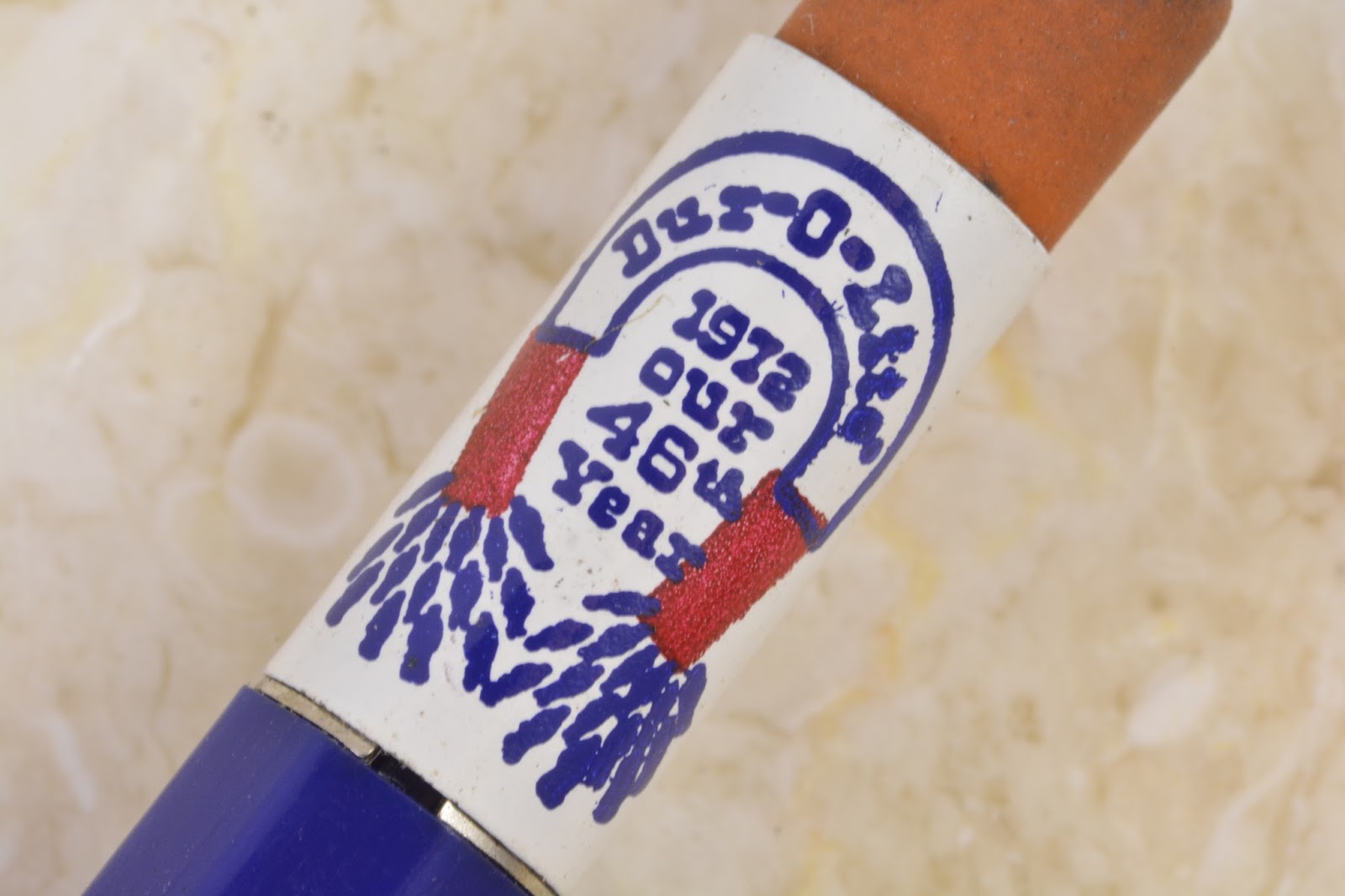
I believe these bolted-on clips were the earliest Dur-O-Lite used; Dur-O-Lite was founded after several of Autopoint’s executives, disgruntled by the Bakelite Corporation’s takeover of a controlling interest in the company, split off to form their own pencil company.  The split happened in 1925, the year Bakelite muscled its way into the picture, so I had always assumed Dur-O-Lite was founded in that year.  Thanks to this Dur-O-Lite “7-11" pencil, though, I now know that the company was founded the following year, in 1926:


This commemorative pencil is dated 1972, “our 46th year”:


Now think a minute about the imprint on this bolted-clip example:


“1927 Compliments . . .”  That’s something you’d hand out before the beginning of 1927 as a New Year’s gift, not something you’d distribute once 1927 was well underway.  Could this be a first year Dur-O-Lite, made during late 1926 in preparation for the coming year?

I think it is.  Compare this one to the other examples with bolted-on clips I’ve managed to turn up:


Note that the tip is shorter than on any of the others, and at the other end there’s something else worthy of our attention:


Every other example of these that I’ve found has threading at the top end of the barrel: this is the only example of a Dur-O-Lite I’ve found on which the top end was secured only by friction (and, since this is the only one missing the top, that explains the addition of threads).

I note there are two styles of imprints found on these.  The first is a logo with flourishes at either end of the word “Dur-O-Lite” – that’s what is found on the lower four examples in that group picture:


The imprints on the remaining two drop the flourishes, but add “Chicago USA” to the end:


I can’t draw any conclusions yet about the imprints.  The flourished imprints do appear on some of the Wahl-style clip examples, particularly on the straight, exposed eraser ferrules . . . but since switching or replacing ferrules is a simple matter of unscrewing one and screwing on another, “junk box provenance” is all we have to go on.  I can tell you that the simpler imprint is what is found on some obviously later models, so I believe that imprint was introduced later . . . perhaps they had a leftover run of a few thousand ferrules with the earlier imprints, which were mixed in with the newer ones during production to use them up.

Obviously, I have no idea what imprint the missing ferrule on my 1926 Dur-O-Lite would have had, but I’ll keep a sharper eye out now for Dur-O-Lites with a friction fit ferrule to be sure!

Note:  an intact example surfaced shortly after this article was written.  The story continues at http://leadheadpencils.blogspot.com/2016/11/asked-and-answered.html.