This article has been included in The Leadhead's Pencil Blog Volume 7, now available here.
If you don't want the book but you enjoy the article, please consider supporting the Blog project here.
Sometimes all it takes is a bit of persistent tugging at that one loose thread on a sweater, and the whole thing unwinds.
After I finished yesterday’s article linking Gordon’s “fanged” clips marked “Safer” with the Worth Featherweight Pen Company, something nagged at me. Since Gordon’s clips also turn up occasionally marked “Banker,” I wondered if there might be any connections between the Banker-marked Gordon clips and the Worth Featherweight story.
Spoiler alert: there wasn’t – at least, none that I was able to find. What I did find, however, answered questions that I’ve had since I first started collecting more than twenty years ago now.
“Banker” – at least, on pens and pencils like my Gordon-clip example – is a brand collectors refer to as “third tier”: lower quality pens and pencils which were typically more colorful than functional. We all cut our collector’s teeth rounding up these cheaper brands in pretty colors – names like Banker, Keystone, Waterson. “No-names” is an accepted collector’s term for cheaper writing instruments such as these, even though you’ll find literally hundreds of different names on their clips. “No name of significance” would be more accurate, I suppose.
Who made these “no-names’ (or produced them) is usually lost to history, just because nobody has taken the time to go gravedigging for them. By the time we graduate to the point where we are doing this level of heavy-duty research, we’ve also graduated to the point that we don’t care about these lowly brands as much as we once did. Now, however, I had a reason to dig a little deeper into my old third-tier, no-name stomping grounds, looking for the proprietors of the “Banker.”
There was a “Bankers Pen Company” in New York during the teens that receives some collector interest. That company is best known as maker (producer) of the “Master Pen,” at 1 Madison Avenue - the Met Life building, as most people know it. David Nishimura has posted articles on the subject – the early Bankers Pen Company was apparently supplied by Julius Schnell (of later airplane-clip “Penselpen” fame), and in 2017 David found a boxed example a few years ago suggesting that the Master Pen (at least at some point) was manufactured by Salz. For David’s story, see https://vintagepensblog.blogspot.com/2017/05/the- master-pen-salz-connection.html.
There’s a more detailed history of the Bankers’ Pen Company in Walden’s Stationer and Printer, published on January 10, 1919:
According to this account, a man named Joe Walsh put together a new kind of pen around 1910 or 1911 (“about eight years ago,” according to the article). He mailed out “about 500" pens to bank officials unsolicited, asking them to try it out and to send him $2.00 if they liked it. Nearly all of the 500 were sold, followed quickly by another 50,000 in short order – thus, Walsh’s pen became known as the “Banker’s Pen.”
According to Walden’s, William P. Chase bought the company from Joe Walsh in 1915 and added “a complete line of office supplies” to the company’s offerings. The 1919 article was published on the occasion of the company’s reincorporation as the “Bankers Pen and Office Supply Company” and notes the company had increased its capitalization from $25,000.00 to $250,000.00 in common stock. Chase is identified as the company’s treasurer, while Louis A. Pinon (a “capitalist” who had spent the last 34 years in Havana) was the company’s president. R.C. Hay, a recent Yale graduate, was the company’s vice president and general manager.
Other sources partly confirm the Walden’s account: Polk’s 1914 copartnership directory lists a Bankers’ Pen Company at 1 Madison Avenue, but it associates the firm with someone else – John J. Kilcoyne:
No patents appear to have been issued either to Joe Walsh or John J. Kilcoyne, and neither registered a federal trademark for the Bankers’ name. However, consistent with the
Walden’s article, Polk’s copartnership directory for 1915 lists a Bankers’ Pen Company, Inc. with Chase serving as secretary to the company. Clifford B. Harmon is listed as president, with James K. Duffy as vice president and Wilson C. Reed as treasurer.
By 1919, Polk’s Copartnership directory lists the individuals identified in the
Walden’s article . . . mostly. Hay isn’t listed (perhaps he was brought into the firm after the directory was published) and three other individuals appear as directors: Lewis M. Symms, W.J. Keely, and Albert A. Ochs:
On August 8, 1920, the Bankers’ Pen Company advertised for salesmen in the
New York Herald:Then . . . the Bankers’ Pen Company vanishes. The company isn’t listed in the New York City Directory for 1922-1923; perhaps it was renamed, but if the company’s bread and butter was supplying the banking industry, the mini-Depression of 1921 which resulted in the failure of so many banks may also have triggered an abrupt end to those who sold them office supplies – other than red ink, I suppose. William P. Chase is listed in the 1922-1923 directory, but as president of the “Kor-Nut Company, Inc.” In the 1925 directory, he is president of the Chase Candy Company, Inc.
Meanwhile, a man named James Kelley appears in the 1922-1923 directory. Was this the same man as “W.J. Keely,” listed as a director of the Bankers’ Pen Company in 1919? Perhaps – as will be discussed later, Kelley had good reason to use aliases. In 1922, however, James Kelley listed an occupation as flamboyant as the man himself must have been: “Specialty King.”
I’m reminded of the time I was contacted by a local community college to see if I would be willing to teach a business law class – for free, of course. I said I would because I thought it would be fun . . . until they put me through a rigorous application process for the privilege of volunteering and they refused to accept my “application” until I provided my title with my current employer.
I’m a sole practitioner, I replied. No, they said. You must have a title. “Fine,” I said. “Put down ‘God’ and ‘Emperor.’”
I did not get the job.
By the time the 1925 directory was published, James Kelley provided a more traditional description of his occupation, identifying his profession as “novelties and fountain pens” with a business address of 407 Broadway. His residence was reported as being in East Orange, New Jersey:
Kelley had been in fountain pens for several years. In 1915, he was just one of several New York pen companies who drew the attention of the newly formed Federal Trade Commission, which instituted proceedings against James Kelley in one of its earliest complaints – number 670, as itemized in the FTC’s first annual report in 1915. The Commission took on the New York pen industry at large for “fictitious pricing” on boxes, intended to mislead the public that the pens were higher quality pens being sold at a discount.
Kelley later operated as the “James Kelley Fountain Pen Company,” although there’s no listing for a company by that name in the directory. On November 12, 1931, Anderson’s Drug Store in Mattoon, Illinois advertised in the
Mattoon Journal Gazette that it would be introducing the new “bullet shape” Banker fountain pens and pencils, made by “the largest manufacturer of fountain pens and pencils in the United States.”
The advertisement, however, includes illustrations of a flattop Banker pen and a bell-top pencil with a Welsh-style nose. But wait a tick . . . what’s that say on the clip?
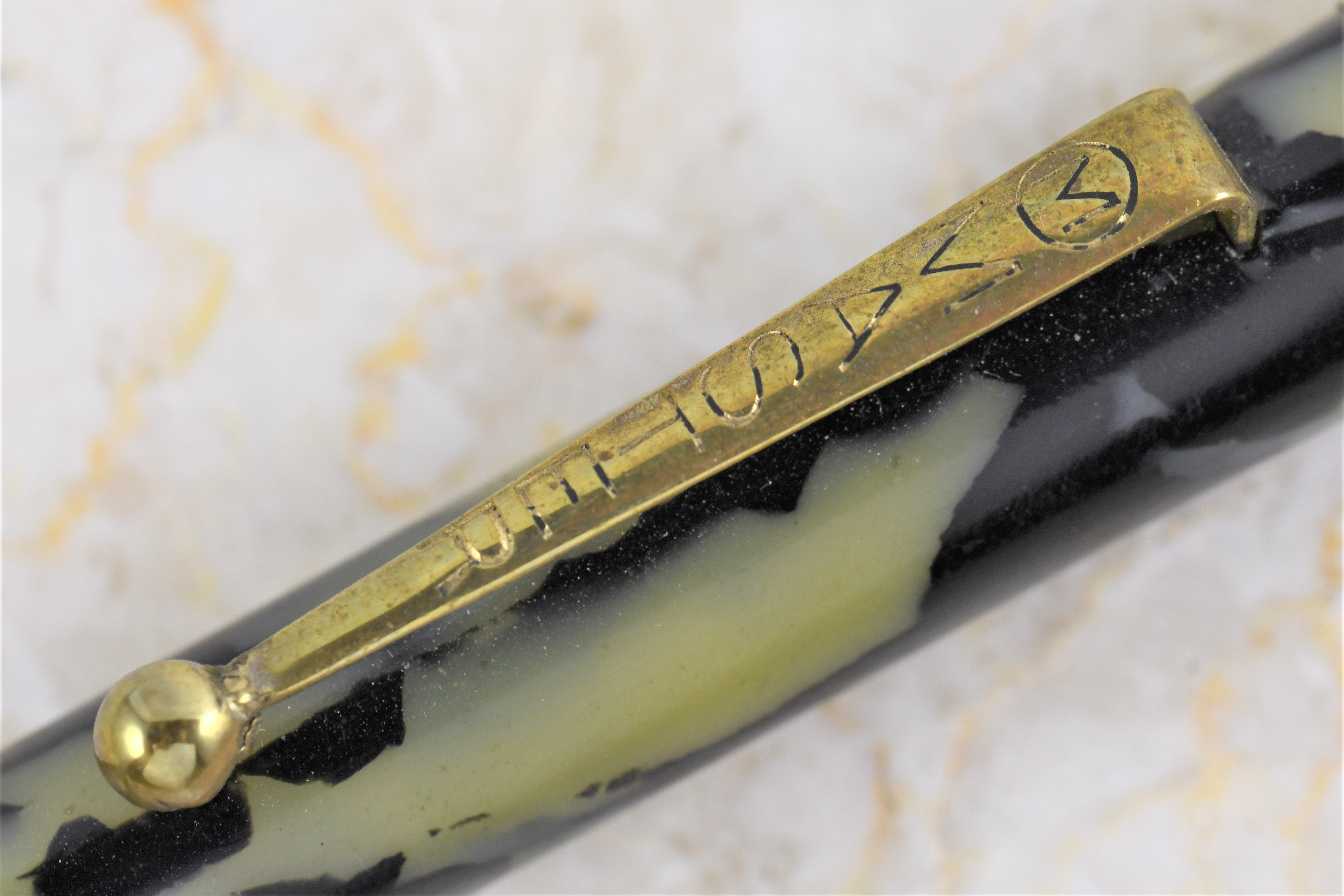
Waterson, with a K within a circle above the name. I have a few Waterson pencils, and just as shown in that 1931 advertisement, all have that K above the name within a circle.
I had always suspected that the K within a circle stood for Kahn, as in David Kahn, Inc., makers of the Wearever, but I had my doubts. Kahn’s other brands had “DK” in a circle, not just the letter K:
Yes, Virginia, we finally have the answer now - that K stands for Kelley, and the Waterson brand was made (or produced) by the James Kelley Fountain Pen Company – which, incidentally, was spelled “Kelly” in his advertisements, whether by accident or obfuscation.
Kelley was likely trying to keep a low profile as he peddled his Watersons under the watchful and litigious eyes of the L.E. Waterman Company. Nevertheless, his stunt did draw attention – if not from Waterman, from the Federal Trade Commission for a second time.
On April 7, 1930, the Commission issued several orders against James Kelley (13 F.T.C. 284), including orders prohibiting him from representing that he was a manufacturer of pens unless he really was; from supplying fictitious price tags to retailers so that they could offer his pens at an equally fictitious “discount”; and last but most revealing, from “using as a tradename for fountain pens or for pencils the name “Waterson” or any other name in sound or appearance simulating the name “Waterman,” or the name of any other manufacturer of fountain pens or of pencils, or any trade name under which any other fountain pens or pencils are commonly known and sold by any other producer of, or dealer in, fountain pens or pencils.”

The Federal Trade Commission’s order didn’t slow James Kelley down much, since the 1931 newspaper advertisement he printed a year after the Commission’s decision stated he was “the largest manufacturer of fountain pens and pencils in the United States” and illustrates a Waterson pencil. Kelley, it appears, simply fled out west, where he must have thought he would be out from under the watchful eyes of Federal regulators – and those pesky other manufacturers he was copying, such as Walter Sheaffer.
Perhaps the illustration of a Banker pencil with a Waterson clip was a gaffe – albeit a telling one. There are Banker pencils which, other than the clips, are identical to the Waterson pencil shown. However, they have Banker clips which are pressed into the barrel rather than Z-clips like those on the Waterson:
In the spring of 1932, advertisements appeared in the western United States, from Nevada to Idaho, announcing “the new 1932 gothic model
Keystone Banker,” which looks remarkably like a Sheaffer Balance. This one appeared in the
Nevada State Journal on April 3, 1932:
The announcement is described as a “manufacturers’ advertising offer,” but at the bottom, the manufacturer is identified not as the James Kelley Fountain Pen Company, but as the “Banker Pen Company” located at 417 Governor Building, Portland, Oregon.
These “gothic model” Bankers are advertised in french onyx, mottled green or black and white. Here’s the examples I’ve found:
Those butterscotch-swirl pencils might be “french onyx” I suppose, which brings me back around to the Banker “gothic” pen with a Gordon clip that started this inquiry. I’ve recently picked up a second one:
The nib on the new one says “Bowl 14k Gold Filled M.B.” As for the other, it makes more sense now, since I know the James Kelley Fountain Pen Company was offering these for sale. “Kelley Banker,” it reads:
The “gothic” shape was apparently abandoned. Bankers appear with a more rounded than tapered profile:
There are also squared off models, some of which are marked “New Banker.” Perhaps Kelley reorganized the company for financial reasons, or perhaps he was trying to evade his competitors and regulators:
These are all marked “New Banker”:
And this last group has “Banker” written in a font and style which is very similar to pencils sold by another rascal, Joseph Starr:
In 1935, the Federal Trade Commission was knocking on Kelley’s door again, since he was required to report back to the commission in writing on or before August 7, 1935 to establish that he had complied with the order. Although he filed an answer, the existence of a 1931 advertisement would have made it difficult for Kelley to argue that he had in fact done so. In 1937, a Federal court affirmed an order from the FTC compelling Kelley’s compliance with the terms of the 1930 order.
In 1939, the Federal Trade Commission pursued James Kelley for a third time. Kelley, “sole trader, trading as James Kelley Fountain Pen Co. and also as The Banker Pen Co.,” was slapped with his third injunction on August 11, 1939. He was prohibited from using words like “Durium Pointed” or other words implying that his nibs “are made or tipped of any purported substance, fanciful or real, when such is not the fact.” Likewise, he was restrained from using the mark “14k” or any similar marks suggesting there was 14k fineness of gold used; and third, he was prevented from continuing to use the words “Life time guarantee” on products if the customer had to pay additional money to have it honored.
The libertarian and me chuckles at how James Kelley ignored the Federal Trade Commission. He had a great scheme going, selling cheap fountain pens and pencils to drug stores with grossly exaggerated prices on them, so that these stores could “discount” them to gullible customers. Seriously . . . any fool dumb enough to mistake one of Kelley’s Watersons for a Waterman is a fool who should be parted with his money.
However, that 1931 advertisement is a rare glimpse behind the curtain of Kelley’s empire: yes, it flagrantly violates the terms of his 1930 Federal Trade Commission injunction, but it has elements of plausible deniability: Kelley’s name is misspelled as “Kelly,” and the advertisement doesn’t specifically offer Waterson pencils – it just includes an illustration of one.
Kelley wouldn’t miss a beat in hawking his cheap writing instruments, P.T. Barnum-style – Federal Trade Commission be damned. He would find other ways to circumvent the injunctions issued against him . . . and the fact that the FTC never caught on to what he was doing during the 1930s explains why it is so difficult to piece things together now.
If only Federal regulators had read the newspapers, though, they would have . . .