Friday, June 25, 2021

Pencil Yahtzee

This article has been included in The Leadhead's Pencil Blog Volume 7, now available here.


If you don't want the book but you enjoy the article, please consider supporting the Blog project here.

Pencil names during the 1920s were a lot of fun.  If you took a pair of dice and wrote words on the faces . . . ever, sharp, rite, ready, point, real . . . and give them a roll, no matter what comes up, you’ll get a known brand name.   Eversharp, Sharp Point, Realpoint.  You can even roll a double and get Rite-Rite.

A few weeks ago I rolled a new one: Ready Sharp.


The listing didn’t contain much information, but I knew more information would be available once I examined what was underneath the pencil in that great box:


It’s a shame this example is a ringtop, because that clip would be the clincher - however, the crown is similar enough to what is illustrated, and that rib near the nose helps, too.  I’m confident this pencil was what originally went with this box:


I would like to see a side-clip model someday, just to know whether that’s an accommodation clip that slips on or whether it was permanently attached.  Good to know where to put the lead (it would have been great if it read “Put it here, dummy”):


What was surprising was the imprint on the pencil.  Nice to see the positive attribution for this brand name:


The American Lead Pencil Company of New York.  

Now, let’s see if I can roll a “Sharp Sharp” . . . or maybe a “Pointy Point” . . .


Thursday, June 24, 2021

Trained Well

This article has been included in The Leadhead's Pencil Blog Volume 7, now available here.


If you don't want the book but you enjoy the article, please consider supporting the Blog project here.

When this one showed up in (yet another) online auction – damn, I miss telling you something interesting about how these things have been coming my way – I knew to bid on it.


At least how I knew to bid on it is something interesting.  Dan Zazove, Parker aficionado and expert, as well as co-author of landmark books on the Parker Duofold and Parker Vacumatic, cornered me at the Ohio Show several years ago with a pencil that he said was special, and he said I needed to buy it.  I did, although with a bit of a blind spot for Parker (I’ve admitted I can appreciate them, not that I’m an expert with them), I did so on faith:


That stubbier cap on the clip model Dan sold me is that quasi-“streamline” model of 1929 – see Volume 4, page 329.  I call it quasi-streamline because, as documented in that previous article, the top end treatment was changed when Parker introduced the slightly rounded (but still flat on the top) “streamline” Duofolds during that year.  

Here’s what’s interesting: these black rubber barrels have groups of lines on them, which to my knowledge streamlined Duofold pens never had:


Dan’s pencil has a label which reads simply “Duofold Junior Pencil $3.50":


The ringtop is denominated model 91, with a $3.00 price tag:


Unfortunately, the PCA’s library is sparse on Parker catalogs from the 1920s.  The 1923 catalog shows only Parker’s new metal “Lucky Lock” pencils, while a 1929 pamphlet illustrates the introduction of streamlined pencils, so production of pencils like these fall somewhere in between.  The only other catalog there is dated 1927, and the page showing black and red pencils illustrates smooth barrels only.  The ringtop is black is model 82, not model 91:


Note that these pencils are “to match the pens,” referring to Parker Duofold pens on the preceding page.  


On a later page, fountain pens are illustrated with black lined barrels matching my pencils – but unlike all the other colors of writing instruments Parker offered that year, no matching pencils are listed:


In addition, the pens shown on this page do not have Duofold imprints, and they are not referred to as such – they were just Parker Black and Gold Pens.

I circled back around to Dan as I was writing this article, to make sure exactly what was so rare about these – the black lined barrels, the lined barrels in combination with the “Duofold” imprint on them, or the price tags . . . or a combination of all three.  Dan confirmed that it was the name “Duofold” on the black lined barrels that is unusual.

But the price tags don’t hurt!

Wednesday, June 23, 2021

More Than a Buck These Days

This article has been included in The Leadhead's Pencil Blog Volume 7, now available here.


If you don't want the book but you enjoy the article, please consider supporting the Blog project here.

This Eversharp Dollar Pencil has appreciated over the last 90 years:


This particular model was made in 1930 or 1931, according to the timeline I’ve assembled (the full story is in Volume 4, page 3).  I know that because earlier models were equipped with the improved (post-1924) Keeran mechanism.  This one sports the same mechanism found on the Equipoised, and later models – like the ones shown in the 1932 catalog – were streamlined.

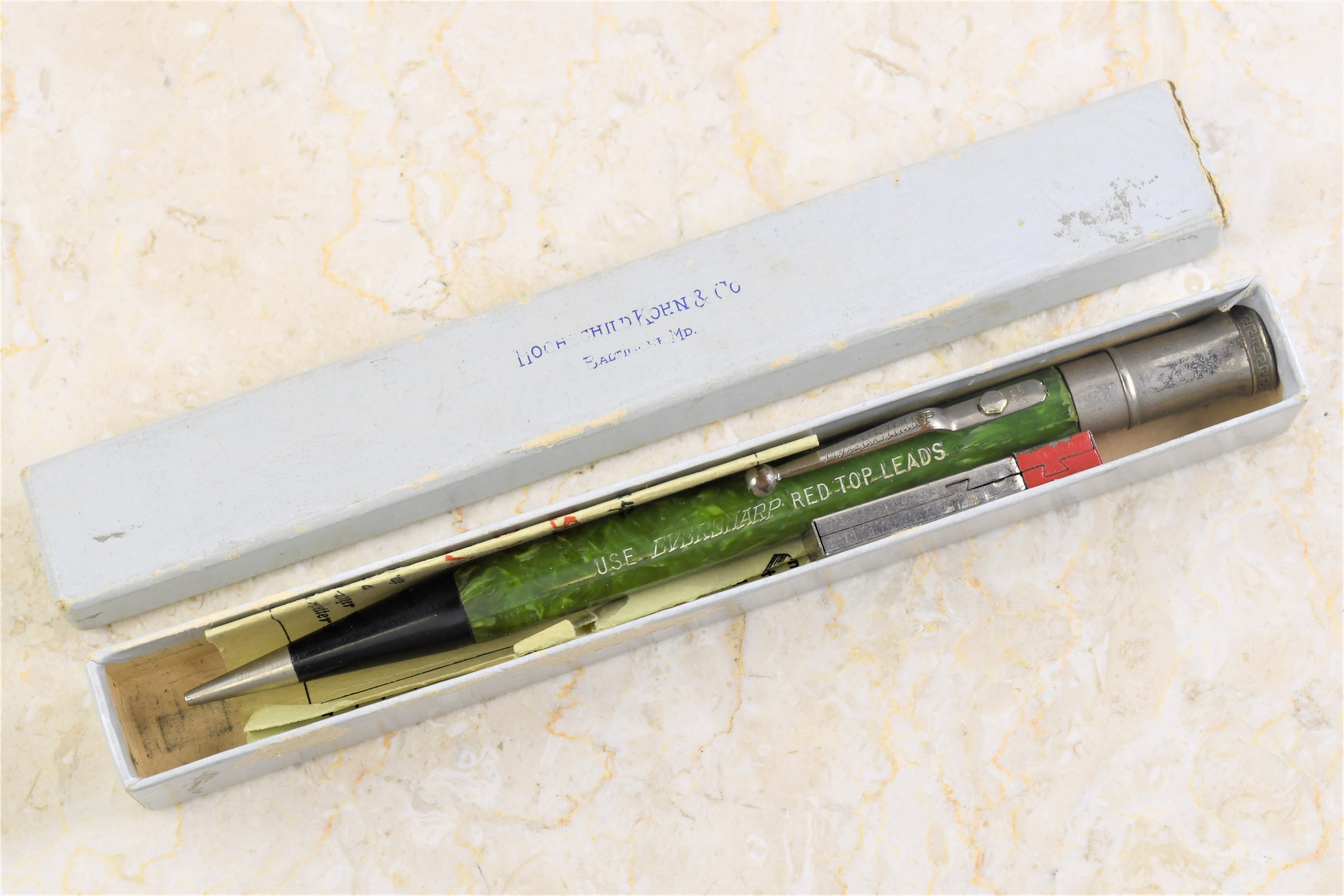
But . . . unlike all the other ones I have found which hawk Eversharp’s “Red Top” leads, this one is in jade.  Pedestrian, perhaps, but more interesting than any other material on which I’ve found this imprint:


Note there were three variations:   “ Eversharp Red Top Leads,” “Use Eversharp Red Top Leads,” and “Always Use Eversharp Red Top Leads.”  The “always” variation is found on the earliest; apparently as time went one, using them every so often was good enough.

There was another reason to bite on this one.  It was visible in the auction pictures, crammed in the bottom of the box:


I’ve just got to know what every piece of paper says.  When I flattened this one out, it was one I haven’t seen before . . . Red Top leads, in those rectangular metal containers, advertised on the other side of paperwork detailing Eversharp’s “Personal Point” pens with screw-in nib units, predating the introduction of the Doric in 1931; so 1930, I’m suspecting for this one, if the paperwork has been riding alongside this pencil for the last 90 years.


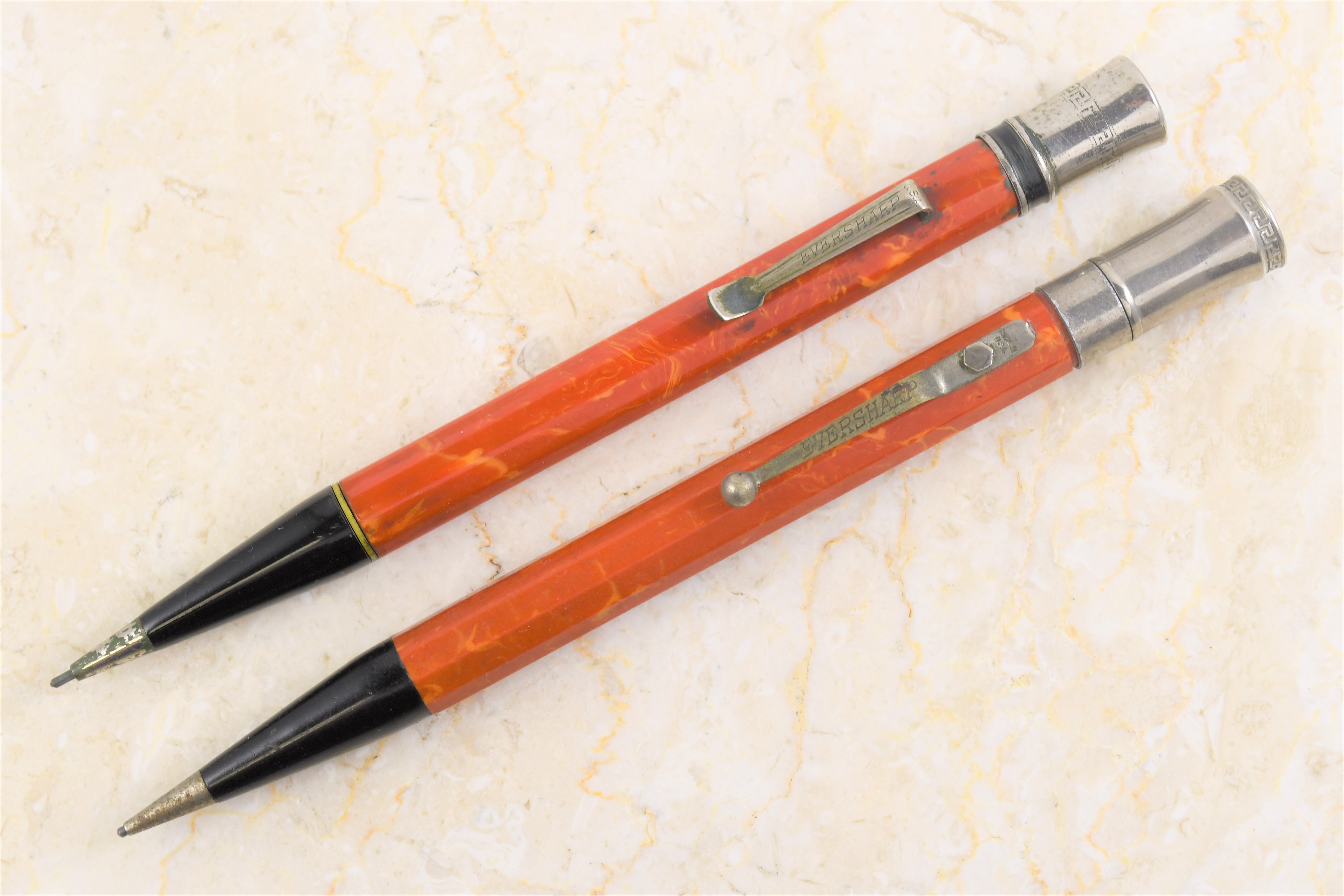
Then, just as I was ready to call it a day for this article, another Eversharp Dollar Pencil showed up in an auction over in England – I just had to bite:


The coral color is spectacular, but that isn’t what’s new.  Here it is alongside the ones you usually see in this color:


The Dollar Pencil series, as documented in my previous article, went through a linear series of developments.  First, the clip was changed from a simple z-clip to that bolted-on one . . . then, the mechanism inside was switched from the venerable Keeran mechanism (as improved in 1924) to the Equipoised mechanism. 


I haven’t found the transitional model in coral yet, with the old mechanism and the new clip.  But the coral was a welcome addition to the other Equipoised-mechanism examples I’ve found:


Eversharp is an infinity pool.  Swim as hard as I can, I still haven’t reached the opposite side.


Tuesday, June 22, 2021

For My Amusement

This article has been included in The Leadhead's Pencil Blog Volume 7, now available here.


If you don't want the book but you enjoy the article, please consider supporting the Blog project here.

When Michael Krut sent me the black and pearl Eversharp Doric I wrote about a few weeks ago (see "My First Love"), he included a few stowaways – bits and pieces of things that he thought I might enjoy, just for fun.  One of them was this:


My initial thought when it popped out of the box was that it might be an unusual smaller version of the Autopoint Model 466 – from that awkward transitional period in 1931 when the noses had been changed from the long metal ones to Bakelite, but before the top end was redesigned to include a matching plastic cap.


These Autopoint transitional models are tougher to find, even though they were offered in Autopoint catalogs through 1936 – for more information, see A Century of Autopoint, page 112.

I’ve never seen a smaller model, and this one looked like it had a replacement cap, from a Dur-O-Lite.  Good luck finding the right cap, I thought . . .


But then I noticed the imprint, and this little guy went from amusing to fascinating faster than you can say Dur-O-Lite or Autopoint:  Keen Point (only two syllables – that’s why it’s faster).  


The Keen Point was also discussed in A Century of Autopoint, due to its connection with the inventor of the original Autopoint, Charles Keeran (see Chapter 7 in A Century of Autopoint).  After Keeran’s second ouster from Autopoint, he engaged in a series of associations with other manufacturers.  In 1927, he filed his trademark registration for the Keen-Point logo:


The earliest Keen Points were made by Dur-O-Lite, as illustrated on page 83:


On that same page, I illustrated a Dur-O-Lite (top) compared to a Keen Point (bottom) with their noses removed, to show how they are different inside.  As I noted in the book, very few Dur-O-Lites, probably very late production during the flattop series, share that same barrel end treatment:


This new example shares similar barrel end treatment:


As I mentioned when I restarted this blog, I’m writing these articles while I’m taking a break from writing a book about the history of Dur-O-Lite titled Dur-O-Lite: The Clandestine Company.   I delve more heavily into the Keen Point in its pages, and I now know that by the time Dur-O-Lite relocated from Chicago to Sycamore, Illinois in 1931, the mark no longer belonged to Charles Keeran.  It had been acquired by Dur-O-Lite, which was by that time marketing a lower priced “Keen-Point” line of pencils.

The cap on Michael’s pencil is probably correct: Dur-O-Lite did offer a thin model during the flattop era which used that cap.  Here’s an image showing that same cap on a slim model found in the Dur-O-Lite factory archive which will be included in the new book:


What I didn’t know until Michael’s example came along was that there were demi-sized thin models, and that the Keen Point changed out the tips from metal to plastic, then the cap.   All the other examples I’ve found have either both metal ends, or both plastic.  


I’m sure that Autopoint inspired Dur-O-Lite to change out the tips.  However, given that this is the only Keen Point I’ve ever seen which didn’t change out the top end as well, I’m wondering if Dur-O-Lite didn’t inspire Autopoint to change out the caps in return.

Monday, June 21, 2021

Troublesome Brazilians

This article has been included in The Leadhead's Pencil Blog Volume 7, now available here.


If you don't want the book but you enjoy the article, please consider supporting the Blog project here.

Someone sadistic person at Eversharp must have enjoyed tormenting people with OCD tendencies.  Consider, for example Eversharp’s “Brazilian Green.”  There’s one lurking in this group of Eversharp purse and clasp pencils, trying to look like it is working and playing well with others (as pictured in Volume 4, page 142):


Brazilian green is fourth from the right, in that green with bronze swirled into it.   Wherever that color appears, it doesn’t quite follow the same rules as all of the other colors.  A few years ago I shot a pair of deco band pencils to illustrate that point:


Both would qualify as “deco,” but every other color in the series has a greek key band.  The center band on the Brazilian green ones is narrower, with offset parallelograms - “rhomboid” bands, collectors call them:


The extra bands were also added to the short, military version of these pencils in the series, as shown in The Catalog on page 61 . . . and to my knowledge, this color wasn’t offered as a ringtop or full length, non-Deco band version:


When it came to the purse pencil line, Eversharp divided the line into “girlier” colors, with a single rhomboid band like the “Tempoint-styled” Brazilian Green models, and “manlier” colors, which had two plain bands.  The Brazilian green, however, fell on the “manlier” side and, for this series, got two plain bands rather than its usual rhomboid one.


A recent online auction brought this one to my doorstep, marking a grim milestone:


That slightly longer top end means this isn’t one of Eversharp’s “purse pencils.”  It’s a “clasp pencil,” according to the 1932 catalog – a more manly version of a smaller pencil:


Consistent with that non-purse designation, the clasp models are found in the manlier colors only, with their usual twin bands:


From this picture, it looks like all I’m missing is a clasp pencil in Brazilian Green, then the set would be complete, right?  That’s the grimness of the milestone – I’ve actually completed the set, according to Eversharp’s 1932 catalog:


These were cataloged in five out of the six “manly” colors . . . all but Brazilian Green, which was offered only as a daintier purse pencil, but with manly trim.  


I don’t know what is worse – thinking Brazilian Green clasp pencils exist and Eversharp’s catalog is off, or thinking my clasp pencil set is complete and Eversharp was . . . well, just plain mean.

Eversharp’s catalog is off, in one respect.  Pictured next to the clasp pencils are the “ring” models; while I’ve never seen one in the purse pencil size, they exist on the manlier line – in fact, they look even larger than clasp models:


They are exactly the same size as their clasp cousins in real life, and they are cataloged in the same five manly colors.  These are even harder to find than clasp models, and I’ve only been able to add two of the five colors to the collection.


With my luck, the next one I find will probably be in Brazilian Green.


Sunday, June 20, 2021

Rib Night at the Museum

This article has been included in The Leadhead's Pencil Blog Volume 7, now available here.


If you don't want the book but you enjoy the article, please consider supporting the Blog project here.

There’s something I want you to notice about that “sterling”(ish) Morrison ringtop from yesterday’s article: that little ring just beneath the cap:


A “tell,” I call it . . . a distinctive little feature that suggests connection with other brands.  The diamonds around the crown are another one.  I’ve come to believe that the Rex Manufacturing Company was quietly working behind the scenes making all of these, shortly before McNary’s patent launched the company onto its trajectory into “stardom,” in my little world.

Recently, a couple other ribbed pencils came my way.  The first is this one:


The name on this one is “Wilrite” – another one that I thought had made the blog before, but I don’t see it. 


 I know I took pictures of one at the Baltimore Show, back when it was at the Tremont Grand.   I don’t remember who had it, but it’s the full-size set along the same lines:


Inside the box lid, there’s a neat logo with “Reg. U.S. Pat. Off.” beneath it:


That’s a cue to check trademarks registered with the Patent Office, and the Wilrite trademark is included in American Writing Instrument Trademarks 1870-1953:


Gustave Rappeport, as Secretary and Treasurer of the Wilrite Fountain Pen Corporation, claimed that the company had used the mark since January, 1922, and the company’s address was 312-314 Lafayette Street, New York City as of the date of the application, January 23, 1925.

The trademark application must have been filed while the company was in the process of moving.  A Wilrite  advertisement for sales representatives in the Chicago Tribune on March 22, 1925 identified the company’s address as 1493 Broadway:


Morrison, according to the trademark filing in yesterday’s article, was offering pencils with that same little rib near the top just a few doors down, at 1547 Broadway.  In fact, New York seems to be the common denominator for a lot of these:


The first two beneath the Wilrite have that same rib, but the top ends and crowns are different.  You’ve seen them before: the “Bonnwear” (Volume 3, page 33 and most recently in Volume 6, page 25):


And the Ever-Rite (Volume 3, page 71).  Note that the color of the cap is slightly different from the barrel, so I can’t say with certainty that it isn’t a replacement:


The Bonnwear and Ever-Rite have a Sheafferesque mechanism, which has led me back down that rabbit hole several times.  The others, however, have caps that just pull off just like the Wilrite.  From top to bottom, there’s a “Keene New York,” sporting a cap with diamonds around the crown, like the Morrison:


A “Just-Rite / P.S.M. Co” (see Volume 4, page 147), with those same diamonds:


A “Handy Pencil,” also with those diamonds:


And a “Newark Pen Co.,” with the same ribbing on the top as the Wilrite:


After these pictures were taken, another one surfaced in an online auction:


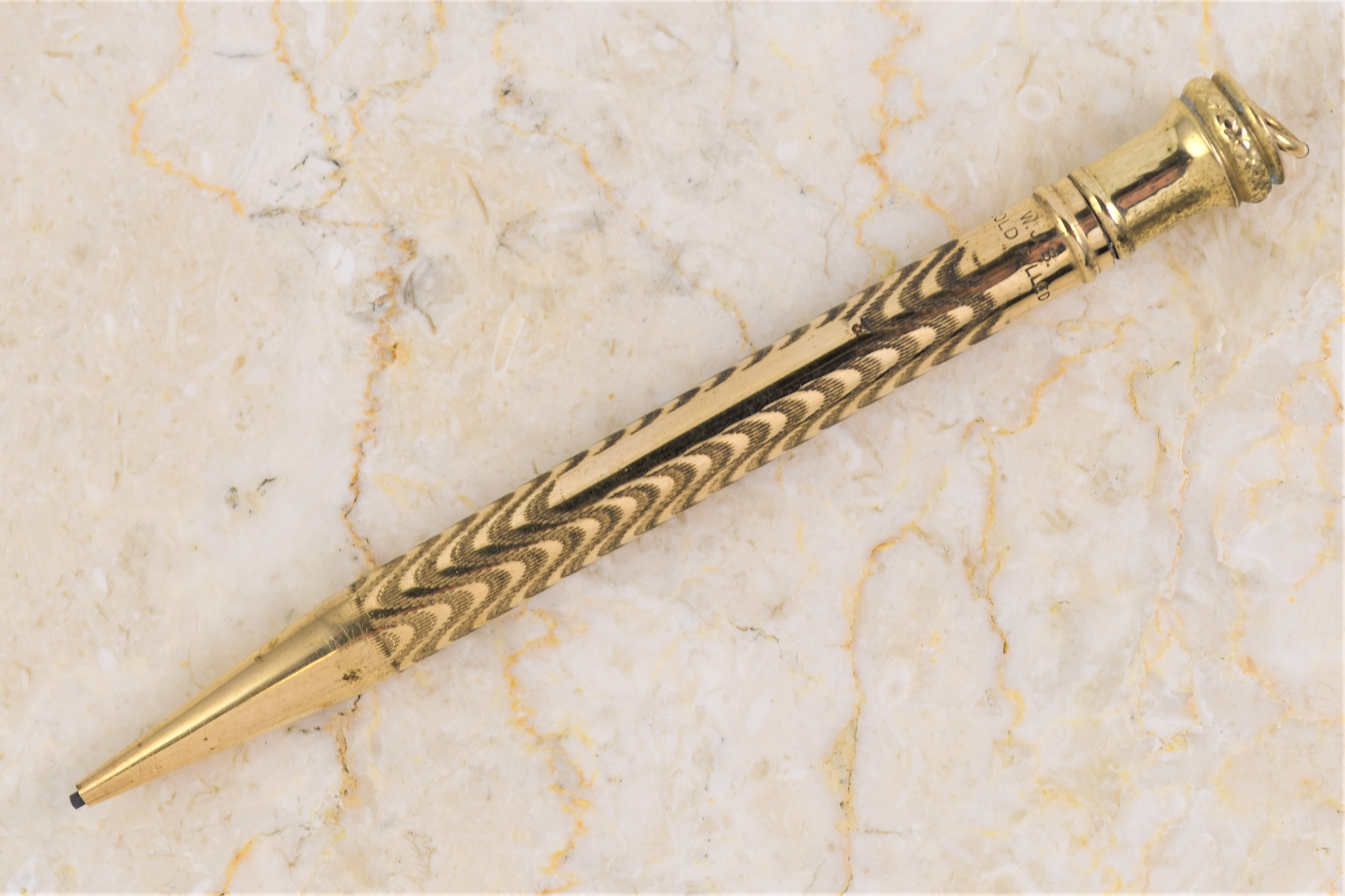
This one also has diamonds around the crown, and another shadowy imprint – “W.J.B.”:


I’m confident that the same firm made the ribbed pencils marked Morrison, Wilrite, Keene, Just-Rite, Handy Pencil, Newark Pen Co., and W.J.B.  It definitely wasn’t Keene, because he was a jeweler, not a manufacturer (see Volume 5, page 285).  I suspect it wasn’t Morrison or Newark Pen, since both were mainly in the pen business.  

That leaves open the P.S.M. Co., maker of the “Just-Rite,” whoever this W.J.B. was, and whoever made the “Handy Pencil.” 

Or someone else entirely.  I haven’t given up on Rex as a possibility, but as of this writing I don’t have enough information.