Thursday, May 27, 2021

Twin Brother of Bug . . . and Friends

This article has been included in The Leadhead's Pencil Blog Volume 7, now available here.
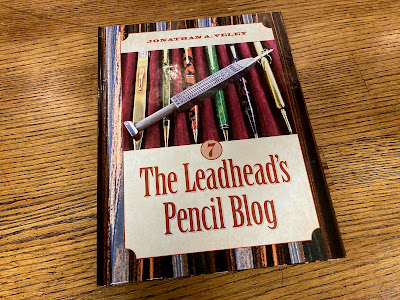

If you don't want the book but you enjoy the article, please consider supporting the Blog project here.

Unfortunately, I don’t have any fun stories about how the Redipoints in this article came to me.  Maybe someday I’ll look back on the novelty of it . . . day after day of pandemic online auction cruising on my couch.  A week, a month, a year.  Time has become a warped; sometimes it feels like a year has flashed by in a blink, and other times I’ve felt like it’s been an eternity.  

I digress.  At some point, maybe a week, or a month, or a year ago, this pair appeared in my mailbox . . . maybe separately, maybe together. 


Both share the same imprint at the top: “Redipoint / Pat.Pdg. B&B St. Paul.”  To back up a bit for the beginners in the audience, “B&B” stands for Brown and Bigelow, the calendar and advertising company which originally introduced the Redipoint brand in 1918 (see “The Real Story of Redipoint” in Volume 4, page 335).  


The flared tops on these two pencils told me they were early, and I couldn’t wait to see if an old friend was inside them:


It was . . . at least, in the bottom one.  “The Bug,” I nicknamed it when I first wrote about them back in 2013 (Volume 2, page 211).  Those goofy “antennae” hold spare leads within the chamber, and they spring outward when the mechanism is removed:


I always smile when I find one of these.  In part, it’s because they are so insanely goofy, and goofiness is my preferred milieu.  But I also remember after that first article ran about "the Bug" just before the DC show that August; so many of my friends at the show commented on the article, and it was the first time I realized people were actually reading this stuff.  

“The Bug” was the gift that kept on giving, providing grist for articles detailing other Brown & Bigelow variations on this weird little theme: “Son of Bug” (Volume 3, page 61) and “Granddaddy of Bug” (Volume 3, page 245).  

However, my other new arrival had an unusual feature not shared with any of these entomological relatives:


It’s actually a more elegant solution to the problem of holding spare leads in place - a simple brass plate bent into a triangle around the mechanism secures a spare lead in each of the spaces at the corners.  

I was dreading going back through all of Brown and Bigelow’s early patents to see if this was factory or if it was ever even patented at all – Brown and Bigelow was assigned a lot of patents in those early days.  Fortunately, they are neatly compiled in American Writing Instrument Patents Vol. 2: 1911-1945, organized in the “Patents by Assignee” section of the book and taking up almost all of page 260:


Pandemic life being what it is, though, I figured I might as well spend an evening picking through the company’s patents one by one.  The first patent listed was for a clip, so I skipped that one.  When I pulled up the second one, that was the patent for “The Bug.”  

But wait a tick . . . 


See it?


Figures 3 and 4 of The Bug’s patent illustrate an “alternate construction of lead holding means for our pencil,” and the patented claims include both versions – “means adapted to hold a series of marking leads automatically distended or collectively drawn together about said propelling means.”

Frank J. Kristofek and Howard L. Fischer applied for patent number 1,353,352 on November 11, 1919, and the patent was issued September 21, 1920; therefore, assuming the imprint was updated after the patent was issued, this pencil was made between these two dates.  The triangular spare lead band is as close a relative to The Bug as you’ll find – not just a brother, but a fraternal twin.

Other metal Redipoints have also been coming my way lately.  One seller was apparently dispensing items out of a dealer’s case, since several auctions for Redipoints with price bands came up at once.  I wasn’t greedy, but I placed small bids on everything; at the end of the day, two of the miniature ringtops found their way to me:


The imprints and bands add the Ingersoll name to the Redipoint moniker, dating both of these pencils to between 1924 and 1926.  The nicer of the two, in gold fill, was model 63, retailing for $2.50:


The lowly silver plated edition was model 20, going for 75 cents:


These two limped their way to Leadquarters at some point . . . perhaps hand in hand, or maybe they met here.  I don’t remember:


The upper one is unusual, because the chasing just sort of tapers off to leave a smooth area for engraving:


And then there’s that imprint, for Crescent Life in Indianapolis: “Masons Exclusively.”  There’s John Hall again, nagging me from beyond.  No, John!  I have too much to do, and I’m not joining the Masons!


The other one has an interesting top that unscrews:


I haven’t figured out what’s going on with the “KOBE” imprint on the barrel, and those unusual lines and pattern.  


I’m betting the barrel design is meant to evoke Kobe products, sort of like that “Every Pound Pulls” rebar pencil from Volume 4, page 296.  When I figure that one out, you’ll be the first (or second, actually) to know!

I’ve saved one of the best for last - this commanding oversized Redipoint has it all, as far as their metal pencils go:


The oversized pencil is capped with a cigarette lighter - I’ve got one other like this, in gold fill:


The silver one has thick checking lead – a “checker” model in Redipoint lingo, and not common at all:


The best part, however, is what’s on the top.  Many Redipoints of the era had advertising discs under celluloid on top, and this one is along those lines:


As a salesman’s imprint, for “style number 61970,” no less!

Wednesday, May 26, 2021

When Wrong Looks So Right

This article has been included in The Leadhead's Pencil Blog Volume 7, now available here.


If you don't want the book but you enjoy the article, please consider supporting the Blog project here.

This one was not my target in an online auction including several other items.  I assumed I already had one:


The top pulls out to reveal the lead magazine and eraser.  It’s a rear drive pencil, just like Sheaffer’s early flattop pencils, but with a squared-off matching celluloid cap instead of the usual gold-filled crown:


And . . . it’s marked Univer on the clip.  When I compared it to my other Univers, all of the other ones I have seen are different.


Earlier examples, like the ones I thought were duplicates for this one, have a much longer nose and a gold filled cap that fits over a bushing at the top end.  These are nose drive pencils, so the lead advances by twisting the nose rather than the cap.   

Later examples, like those shown at the bottom in dyed celluloid (that’s actually black and pearl celluloid dyed red, green and blue, something Sheaffer did during the Depression to cut costs), have a rounded cap.  These have a similar lead magazine attached to the cap, but the cap is not functional – these are also nose drive pencils.

Univer pencils like these came in a wide range of colors Sheaffer normally didn’t use:


Roger Wooten just published an article in the Spring 2021 issue of The Pennant, in which he outlines the history of the Universal Pen Company, organized by Sheaffer as a Delaware Corporation on July 23, 1928.  According to Roger, Universal Pen Company operated under that name until November 29, 1933, when the company formally changed its name to the “Vacuuum-Fil” pen company.  

That explains these pencils, which notwithstanding their inability to suck up lead out of a box, proudly bore the “Vacuum-Fil” name on their clips:


Roger states that the company’s name was changed one last time to The WASP Pen Company on May 29, 1936, so in rough terms, my Univer pencils date between 1928 and 1933, and my Vacuum-fil pencils date between 1934 and mid-1936 – assuming, of course, that the names were switched close to the times the name was changed and also assuming the company used only its current name on the products it sold.

As far as the weird Univer pencil that started this article, it’s actually nicer than a Sheaffer Titan, more polished in appearance with the same function.  It had to be one of the Universal Pen Company’s earliest efforts


Tuesday, May 25, 2021

Still Not Done . . . After Three Tries

This article has been included in The Leadhead's Pencil Blog Volume 7, now available here.


If you don't want the book but you enjoy the article, please consider supporting the Blog project here.

The “Redypoint” is among the earliest pencils made by DeWitt-LaFrance (better known as manufacturers of the “Superite”), for Boston stationer Samuel Ward Manufacturing Company.  

I first started shooting some photographs of my Redypoints when the one at the bottom of this picture came my way:


The top example is the Redypoint which unraveled the whole story of “Wahl, Sheaffer and the Race for Boston” (Volume 4, beginning on page 300) - it is identical to an early Sheaffer Sharp Point pencil, and the pattern engraved on the barrel is unique to early Sheaffers.

Other than the name on the side and some really weird, heavy wear on the crown, this new one was the cleanest example I’ve found:


And I thought I was done.  Kind of a short article, so I didn’t do anything with it.

Then along came another example, in sterling, with something else that I’ve been itching to delve into a bit more:


As mentioned earlier, the only Redypoint I’ve found in a pattern also used by Sheaffer is that Sharp Point lookalike – but that checkerboard chasing on this example is closer to a Sheaffer pattern than any other I’ve seen to date.  Of course, it’s also close to a pattern found on pencils made by another character in the Wahl/Sheaffer story:


The silver Redypoint is shown here flanked above by an early Heath-clip Ever Sharp made by Heath for Charles Keeran before Wahl started making his pencils.  Below it are two Sheaffer Sharp Points - the one with the broken clip has a normal gauge barrel, while the bottom one is much lighter and thinner, more like the GF (General Fireproofing) pencils I’ve speculated about.  

Here’s a closeup of the Redypoint and the Ever Sharp:


They are close - on both, you can see how the chasing blades bounce a little with each cut.  However, the Redypoint has squares consisting of four lines, while the Ever Sharp has five.  

The more refined of the two Sharp Point pencils has squares consisting of six lines, and the engraving is more even:


While the other example with the thinner barrel has more pronounced lines like the Redypoint, but in squares of five lines:


And with that, I thought I was done with this article . . . again.  All I have to report is that this latest Redypoint has engraving which is similar to both a pre-Wahl Ever Sharp and two Sheaffer Sharp Points, but not identical to either.

Then I received an email that a package was being shipped to me from David Nishimura’s Vintage Pens, LLC.  Curious, I thought: I hadn’t ordered anything from David’s website, and all I was expecting from him was a check for the things I bought for him at the Krinke auction.  Maybe he was sending me one of those really big checks as a gag or something, I thought.

Nope.  A normal-sized check arrived in a box accompanied by a small “thanks for bidding for me” gift . . . one David knew would grab my attention:


There’s another Masonic emblem, the third to arrive since John Hall passed.  I swear my buddy is pestering me from the hereafter:


However, there is no manufacturer’s mark, which is infuriating since it is a dead ringer for a General Fireproofing pencil:


That’s a ringtop GF pencil in the same pattern, and the lighter Sheaffer Sharp Point.  As to the GF, I mean the same pattern, not a similar one –  boxes made up of four lines, just like on my new sterling Redypoint:


The last time I was muddling around with GF pencils, it was to discuss an example I had found that shared the same triangle/dot pattern found on my Redypoint/Sharp Point lookalike (see Volume 6, page 197).  I was so close to proving that the GF pencils were made by DeWitt-LaFrance in 1917-1919 that I could taste it: “All we need now is documentation to establish when General Fireproofing began offering pencils for sale,” I concluded.

You can see lettering on the barrel of the Masonic pencil . . . could this be the missing piece?


“Wieland - No. 714 / 1871-1921.”  Geez . . . this pencil is almost what I’ve been looking for in so many ways.  It’s almost a General Fireproofing pencil, but without any markings there’s no way to know for sure.  It almost fits within the timeline, but just a couple years too late – after Sheaffer had set up its pencil manufacturing plant in Fort Madison.  

And the embossing for that commemorative inscription?  Raised lettering rather than stamped is something I haven’t found on a GF, a DeWitt-LaFrance pencil or a Sheaffer.

Almost . . . almost . . . almost.  I’ve taken three swings at this article, and I still haven’t found the answers I’m seeking!

Monday, May 24, 2021

The Embryotic Volume Three

This article has been included in The Leadhead's Pencil Blog Volume 7, now available here.


If you don't want the book but you enjoy the article, please consider supporting the Blog project here.

The Patent and Trademark books I’ve written are like pillars in Shrodinger’s library: they are both my greatest successes and my greatest failures at the same time.  

On the success side, all three cover their respective areas so well that I believe they will be the definitive resources on their subjects long after I’m gone.  Their failures have been financial, and have been even more spectacular.  

My goal was never to get rich on those three books – they were tools I needed for my own research, they didn’t exist, and I thought others would be able to use them, too.  Mission accomplished, although on a much smaller scale than I hoped.  These days, my goal is to outlive my inventory . . . and I think that’s a longshot.  

In the years since these three books have come out, several who have them and use them have asked if I will do a third volume in the patent book series.  My answer, and I apologize if there has been a touch of annoyance in my voice, has been that I’ve lost enough money as an author.

That answer isn’t strictly accurate.  I started work on a third patent volume right after Volume 2 came out, and before I abandoned the idea in 2015 I made quite a bit of progress in that direction.  The database I built was in its early development, so it includes only patents issued in category 401 – the main writing instruments category – but it includes 1,957 of them issued between 1946 and 1980.  

As was the case with the other patent volumes, I built the database for my own use.  I didn’t feel as compelled to share the tool I made for myself in book form, since I generally collect pre-War writing instruments.  I’ve only rarely needed this tool as much as I have needed the other ones, so I didn’t see the same urgency to make it available.  If felt tip markers ever become a hot collectible, maybe I’d rethink that.

I’ve only rarely needed this half-finished tool, but this was one of those times.

I nearly consigned this pencil to the junk box when it came in amongst a lot of . . . well, mostly junk.  I don’t even remember what caused me to buy the bunch in which it arrived:


It feels light and cheap, like a Bic ballpoint.  Yet those colored panels around the upper barrel had me wondering whether it might be a multicolor pencil:


A bit of twisting the top back and forth revealed it is, and it works like more expensive metal multicolor pencils from Germany.  Twisting one way retracts whatever color is in use until it reaches the top, then with a click that dot on the knob advances to the next color.  Twisting in the opposite direction advances the selected color, along with the matching colored panel:


The nose wiggles off to reveal the different colored rods which can be advanced, and the mechanism is more compact and elegant solution than the more expensive-feeling variations on the theme:


There was a name on the clip – the only clue I had to find out what this thing might be and who might be behind it.  “Sparkes ‘66'”, it reads:


A bit of poking around revealed how far ahead of its time this pencil was.  It was introduced in 1951, as shown in this advertisement from the New York Daily Times on December 2, 1951:


The big break in the story was a short news piece in the Kingston (New York) Daily Freeman on October 25, 1951, which identified gun designer Walton Musser, “who is now working on a top secret government project,” as the inventor of a new six-color pencil called the “Sparkes ‘66'”:


I have my doubts about the “top secret government project” stuff being published in the paper: if it's true, as the Cold War was picking up steam the last thing anybody would do is advertise that involvement in the paper.  

With this clue in hand, I dusted off my phantom Volume 3 to see if the dormant project could verify the rest of the story.  It contains three patents, all issued to Musser and all applied for on October 10, 1950.  The first was issued October 5, 1954 as number 2,690,736:


Number 2,703,070 followed on March 1, 1955:


And finally, number 2,704,532 – covering the collet assembly inside – was issued on March 22, 1955.


C. Walter Musser’s description as merely a “gun designer” doesn’t do his contributions justice.  During World War II, while working as an engineer at the Frankford Armory in Pennsylvania, he co-invented “recoilless” guns along with ballistic expert Dr. William J. Kroeger.  The platform, along the lines of a bazooka, included a one-man 57mm gun and a 75mm gun – the latter of these was the caliber used in French artillery cannons during World War I, but Musser’s gun was a portable cannon that could be operated by two men, firing a 14-pound shell with “deadly accuracy” at ranges up to 4,000 yards.

The gun was a gamechanger during World War II.  It was demonstrated before reporters on July 20, 1945, and a photograph including onlookers appeared on page 3 of the Camden, New Jersey Courier-Post.  None were identified as Musser, but a few civilians were on hand:


In 1957, Musser invented and patented the harmonic gearing while he was an adviser at the United Shoe Machinery.   The gearing, commonly used in robotics and a myriad of other applications to this day, proved to be his most significant innovation out of more than 250 patents to his credit.  He died in Lancaster, Pennsylvania on June 8, 1998.