Sunday, April 26, 2020

Wearever, Not Whatever

This article has been edited and included in The Leadhead's Pencil Blog Volume 6, now on sale at The Legendary Lead Company.  I have just a few hard copies left of the first printing, available here, and an ebook version in pdf format is available for download here.

If you don't want the book but you enjoy this article, please consider supporting the Blog project here.

I got to see Daniel Thayer at the Baltimore Show this year, and that’s an occasional reunion I always enjoy.  When I edited The Pennant a few years ago, I started a back-page feature that profiled some of the new collectors I was seeing at the pen shows – “New Faces at the Show” is what I called it, not very imaginatively.

We pen(cil) folk are a gregarious bunch, and there’s never any shame in walking up to someone at a show and saying “Hey.  I don’t know you.  What is your name and tell me about you.”  But it does take a special sort of volunteer to tell you everything you want to know, and let you take their picture, and then print it. Many of the folks I approached were cautious, and I was just as cautious about who I picked to appear in the magazine.

My judgment was good with Daniel, and we’ve remained on good terms since my days at The Pennant ended some four years ago now . . . geez, has it been four years?  Feels like it’s just been ten minutes or so.  Sigh . . . I digress . . .

Daniel had a few pencils on hand he was looking to move on, and this was one of them:


I didn’t roll my eyes that the clip read “Wearever,” although the brand doesn’t get a lot of respect in collecting circles.  David Kahn, Inc., maker of the Wearever brand (as well as Pioneer, Leeds and a host of others) was more innovative than the credit given to the company.  David Kahn himself held quite a few patents – true, his company was known for maing cheap pens and pencils, but the company was a real pioneer in how they made things more cheaply.

Take the clip on this one, for example.  If you knew immediately that was a Wearever clip, that’s because Kahn took steps to protect that look.  It was the subject of a design patent issued to Kahn on an application he filed on November 18, 1935, issued as Design Patent 98,255 on January 21, 1936:


I have archived the different variations of Wearevers that have come my way over the years, but I couldn’t recall ever seeing one in this color.  With that cap, I assumed it was a combination pen and pencil, which I don’t normally collect.  What the heck, I thought to myself, I might as well check out the nib on the off chance something better than your typical steel nib was installed in this one.

Something better was indeed hiding under that cap, but it wasn’t a nib . . .


This one is fitted with a slip cap over the other end of a double ended pencil.  So here’s a color I haven’t run across before, a slip cap when all the pens and combos I’ve seen have screw caps, and while I’ve seen double-ended Wearever pencils, I haven’t seen a short one like this – and never with a cap.  In all my years of collecting, this one was all new to me. 

Saturday, April 25, 2020

Speerbob Is Doubly Keen

This article has been edited and included in The Leadhead's Pencil Blog Volume 6, now on sale at The Legendary Lead Company.  I have just a few hard copies left of the first printing, available here, and an ebook version in pdf format is available for download here.

If you don't want the book but you enjoy this article, please consider supporting the Blog project here.

Bob Speerbrecher is an ubiquitous online seller.  He’s got a great eye for pencils, and from time to time he’ll drop me a line to ask if I’m interested in something he’s found.  This was one of those times I said yes . . . thank you very much . . .


The one Bob sold to me is the silver one at the bottom of the picture.  These don’t come along very often – they are the “Keen Point Double Action”:


I’ve got a real affinity for these, because they have these interesting clips that don’t appear anywhere else in the pencil world:


These aren’t Charles Keeran’s “Keen Point” pencils, made in the late 1920s by Dur-O-Lite (and then by others, as detailed in A Century of Autopoint).  I explored these pre-Keeran Keen-Points here back in 2013 (the article is now only in the books, at The Leadhead’s Pencil Blog Volume 2, at page 93).  The Keen-Point name, as reported in the 1922 edition of Trade-Marks of the Jewelry and Kindred Trades, was held by The O.R. Johnson Co., of Providence, Rhode Island:


At some point since that last article, I stumbled across advertisements confirming that point in The Jewelers’ Circular, in 1921 and 1922:


Joe Nemecek and I talk a lot about our different collecting styles – he’s a “representative sample” collector who, once he has an outstanding example of the breed, is content.  I’m an “archival OCD” collector – once I observe two patterns, I’m inclined to try to find the other hundred that might be out laying in the weeds.  And if I find two in the same pattern in different materials?  Oh, that’s an itch I won’t scratch until I’ve either found or ruled out the possibility that the other patterns came in those materials.

But I have to say, when it comes to the hard-to-find Keen Point Double Actions, I’m finding the range that I’ve turned up to be satisfying . . .


Three different patterns, all done very artfully. . . one each in yellow gold fill, green gold fill and silver(ish). 

Thank God two of them weren’t in the same pattern.  Or the same material.

Friday, April 24, 2020

Return of the Crowdpleaser

This article has been edited and included in The Leadhead's Pencil Blog Volume 6, now on sale at The Legendary Lead Company.  I have just a few hard copies left of the first printing, available here, and an ebook version in pdf format is available for download here.

If you don't want the book but you enjoy this article, please consider supporting the Blog project here.

People love these, and whenever I get the chance to circle back around to them I jump at the chance:


I was looking for something else when I ran across a junk box full of stuff on Etsy, and although the clip was facing away, it’s so freakishly huge on these short models that I knew what it was . . . a Gordon:


These short ones are great, with what might be a telephone dialer on top.  Maybe, maybe not . . . none of the ones I’ve found show any of the kind of wear you’d expect if these little guys were used to dial telephones:


What’s really unusual about the Gordons are the “fanged” clips, designed to keep your pencil in your pocket so you wouldn’t lose it:


Pushing down on the gawky bail at the top of the clip retracts the fangs so that it can be removed without shredding your shirt or suit pocket:


I’ve written about the Gordon here before.  The last time I wrote about them in 2015, I ran down the three patents for the Gordon “fanged” clip (the article is still live, at https://leadheadpencils.blogspot.com/2015/03/always-crowd-pleaser.html).  The first style clip I’ve never found, and the second style found on today’s pencil is the most prevalent.  I’ve got a few full-sized examples too - I think these are on the earlier end of the spectrum:


The top two pieces came from the estate of Edgar Nichols, inventor of the “Tri-Point” line of pencils.  That top thing might be a cigar holder, or maybe a wood pencil holder – it’s an empty cylinder with a top that screws off.  Along with these other three, these all have a different feel to them than ordinary celluloid - bakelite, maybe.

Then there are the regular full sized line, and I’m long overdue to give you an updated family photo:


The third incarnation of the Gordon clip had a tab at the top which pushed in towards the barrel rather than down towards the tip.  I’ve only found one pencil with that clip:


And it has a great imprint for the company, including its Union City, New Jersey address and the company’s telephone number:


Viewed from the side, you can see the principle is the same – only the execution is slightly different:


I mentioned in that last article that in addition to pencils, there are Gordon pens – and I have a few updates on that front, too.  Here’s three Gordon-clipped pens, two of which are combination fountain pens/pencils:


If you guessed that these look like “Banker” third-tier pens, you got one out of three right.  Although all three have the Gordon logo with two animals flanking the letter G at the bottom of the clips, They are marked “Banker,” “Safer,” and “Gordon”:


I’ve picked up a few other Gordon fountain pens since I last wrote about these that are worth showing you, too.


The nibs on these are your ordinary steel generic nib stuff.  Still, I’m loving that green veined plastic, and even more so, I’m loving the sticker on that syringe filler.  Chicago World’s Fair stuff is a real passion of mine:


This third-generation Gordon pen is something I’ve already shown you, but since my photography skills have improved since we last visited the subject, I feel like I owe you something better than what I gave you the last time around:


But the coup de grĂ¢ce I’m eager to show you was something that turned up at the Baltimore Show.  Seems like some of the best stuff turns up late in the show and usually at the table right next door to me, since I spend more time chatting and less time shopping with my neighbors.  This year, Paul Ketchpaw was next to me, and during a break in the action as we were talking, this little thing caught my eye on his table:


It’s a stylographic pen, a bit outside my normal area of expertise, but the name . . . “Gordon’s Ink Pencil” . . . had me intrigued.  On closer inspection, no question it’s the same Gordon – complete with the logo!


Thursday, April 23, 2020

All of the Good Points . . . None of the Bad

This article has been edited and included in The Leadhead's Pencil Blog Volume 6, now on sale at The Legendary Lead Company.  I have just a few hard copies left of the first printing, available here, and an ebook version in pdf format is available for download here.

If you don't want the book but you enjoy this article, please consider supporting the Blog project here.

I know they’re just pencils, workaday items that just don’t matter that much in the grand scheme of human civilization.  But as I tell these stories, I’ve come to appreciate that there are times when something passes into my hands that brings with it more than just the ability to make a dark line on a sheet of paper  - it brings along with it the baggage of rich history.

That’s what happened when this came along:


I’ve put together the story of the Dollarpoint Pencil Company here in many installments - the five-part detailed history was posted in 2014 (it starts in The Leadhead’s Pencil Blog Volume 3, page 47) and I’ve added a few follow up pieces to the story since then (see “What Became of Dollarpoint . . . Revealed” at https://leadheadpencils.blogspot.com/2016/11/what-became-of-dollarpoint-revealed.html and “The Handoff to Western” at https://leadheadpencils.blogspot.com/2016/11/the-handoff-to-western.html).

I inadvertently hoard Dollarpoints, because there are still so many gaps in what I know that I’m always hoping a different imprint or some other feature will fit into that puzzle.  When this one came up in an online auction, I knew it was only a matter of how many dollars it would take to book a one-way ticket for it to travel to Newark, Ohio.  At the end of the day, it was a lot cheaper than I thought it would be.  Sigh . . . sometimes I feel like I’m a cult of one.

Note that on the front of this salesman’s case J.E. Roach & Company is identified as “National Distributors” for the brand – Jesse E. Roach was the assignee of all the company’s design and utility patents, and the company named after him was sometimes identified as the manufacturer, sometimes as the distributor.  Roach was on the board of directors for Dollarpoint, as well.  ‘Twas quite the tangled web.

Inside the case are a nice grouping of Artpoint and Dollarpoint pencils . . . and a note left for posterity:


“C.G. Francis - First Pencil Samples for selling - approx. 1920.”  Not approximately, methinks – damned spot on is more like it.  All of the initial patents, both utility and design, were applied for in 1920, and the incorporation of the Dollarpoint Pencil Company was reported in The Bookseller, Newsdealer and Stationer on July 1, 1920.  In my 2014 series, I reproduced a snippet view from Modern Stationer, which wasn’t available for full viewing at the time.  “The new Dollarpoint and Artpoint pencils will be ready for the market soon,” the Modern Stationer piece indicated.

Since 2014, the full version has been made available, and while that volume of Modern Stationer started in 1920, it overlapped 1921 - this piece actually ran on February 25, 1921, and here’s a clearer copy of the announcement:


I have no idea who C.G. Francis was.  Perhaps he (or she) was a salesperson who received an advance order.  Perhaps Francis had some affiliation with J.E. Roach & Co. or with the stationer Cardinell-Vincent, which had the west coast agency for the brand.  Time will tell, but for our purposes, Francis was a person with the real inside track on what was about to be rolled out at Dollarpoint.

And their offerings, as indicated by the pencils inside this case, were impressive indeed:


The top and bottom examples in this picture are the company’s budget line, marked “Dollarpoint” at the nose.  They are slightly less hefty and lack the more intricate scrollwork found on the upper “Artpoint” line:


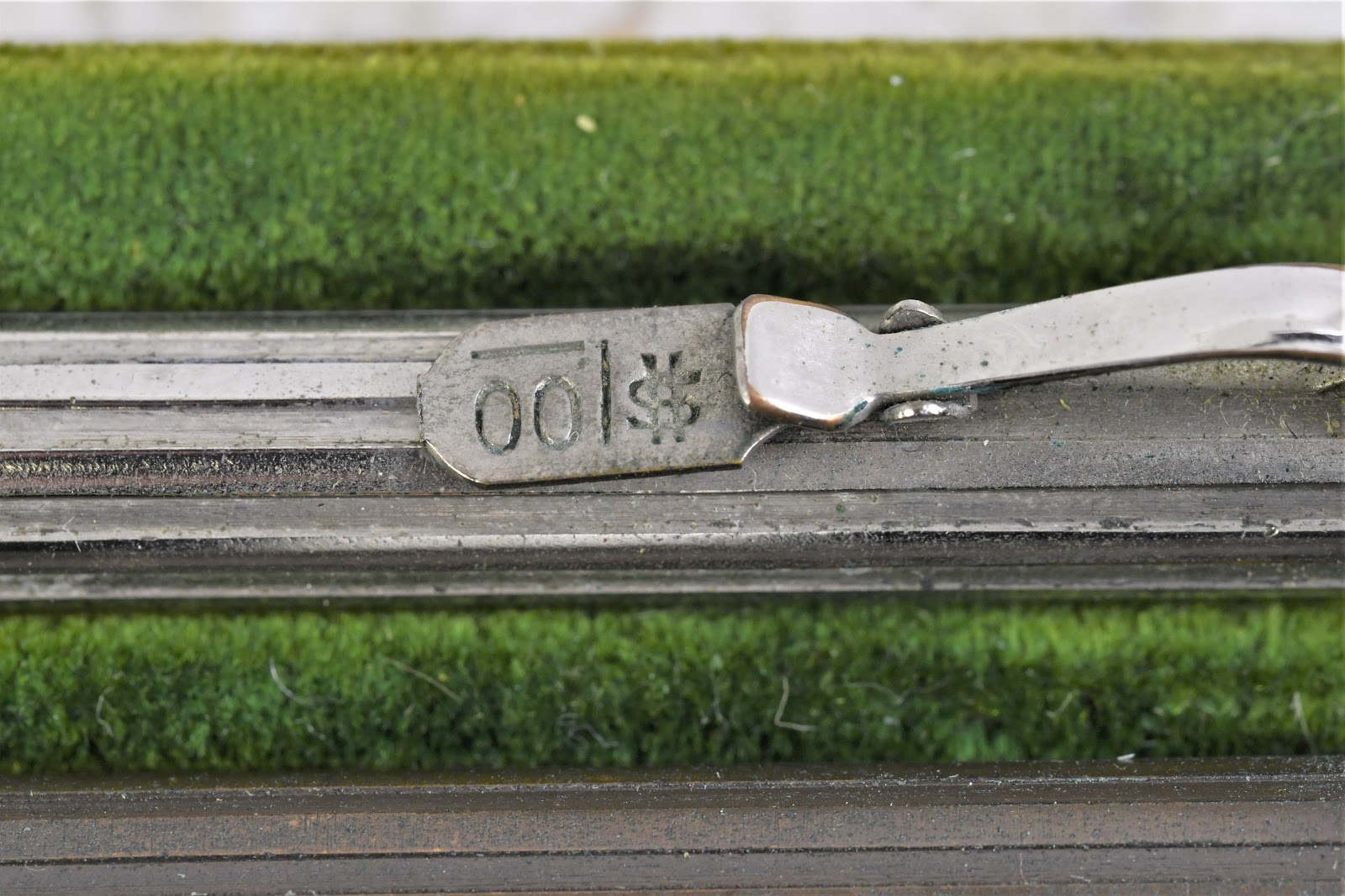
There’s a couple really interesting things about that top one.  First, it’s in a shorter size with a side clip – out of some 25 of these Artpoints and Dollarpoints I’ve found over the years, only one other example has come my way in this size, and it’s an Artpoint rather than a Dollarpoint.  Also, it still has its metal price tag of $1.00, fashioned as a neat little tab that fits under the clip:


The Artpoint ringtop also has a price tag - $1.50 for the heavier, more intricately detailed line’s smallest model:


The long Artpoint with a cap that looks a bit off is a bit worse for wear, but it appears to be corrosion that has occurred sitting in the case over the last century rather than wear from use.  As for the cap, it makes sense to include it in a salesmans’ case since it shows off one of the company’s other talents:


Just like the big boys, Dollarpoint offered custom enamel advertising emblems for the tops of their pencils.   Jevnes’ Fine Foods was a real operation: I found an undated photograph which was supposedly taken at Palos Verdes Estates, California in which one of their delivery trucks unintentionally made a cameo appearance:


The nicest piece in the bunch, at least to me, is that gold filled Artpoint.  It’s also in that rare short side-clip size, and while the plating on these was prone to wear, this one has fared very well in this case for the last century:


Just as the case advertises, “All of the good points . . . none of the bad.”

Wednesday, April 22, 2020

Why I Think What I Do

This article has been edited and included in The Leadhead's Pencil Blog Volume 6, now on sale at The Legendary Lead Company.  I have just a few hard copies left of the first printing, available here, and an ebook version in pdf format is available for download here.

If you don't want the book but you enjoy this article, please consider supporting the Blog project here.

A couple weeks ago I divided the evolution of Parker’s pencil manufacturing into three epochs, “Ignore them,” “Oh crap” and “Screw it.”  If there’s die-hard Parker fans still reading this blog, God love you for having a good sense of humor about that!

Parker’s decision to outsource production of pencil mechanisms to Cross in the mid-1930s, I opined, signified the beginning of the “Screw it” period, after which Parker didn’t really show much interest in what went inside their pencils, as long as the outsides of them looked like their pens (the Liquid Lead pencils, I said didn’t count since they were just ballpoint pens using graphite paste rather than ink).

Over on Facebook, Mike Crawford asked a good question: so what about the Parker Vacumatic cap-actuated repeating pencils, like these?


All of these sport Made in U.S.A. imprints, all of which have date codes of 8 (the top three) or 9 (the bottom four), for 1938 and 1939:


Most cap-actuated repeating Vacumatics, if I remember correctly, were made in Canada.  My collection isn’t the best straw poll for that statement, since I steer away from Canadian models – not that I have anything against them, but since I don’t actively collect Vacumatics, it’s easier for me to keep fast to my “I only collect American pencil” excuse when someone tries to sell me one.  Not that I haven’t fallen off the wagon . . . at least once . . .


So what of my comment, that this is “what the insides of Parker Vacumatics look like after the “Screw it” era began”?


OK, you got me.  That’s what the twist-action Vacs look like.  But while the cap-actuated repeaters were totally different deal inside, they were exactly the same deal when it came to Parker’s attitude towards pencils.  I think Parker was still outsourcing mechanisms in 1938 when the Vacumatic was dressed up in cap-actuated trim . . . I just think it was coming from a different source:


Here’s that 1938 burgundy Vacumatic alongside a contemporaneous Esterbrook pencil.  Both cap actuated, and under the hood they are far too similar to be coincidental:


In both, the mechanism is secured to the barrel by a threaded bushing, which travels up and down between two protruding ribs on the mechanism’s outer tube.  The only difference between the Parker and Esterbrook is the location of the spring – on the Parker, the spring rests against that washer inside the front of the barrel, while the Esterbrook has the spring mounted behind a self-contained plug.

Now, I’ll be the first to admit that I don’t know all that much about Parker, and since Parker continued cap-actuated pencils well into the Parker 51 era, it’s possible that Parker actually did make these mechanisms themselves – maybe from the outset, or maybe after outsourcing them from someone else for a while.

Suffice to say that if it wasn't Esterbrook making these Vac mechanisms, whoever did was copying Esterbrook.