Thursday, February 19, 2015

Newsweek V?

This article has been edited and included in The Leadhead's Pencil Blog Volume 3; copies are available print on demand through Amazon here, and I offer an ebook version in pdf format at the Legendary Lead Company here.

If you don't want the book but you enjoy this article, please consider supporting the Blog project here.

That was how this pencil was advertised in an online auction:


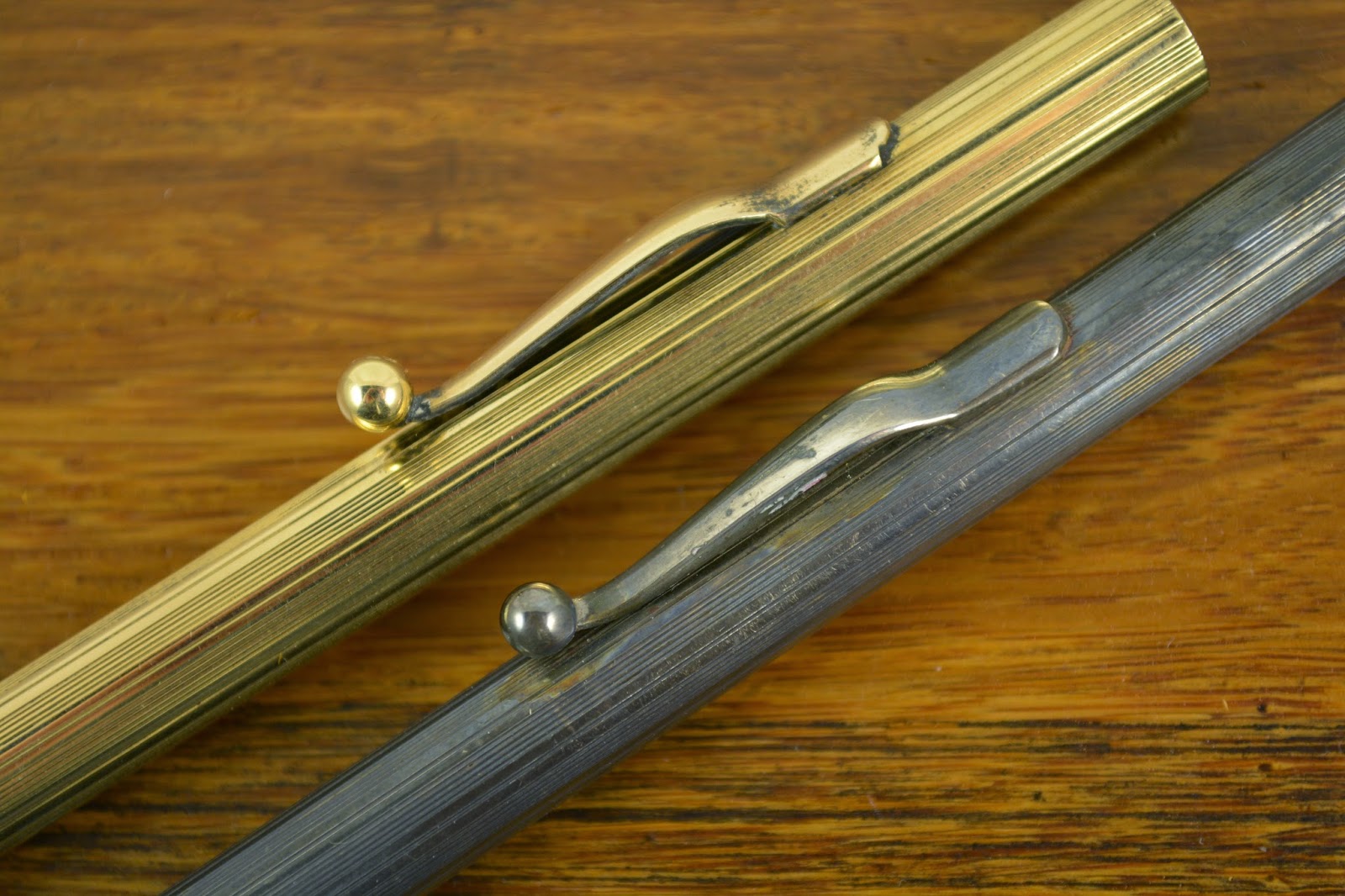
With that upturned clip I was confident that it was another member of the Hicks family, but I had no idea what "Newsweek V" meant – of course that meant I had to bite and find out. When it arrived, I understood fully what the seller meant:


Yes, Virginia, the pencil does in fact say "Newsweek V"; however, that’s not a brand, but what was engraved by the owner of the pencil to personalize it. The brand is stamped on the nose:


"LT & Son." There isn’t much out there on this, and I’ve probably forgotten who this stands for three times or more. It was another New York jewelry firm, whose writing instruments were without question manufactured by Hicks. No, it wasn’t Louis Tiffany & Son – I remember following up on that lead only to hit a dead end. Someone told me at one point who this is . . . and I’ve been racking my brain trying to remember what the name of the firm was. I’m hoping now that I’ve posted this, someone will remind me so that I can finally document this.

UPDATE:  David Nishimura answered this question in a nice article he posted over at his blog:  Louis Tamis & Sons, a New York jewelry firm founded in 1909.


The direct link to David's article is http://vintagepensblog.blogspot.com/2015/03/lt-louis-tiffany.html.

Wednesday, February 18, 2015

The Patriarch of the Family

This article has been edited and included in The Leadhead's Pencil Blog Volume 3; copies are available print on demand through Amazon here, and I offer an ebook version in pdf format at the Legendary Lead Company here.

If you don't want the book but you enjoy this article, please consider supporting the Blog project here.

Two of these pencils were ones I picked up at the Ohio Show’s Saturday auction last November:


The top one was one of them – it’s the same one I compared to the Black, Starr and Gorham pencil here a couple days ago. The middle one was the other item in that lot, also made by Hicks. Since the auction photos were not posted online before the show, I had no idea this was going to be available – that proved to be both good and bad. The bad wasn’t really so bad: I raised my hand at the auction because the example up for bids looked to be larger than what I remembered having at home, and obviously, that wasn’t true.

But the good far outweighed the bad. If the picture had been posted in advance, I likely would have compared it to the one I had, noted just minor differences, and I would have passed on it thinking those minor differences weren’t worth the price of admission.

I also would have missed one other slight difference, one which makes all the difference in the world to me:


The one I bought at the auction, on the left here, is marked W.S. Hicks. The one I had at home was marked Edward Todd. The similarities between pencils offered by these two firms have been well documented here as well as by other collectors, but nothing better illustrates the point, in my mind, than this. I can also think of no better picture to lead into the question: who was making these, and who was having them made?

I believe all the evidence points to the conclusion that Hicks made Edward Todd’s pencils, at least during this period. As we saw earlier, Hicks made pencils for Black, Starr and Frost – both before and after the company’s merger with Gorham.

There are others. Here’s a picture I took of a couple Hicks pencils a while back, alongside the Todd calendar pencil:


At the nose is the Hicks hallmark, and some other important information:


Patent number 1,259,738 was applied for by William S. Hicks on August 23, 1917 and was issued March 19, 1918. It was assigned to Edward D. Hicks (Trading as William S. Hicks’ sons) of New York:


Yet the rounded cap on this one, as distinctive a Hicks feature as the upturned clip which also appears in the patent drawings, bears another name:


Cartier. And then, let’s consider Tiffany & Co. Until recently, I was on the fence as to whether it was Edward Todd or Hicks which made Tiffany’s pencils, such as this one:


I picked this one up at the Ohio Show. The fact that it included a box, even with a few stains, didn’t break my heart, either:


This example is quite a study in understatement: very large, very heavy, but without a clip or any ornamentation.

No ornamentation, that is, except for this:


This is the only example of a Tiffany marked with the actual manufacturer’s hallmark, and it’s marked Hicks. Pulling out Occam’s handy razor, if Hicks made pencils for high quality silver houses such as Black, Starr and Frost, Cartier and Tiffany & Co., and was making pencils at the same time nearly identical pencils were being offered by Georg Jensen, why is there any reason to believe that Edward Todd-marked pencils would be made by anyone else?

Tuesday, February 17, 2015

Later Than You Think

This article has been edited and included in The Leadhead's Pencil Blog Volume 3; copies are available print on demand through Amazon here, and I offer an ebook version in pdf format at the Legendary Lead Company here.

If you don't want the book but you enjoy this article, please consider supporting the Blog project here.

There might have been something in yesterday’s article that bugged you a little bit – the notion that a Hicks family pencil with that upturned clip would have been made after 1940, and maybe even as late as 1962. Even though 1940 was 75 years ago now, that’s not a decade you’d normally associate with high quality when it comes to mechanical pencils. I for one used to associate these stockbroker-style, quality pencils with the Golden Age of the 1920s and 1930s.

Yet when I stumbled across yesterday’s Black, Starr & Gorham pencil and learned that the trade name was used between 1940 to 1962, I was prepared to accept those dates, because I’d already had some indications that these impressive pencils remained in production much later than I originally thought.

The realization came to me a few months ago, when this pair turned up in an online auction:


These are very similar to the Hicks family of pencils, with the exception of those straight (and in the case of the stockbroker, straight and bolted-on) clips, and both appear to be classic 1920s pencils. Both are a little bit rough, but I still thought they were worth investing a bit for two reasons: first, they are sterling, so the sheer amount of silver in this pair was nothing to sneeze at. Second, though, was the names found on them, which were absent from my stash:


"Georg Jensen Inc. USA." In the past, I’d resisted the temptation to buy Jensen pencils. Sure, the guy was a high quality silversmith, but a Danish one – and to the greatest extent I am able, I resist branching out into non-American pencils. This time, I caved: the "USA" mark was just too close to my perimeter fence for me to resist reaching through and snapping these up.

When I started poking around on these, though, I found that the USA mark was used only for a short window in time, from around 1941 or 1942 through 1950. Even though Georg Jensen had offices in New York since the 1920s, it was impossible to import silver from Europe during the Second World War – hence the sudden addition of "USA" to the company’s hallmarks.

But could these really have been made that late?


Yes. This advertisement appeared in The Rotarian. In May, 1947. Were these just a holdover? Leftover parts from Golden Age production of Hicks pencils, like this one?


You’d think this one was twenty years earlier, until you read the inscription:


"Stark Bros. C.J.W. 1922-1947."

Monday, February 16, 2015

Welcome to the Family

This article has been edited and included in The Leadhead's Pencil Blog Volume 3; copies are available print on demand through Amazon here, and I offer an ebook version in pdf format at the Legendary Lead Company here.

If you don't want the book but you enjoy this article, please consider supporting the Blog project here.

A new (to me) member of the W.S. Hicks / Edward Todd family of pencils recently came my way that was neither marked Hicks nor Edward Todd:


I picked this one up from Tom Heath at the Philadelphia Show last month. It’s a pretty good match for a Hicks I picked up at the Ohio Show’s Saturday night auction in November:


Both share the same dimensions, pattern and that distinctive turned-up clip:


Don’t let the color fool you – these have even more in common than you might think.


That gold fill is over sterling, a material called "vermeil." As an aside, all the sources I’ve read indicate that it’s all right to pronounce that word either as "ver-meal" or "vermay," probably depending on whether you have the urge to extend your pinky as you drink a beverage. The hallmark is at the right - W. S. Hicks.

However, the all-sterling example I picked up from Tom has a different imprint:


"B.S. & G." A little snooping around suggested that the acronym stands for Black, Starr & Gorham, which according to The Online Encyclopedia of Silver Marks, Hallmarks and Makers’ Marks (http://925-1000.com/americansilver_B4.html) was in business from 1940 to 1962. One source (http://www.steinmarks.co.uk/pages/pv.asp?p=stein462) indicates that in 1929, The Gorham Manufacturing Company merged with Black, Starr & Frost to become Black, Starr & Frost-Gorham, Inc., which was shortened to Black, Starr & Gorham in 1940. According to Black, Starr & Frost’s website (http://www.blackstarandfrost.com/bsf-legacy/timeline/), Gorham parted ways with their firm in early 1962.

I was glad to see that Black, Starr & Frost has added a page with some information about the company’s history, and I like to think I might have had something to do with it. A couple years ago, I called the company to ask them what they knew about this pencil, and I was told that the new owners of the company had no company archives to consult:


This is a large, heavy pencil with great detailing at either end:


"Black, Starr & Frost" is stamped on the barrel just above the nose:


On the nose, there’s a hand-engraved serial number and a little acorn after the word "sterling" . . .


. . . just like the serial number engraved on the 14-karat Hicks I posted a couple days ago:


And the acorn hallmark was a W.S. Hicks hallmark.

Black, Starr & Frost’s website dates the Gorham merger to 1920, nine years earlier than the other sources out there; unfortunately, while I applaud BS&F’s efforts to learn about its own past, I believe the other sources I’ve read as opposed to the company’s (reconstructed) account of its history. In support of a late-1920s merger, here’s a 1925 advertisement from Country Life, which doesn’t mention Gorham:


I think my Black, Starr & Frost pencil was made prior to 1929, and my "BS&G" pencil was made right around 1940 . . . and I think all the pencils associated with Black, Starr and Frost – with or without Gorham along as a partner – were made by W.S. Hicks.

Sunday, February 15, 2015

Tougher to Lose

This article has been edited and included in The Leadhead's Pencil Blog Volume 3; copies are available print on demand through Amazon here, and I offer an ebook version in pdf format at the Legendary Lead Company here.

If you don't want the book but you enjoy this article, please consider supporting the Blog project here.

I need mitten clips for my loupes when I go to shows. I usually take four or so with me to every show, becuase I have a habit of getting distracted and leaving them on other dealers’ tables, or loaning them out, or just generally putting them down somewhere – anywhere – other than where I think I did.  

I don’t actually lose too many of them anymore, but there for a while I was buying them by the dozen, like a bad golfer buys balls. After a couple weeks of unpacking after a show, they all seem to find there way back to the loupe corral.

These might be a better alternative:


Although the clip looks like a Parker, it’s just a litlte bit cheesy – and the plastic is just a little bit different consistency than a Parker. At some point I did find what I was convinced was a genuine Parker cap with the bushing that secures the magnifier screwed into one end, but I can’t find it right now – it’s probably with one of those loupes that won’t be back until the cows come home.


I’d always wondered what purpose that bushing might have served, and even if this isn’t a genuine Parker artifact, finally finding something that made some sense of it gave me just a little bit of satisfaction thinking this might have been it. And then came the Philadelphia Mother Lode, which has me thinking a little more about these:


Better quality and a different color.

Saturday, February 14, 2015

The Part I Don't Love

This article has been edited and included in The Leadhead's Pencil Blog Volume 3; copies are available print on demand through Amazon here, and I offer an ebook version in pdf format at the Legendary Lead Company here.

If you don't want the book but you enjoy this article, please consider supporting the Blog project here.

By chance, here I am talking about something I loathe on Valentine’s Day. No worries – all is well at home, and as you are reading this Janet and I are no doubt enjoying a romantic dinner together. However, the pencil that made a brief appearance in yesterday’s article – including my love/hate relationship with it – brings me around to finally writing about it:


I love writing about pencils no one has written about before – not "undiscovered," obviously, but definitely the unusual the unsung, and the . . . the "un-thought about." I generally don’t like writing about things I’m "supposed" to like.

As for this W.S. Hicks, I know I’m supposed to like it the same way I’m supposed to like the girl in a Playboy Centerfold -- and dammit, I do like it. It’s just too gorgeous not to like it, even though I also agree with one of my pencil buddies who called it "gaudy":


But the thing I don’t like it, and the part that I never will like, is what it’s made of:


This thing was so important when it was made that it was even given a manufacturer-scratched serial number.

I don’t like this kind of pressure. It’s hard to enjoy a pencil that’s in my safe deposit box. I don’t like the pressure of knowing, if gold prices skyrocket even further in the midst of a financial meltdown, that this may someday be destroyed for the intrinsic value of the metal it contains.

None of that stopped me from paying a small fortune (by my standards) for it. And I do like knowing that at least during my lifetime, it’s safe.

Friday, February 13, 2015

Inside and Out

This article has been edited and included in The Leadhead's Pencil Blog Volume 3; copies are available print on demand through Amazon here, and I offer an ebook version in pdf format at the Legendary Lead Company here.

If you don't want the book but you enjoy this article, please consider supporting the Blog project here.

As far as I’m concerned, "Eversharp copy" means more than a metal pencil that kind of looks like a metal Eversharp. It has to both look and operate like one:


None of these are American. Although I strive mightily to limit my collection to American mechanical pencils, when it comes to all things Eversharp, I do bend the rules on occasion. Have a look inside these:


OK, the bottom one isn’t exactly like an Eversharp, but I’ve got a thing for perpetual calendars, too. Sue me. However, the others match what you’ll find inside an Eversharp (that’s the ringtop example below in this picture):


None of the imposters are marked with a manufacturer’s imprint, but all are clearly foreign. The bolted-on clips are usually a pretty good indicator, but the clincher is the silver content stamped on the tangs of the clips:


Eighty three to eighty three and a half percent silver isn’t quite sterling, but it’s close. 

Here’s a "Dictator" that I couldn’t resist, either.


Inside, the pencil has something very close to an Eversharp mechanism, but with a sold slotted tube rather than a true Eversharp mechanism with separately formed "legs" inside which the threaded pushrod travels:


The "Dictator" is stamped "Alpacca" on the crown:


Alpacca isn’t a brand - it’s another designation of the metal content, which is also known as "German Silver." German silver doesn’t actually have any silver content at all: it’s an alloy usually comprised of 60 percent copper, 20 percent nickel and 20 percent zinc.

Even though I usually don’t go out of my way to pick up foreign copies of the American Eversharp, at the Ohio Show there were a couple things in the auction that I made a point to bring home:


True to form for foreign Eversharp copies, both have bolted on clips, and the silver is marked close to sterling:


But these don’t look anything like an Eversharp. In fact, the rounded tops and complicated groupings of rings look a lot more like something made by W. S. Hicks:


But only on the outside: